4.4Body Systems and Plants
Excretion and homeostasis — EST 2 Biology Revision Notes & Topical Questions
20 min read 33 parts Lesson 4 of 8 3 quizzes
Lesson summary
SAT Biology excretion and homeostasis: build a complete explanation of the core structures, processes and exam relationships.Homeostasis maintains internal conditions within limits despite external change.
- Negative feedback reverses deviation from a set range, as in control of temperature, blood glucose and water balance
- Urine containing urea, excess salts and water passes through ureters to the bladder and leaves through the urethra
Part 1 of 5Homeostasis
Homeostasis
Homeostasis maintains internal conditions within limits despite external change. Receptors detect a change, a coordination centre processes it, and effectors produce a response.
Negative feedback reverses deviation from a set range, as in control of temperature, blood glucose and water balance.
Part 2 of 5Excretory products
Excretory products
Excretion removes metabolic wastes. Lungs remove carbon dioxide, kidneys remove urea and regulate water and salts, and skin loses water, salts and small amounts of urea.
The liver deaminates excess amino acids. Toxic ammonia is converted to urea, transported in blood and excreted by the kidneys.
Part 3 of 5Nephron filtration
Nephron filtration
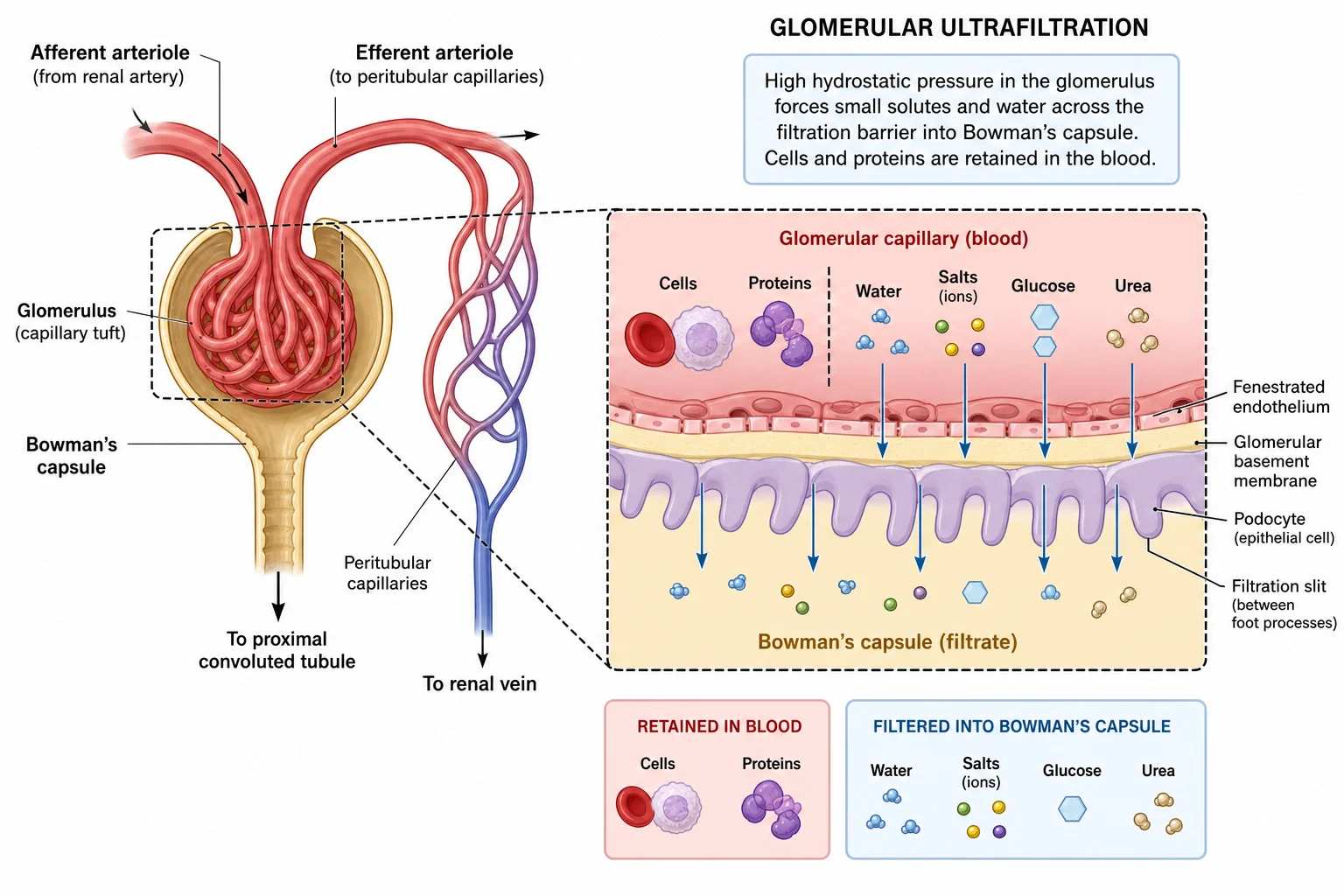
High pressure in the glomerulus filters water and small solutes into Bowmans capsule while cells and large plasma proteins remain in blood.
The filtrate contains water, ions, glucose and urea. Useful substances must be selectively reabsorbed as it passes along the nephron.
Part 4 of 5Selective reabsorption
Selective reabsorption
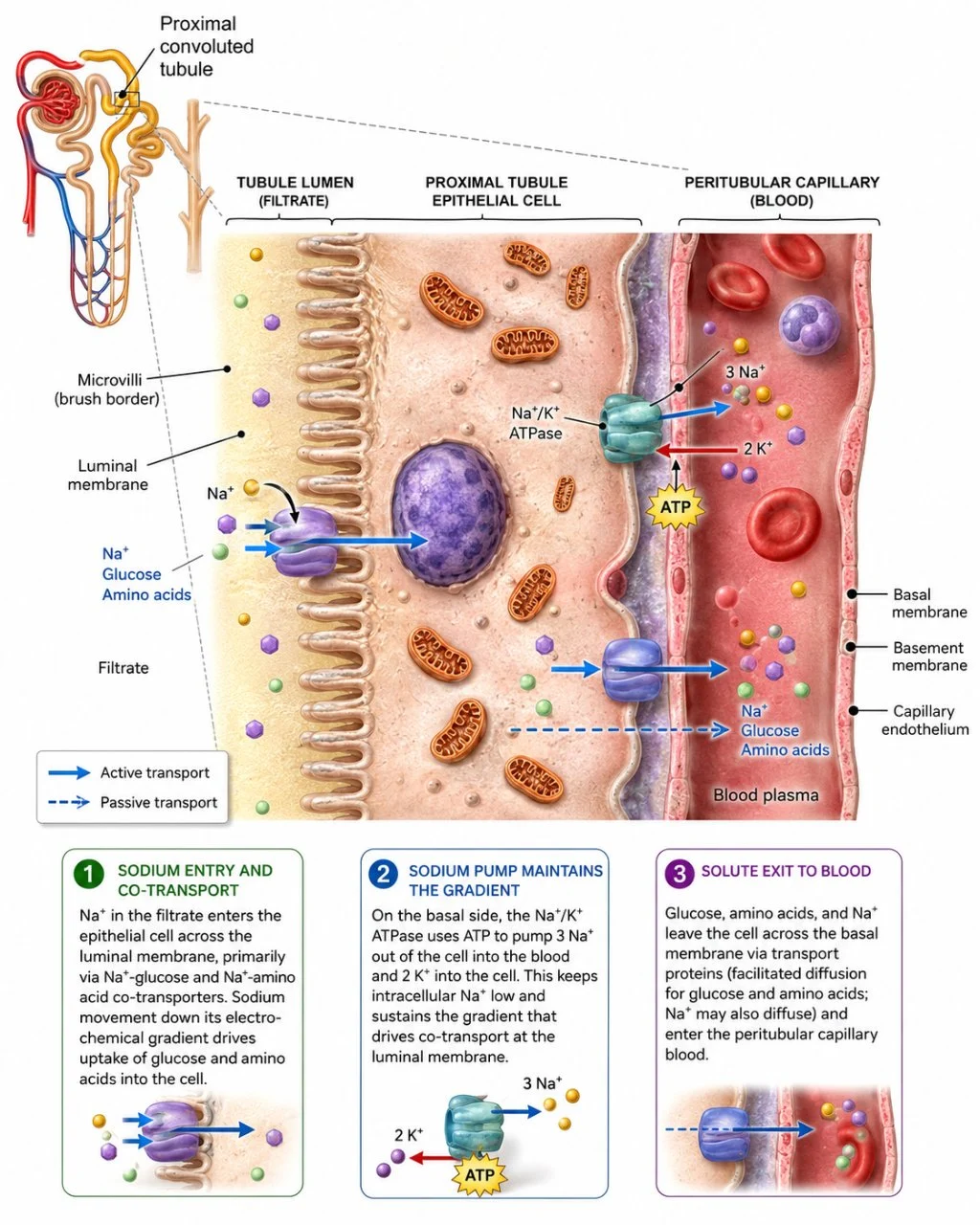
All glucose and needed ions are actively reabsorbed, and much water follows by osmosis. The loop and collecting duct help create concentrated urine.
Urine containing urea, excess salts and water passes through ureters to the bladder and leaves through the urethra.
Part 5 of 5ADH and water balance
ADH and water balance
When blood water potential falls, the pituitary releases more ADH. Collecting ducts become more permeable, so more water is reabsorbed and a smaller volume of concentrated urine forms.
When blood contains excess water, less ADH is released, less water is reabsorbed and a larger volume of dilute urine is produced.
Marked practiceQuizzes for this lesson
Last updated:
\n