4.5Body Systems and Plants
Coordination and response — EST 2 Biology Revision Notes & Topical Questions
35 min read 55 parts Lesson 5 of 8 3 quizzes
Lesson summary
SAT Biology coordination and response: build a complete explanation of the core structures, processes and exam relationships.A stimulus is detected by a receptor.
- Electrical impulses travel rapidly along neurons, while neurotransmitters diffuse across synapses in one direction
- Temperature receptors and the hypothalamus coordinate these negative-feedback responses around the normal range
Part 1 of 5Nervous coordination
Nervous coordination
A stimulus is detected by a receptor. Sensory neurons carry impulses to the central nervous system, which coordinates a response through motor neurons and effectors.
Electrical impulses travel rapidly along neurons, while neurotransmitters diffuse across synapses in one direction.
Part 2 of 5Reflex actions
Reflex actions
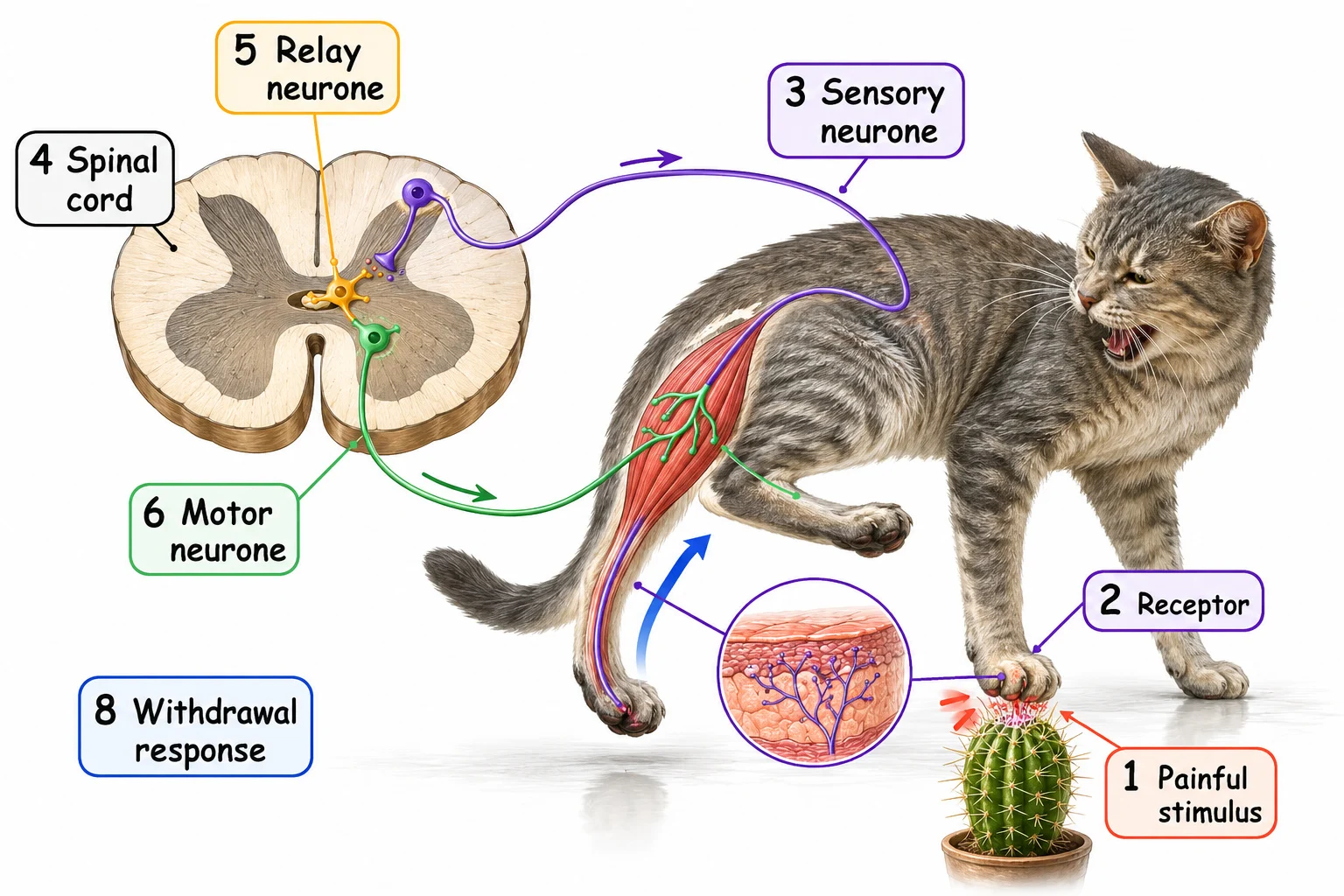
A reflex is a rapid automatic response that helps prevent injury. A reflex arc passes from receptor through sensory and relay neurons to a motor neuron and effector.
The response can occur before conscious awareness because initial coordination takes place in the spinal cord or brain stem.
Part 3 of 5Hormonal coordination
Hormonal coordination
Endocrine glands release hormones into blood. Hormonal responses are generally slower than nervous responses but can last longer and affect multiple target tissues.
Insulin lowers blood glucose by promoting uptake and storage, while glucagon raises it by stimulating glycogen breakdown in the liver.
Part 4 of 5Thermoregulation
Thermoregulation
When body temperature rises, skin arterioles dilate and sweating increases heat loss. When temperature falls, vasoconstriction and shivering conserve or generate heat.
Temperature receptors and the hypothalamus coordinate these negative-feedback responses around the normal range.
Part 5 of 5Plant responses
Plant responses
Shoots show positive phototropism and roots usually show positive gravitropism. Unequal auxin distribution changes cell elongation and bends the organ.
Tropisms improve access to resourcesshoots grow toward light for photosynthesis, while roots grow into soil for anchorage and absorption.
Marked practiceQuizzes for this lesson
Last updated:
\n