4.7Body Systems and Plants
Plant biology — EST 2 Biology Revision Notes & Topical Questions
25 min read 37 parts Lesson 7 of 8 2 quizzes
Lesson summary
SAT Biology plant biology: build a complete explanation of the core structures, processes and exam relationships.Photosynthesis converts light energy into chemical energy: carbon dioxide and water form glucose and oxygen.
- Auxin helps coordinate tropisms, allowing shoots to grow toward light and roots to respond to gravity
Part 1 of 5Photosynthesis
Photosynthesis
Photosynthesis converts light energy into chemical energy: carbon dioxide and water form glucose and oxygen. Chlorophyll absorbs light, and enzymes control the reactions.
Light intensity, carbon dioxide concentration and temperature can limit the rate. Increasing only the limiting factor raises the rate until another factor becomes limiting.
Part 2 of 5Leaf adaptations
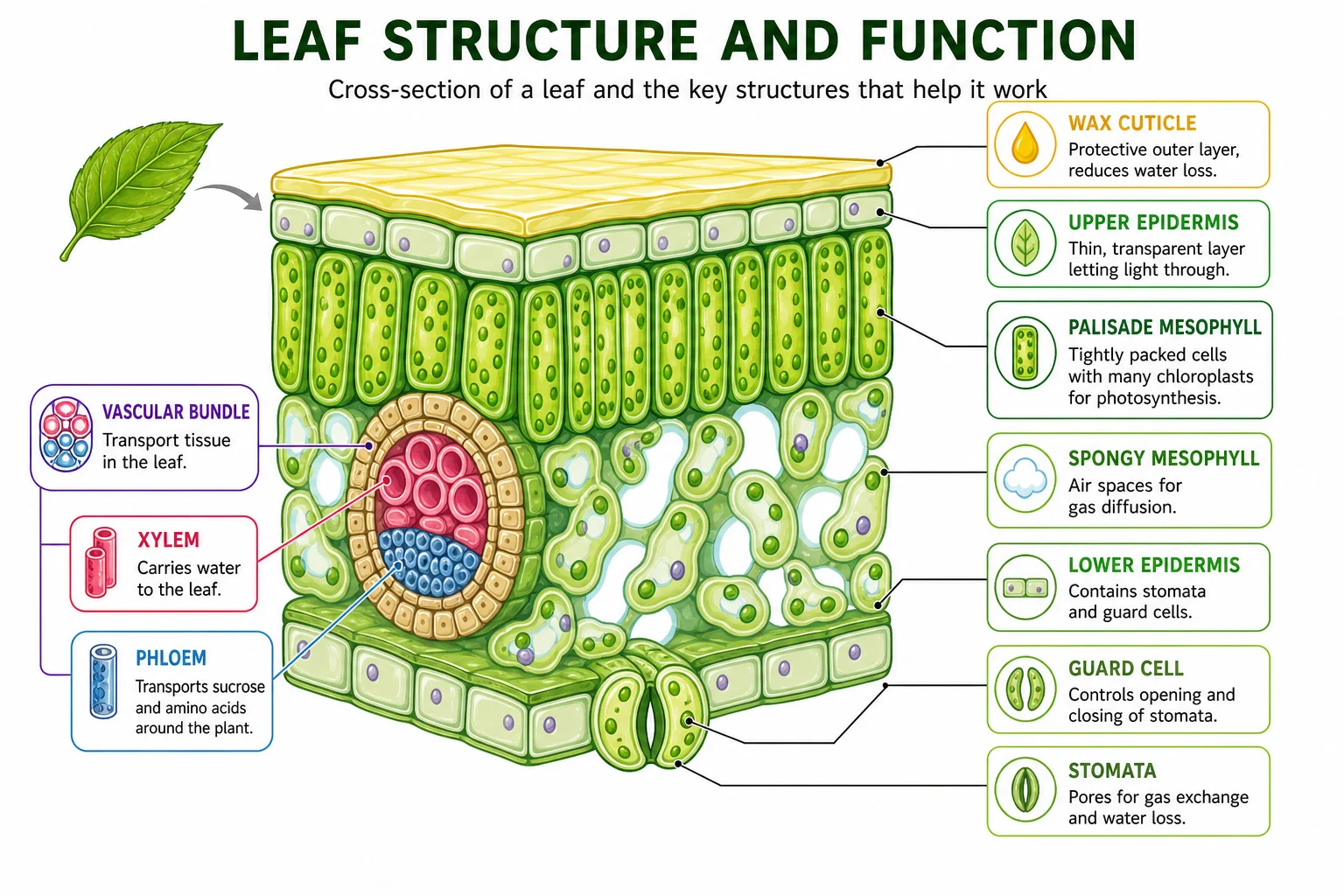
Leaf adaptations
A broad thin lamina provides a large light-absorbing area and short diffusion distance. Palisade cells near the upper surface contain many chloroplasts.
Air spaces in spongy mesophyll aid gas diffusion, veins supply water and remove sugars, and stomata regulate gas exchange.
Part 3 of 5Water uptake and xylem
Water uptake and xylem
Root hair cells provide a large surface for absorbing water by osmosis and mineral ions by active transport. Water crosses the root into xylem vessels.
Xylem is formed from dead hollow cells with lignified walls and carries water and minerals upward while also supporting the plant.
Part 4 of 5Transpiration
Transpiration
Evaporation from mesophyll surfaces and diffusion through stomata create transpiration pull. Cohesion maintains a continuous water column in xylem.
Higher temperature, brighter light, faster wind and lower humidity generally increase transpiration; stomatal closure reduces water loss.
Part 5 of 5Phloem and plant responses
Phloem and plant responses
Phloem translocates sucrose and amino acids from sources such as leaves to sinks such as roots, fruits and growing tissues. Transport can occur in either direction.
Auxin helps coordinate tropisms, allowing shoots to grow toward light and roots to respond to gravity.
Marked practiceQuizzes for this lesson
Last updated:
\n