5.3Physical Chemistry and Transition Elements
Acids, Bases and Buffers
10 min read 18 parts Lesson 13 of 40
Lesson summary
Complete PDF with figures and original page layoutPage 1 OCR A Level Chemistry A Your notes Acids, Bases & Buffers Contents Acids & Bases Ka, pH & Kw pH Calculations Buffers Neutralisation Page 2 Acids & Bases …
Section 1 of 18Bronsted–Lowry acids and bases


Bronsted acid
Bronsted acid a species that can donate a proton
- HCl(aq) → H+(aq) + Cl−(aq).
Bronsted base
Bronsted base a species that can accept a proton
- OH−(aq) + H+(aq) → H2O(l).
Conjugate acid–base pair
Conjugate acid–base pair two species that differ by one H+
- In CH3COOH + H2O ⇌ CH3COO− + H3O+, CH3COOH (acid) pairs with CH3COO− (conjugate base).
- H2O (base) pairs with H3O+ (conjugate acid).
Weak acid
- Weak acid it partially dissociates, so CH3COOH, H2O, CH3COO− and H3O+ are all present at equilibrium
Section 2 of 18Monobasic, dibasic and tribasic acids
Monobasic (monoprotic)
- Monobasic (monoprotic) one ionisable hydrogen per molecule, e.g. HCl, HNO3, HCN
- HCl + NaOH → NaCl + H2O.
Dibasic (diprotic)
- Dibasic (diprotic) two ionisable hydrogens, ionising in two steps, e.g. H2SO4
- H2SO4 + 2NaOH → Na2SO4 + 2H2O.
Tribasic (triprotic)
- Tribasic (triprotic) three ionisable hydrogens, ionising in three steps, e.g. H3PO4
- H3PO4 + 3NaOH → Na3PO4 + 3H2O.
Section 3 of 18Ionic equations for acid reactions
- Method
- write all ions, then cancel the spectator ions to show H+(aq) as the active species
| Acid with | Products | Ionic equation |
|---|---|---|
| Metal | Salt + hydrogen | 2H+(aq) + Zn(s) → Zn2+(aq) + H2(g) |
| Metal oxide | Salt + water | 2H+(aq) + CaO(s) → Ca2+(aq) + H2O(l) |
| Insoluble carbonate | Salt + water + CO2 | 2H+(aq) + CuCO3(s) → Cu2+(aq) + H2O(l) + CO2(g) |
| Soluble carbonate | Salt + water + CO2 | 2H+(aq) + CO32−(aq) → H2O(l) + CO2(g) |
| Alkali | Salt + water | H+(aq) + OH−(aq) → H2O(l) |
Section 4 of 18Acid dissociation constant K<sub>a</sub> and pK<sub>a</sub>

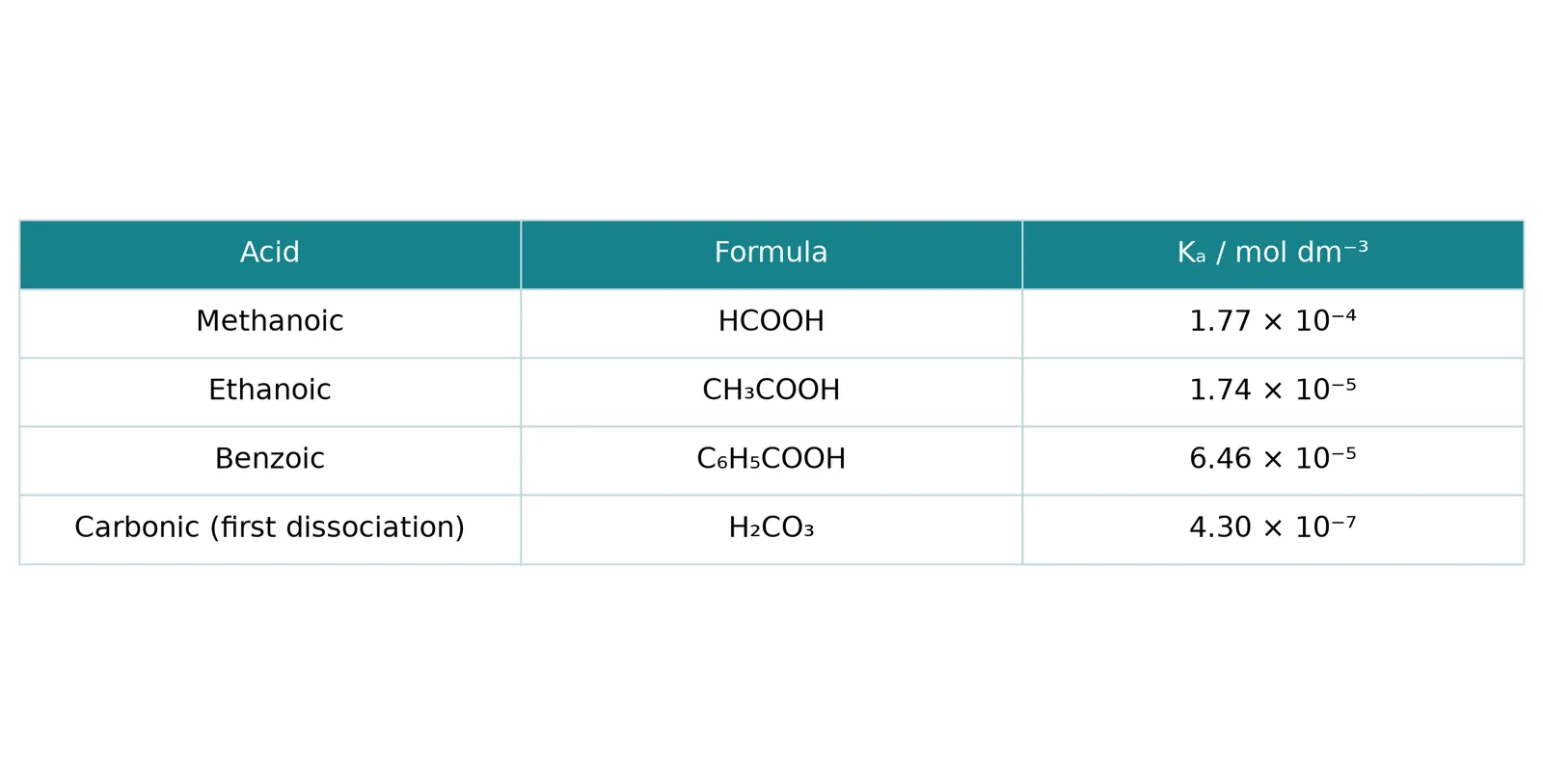
Weak acid
Weak acid an acid that partially dissociates in aqueous solution
- Examples are organic acids such as ethanoic acid, and HCN, H2S and H2CO3.
- The equilibrium lies mostly to the left.
Ka
[H+][A−] ÷ [HA], with units mol dm−3
What the symbols mean: Ka = acid dissociation constant (mol dm−3) · [H+], [A−], [HA] = equilibrium concentrations (mol dm−3); larger Ka = stronger acid
- Values are very small, e.g. 1.74 × 10⁻⁵ mol dm−3 for ethanoic acid.
- A higher Ka means more dissociation and a stronger acid.
pKa
−log Ka
- It makes the wide range of small Ka values easier to handle.
- Most weak acids have pKa between 3 and 7.
Section 5 of 18pH and the ionic product of water


1pH
−log[H+],
- and [H+] = 10−pHWhat the symbols mean: pH has no unit · [H+] = concentration of hydrogen ions (mol dm−3); each 1 pH unit is a ten-fold change in [H+]
- The scale is logarithmic, so pH 5 has ten times the [H+] of pH 6.
- pH values are usually given to 2 decimal places.
2Ionic product of water, Kw
[H+][OH−] = 1 × 10⁻¹⁴ mol2 dm−6
What the symbols mean: Kw = ionic product of water (1.00 × 10⁻¹⁴ mol2 dm−6 at 298 K) · [H+], [OH−] = ion concentrations (mol dm−3)
- It comes from the equilibrium in which a few water molecules dissociate into H+ and OH−.
- [OH−] = Kw ÷ [H+] and [H+] = Kw ÷ [OH−].
Section 6 of 18pH of strong acids and strong bases
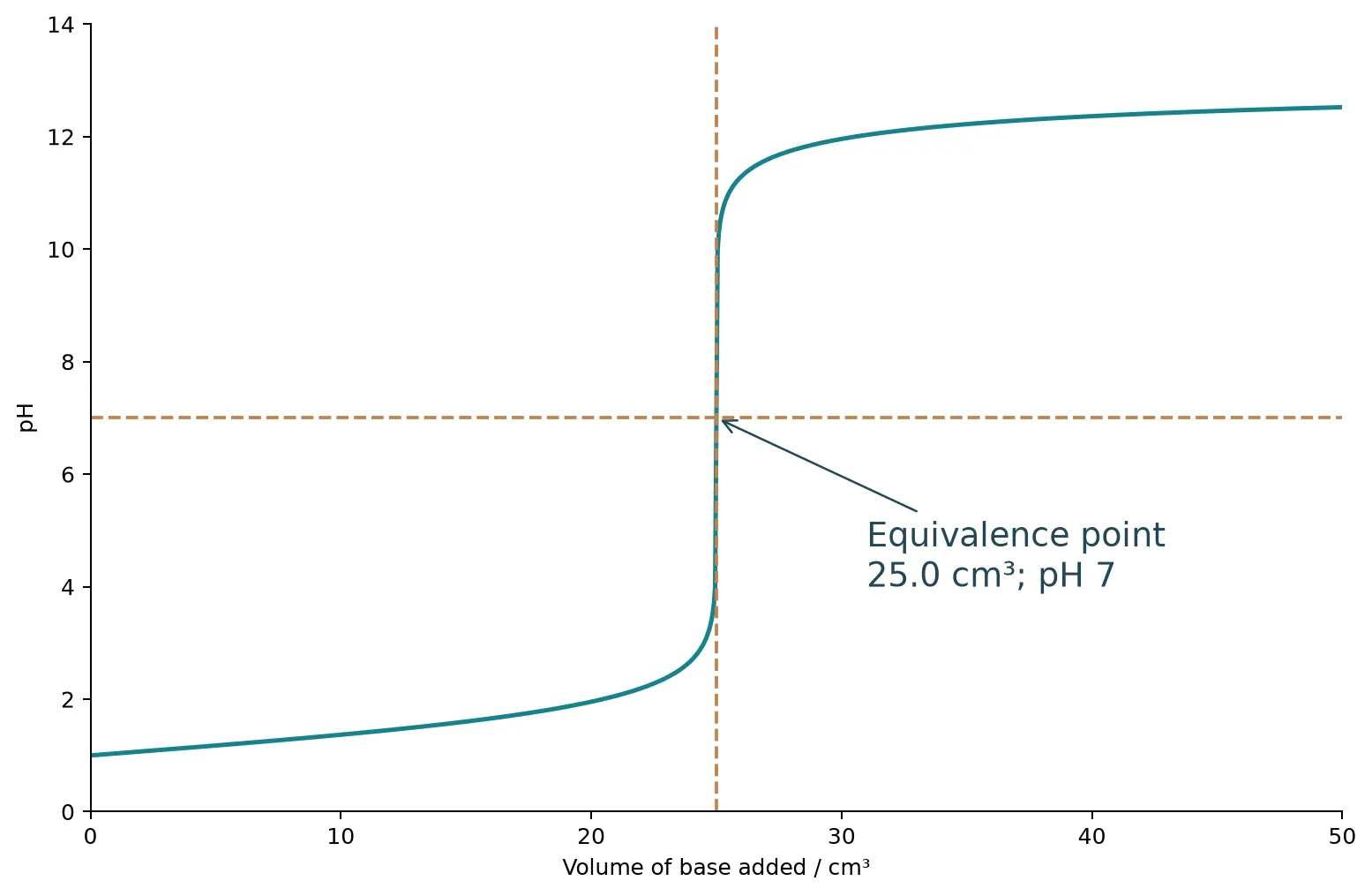

Strong acid
- Strong acid fully ionised, HA → H+ + A−, so [H+] = [HA]
- H+ from water is negligible.
- 0.01 mol dm−3 HCl has pH = −log 0.01 = 2.00.
Strong base
- Strong base fully ionised, so [OH−] equals the concentration of base
- Find [H+] = Kw ÷ [OH−], then pH = −log[H+].
- 0.15 mol dm−3 NaOH gives [H+] = 6.66 × 10⁻¹⁴ and pH 13.17.
Finding [OH−] from pH
- Finding [OH−] from pH pH 10.50 gives [H+] = 10−10.50 = 3.16 × 10⁻¹¹ mol dm−3.
- [OH−] = 10−14 ÷ 3.16 × 10−11 = 3.16 × 10⁻⁴ mol dm−3.
Check
- [OH−] of 1.0 × 10⁻³ mol dm−3 gives [H+] = 1.0 × 10⁻¹¹, so pH 11.00
Section 7 of 18pH of a weak acid


Data needed
- Data needed the concentration of the acid and its Ka
Simplification
- HA dissociates into one H+ and one A−, so [H+] = [A−]
- Ka = [H+]2 ÷ [HA], so [H+] = √(Ka × [HA]).
1
Write the Ka expression.
2
Set [H+] = [A−] and rearrange for [H+].
3
Substitute Ka and [HA].
4
Calculate pH = −log[H+].
- Example
- 0.100 mol dm−3 ethanoic acid with Ka 1.74 × 10⁻⁵
- [H+] = 1.32 × 10⁻³ mol dm−3, so pH 2.88.
Section 8 of 18Assumptions in weak acid calculations
Assumptions
- [H+] equals [A−] at equilibrium because of 1 : 1 dissociation and negligible H+ from water.
- Dissociation is so small that the equilibrium [HA] equals the initial [HA].
Acid strength
- Acid strength the stronger the acid, the higher [H+] at equilibrium and the larger Ka
- Dissociation is greater, so the difference between initial and equilibrium [HA] is greater and the approximation is less valid.
Section 9 of 18Buffer solutions
Buffer
Buffer a solution that resists changes in pH when small amounts of acid or alkali are added
- It keeps [H+] and [OH−] almost constant.
Acidic buffer
- Acidic buffer a weak acid and a soluble salt of the acid, e.g. ethanoic acid and sodium ethanoate
- CH3COOH ⇌ H+ + CH3COO− is partial, so the acid has a high concentration.
- CH3COONa fully dissociates, giving a high concentration of CH3COO−.
- The mixture has large reservoirs of both the weak acid and its conjugate base.
Section 10 of 18How a buffer acts
Added H+
- The extra H+ reacts with CH3COO− to form CH3COOH.
- The equilibrium shifts left, limiting the fall in pH.
- The large supply of CH3COO− means its concentration barely changes, so pH stays almost constant.
Added OH−
- OH− reacts with H+ to form water.
- The fall in [H+] shifts the equilibrium right, so more CH3COOH dissociates to replace H+.
- The pH therefore stays nearly constant.
Section 11 of 18Making a buffer from excess weak acid and strong alkali
Method
- Method mix a weak acid with a limited amount of strong alkali, with the weak acid in excess
- CH3COOH + NaOH → CH3COONa + H2O uses up all the alkali.
- Excess CH3COOH remains, together with the CH3COONa formed.
- This is the same acid and conjugate base mixture, so it buffers in the same way.
Key condition
- Key condition the weak acid must be in excess; if the alkali were in excess no buffer would form
Explanation needed
- Explanation needed state that the weak acid is in excess and that both the weak acid and its conjugate base are present
- (partial neutralisation)
Section 12 of 18Calculating the pH of a buffer
- Data needed
- Ka and the concentrations of the weak acid and its salt
- Ka = [salt][H+] ÷ [acid], so [H+] = Ka × [acid] ÷ [salt].
- In logarithms, pH = pKa + log([salt] ÷ [acid]), the Henderson–Hasselbalch equation.
1
Write the Ka expression.
2
Rearrange to [H+] = Ka × [acid] ÷ [salt].
3
Substitute the concentrations.
4
Calculate pH = −log[H+].
- Example
- 0.305 mol dm−3 ethanoic acid and 0.520 mol dm−3 sodium ethanoate, Ka 1.74 × 10⁻⁵
- [H+] = 1.74 × 10−5 × 0.305 ÷ 0.520 = 1.02 × 10⁻⁵ mol dm−3.
- The pH is 4.99.
Section 13 of 18Blood buffer
Role of HCO3−
- Role of HCO3− it keeps blood pH between 7.35 and 7.45
- Cells produce CO2 in aerobic respiration, which forms H+ in blood: CO2 + H2O ⇌ H+ + HCO3−.
Added H+
- Added H+ the equilibrium shifts left, lowering [H+] and keeping pH constant
Removed H+
- Removed H+ the equilibrium shifts right, raising [H+] and keeping pH constant
Importance
- Importance uncontrolled H+ would lower blood pH and cause acidosis
- Acidosis is too much acid in body fluids, which can cause malfunction and eventually coma.
Section 14 of 18pH titration curves
pH curve
pH curve a graph of pH against volume of acid or base added, measured with a pH meter
- It is S-shaped, and the midpoint of the vertical section is the equivalence (stoichiometric) point.
Information from a curve
- The starting pH, which gives the pH of the solution in the flask.
- The pH at the equivalence point.
- The volume of titrant at the equivalence point.
- The pH range of the vertical section.
Four combinations
- Four combinations strong acid + strong base, weak acid + strong base, strong acid + weak base, weak acid + weak base
- Identify which is shown from the starting and finishing pH.
- Plotting pH against volume of acid added gives the mirror image with the same information.
Section 15 of 18Acid–base indicators
Indicator
Indicator a weak acid HIn whose conjugate base In− has a different colour
- HIn + H2O ⇌ H3O+ + In−.
Colour change
- Colour change it depends on the ratio [HIn] : [In−]
- In acid the equilibrium shifts left and the HIn colour dominates.
- In alkali it shifts right and the In− colour dominates.
- The colour changes gradually over a pH range, not at a single pH.
End point
- [HIn] = [In−], so pKa of the indicator = pH at its end point
Section 16 of 18Choosing an indicator
Choosing an indicator
Principle
- Principle the pH changes very rapidly around the equivalence point
- An indicator changes colour over a narrow range centred near its pKa.
- It is suitable if its range falls within the rapid pH change of the titration.
Strong acid with strong base
- Strong acid with strong base the pH changes from about 4 to 10 at the end point
- Methyl red and phenolphthalein are both suitable.
Weak acid with strong base
- Weak acid with strong base the equivalence point is above pH 7, so phenolphthalein is suitable and methyl red is not
Strong acid with weak base
- Strong acid with weak base the equivalence point is below pH 7, so methyl red is suitable and phenolphthalein is not
Weak acid with weak base
- Weak acid with weak base there is no sharp vertical section, so no simple indicator is suitable
Section 17 of 18Key terms
| Term | Meaning |
|---|---|
| Bronsted acid | A proton donor |
| Conjugate acid–base pair | Two species that differ by one H+ |
| Ka | Acid dissociation constant, [H+][A−] ÷ [HA] |
| pH | −log of the hydrogen ion concentration in mol dm−3 |
| Kw | Ionic product of water, 1 × 10⁻¹⁴ mol2 dm−6 |
| Monobasic acid | An acid with one ionisable hydrogen per molecule |
| Term | Meaning |
|---|---|
| Buffer solution | A solution that resists changes in pH on adding small amounts of acid or alkali |
| Equivalence point | The point at which the acid and base have reacted in exact stoichiometric amounts |
| Indicator | A weak acid whose acid and conjugate base forms have different colours |
| Henderson–Hasselbalch equation | pH = pKa + log([salt] ÷ [acid]) |
| Acidosis | A condition of too much acid in body fluids such as blood |
Section 18 of 18Exam technique
1
Using [H+] = [HA] for a weak acid — only strong acids fully dissociate
2
Forgetting to take the square root when finding [H+] of a weak acid
3
Calculating pH of a strong base as −log[OH−] — find [H+] from Kw first
4
Confusing Ka and pKa — a stronger acid has a larger Ka and a smaller pKa
1
Saying a buffer stops pH changing — it only resists changes
2
Explaining a buffer without stating the weak acid is in excess and both acid and conjugate base are present
3
Using the wrong ratio in the buffer expression — [H+] = Ka × [acid] ÷ [salt]
4
Choosing an indicator whose range lies outside the vertical section of the curve