6.5Organic Chemistry and Analysis
Optical Isomerism
5 min read 5 parts Lesson 16 of 33
Lesson summary
Complete PDF with figures and original page layoutPage 1 OCR A Level Chemistry A Your notes Optical Isomerism Contents Optical Isomers Identification of Chiral Centres Page 2 Optical Isomers …
Section 1 of 5Stereoisomers and chirality
Stereoisomers
Stereoisomers molecules with the same structural formula but different arrangements of atoms in space
- The two types are geometrical (E/Z) and optical.
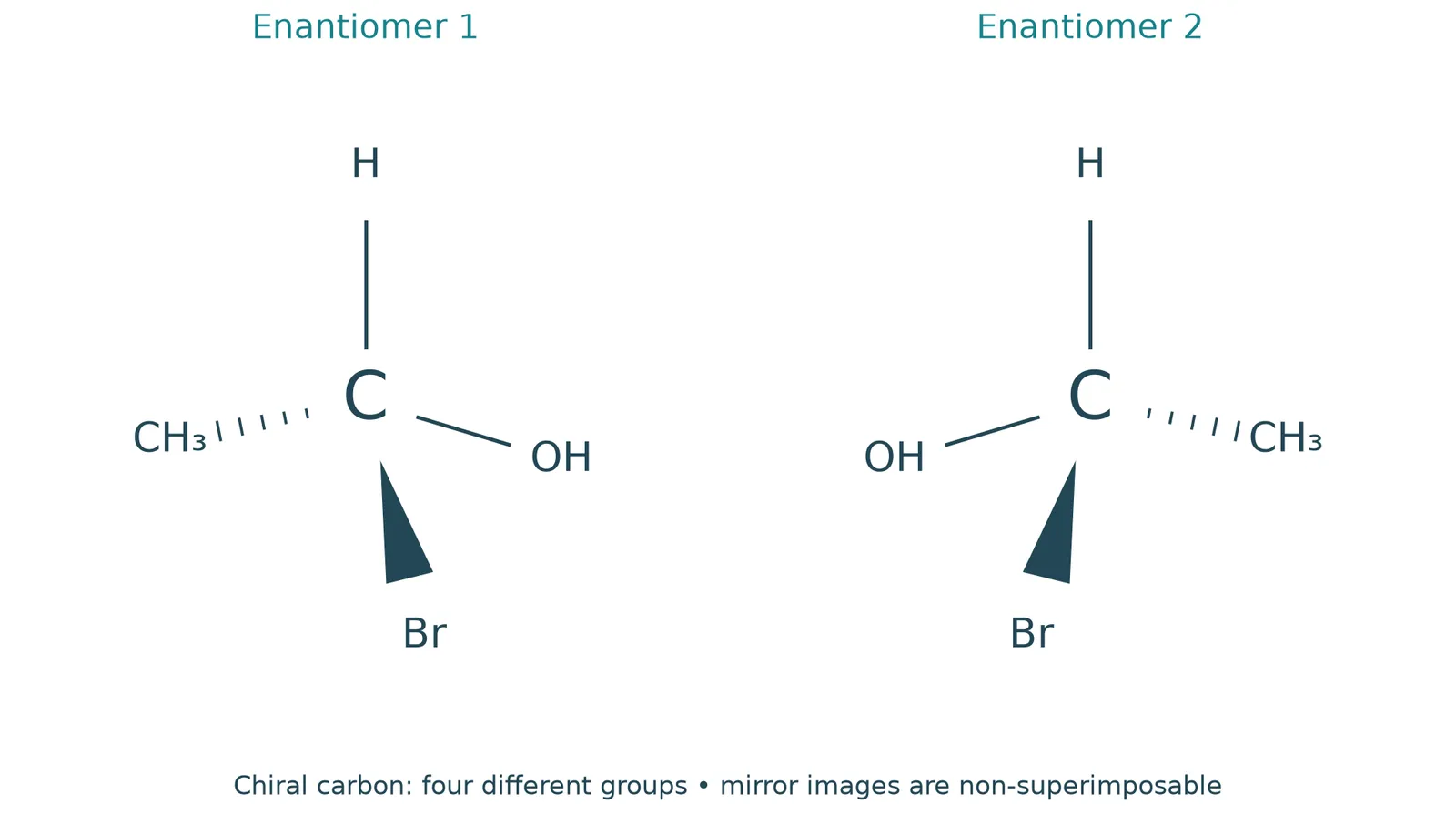
Chiral centre
Chiral centre a carbon atom bonded to four different atoms or groups of atoms
- The word chiral comes from the Greek for hand, describing the handedness of such molecules.
Enantiomers
Enantiomers the two optical isomers of a chiral molecule
- They are non-superimposable mirror images, like left and right hands.
Section 2 of 5Identifying chiral centres
- Test
- a carbon is chiral if bonded to four different atoms or groups
- If a carbon has two identical atoms or groups attached, it cannot be chiral.
Identifying chiral centres
From a molecular formula, draw the condensed structural or displayed formula so all bonds and groups are visible.
Examine each carbon in turn.
Mark a carbon with an asterisk (*) if its four attached groups are all different.
Example
- Example isomers of C4H9Br
- Only 2-bromobutane has a carbon bonded to H, Br, CH3 and CH2CH3, so only it is chiral.
3D drawings
- 3D drawings chiral centres can be recognised in 3D drawings, e.g. the middle carbon of glyceraldehyde
Section 3 of 5Drawing optical isomers
- Conventions
- A solid line is a bond in the plane of the paper.
- A dotted (hatched or shaded) line is a bond receding behind the paper.
- A solid wedge is a bond coming out of the paper.
1
Draw a vertical dotted line down the centre of the page to represent a mirror plane.
2
Draw the chiral carbon with four bonds in a tetrahedral arrangement.
3
Make two bonds lie in the plane of the paper, one come out and one recede.
4
Add the four different groups on one side, e.g. for alanine CH3CH(NH2)COOH.
5
Draw the mirror image on the other side of the line, reversing the sequence of the groups.
Section 4 of 5Key terms
| Term | Meaning |
|---|---|
| Chiral centre | A carbon atom bonded to four different atoms or groups |
| Enantiomers | Non-superimposable mirror image optical isomers |
| Stereoisomers | Compounds with the same structural formula but different arrangement in space |
| Optical isomerism | Stereoisomerism from a chiral centre |
| Wedge bond | A solid wedge showing a bond coming out of the plane of the paper |
Section 5 of 5Exam technique
1
Calling a carbon chiral because it has four bonds — the four groups must all be different
2
Drawing the two enantiomers with the same group sequence — one must be the mirror image of the other
3
Thinking enantiomers differ in chemical formula — they have identical structural formulae
4
Forgetting that a carbon with two identical groups cannot be a chiral centre