6.8Organic Chemistry and Analysis
Organic Synthesis
5 min read 9 parts Lesson 25 of 33
Lesson summary
Complete PDF with figures and original page layoutPage 1 OCR A Level Chemistry A Your notes Organic Synthesis Contents Techniques Synthetic Routes Page 2 Techniques …
Section 1 of 9Preparing an organic solid
Skills covered
- Using appropriate apparatus to record a range of measurements.
- Heating with a water bath, electric heater or sand bath.
- Using laboratory apparatus for a variety of techniques.
- Purifying a solid by recrystallisation.
- Using melting point apparatus.
- Handling solids and liquids safely.
Common preparations
- Common preparations aspirin, benzoic acid, and nitration of methyl benzoate
Section 2 of 9Recrystallisation
- Principle
- a hot solvent dissolves both the solid and the impurities, and as the solution cools the solid crystallises and the impurities stay in solution
- Use the minimum amount of hot solvent to avoid losing product.
1
Dissolve the impure solid in the minimum volume of hot solvent.
2
If solid impurities remain, filter the hot solution.
3
Let the solution cool to room temperature so crystals form.
4
Filter off the crystals, faster using Buchner apparatus under reduced pressure.
5
Wash the crystals with fresh cold solvent.
6
Dry them on filter paper.
- Notes
- Repeating recrystallisation increases purity but lowers the yield each time.
- Slow cooling gives larger, well-defined crystals that are easier to filter and dry.
Section 3 of 9Melting point determination


Information
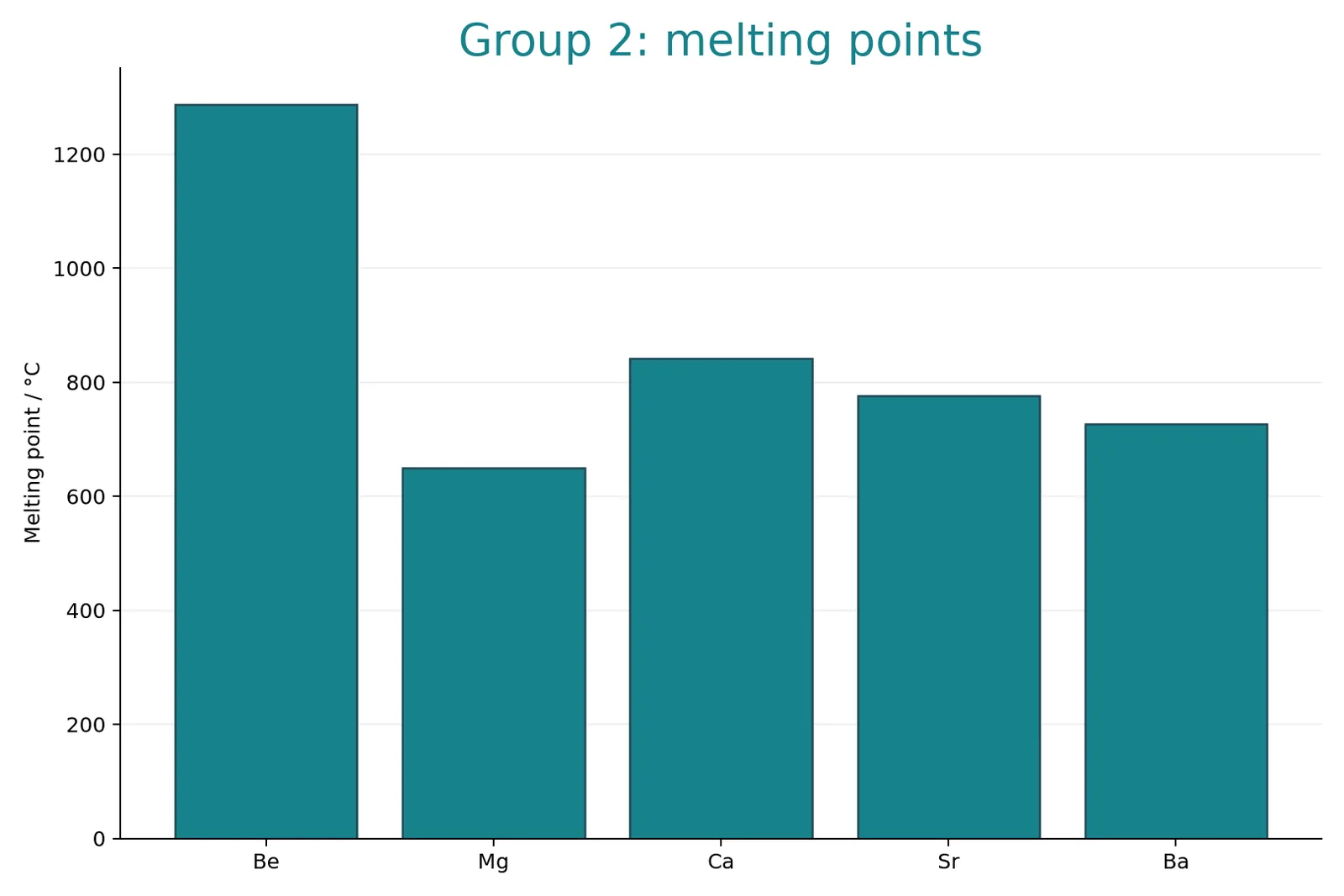
- Information the melting point shows the purity and identity of a solid
- It can be matched to a known substance to identify or confirm a product.
- Closeness to the data-book value shows purity.
Impurities
- Impurities they lower the melting point and broaden the range
- Pure substances have sharp, well-defined melting points.
- Impure substances melt over a wide range.
Key skills
- Prepare the melting point tubes correctly.
- Use a totally dry, finely powdered sample, crushed on filter paper or a white tile.
- Heat the tubes very slowly.
- Repeat, normally three times.
Method
- Method use the first tube for an approximate range, then repeat with much slower heating
- Apparatus can be an oil bath, a Thiele tube or a melt station.
Quoting
- Quoting give a melting point as a range, and reference a data-book value if available
Section 4 of 9Functional groups for synthesis

Functional groups for synthesis
Principle
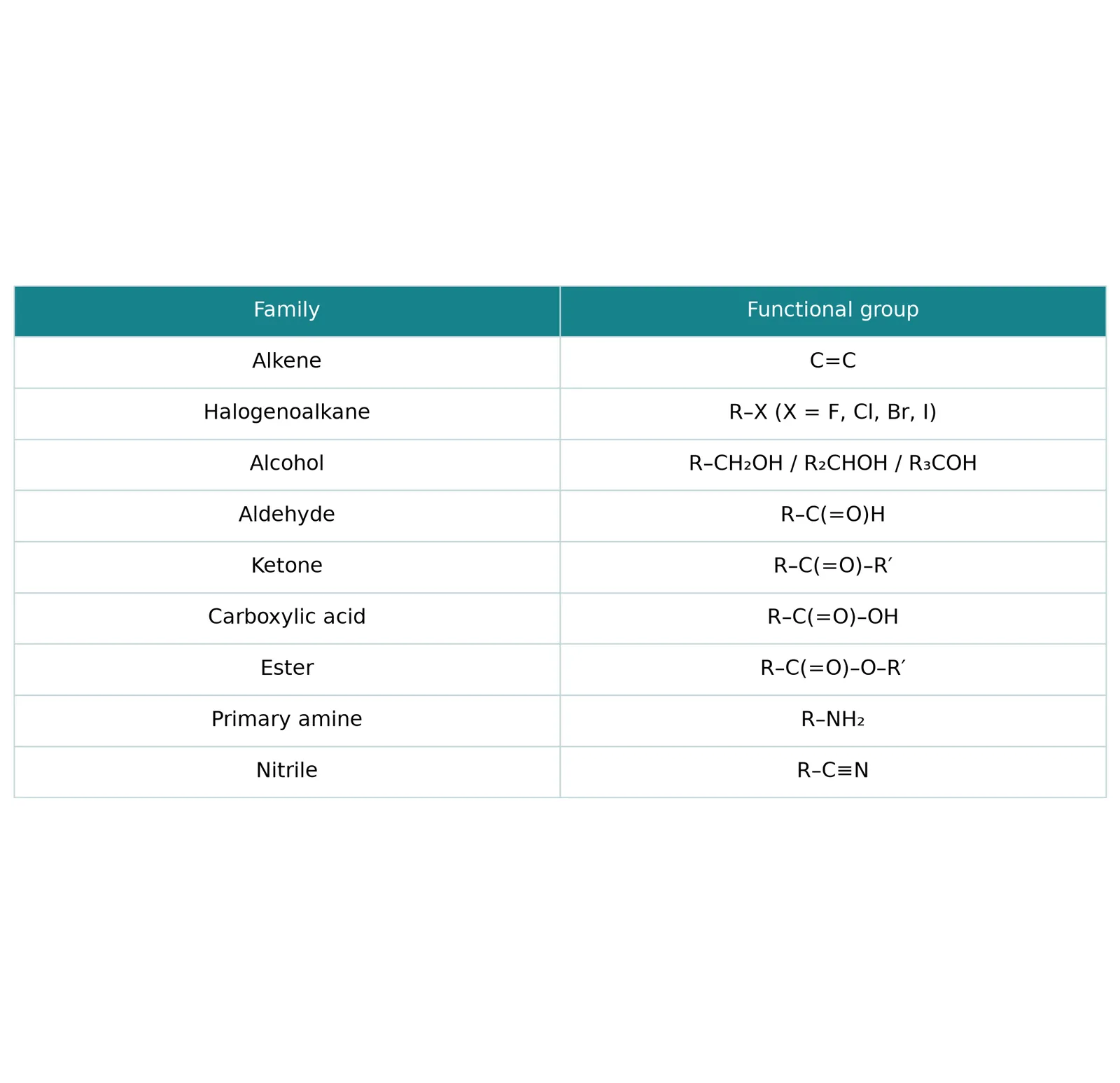
- Principle many products are made from a few starting compounds with suitable reagents and conditions
- Knowing how functional groups are related is key.
Groups to know
- Groups to know alkanes, alkenes, haloalkanes, nitriles, amines, alcohols, carbonyls, hydroxynitriles, carboxylic acids, esters, acyl chlorides,
- and primary and secondary amides
- (aldehydes and ketones)
- You must also identify these groups in structures given.
Section 5 of 9Aliphatic reaction pathways

| Change | Reagents and conditions |
|---|---|
| Alkane to haloalkane | Halogen, UV light (radical substitution) |
| Alkene to alkane | H2, nickel catalyst |
| Alkene to haloalkane | Hydrogen halide, room temperature |
| Alkene to alcohol | Steam, H3PO4 or H2SO4 catalyst |
| Haloalkane to alcohol | Aqueous NaOH, heat |
| Haloalkane to nitrile | Ethanolic KCN, reflux |
| Haloalkane to amine | Excess ethanolic ammonia, heat under pressure |
| Alcohol to haloalkane | NaBr with H2SO4 (HX in situ) |
| Alcohol to alkene | Concentrated H2SO4 or Al2O3, heat |
| Alcohol to aldehyde / carboxylic acid / ketone | Acidified K2Cr2O7: distil, reflux, or heat |
| Carbonyl to alcohol | NaBH4 |
| Carbonyl to hydroxynitrile | HCN (KCN with acid) |
| Nitrile to amine | LiAlH4 in dry ether, or H2 with Ni |
| Nitrile to carboxylic acid | Dilute acid or alkali then acid, heat |
| Carboxylic acid to ester | Alcohol, concentrated H2SO4, reflux |
| Carboxylic acid to acyl chloride | SOCl2 |
| Acyl chloride to amide / ester | Ammonia or amine / alcohol |
Section 6 of 9Aromatic reaction pathways
| Change | Reagents and conditions |
|---|---|
| Benzene to nitrobenzene | Concentrated HNO3 and H2SO4, 25–60 °C |
| Nitrobenzene to phenylamine | Sn with concentrated HCl, reflux, then excess NaOH |
| Benzene to halobenzene | Halogen with AlCl3 or FeBr3 carrier |
| Benzene to alkylbenzene | Chloroalkane with AlCl3 |
| Benzene to acylbenzene (ketone) | Acyl chloride with AlCl3 |
| Phenol to bromophenol | Bromine water, room temperature |
Section 7 of 9Designing a reaction pathway
1
Draw the structures of the target molecule and the starting molecule.
2
Check whether they have the same number of carbons; to lengthen the chain, add a nitrile group by nucleophilic substitution.
3
List all compounds that can be made from the starting molecule and all that can be converted into the target.
4
Match the groups they have in common and work out the reagents and conditions.
Example
- Example ethene to 1-aminopropane
- Ethene + HBr gives bromoethane.
- Bromoethane with ethanolic KCN gives propanenitrile, adding one carbon.
- Reduction with LiAlH4 or H2/Ni gives 1-aminopropane.
Level
- A Level requires multistage synthesis; past papers generally go to four steps
Section 8 of 9Key terms
| Term | Meaning |
|---|---|
| Recrystallisation | Purifying a solid by dissolving in hot solvent and allowing crystals to form on cooling |
| Buchner filtration | Faster filtration under reduced pressure |
| Melting point range | The temperatures from first to complete melting, narrow for a pure substance |
| Target molecule | The molecule a synthesis is designed to produce |
| Hot filtration | Filtering a hot solution to remove insoluble impurities |
Section 9 of 9Exam technique
1
Using too much solvent in recrystallisation — this reduces the yield
2
Quoting a melting point as one value — give a range
3
Saying impurities raise the melting point — they lower it and widen the range
4
Forgetting the in-between step that lengthens the chain by a nitrile in a synthesis