Section 1 of 9The cell cycle


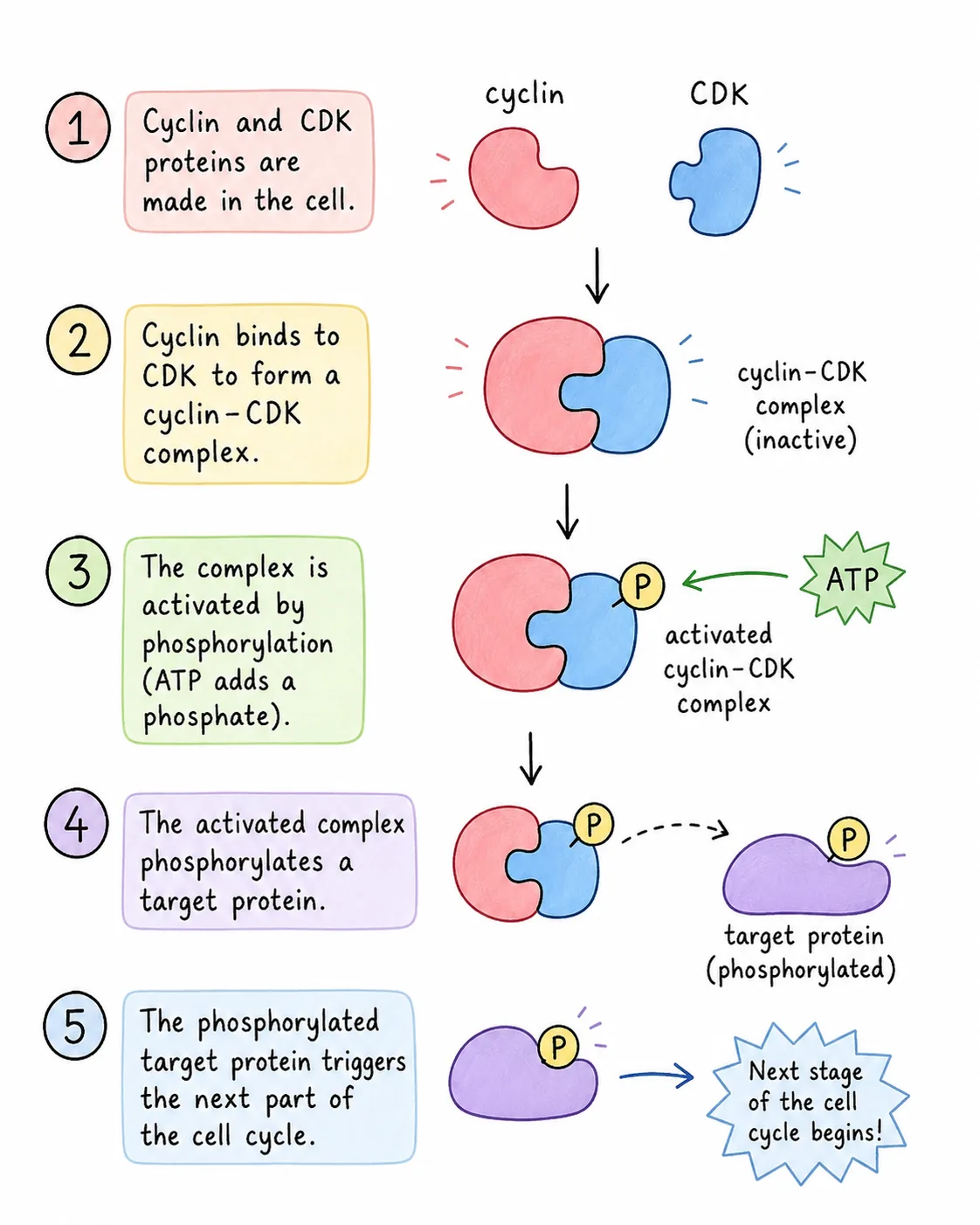

The cell cycle is the series of events by which a body cell grows and divides to produce two identical daughter cells. It has three main stages.
The cell cycle is controlled by genes. If control fails, cells may divide uncontrollably, which results in a tumour; this is how cancer begins.
Section 2 of 9Stages of mitosis
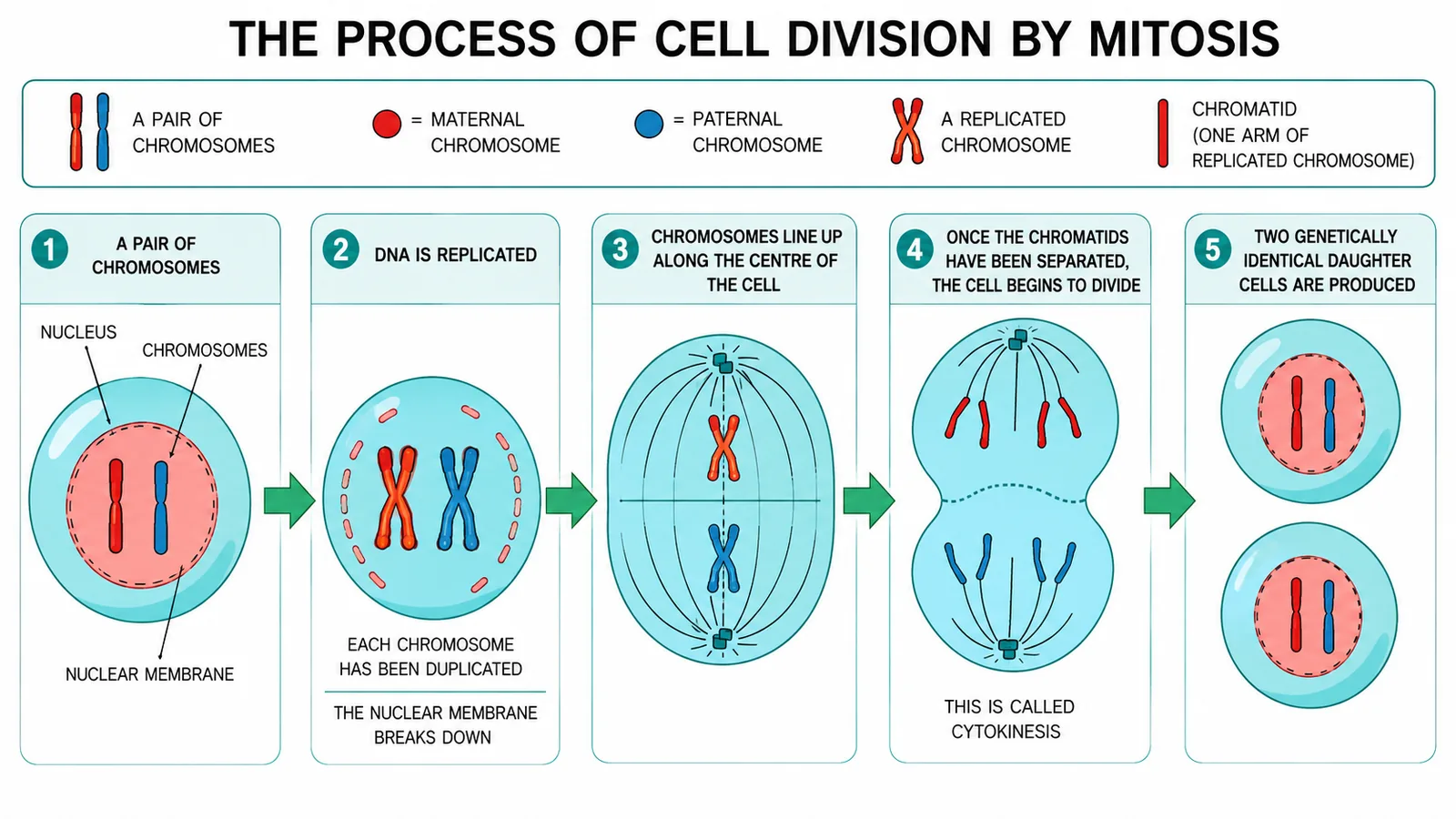
Mitosis itself is a continuous process, but it is helpful to describe it in stages.
The result is two nuclei with identical sets of chromosomes. After cytokinesis, there are two cells genetically identical to each other and to the parent cell.
Section 3 of 9Why mitosis is important
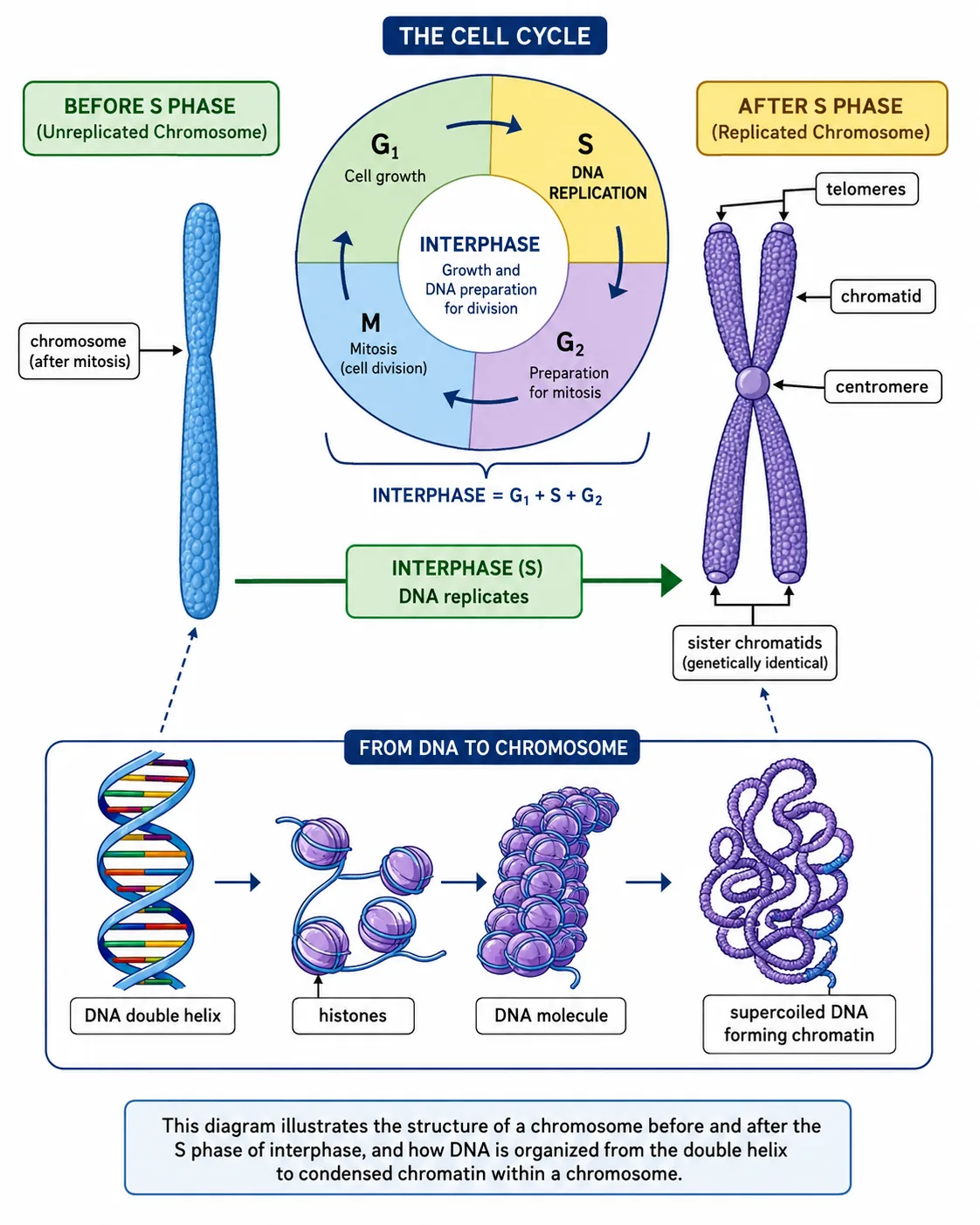

Since the daughter cells are genetically identical, there is no variation from mitosis. That is an advantage when the parent is well adapted, but a disadvantage if the environment changes.
Section 4 of 9Calculations and data


You may need to analyse the proportion of cells in different stages.
Doubling is also tested
- starting from one cell, after n divisions there are 2n cells.
- After 5 divisions there are 32 cells.
- In standard form this becomes useful for rapid growth, such as tumours where cells divide repeatedly.
| Stage | What happens to DNA |
|---|---|
| Interphase (growth) | DNA is replicated |
| Mitosis | Copies are separated into two nuclei |
| Cytokinesis | Cell divides into two |
Section 5 of 9Cancer and cell division
If mutations damage the genes that control the cell cycle, a cell can divide without stopping and form a mass of cells called a tumour.
This lesson connects to stem cells, which divide by mitosis, and to inheritance, where a different division (meiosis) is used to make gametes.
Section 6 of 9Observing mitosis in a root tip


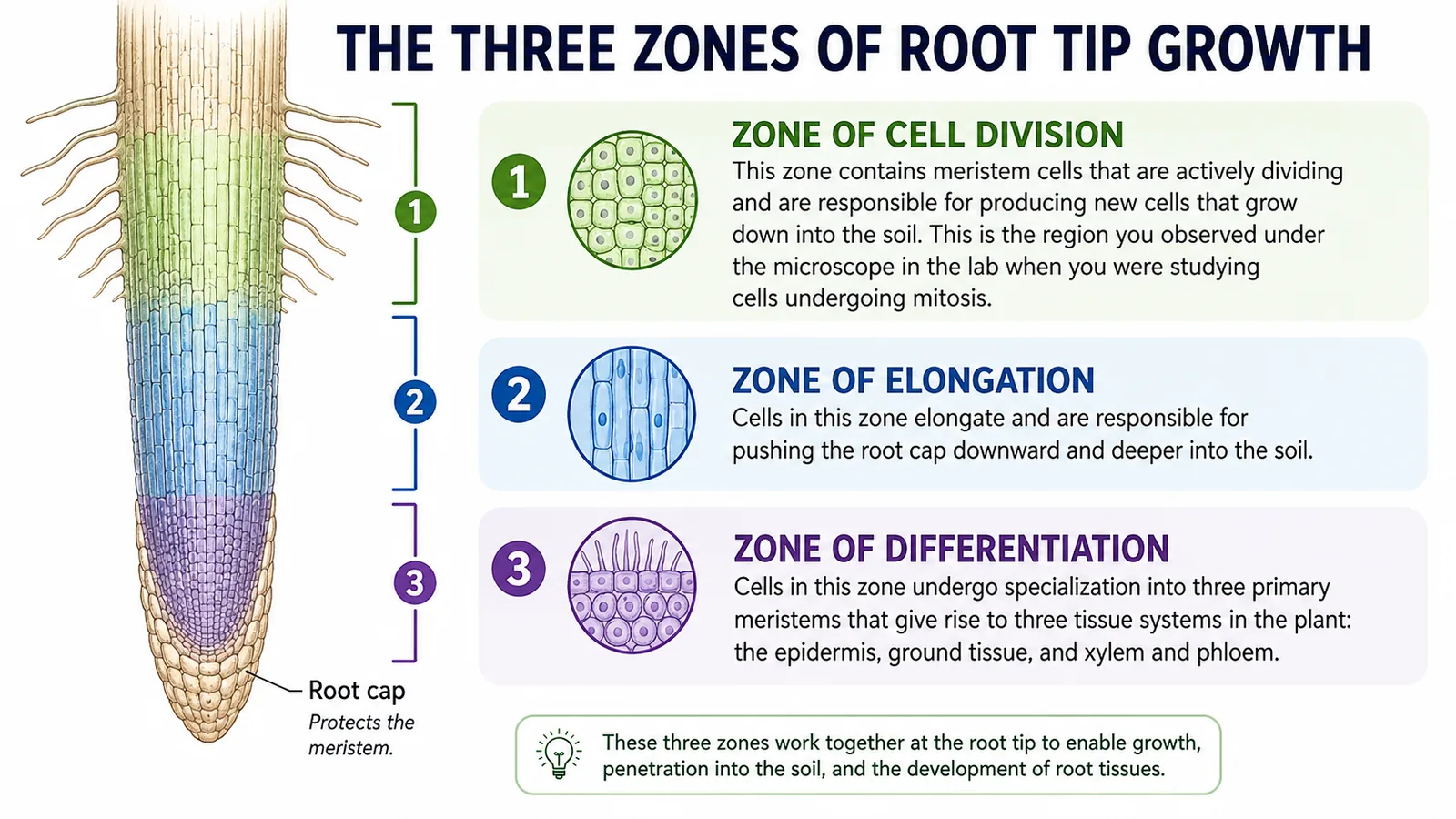
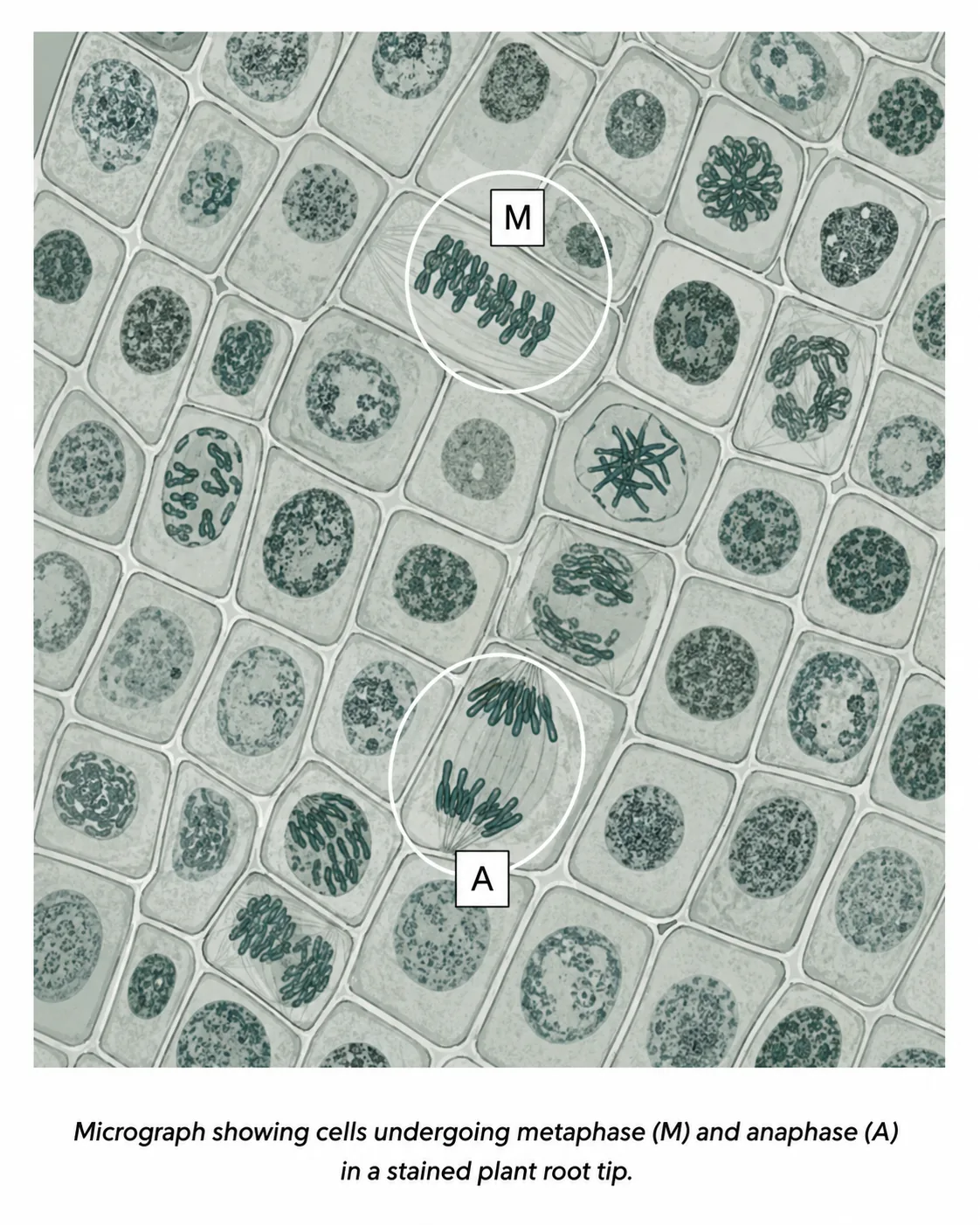

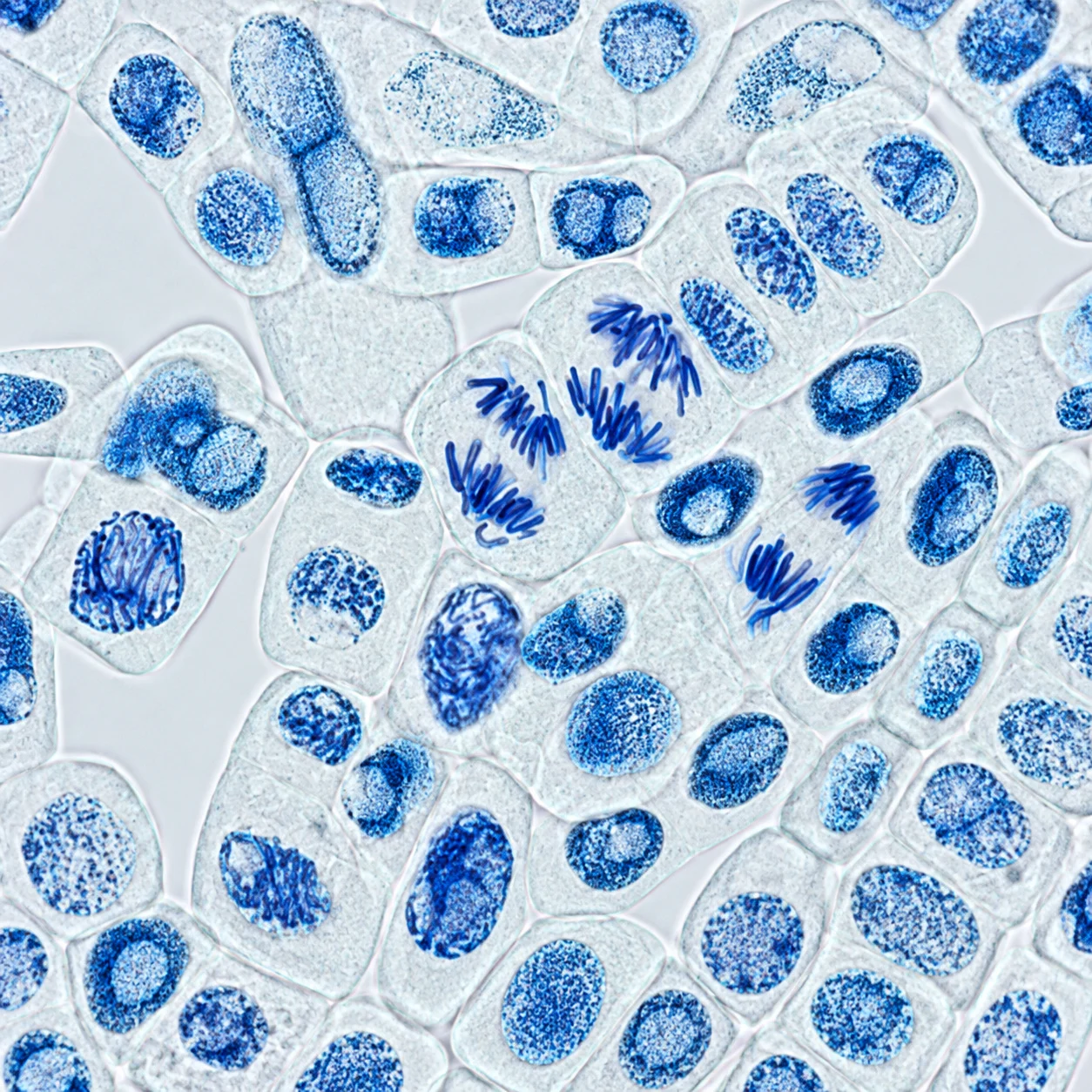
The tip of a growing onion or garlic root is a good place to see mitosis, because the cells there divide rapidly.
Remember that because mitosis is brief compared with the whole cycle, most cells in any sample appear to be in the growth stage, not dividing.
Section 7 of 9Exam-style questions

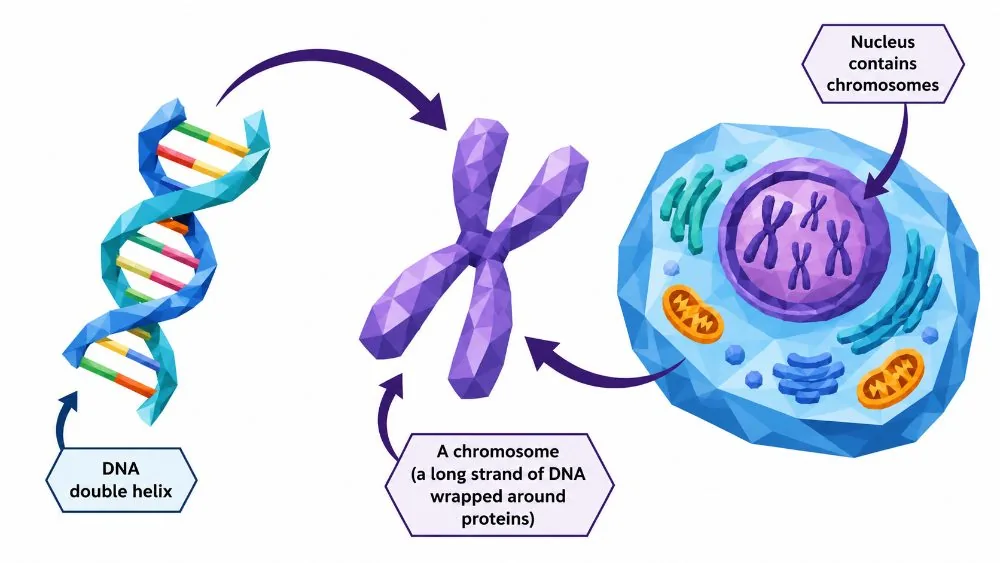

Describe what happens to the DNA before mitosis begins. [2]2 marks
The DNA is replicated / copied [1], so that each chromosome consists of two identical copies [1].
A root tip contains 250 cells; 40 are in mitosis. Calculate the percentage of cells in mitosis. [2]2 marks
40 / 250 [1] x 100 = 16% [1].
Explain why the cells produced by mitosis are genetically identical and why this is important in a healing wound. [3]3 marks
DNA is copied exactly before division [1], and one copy of each chromosome goes to each daughter cell [1]. New skin cells therefore have the same genes and function as the cells they replace [1].
Section 8 of 9Key terms

| Term | Meaning |
|---|---|
| Cell cycle | Series of stages in which a cell grows and divides. |
| Mitosis | Division of the nucleus producing two identical nuclei. |
| Cytokinesis | Division of the cytoplasm and membrane. |
| Replication | Copying of DNA. |
| Clone | An organism genetically identical to its parent. |
| Tumour | An abnormal mass of cells formed by uncontrolled division. |
| Benign | A tumour that does not spread. |
| Malignant | A tumour that invades and spreads (cancer). |
Section 9 of 9Exam technique
Marked practiceQuizzes for this lesson
Magnification Triangle & Unit Conversion
Formula: M = I / A ⇔ A = I / M ⇔ I = M × A
Units: 1 mm = 1,000 μm = 1,000,000 nm.
Rule: Convert Image size (ruler mm) to μm by ×1,000 before dividing by Actual size.