Section 1 of 8Why aseptic technique?
Two aims
- Two aims To stop the cultured microbes escaping into the lab and to stop unwanted microbes contaminating the culture.
Safe temperature
- Safe temperature Cultures in schools are not grown at body temperature, so that microbes which can infect humans do not thrive.
Section 2 of 8Techniques to know
| Technique | Reason |
|---|---|
| Wash hands; no food or drink | Prevents transfer of microbes |
| Disinfect surfaces | Kills microbes on the bench |
| Flame loops and bottle necks; use sterile swabs | Kills microbes on equipment |
| Autoclave glassware and agar | Sterilises with high-pressure steam |
| Lit Bunsen burner nearby | Rising warm air carries contaminants away from the agar |
| Lift petri dish lids only when needed | Limits entry of airborne microbes |
| Wear gloves and goggles | Protects the worker |
| Sterilise or dispose of used equipment | Prevents release of the culture |
Section 3 of 8Disc diffusion method
1
Soak paper discs in different antibiotic solutions of the same concentration so the comparison is fair.
2
Spread diluted bacterial broth over the surface of a sterile agar plate with a sterile spreader.
3
Lightly press the discs onto the agar, spaced apart and away from the edge of the plate.
4
Incubate the plate overnight at a suitable temperature.
5
Examine the plate with the lid on and measure each clear zone.
Section 4 of 8Interpreting results
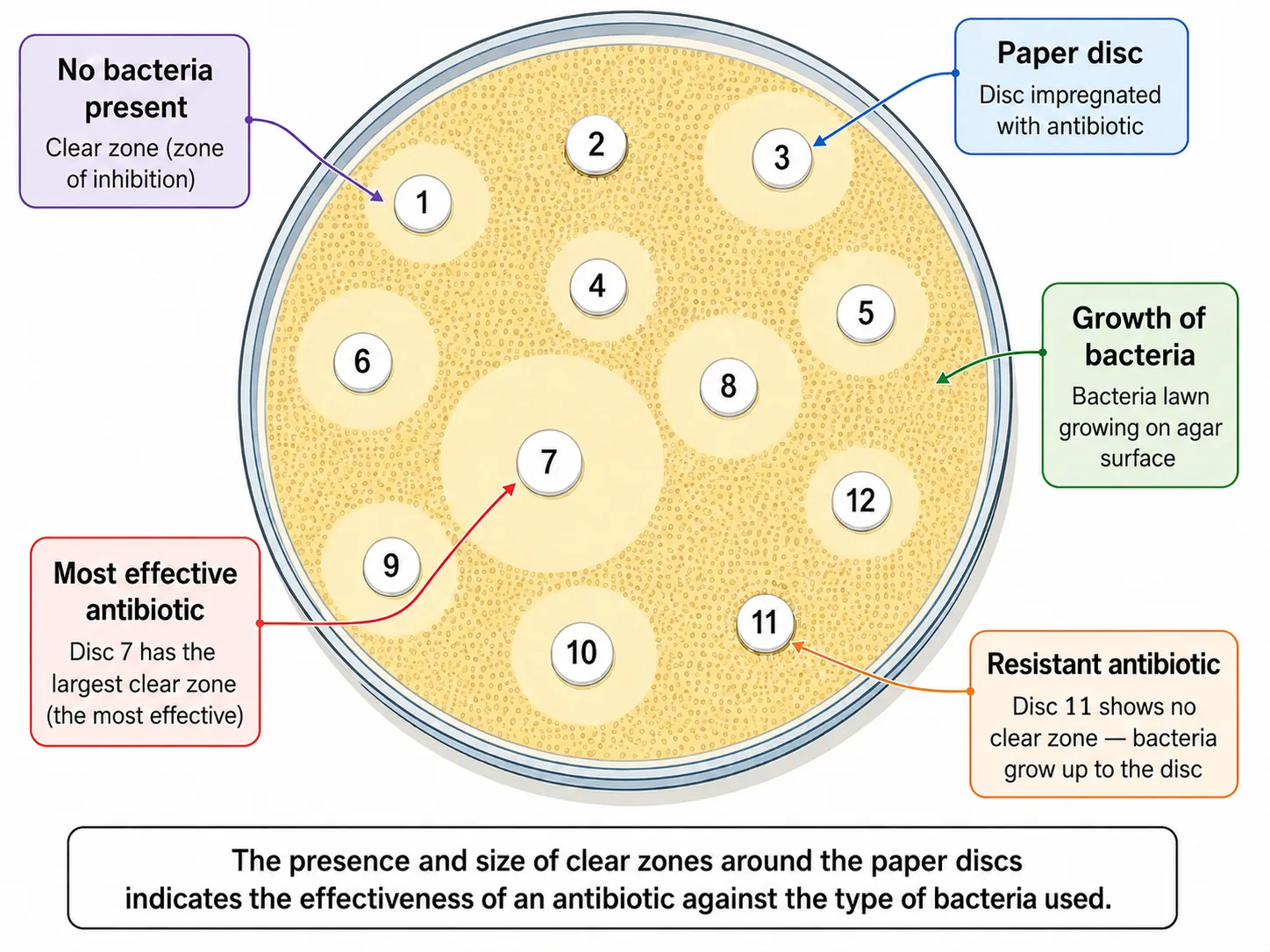
1Diffusion
- Diffusion Antibiotic spreads out from each disc, most concentrated at the disc.
2Clear zone
- Clear zone Where bacteria are susceptible, no bacteria grow around the disc.
3Bigger zone
- Bigger zone A more effective antibiotic kills bacteria at lower concentrations, so the zone is larger.
4No zone
- No zone The bacteria are resistant to that antibiotic.
Section 5 of 8Variables and calculation of zone size
Variables
- Variables The independent variable is the type of antibiotic;
- the dependent variable is the diameter of the clear zone.
- Control variables include antibiotic concentration, disc size, volume of bacteria, agar depth, incubation time and temperature.
Area of the zone
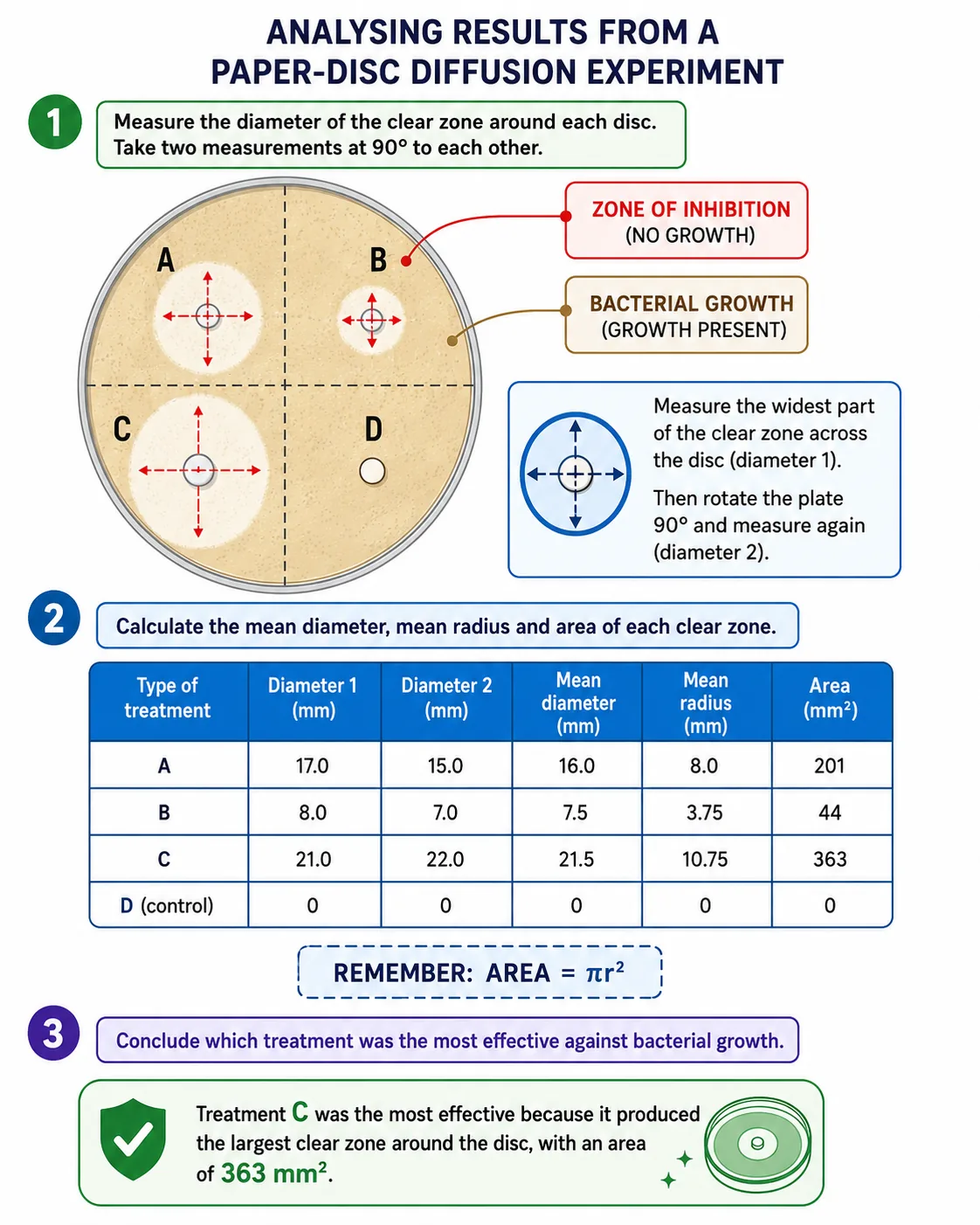
- Area of the zone The clear zone is circular, so its area is πr2, where r is half the diameter measured in mm.
Example
- Example A zone of diameter 16 mm has r = 8 mm and area = π × 82 ≈ 201 mm2.
Section 6 of 8Safety and ethics



Working safely with microbes
Seal the plate
- Seal the plate Tape the lid with two or three short pieces and never seal it all the way round, so oxygen can enter.
Do not open after incubation
- Do not open after incubation The plate may contain harmful bacteria, so the lid stays on and the plate is sterilised in an autoclave after use.
Sterile spreaders
- Sterile spreaders Use a sterile spreader or loop, and flame the neck of the culture bottle each time it is opened.
Hands and surfaces
- Hands and surfaces Wash your hands and disinfect the bench both before and after the practical.
Section 7 of 8Key terms
| Term | Meaning |
|---|---|
| Aseptic technique | Methods that prevent unwanted microbes from contaminating a culture or escaping. |
| Agar | A jelly containing nutrients on which microorganisms are grown. |
| Autoclave | A machine that sterilises using high-pressure steam. |
| Antibiotic resistance | The ability of bacteria to survive an antibiotic. |
| Clear zone | The area around an antibiotic disc where bacterial growth is prevented. |
| Incubate | To keep cultures at a controlled temperature so that microorganisms can grow. |
Section 8 of 8Exam technique
1
Using different concentrations of antibiotic and then comparing the clear zones.
2
Taping the lid of the petri dish fully shut, which could allow anaerobic bacteria to grow - tape only in a few places.
3
Incubating at 37 °C in school, rather than around 25 °C.
4
Opening the lid to examine the plate after incubation.