1.1Physical Chemistry
Atomic Structure
10 min read 22 parts Lesson 1 of 63
Lesson summary
Complete PDF with figures and original page layoutPage 1 Oxford AQA International Your notes A Level (IAL) Chemistry Atomic Structure Contents Fundamental Particles Mass Number & Isotopes Electron Configuration Ionisation Energy Pa…
Section 1 of 22The structure of the atom

The structure of the atom
Atoms
- Atoms the smallest parts of an element that can take part in chemical reactions, and mostly empty space around a tiny dense nucleus
Nucleus
- Nucleus it contains protons and neutrons, called nucleons, and has an overall positive charge
Electrons
- Electrons negatively charged electrons are found in orbitals in the space around the nucleus
Model
- Model understanding of atomic structure has evolved with evidence from experiments
Section 2 of 22Subatomic particles


- Relative charges
- actual charges are too small for coulombs, so they are compared with each other
| Particle | Relative charge | Relative mass |
|---|---|---|
| Proton | +1 | 1 |
| Neutron | 0 | 1 |
| Electron | -1 | 1/1836 |
Subatomic particles
Actual charge
- Actual charge an electron has -1.602 × 10⁻¹⁹ C and a proton has +1.602 × 10⁻¹⁹ C
Neutral atoms
- Neutral atoms the number of protons equals the number of electrons
Ions
- Ions an atom that loses electrons forms a positive ion, and one that gains electrons forms a negative ion
Section 3 of 22Atomic number and mass number

1Atomic (proton) number, Z
- Atomic (proton) number, Z the number of protons in the nucleus, equal to the number of electrons in an atom, and unique to each element
2Chemical change
- Chemical change electrons can be lost, gained or shared, but the proton number never changes
3Mass (nucleon) number, A
- Mass (nucleon) number, A the total number of protons and neutrons
4Location
- Location both numbers are on the Periodic Table
Section 4 of 22Calculating particles in atoms and ions
Calculating particles in atoms and ions
Protons
- Protons equal to the atomic number
Neutrons
- Neutrons mass number minus atomic number
Electrons in an atom
- Electrons in an atom equal to the atomic number
Electrons in an ion
- Electrons in an ion atomic number adjusted by the charge, because a 2+ ion has lost two electrons and a 1- ion has gained one
| Species | Protons | Neutrons | Electrons |
|---|---|---|---|
| Mg | 12 | 12 | 12 |
| O2- | 8 | 8 | 10 |
| Al3+ | 13 | 14 | 10 |
Section 5 of 22Isotopes


Isotopes = atoms of the same element with the same number of protons and electrons but different numbers of neutrons
Notation
- Notation the symbol or name then the mass number, such as carbon-12 and carbon-14 with 6 and 8 neutrons
Hydrogen
- Hydrogen its isotopes have the same protons but different neutrons
Section 6 of 22Time of flight mass spectrometry: purpose and stages
1Purpose
- Purpose to find the relative atomic mass of an element from the abundance and mass of its isotopes, to identify it,
- and to find relative molecular mass
2Common principle
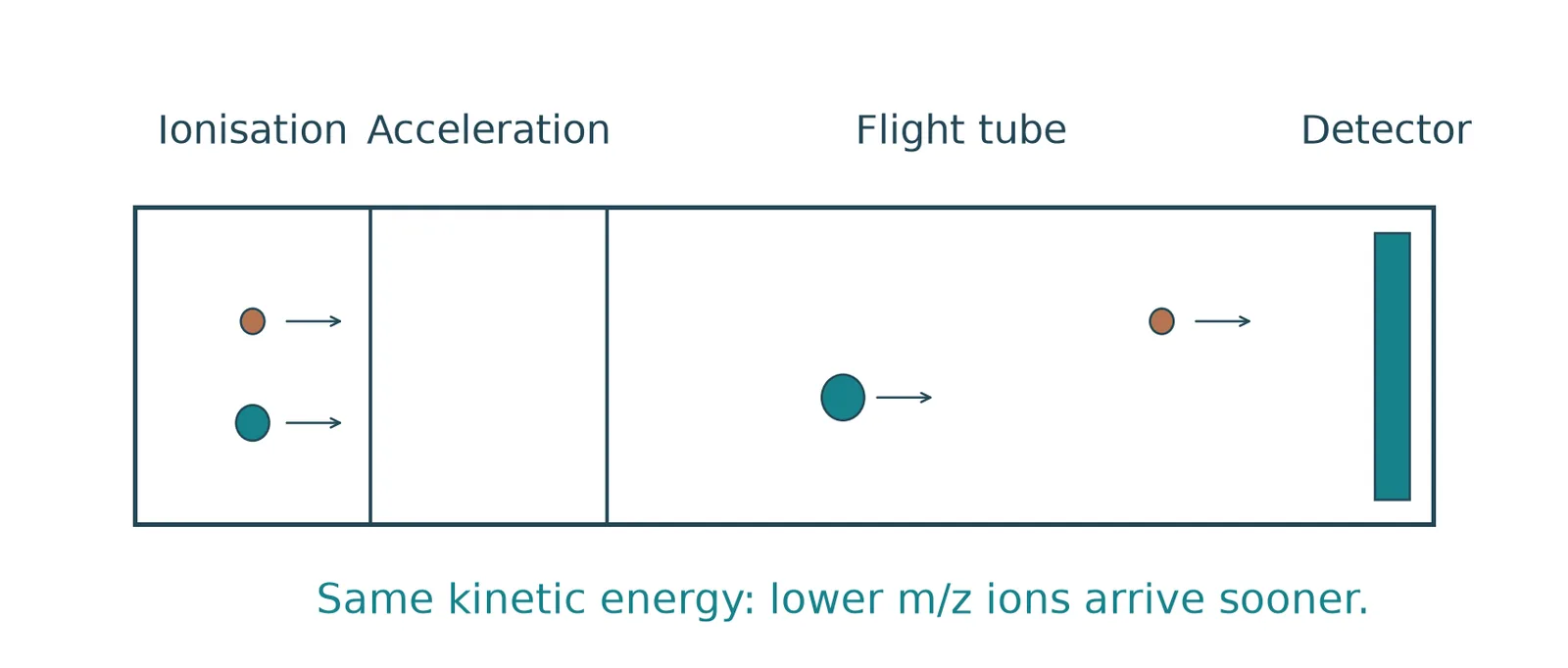
- Common principle the sample is ionised, accelerated, and the ions are separated by their charge-to-mass ratio
3TOF stages
- TOF stages ionisation, acceleration, ion drift and detection
Section 7 of 22Time of flight: ionisation and acceleration
Time of flight: ionisation and acceleration
Ionisation
- The sample is dissolved in a volatile solvent and injected through a fine hollow needle to make a mist.
- The needle is on a high-voltage supply, so particles lose electrons: X(g) → X+(g) + e-.
- Most ions have a 1+ charge because removing further electrons is difficult.
- The solvent evaporates, leaving only positive ions.
Acceleration
- Positive ions are attracted to a negatively charged plate and accelerate in an electric field.
- All ions gain the same kinetic energy, so their speed depends on mass.
- Lighter ions move faster and heavier ions move slower.
Section 8 of 22Time of flight: ion drift and detection
Ion drift
- The ions pass through a hole in the plate into a flight tube.
- The time of flight depends on velocity.
Detection
- Ions hit a negatively charged detector plate and gain an electron, producing a current.
- The size of the current is proportional to the abundance of the ions.
- Lighter ions arrive first and heavier ions arrive later.
- A computer converts the signal into the mass spectrum.
Key point
- Key point all ions have the same kinetic energy, so separation depends only on mass
Section 9 of 22Interpreting mass spectra


Relative abundance
- Relative abundance the proportion of one isotope in the natural mixture, such as Cl-35 at 75% and Cl-37 at 25%
Peaks
- Peaks their heights show abundance, and the horizontal axis is m/z, which equals the mass number for 1+ ions
Boron
- Boron two peaks show two isotopes, B-10 at 19.9% and B-11 at 80.1%
Interpreting mass spectra
Multiply each isotope’s abundance by its m/z.
Add the products.
Divide by 100.
Interpreting mass spectra
Result
- Ar of boron = ÷ 100 = 10.8
- (19.9 × 10 + 80.1 × 11)
Types
- Types low resolution mass spectrometry gives relative atomic mass, and high resolution gives relative molecular mass of a compound
Section 10 of 22Electron energy levels


Electronic configuration
- Electronic configuration the arrangement of electrons in energy levels (shells) around the nucleus
Principal quantum number, n
- Principal quantum number, n it numbers the shells from 1 to 4, and the lower the n the closer to the nucleus and the lower the energy
| Shell (n) | Maximum electrons |
|---|---|
| 1 | 2 |
| 2 | 8 |
| 3 | 18 |
| 4 | 32 |
Spacing
- Spacing energy levels get closer together further from the nucleus, with an overlap between the third and fourth levels
Sub-shells
- Sub-shells shells divide into sub-shells s, p, d
- (and f for elements with more than 57 electrons)
Energy order
- Energy order s < p < d < f
Orbital
- Orbital a volume of space with a high probability of finding an electron
Content by level
- Content by level the first level has one s orbital, and the second level has an s and p orbitals
Section 11 of 22Orbitals in each shell
- Capacity
- each atomic orbital holds a maximum of two electrons
| Shell (n) | Sub-shell | Orbitals | Electrons in sub-shell | Electrons in shell |
|---|---|---|---|---|
| 1 | s | 1 | 2 | 2 |
| 2 | s | 1 | 2 | 8 |
| 2 | p | 3 | 6 | 8 |
| 3 | s | 1 | 2 | 18 |
| 3 | p | 3 | 6 | 18 |
| 3 | d | 5 | 10 | 18 |
| 4 | s | 1 | 2 | 32 |
| 4 | p | 3 | 6 | 32 |
| 4 | d | 5 | 10 | 32 |
| 4 | f | 7 | 14 | 32 |
- Exam requirement
- know the number of s, p and d orbitals in each level, and the shapes of s and p orbitals only
Section 12 of 22Orbital shapes
s orbital
- s orbital spherical
- Its size increases with shell number, so 3s is bigger than 1s.
p orbital
- p orbital dumbbell-shaped
- Every shell except n = 1 has three p orbitals.
- They lie along the x, y and z axes at right angles to each other.
- The lobes become larger and longer with increasing shell number.
Section 13 of 22Rules for filling orbitals
1Lowest energy first
- Lowest energy first electrons fill orbitals of lower energy before higher ones
2Maximum two
- Maximum two each orbital holds at most two electrons, with opposite spins
3Singly first
- Singly first orbitals of equal energy, such as the three 2p orbitals, fill singly before pairing
44s before 3d
- 4s before 3d the 4s orbital is lower in energy than 3d, because of the overlap between the third and fourth levels, so it fills first
Section 14 of 22Box notation
Boxes
- Boxes each box represents an atomic orbital, arranged in order of increasing energy from bottom to top
Electrons
- Electrons shown as opposite arrows to represent opposite spins
Examples
- Examples nitrogen, sodium, chlorine and titanium can all be drawn this way
Section 15 of 22Writing electronic configurations
Notation
- Notation each sub-shell is written as number, letter and a superscript giving the electrons, such as hydrogen 1s1
Potassium
- 1s2 2s2 2p6 3s2 3p6 4s1
Shorthand
- Shorthand use the nearest preceding noble gas in square brackets, so potassium is [Ar] 4s1
Calcium
- 1s2 2s2 2p6 3s2 3p6 4s2, or [Ar] 4s2
Gallium
- 1s2 2s2 2p6 3s2 3p6 3d10 4s2 4p1, or [Ar] 3d10 4s2 4p1
- Configurations are often written in numerical order, so 3d is written before 4s even though 4s fills first.
Ions
- Ions remove electrons from the outermost shell
- Mg2+ loses its two 3s electrons, so it is 1s2 2s2 2p6 or [Ne].
Section 16 of 22Blocks of the Periodic Table
s block
- s block outer electrons in an s orbital
p block
- p block outer electrons in a p orbital
d block
- d block outer electrons in a d orbital
f block
- f block outer electrons in an f orbital
Section 17 of 22Ionisation energy and successive ionisation energies
First ionisation energy = the energy needed to remove one mole of electrons from one mole of gaseous atoms to form one mole of gaseous 1+ ions
Conditions and units
- Conditions and units measured at 298 K and 101 kPa in kJ mol-1, and always positive because it is endothermic
Equations
- Equations first: Na(g) → Na+(g) + e-, second: Na+(g) → Na2+(g) + e-, third: Na2+(g) → Na3+(g) + e-
Starting species
- Starting species the second ionisation energy of magnesium starts from Mg+(g)
Increase
- Increase each successive ionisation energy is larger, because electrons are removed from increasingly positive ions
Sodium data (kJ mol−1)
- 496, 4563, 6913, 9544, 13352, 16611, 20115, 25491, 28934, 141367, 159079
Section 18 of 22Using ionisation energies to find shells and group
Energy levels in sodium
- Energy levels in sodium the first electron is easy to remove, the next 8 are harder, and the last 2 closest to the nucleus are hardest
Group
- Group the largest jump between successive ionisation energies shows the group, as a jump between 1st and 2nd means Group 1
Reason
- Reason the next electron comes from an inner shell closer to the nucleus
Section 19 of 22Ionisation energy across Period 3
Trend
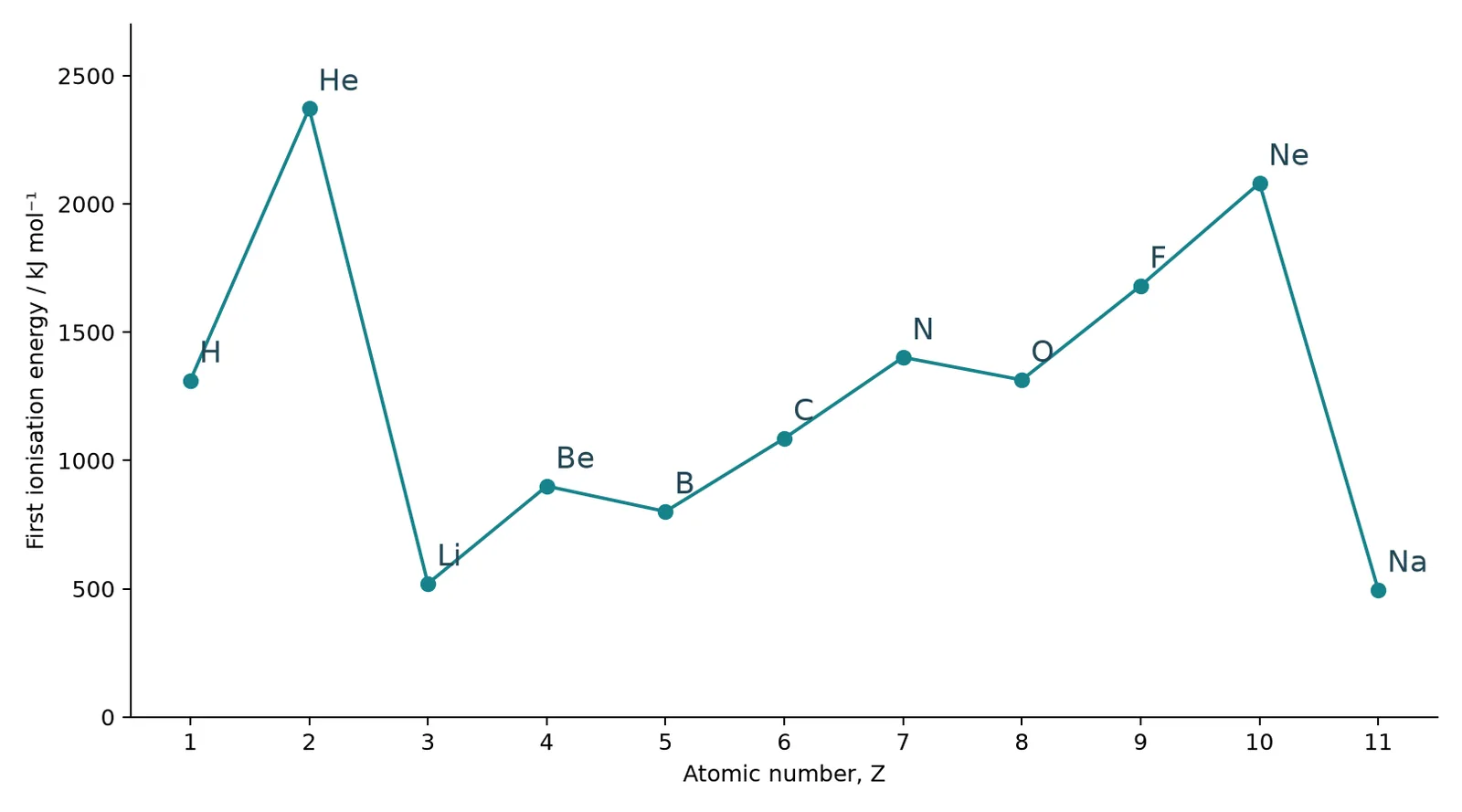
- Trend the first ionisation energy generally increases across the period
Nuclear charge
- Nuclear charge it increases, so the outer shell is pulled closer and atomic radius decreases
Shielding
- Shielding it stays nearly constant because electrons are added to the same shell
Result
- Result it is harder to remove an electron, so more energy is needed
Aluminium lower than magnesium
- Magnesium loses a 3s electron.
- Aluminium loses a 3p electron, which is slightly higher in energy.
- This is evidence for s and p sub-shells.
Sulfur lower than phosphorus
- Phosphorus has one electron in each of three 3p orbitals.
- Sulfur has a pair of electrons in one 3p orbital.
- Repulsion between the paired electrons makes one easier to remove.
Section 20 of 22Ionisation energy down Group 2
Ionisation energy down Group 2
Trend
- Trend the first ionisation energy decreases down the group
Reason
- Reason atomic radius increases and shielding by inner shells increases, outweighing the increase in nuclear charge
Result
- Result the outer electron is easier to remove
Exam skills
- Exam skills write ionisation equations with state symbols, explain the trends, and explain deviations as evidence for shells and sub-shells
Section 21 of 22Key terms
| Term | Meaning |
|---|---|
| Nucleon | A proton or a neutron in the nucleus. |
| Isotopes | Atoms of the same element with different numbers of neutrons. |
| Relative isotopic abundance | The proportion of an isotope in a natural mixture. |
| m/z | The mass-to-charge ratio of an ion. |
| Principal quantum number | The number n that labels an electron shell. |
| Orbital | A region of space where an electron is likely to be found. |
| Term | Meaning |
|---|---|
| Ionisation energy | The energy to remove one mole of electrons from one mole of gaseous atoms. |
| Sub-shell | A division of a shell into s, p, d or f orbitals. |
| Shielding | The repulsion of outer electrons by inner-shell electrons. |
| Successive ionisation energies | The energies to remove electrons one after another from an atom. |
| Shorthand configuration | A configuration written using the preceding noble gas symbol. |
Section 22 of 22Exam technique
1
Saying the electron has a mass of 1 — its relative mass is 1/1836.
2
Changing the proton number to form an ion — ions form by changing electrons only.
3
Saying all ions have the same speed in TOF — they have the same kinetic energy but different speeds.
4
Forgetting to divide by 100 in relative atomic mass — divide the weighted sum by 100.
1
Writing the second ionisation equation from the atom — start from the 1+ ion.
2
Forgetting state symbols — ionisation equations need (g).
3
Saying aluminium has a lower IE than magnesium because of smaller nuclear charge — it loses a higher-energy 3p electron.
4
Filling 3d before 4s — 4s fills first.