1.2Physical Chemistry
Amount of Substance
15 min read 32 parts Lesson 6 of 63
Lesson summary
Complete PDF with figures and original page layoutPage 1 Oxford AQA International Your notes A Level (IAL) Chemistry Amount of Substance Contents Relative Atomic Mass & Relative Molecular Mass The Mole & The Avogadro Constant The Ideal Gas Equation Emp…
Section 1 of 32Unified atomic mass unit
Reason
- Reason atoms are too small to weigh directly, so masses are compared with a standard
Definition
- Definition the unified atomic mass unit, u (or Da), is one twelfth of the mass of a carbon-12 atom
Value
- 1 u = 1.66 × 10⁻²⁷ kg
Section 2 of 32Relative atomic mass
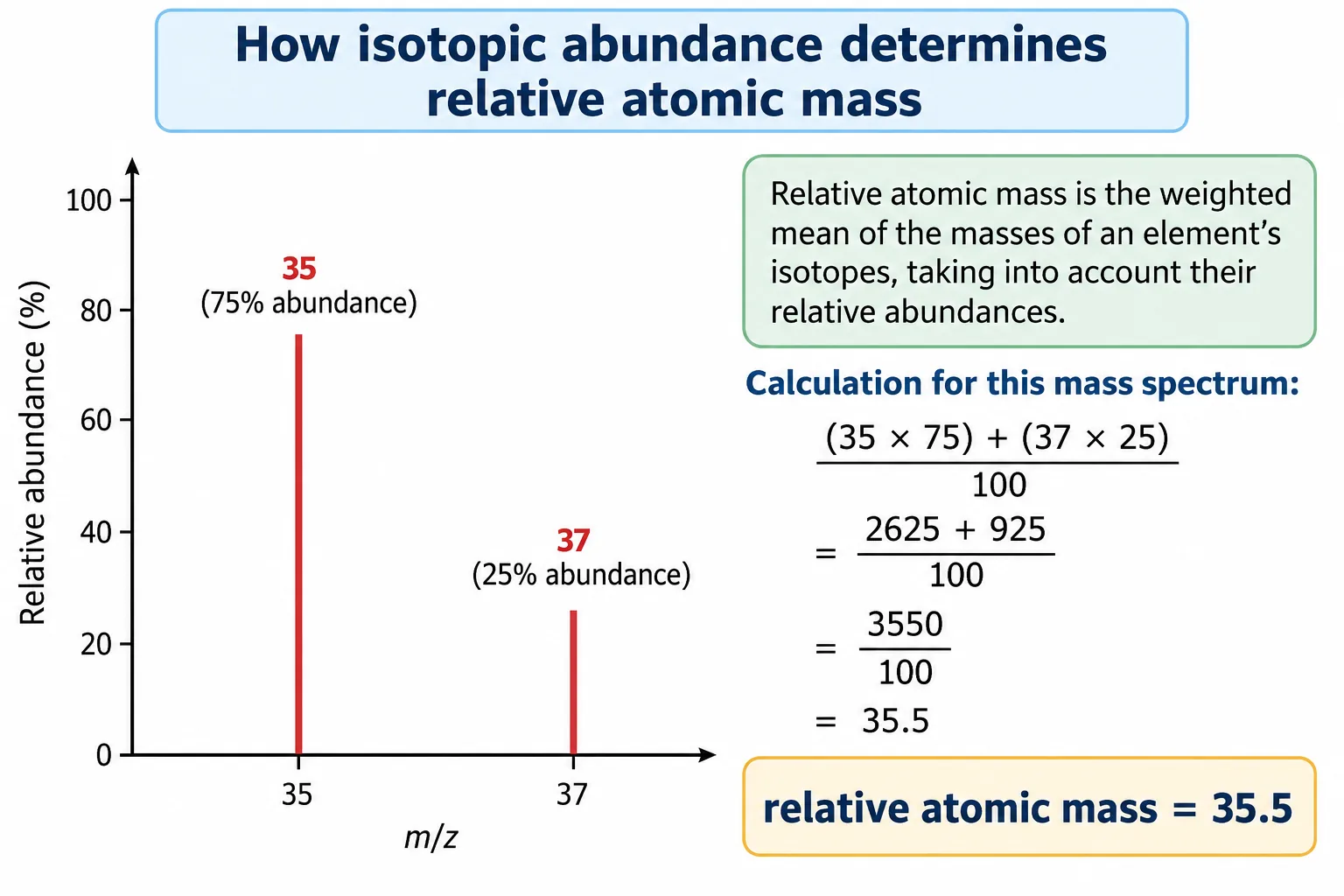
Relative atomic mass, Ar = the ratio of the average mass of the atoms of an element to the unified atomic mass unit
Basis
- Basis it uses the average mass of the isotopes of the element
Units
- Units it has none because it is a ratio
Formula
- Ar = average mass of one atom of X ÷ one twelfth of the mass of a carbon-12 atom
Calculation
- Calculation it can also be found from isotopic abundances
Common definition
- Common definition the mass of an atom compared with one twelfth of a carbon-12 atom
Section 3 of 32Relative molecular and formula mass
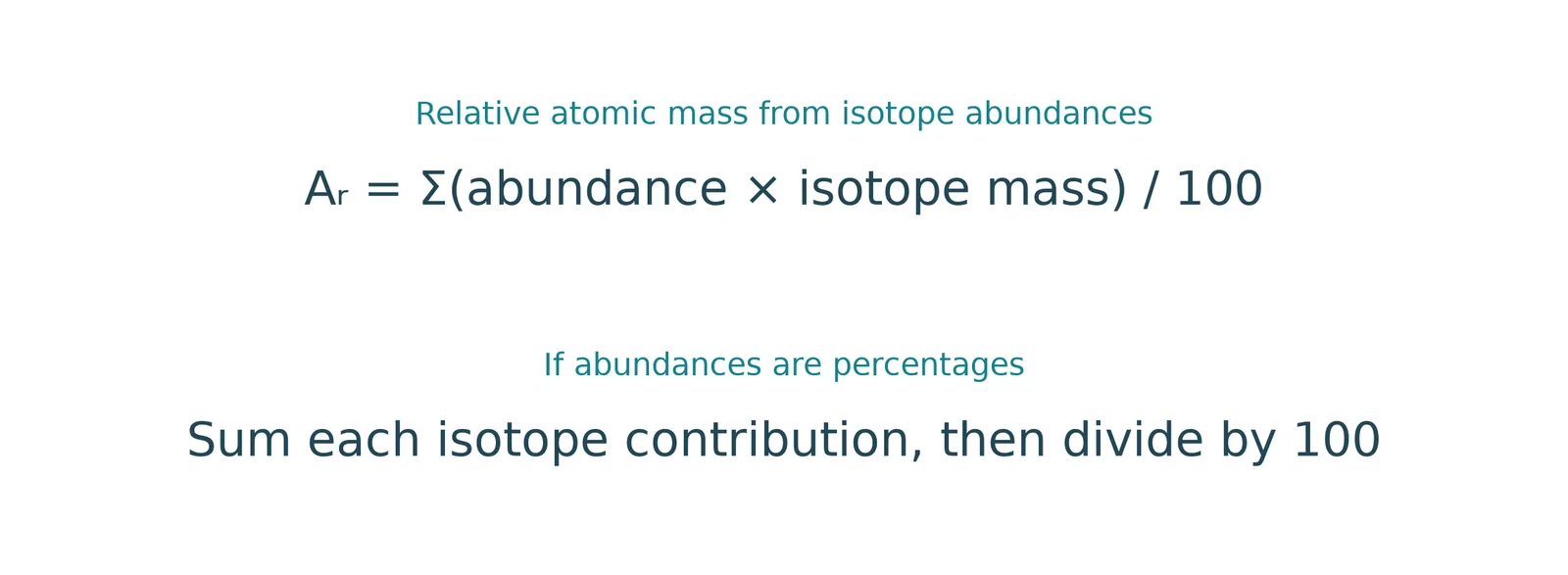
Relative molecular mass, Mr = the ratio of the weighted average mass of a molecule to the unified atomic mass unit, with no units
Calculation
- Calculation add the relative atomic masses of all atoms in one molecule
Simplest formula
- Simplest formula for giant structures the formula unit is used, such as SiO2
Relative formula mass
- Relative formula mass the term used for ionic compounds, calculated in the same way
| Substance | Calculation | Mr |
|---|---|---|
| H2 | 2 × 1.0 | 2.0 |
| H2O | (2 × 1.0) + 16.0 | 18.0 |
| SiO2 | 28.1 + (2 × 16.0) | 60.1 |
| K2CO3 | (2 × 39.1) + 12.0 + (3 × 16.0) | 138.2 |
| Ca(OH)2 | 40.1 + (2 × 16.0) + (2 × 1.0) | 74.1 |
| (NH4)2SO4 | (2 × 14.0) + (8 × 1.0) + 32.1 + (4 × 16.0) | 132.1 |
Section 4 of 32The mole and the Avogadro constant

The mole and the Avogadro constant
Avogadro constant, NA
- Avogadro constant, NA the number of particles in a mole, 6.02 × 10²³ mol-1, applying to atoms, molecules, ions and electrons
Mole = the amount of substance containing the same number of fundamental units as there are atoms in exactly 12.00 g of carbon-12
Molar mass
- Molar mass one mole of an element has a mass equal to its Ar in grams, so a mole of carbon is 12 g and a mole of water is 18 g
Particles
- Particles number of particles = moles × NAWhat the symbols mean: N = number of particles · n = amount (mol) · NA = Avogadro constant (6.02 × 10²³ mol−1)
Exam note
- Exam note the value of the Avogadro constant need not be recalled
Section 5 of 32Particles in a mole
| 1 mole of | Atoms | Molecules | Mass / g |
|---|---|---|---|
| Na | 6.02 × 10²³ | — | 23.0 |
| H2 | 1.204 × 1024 | 6.02 × 10²³ | 2.0 |
| NaCl | 1.204 × 1024 (total) | 6.02 × 10²³ formula units | 58.5 |
- Reasoning
- H2 has 2 atoms per molecule, and NaCl has one Na and one Cl per formula unit, so total atoms double
Section 6 of 32Moles, mass and molar mass

Equation
- Equation moles = mass ÷ molar mass, and mass = moles × molar mass
Example
- 0.250 mol of zinc (65.4 g mol-1) has a mass of 16.4 g
Example
- 2.64 g of a compound with Mr 342.3 is 7.71 × 10⁻³ mol
Formula triangle
- Formula triangle cover the quantity wanted to see the calculation
Section 7 of 32Moles, concentration and volume

Equation
- Equation moles = concentration × volume in dm3, with concentration in mol dm-3
Use
- Use titration calculations, as in Required Practical 1
Example
- 80.0 g of NaOH (Mr 40.0) is 2 mol, and in 0.5 dm3 the concentration is 4 mol dm-3
Units
- Units convert cm3 to dm3 by dividing by 1000
Section 8 of 32Kinetic theory and ideal gases
Assumptions of the kinetic theory
- Gas molecules move very fast and randomly.
- They have negligible volume.
- They do not attract or repel each other.
- Collisions are elastic, so no kinetic energy is lost.
- Temperature relates to the average kinetic energy.
Ideal gas = a gas that obeys these assumptions, whereas real gases fit them only approximately
Volume
- Volume it depends on pressure and temperature,
- and at constant pressure volume is directly proportional to temperature because particles move further apart as they gain kinetic energy
Section 9 of 32Limitations of the ideal gas law
Conditions
- Conditions real gases deviate at very low temperature and high pressure, when molecules are close together
Attractive forces
- Attractive forces induced or permanent dipole forces exist between molecules
- They pull molecules away from the container wall, so the pressure is lower than expected.
Molecular volume
- Molecular volume it is not negligible, so the volume of the gas is smaller than expected for an ideal gas
Section 10 of 32The ideal gas equation
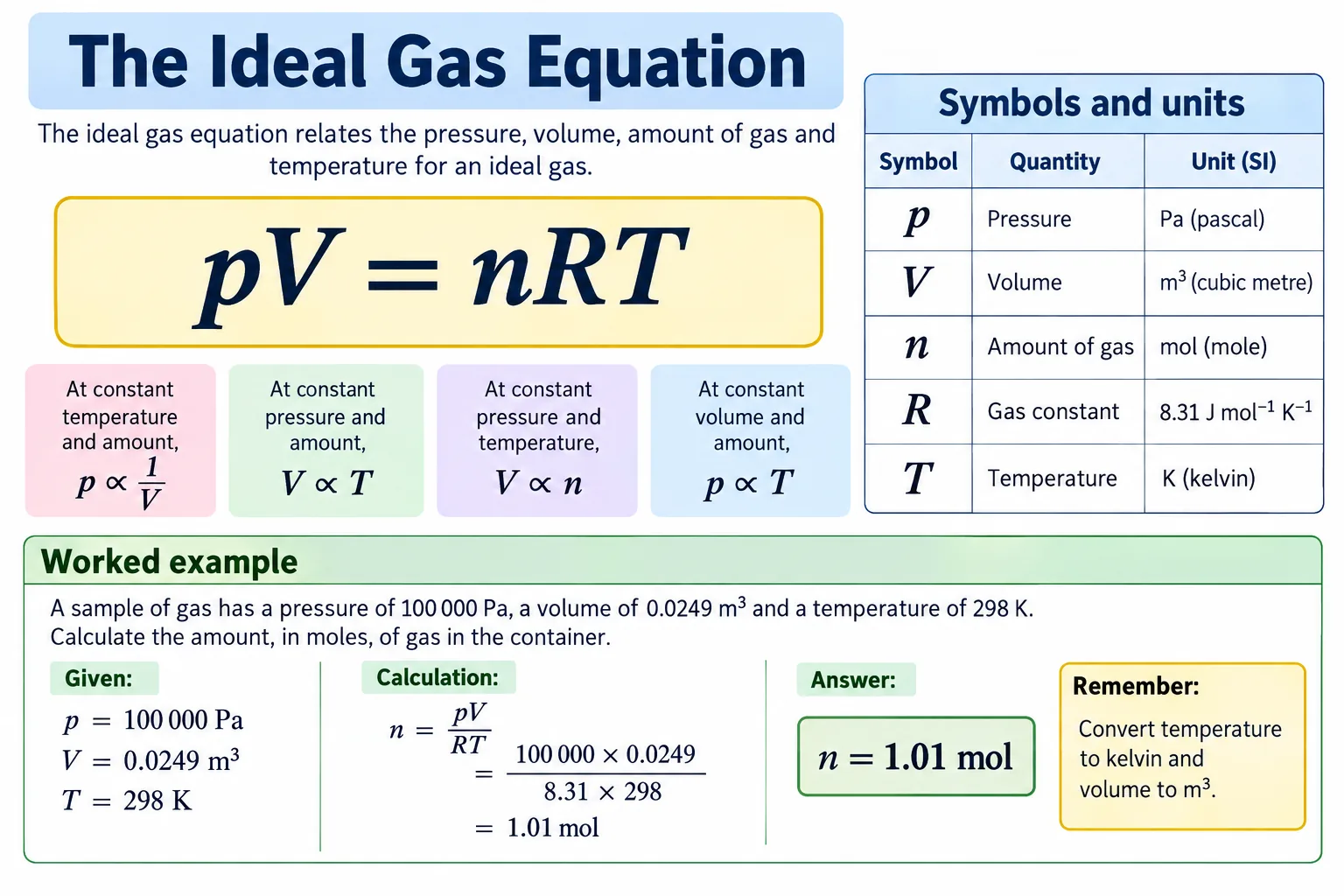

- Equation
- PV = nRTWhat the symbols mean: p = pressure (Pa) · V = volume (m3) · n = amount of gas (mol) · R = 8.31 J mol−1 K−1 · T = temperature (K = °C + 273)
- PV = nRT
| Symbol | Quantity | Unit |
|---|---|---|
| P | Pressure | Pa |
| V | Volume | m3 |
| n | Amount of gas | mol |
| R | Gas constant (8.31) | J K-1 mol-1 |
| T | Temperature | K |
Conversions
- Conversions kPa to Pa by multiplying by 1000, °C to K by adding 273, and dm3 to m3 by dividing by 1000
Example
- 0.781 mol of oxygen at 220 kPa and 21 °C (294 K) has V = nRT ÷ P = 0.00867 m3 = 8.67 dm3
Section 11 of 32Finding molar mass of a gas from PV = nRT
1
Rearrange to n = PV ÷ RT.
2
Convert units: kPa to Pa, cm3 to m3 and °C to K by adding 273.
3
Calculate the moles of gas.
4
Use molar mass = mass ÷ moles.
Example
- 6.39 g of gas in 1000 cm3 at 300 kPa and 23 °C (296 K) is 0.12 mol, so the molar mass is 53.25 g mol-1
Skill
- Skill rearrange the equation for any quantity, and take great care with units
Section 12 of 32Empirical and molecular formulae
Molecular formula = the formula showing the number and type of each atom in a molecule, such as C2H4O2 for ethanoic acid
Empirical formula = the simplest whole-number ratio of elements in a molecule or formula unit, such as CH2O for ethanoic acid
Pattern
- Pattern organic molecules often differ in empirical and molecular formula, simple inorganic molecules less often,
- and ionic compounds always have the same
Source of data
- Source of data masses of each element, or percentage composition by mass
Section 13 of 32Calculating an empirical formula
1
Write the mass (or percentage) of each element.
2
Divide each by its Ar to give moles.
3
Divide all by the smallest value to find the ratio.
4
Multiply to turn non-integer ratios into whole numbers, such as ×3 for 1 : 1.33.
5
Write the formula.
From masses
- 2.72 g C and 7.28 g O give 0.227 and 0.455 mol, ratio 1 : 2, so CO2
From percentages
- 90.0% C and 10.0% H give 7.5 and 10.0 mol, ratio 1 : 1.33, multiplied by 3 to give C3H4
Section 14 of 32Calculating a molecular formula
1
Find the empirical formula.
2
Find the relative formula mass of the empirical formula.
3
Divide the Mr of the compound by that value.
4
Multiply every number in the empirical formula by the result.
Example
- 24.2% C, 4.1% H and 71.7% Cl give empirical formula CH2Cl, with relative mass 49.5
Result
- Result an Mr of 99.0 gives a multiplier of 2, so the molecular formula is C2H4Cl2
Section 15 of 32Balancing equations
Symbol equation
- Symbol equation it shows the number and type of each atom using symbols, and a word equation uses only words
Conservation
- Conservation atoms cannot be created or destroyed, so each side must have the same number of each atom
Rules
- Never change the formulae.
- Put balancing numbers in front of formulae.
- In combustion of organic compounds, balance carbon first, then hydrogen, then oxygen.
1
Write the formulae of the reactants and products.
2
Count the atoms of each element on each side.
3
Balance one element at a time.
4
Add state symbols.
State symbols
- (s) solid, (l) liquid, (g) gas and (aq) aqueous
Example
- 2Mg(s) + O2(g) → 2MgO(s), showing 2 mol Mg reacts with 1 mol O2 to form 2 mol MgO
Section 16 of 32Ionic equations
Dissociation
- Dissociation in aqueous solution ionic compounds split into ions
Spectator ions
- Spectator ions ions that take no part in the reaction
Ionic equation
- Ionic equation it shows only the ions or particles that react, with spectator ions cancelled
1
Write the full balanced equation with state symbols.
2
Split aqueous ionic compounds into ions.
3
Cancel the ions that appear unchanged on both sides.
4
Write what remains.
- Example
- Zn(s) + CuSO4(aq) → ZnSO4(aq) + Cu(s) becomes Zn(s) + Cu2+(aq) → Zn2+(aq) + Cu(s), with SO42- as the spectator
Section 17 of 32Reacting masses
Purpose
- Purpose to find how much of each reactant exactly reacts, preventing waste
Stoichiometry
- Stoichiometry the balanced equation gives the ratio of moles of reactants and products
1
Write the balanced equation.
2
Find the molar masses.
3
Calculate moles of the given substance using n = mass ÷ Mr.
4
Use the equation ratio to find moles of the required substance.
5
Calculate its mass using moles × Mr.
- Example
- 7.5 g of Mg (24.3) is 0.3086 mol, the ratio 2Mg : 2MgO is 1 : 1, so the mass of MgO (40.3) is 12.44 g
Section 18 of 32Molar gas volume
Value
- Value at room temperature and pressure, one mole of any gas occupies 24.0 dm3
Conditions
- Conditions room temperature is 20 °C and room pressure is 100 000 Pa
Alternative
- Alternative if RTP is not stated, use PV = nRT
Equations
- Equations volume (dm3) = moles × 24.0, and moles = volume (dm3) ÷ 24.0
Section 19 of 32Gas volume and moles calculations
- Equations
- volume = moles × 24.0 dm3, and moles = volume ÷ 24.0What the symbols mean: V = volume of gas at r.t.p. (dm3) · n = amount (mol) · 24 dm3 mol−1 = molar gas volume at room temperature and pressure
- volume = moles × 24.0 dm3, and moles = volume ÷ 24.0
| Gas | Moles | Volume / dm3 |
|---|---|---|
| Hydrogen | 3.0 | 72.0 |
| Carbon dioxide | 0.25 | 6.0 |
| Oxygen | 5.4 | 129.6 |
| Ammonia | 0.02 | 0.48 |
| Gas | Volume / dm3 | Moles |
|---|---|---|
| Methane | 225.6 | 9.4 |
| Carbon monoxide | 7.2 | 0.30 |
| Sulfur dioxide | 960 | 40 |
Section 20 of 32Percentage yield
1Reasons for less than 100%
- Reasons for less than 100% other reactions occur at the same time, the reaction does not go to completion,
- or reactants and products are lost to the atmosphere
2Equation
- Equation percentage yield = × 100
- (actual yield ÷ theoretical yield)
3Actual yield
- Actual yield the moles or mass obtained experimentally
4Predicted (theoretical) yield
- Predicted (theoretical) yield the moles or mass calculated from the equation
1
Write the balanced equation.
2
Calculate moles of the limiting reactant.
3
Use the ratio to find the theoretical moles and mass of product.
4
Divide the actual mass by the theoretical mass and multiply by 100.
- Example
- 6.54 g of zinc is 0.10 mol, giving a theoretical 6.35 g of copper, and 4.80 g obtained is 75.6%
Section 21 of 32Atom economy
Definition
- Definition it shows how much of the mass of the reactants becomes the desired product, with the rest wasted
Equation
- Equation percentage atom economy = (Mr of desired product ÷ sum of Mr of all reactants) × 100
Source
- Source it is found directly from the balanced equation
Addition reactions
- Addition reactions they have 100% atom economy because all atoms form the desired product, as does any reaction with one product
Mass version
- Mass version divide the mass of desired product by the total mass of reactants
Importance
- Importance high atom economy means fewer resources used and less waste, which supports sustainable development
Section 22 of 32Atom economy comparisons and calculation
Atom economy comparisons and calculation
Making ethanol
- Hydration of ethene, C2H4 + H2O → C2H5OH, has 100% atom economy.
- Substitution of bromoethane, C2H5Br + NaOH → C2H5OH + NaBr, wastes NaBr.
Blast furnace, Fe2O3 + 3CO → 2Fe + 3CO2
- Desired product 2 × 55.8, reactants 159.6 + (3 × 28.0).
- Atom economy is 45.8%, and the Mr of CO2 is not needed.
Section 23 of 32Concentration and volumes of solutions
Concentration
- Concentration the amount of solute dissolved in a solvent to make 1 dm3 of solution
Equation
- Equation concentration (mol dm-3) = moles of solute ÷ volume of solution (dm3)
Concentrated and dilute
- Concentrated and dilute a concentrated solution has a high concentration and a dilute solution a low one
Points to remember
- Convert mass in grams to moles.
- Convert cm3 to dm3.
Mass of solute
- Mass of solute moles = concentration × volume (dm3), then mass = moles × molar mass
Section 24 of 32Reaction calculations in solution
1
Write the balanced equation.
2
Calculate moles of the substance with known mass or concentration and volume.
3
Use the equation ratio to find moles of the other substance.
4
Calculate volume = moles ÷ concentration, or concentration = moles ÷ volume.
Volume example
- 2.5 g CaCO3 (100) is 0.025 mol and needs 0.05 mol HCl for CaCO3 + 2HCl → CaCl2 + H2O + CO2, so 0.05 dm3 of 1.0 mol dm-3 acid
Concentration example
- 25.0 cm3 of 0.050 mol dm-3 Na2CO3 is 0.00125 mol and needs 0.00250 mol HCl, so 20.0 cm3 of acid is 0.125 mol dm-3
Section 25 of 32Required Practical 1 Part A: making a volumetric solution
Required Practical 1 Part A: making a volumetric solution
Aim
- Aim to prepare 250 cm3 of 0.100 mol dm-3 sodium hydrogensulfate, NaHSO4 (Mr 120.1)
Apparatus
- Apparatus weighing bottle, 250 cm3 volumetric flask, solid NaHSO4, filter funnel, spatula, deionised water, 250 cm3 beaker, glass rod and a balance reading to 2 or 3 decimal places
Mass needed
- 0.100 mol dm-3 is 12.01 g per dm3, so 250 cm3 needs 3.0025 g (about 3.02 g)
1
Calculate the mass of solid needed.
2
Weigh out about that mass into the weighing bottle and record the exact mass.
3
Transfer the solid to the beaker.
4
Rinse the weighing bottle with deionised water and add the washings to the beaker.
5
Add about 100 cm3 of deionised water and stir until all the solid dissolves.
6
Transfer the solution to the volumetric flask.
7
Rinse the beaker and glass rod and add the washings to the flask.
8
Make up to the graduation mark.
9
Stopper and invert to mix.
10
Calculate the exact concentration from the exact mass.
Required Practical 1 Part A: making a volumetric solution
Source of error
- Source of error the most common error is loss of solid when transferring it between vessels
Result
- Result the only measurement is the mass, recorded to the balance’s number of decimal places
Section 26 of 32Exact concentration of the standard solution
Exact concentration of the standard solution
Record the exact mass of solid weighed.
Calculate moles = mass ÷ Mr.
Divide by the volume in dm3.
- Example
- 3.02 g of NaHSO4 (Mr 120.1) is 0.0251 mol, and in 0.250 dm3 the concentration is 0.1004 mol dm-3
Section 27 of 32Mass of a hydrated solute
Principle
- Principle use the Mr of the hydrated formula, including the water of crystallisation
Method
- Method moles = concentration × volume (dm3), then mass = moles × Mr
Example
- 250 cm3 of 0.050 mol dm-3 NaHSO4·H2O needs 0.0125 mol, and with Mr 138.1 the mass is 1.73 g to 3 significant figures
Section 28 of 32Required Practical 1 Part B: titration set-up
Required Practical 1 Part B: titration set-up
Aim
- Aim to find the concentration of sodium hydroxide solution using a standard sodium hydrogensulfate solution
Apparatus
- Apparatus burette, stand and clamp, 25 cm3 volumetric pipette with filler, 250 cm3 conical flasks, funnel, wash bottle, phenolphthalein, 150 cm3 standard NaHSO4 solution and 150 cm3 NaOH of unknown concentration
Section 29 of 32Required Practical 1 Part B: method
1
Rinse the burette with the standard solution, then fill it.
2
Rinse a conical flask with deionised water.
3
Rinse the pipette with the sodium hydroxide solution.
4
Transfer exactly 25.0 cm3 of sodium hydroxide into the flask.
5
Add two to three drops of phenolphthalein.
6
Construct a results table and record the initial burette reading to the appropriate precision.
7
Add the standard solution slowly with swirling, and dropwise near the end-point where the indicator changes colour.
8
Record the final reading and calculate the volume used.
9
Repeat until two results are concordant, within 0.1 cm3, doing at least three titrations.
10
Calculate the mean volume and then the concentration of sodium hydroxide, showing working.
- Practical points
- A rough titration first shows the approximate end-point, so the burette can be run to within 2–3 cm3 and then added dropwise.
- Use only a few drops of indicator, because indicators are weak acids and can affect results.
Section 30 of 32Required Practical 1 Part B: results and calculation
- Table
- columns for rough, run 1, run 2 and run 3 with initial reading, final reading and titre volume
1
Identify the concordant results, within 0.1 cm3.
2
Calculate the mean titre.
3
Calculate moles of the standard solution using concentration × volume (dm3).
4
Use the equation ratio to find moles of the unknown, as NaHSO4 + NaOH → Na2SO4 + H2O is 1 : 1.
5
Divide by the volume in dm3 to get the concentration.
Required Practical 1 Part B: results and calculation
Example
- Example titres 25.10 and 25.00 cm3 give a mean of 25.05 cm3,
- so 0.002505 mol of 0.100 mol dm-3 acid reacts with 25.0 cm3 of alkali,
- giving 0.1002 mol dm-3 NaOH
Careful
- Careful convert cm3 to dm3 before the final step
Section 31 of 32Key terms
| Term | Meaning |
|---|---|
| Relative atomic mass | The average mass of an element’s atoms compared with one twelfth of a carbon-12 atom. |
| Relative molecular mass | The weighted average mass of a molecule compared with one twelfth of a carbon-12 atom. |
| Mole | The amount of substance containing 6.02 × 10²³ particles. |
| Avogadro constant | The number of particles in one mole. |
| Ideal gas | A gas that obeys the kinetic theory assumptions exactly. |
| Gas constant | R, 8.31 J K-1 mol-1. |
| Term | Meaning |
|---|---|
| Empirical formula | The simplest whole-number ratio of atoms of each element in a compound. |
| Molecular formula | The actual number of atoms of each element in a molecule. |
| Spectator ion | An ion that does not take part in a reaction. |
| Ionic equation | An equation showing only the ions or particles that react. |
| Stoichiometry | The ratio of moles of substances in a balanced equation. |
| Molar gas volume | 24.0 dm3 per mole at room temperature and pressure. |
| Term | Meaning |
|---|---|
| Percentage yield | Actual yield divided by theoretical yield, times 100. |
| Atom economy | The proportion of the mass of reactants that becomes the desired product. |
| Volumetric solution | A solution of accurately known concentration made in a volumetric flask. |
| Concentration | The amount of solute per dm3 of solution. |
| Theoretical yield | The maximum product calculated from the balanced equation. |
| Term | Meaning |
|---|---|
| Standard solution | A solution of accurately known concentration. |
| Titre | The volume of solution added from the burette to reach the end-point. |
| Concordant results | Titres within 0.1 cm3 of each other. |
| End-point | The point at which the indicator changes colour. |
| Hydrated salt | A salt containing water of crystallisation in its formula. |
Section 32 of 32Exam technique
1
Using the Avogadro constant as grams per mole — it is per mole, and the mass of a mole is the molar mass.
2
Using cm3 in moles = concentration × volume — convert to dm3.
3
Using kPa or dm3 in PV = nRT — use Pa and m3.
4
Saying Ar has units — it is a ratio.
1
Using cm3 directly in PV = nRT — convert to m3.
2
Forgetting to convert °C to K — add 273.
3
Changing a subscript to balance an equation — only change the coefficients.
4
Leaving a non-integer ratio in an empirical formula — multiply to get whole numbers.
1
Using the molar volume 24.0 when RTP is not stated — use PV = nRT.
2
Calculating atom economy using the mass of a non-desired product — only the desired product goes on top.
3
Using actual yield on the bottom of percentage yield — theoretical yield goes on the bottom.
4
Not rinsing the beaker and weighing bottle — loss of solid makes the concentration inaccurate.
1
Using the rough titre in the mean — use only concordant results.
2
Using the unhydrated Mr for a hydrated solid — include the water of crystallisation.
3
Adding too much indicator — it is a weak acid and affects the result.
4
Forgetting the mole ratio from the equation — the 1 : 1 here may differ elsewhere.