1.4Physical Chemistry
Energetics
10 min read 17 parts Lesson 21 of 63
Lesson summary
Complete PDF with figures and original page layoutPage 1 Oxford AQA International Your notes A Level (IAL) Chemistry Energetics Contents Enthalpy Change Calorimetry Measurement of an Enthalpy Change Applications of Hess’s Law Bond Enthalpies …
Section 1 of 17Enthalpy change

Enthalpy
- Enthalpy the total chemical energy (heat content) of a substance
Enthalpy change, ΔH = the heat change measured under conditions of constant pressure
Sign
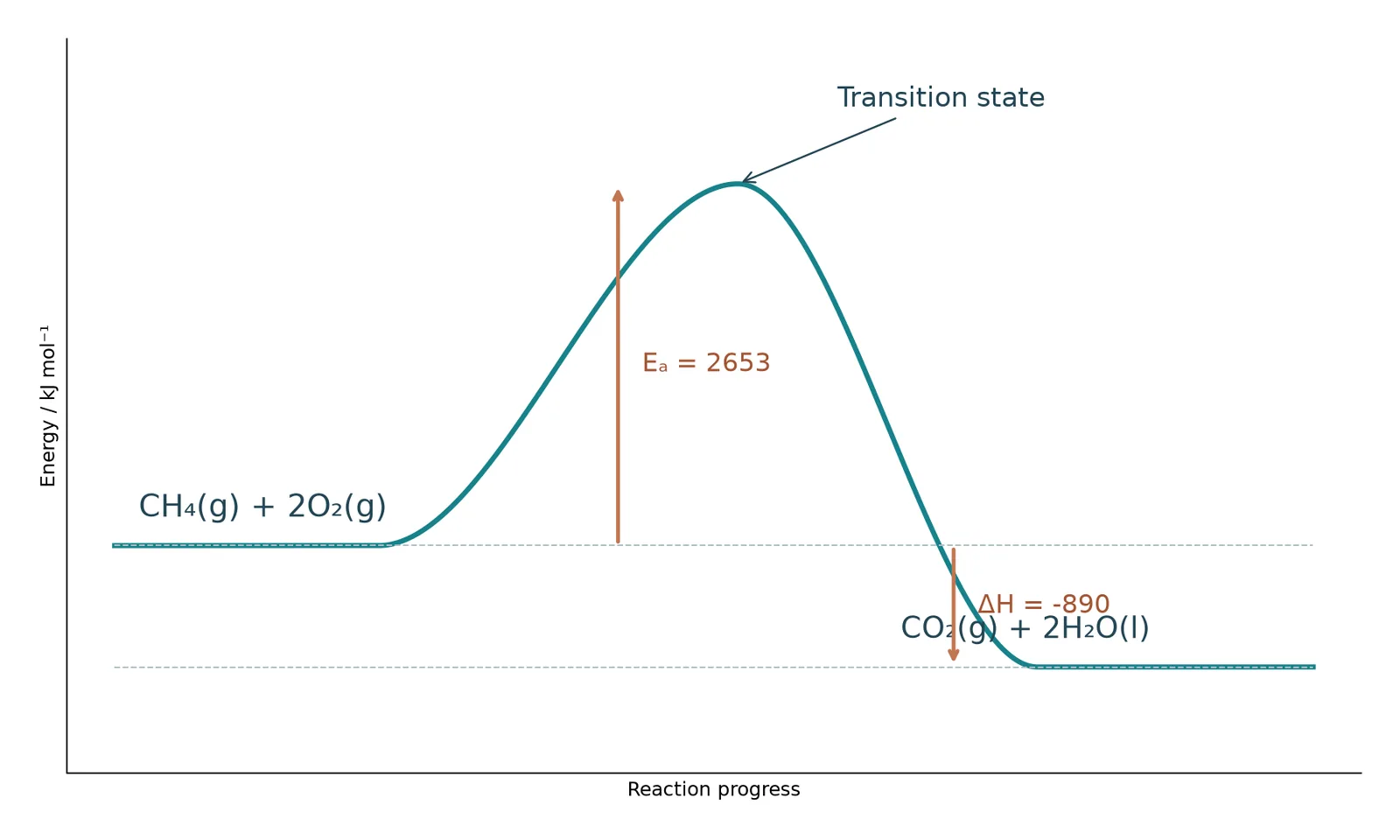
- ΔH is negative for exothermic and positive for endothermic reactions, shown on enthalpy level diagrams
Exothermic
- Heat is given out to the surroundings, so their temperature increases.
- Products have less energy than reactants, so ΔH is negative.
Endothermic
- Heat is taken in from the surroundings, so their temperature decreases.
- Products have more energy than reactants, so ΔH is positive.
Section 2 of 17Standard conditions and standard enthalpy changes

Standard conditions
- Standard conditions pressure 100 kPa, temperature 298 K (25 °C), and every substance in its normal physical state
Symbol
- Symbol the standard symbol θ is added to ΔH, sometimes written ΔH298
Standard enthalpy of combustion, ΔHc = the enthalpy change when one mole of a substance is completely burned in oxygen under standard conditions with everything in standard states
Combustion sign
- Combustion sign it is always negative because combustion is exothermic
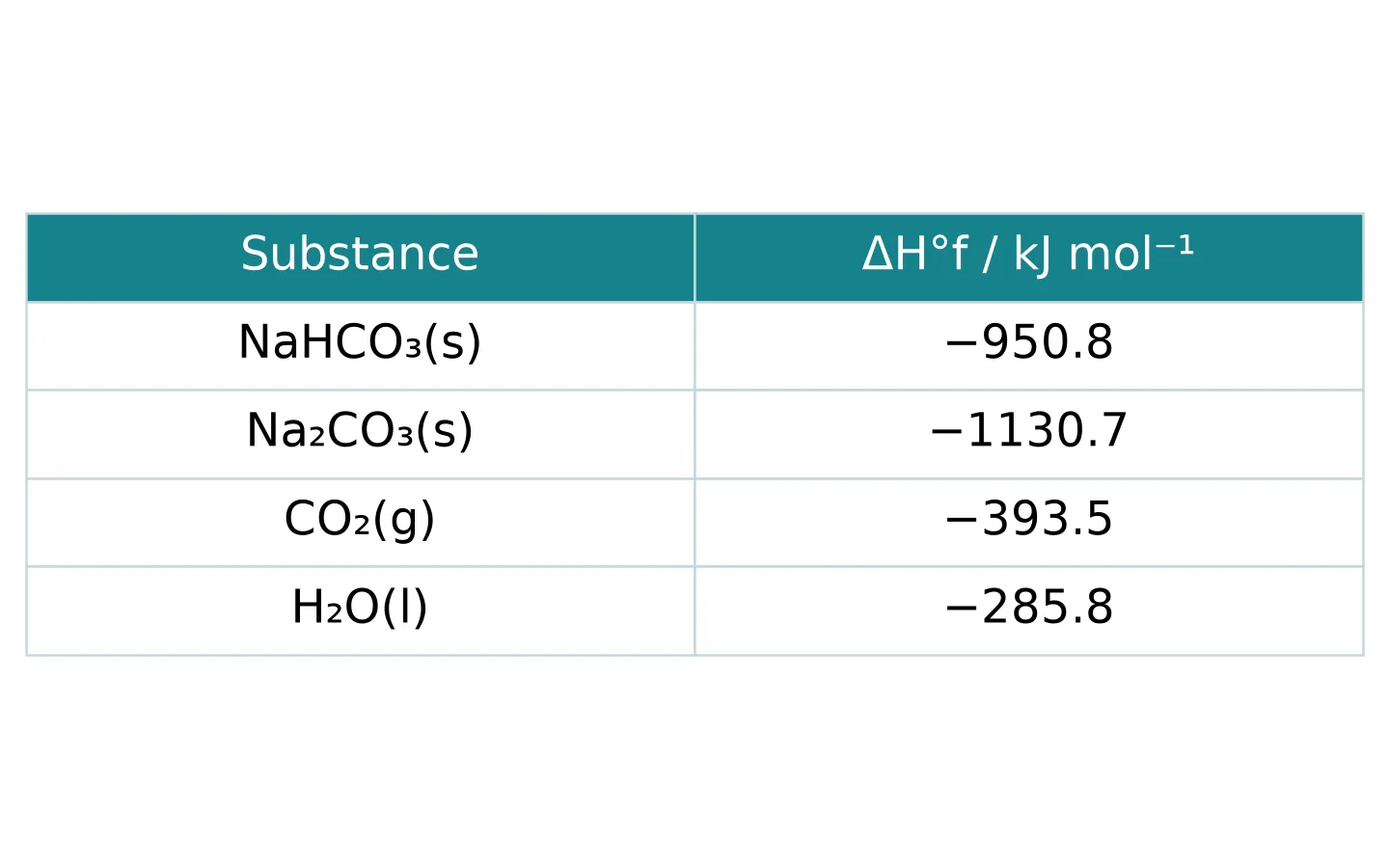
Standard enthalpy of formation, ΔHf = the enthalpy change when one mole of a substance is formed from its constituent elements under standard conditions with everything in standard states
Formation sign
- Formation sign it can be positive or negative, and it is 0 for elements
Section 3 of 17Calorimetry of fuels

- Method
- a fuel burned in a spirit burner heats water in a copper can, with a lid to prevent heat loss
1
Measure a fixed volume of water into a copper can.
2
Weigh the spirit burner with fuel.
3
Measure the initial water temperature.
4
Burn the fuel and stir the water.
5
Extinguish the flame when the temperature has risen by about 20 °C.
6
Record the final temperature and re-weigh the burner.
Calorimetry of fuels
Specific heat capacity, c
- Specific heat capacity, c the energy to raise 1 g of a substance by 1 °C, 4.18 J/g/°C for water
Energy released
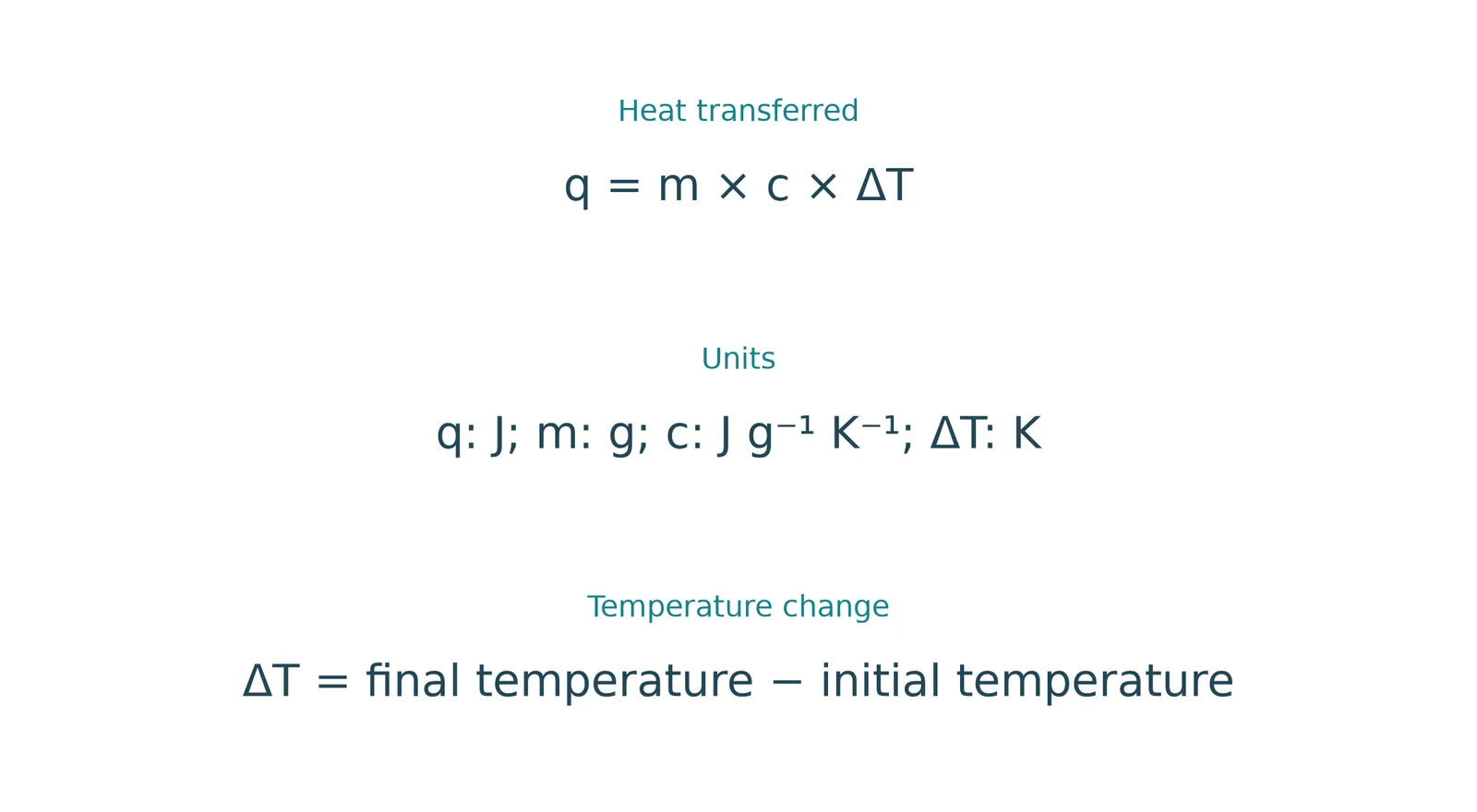
- Energy released q = m × c × ΔT, with q in J, m in g and ΔT in °CWhat the symbols mean: E, Q or q = energy transferred (J) · m = mass · c = specific heat capacity (J kg−1 °C−1; water 4.18 J g−1 °C−1) · ΔT or Δθ = temperature change (°C or K)
- (kg; g in chemistry calorimetry)
Per gram
- Per gram energy released per gram = q ÷ mass of fuel burned
Per mole
- ΔH = q ÷ nWhat the symbols mean: ΔH = enthalpy change (kJ mol−1) · q = heat energy measured · n = amount of the limiting reactant (mol); negative sign = exothermic
- (J, divide by 1000 for kJ)
Example
- 0.01 mol of propanol heats 250 g of water by 12 °C, so q = 12 540 J and ΔH = −1254 kJ mol-1
Section 4 of 17Calorimetry of reactions in solution
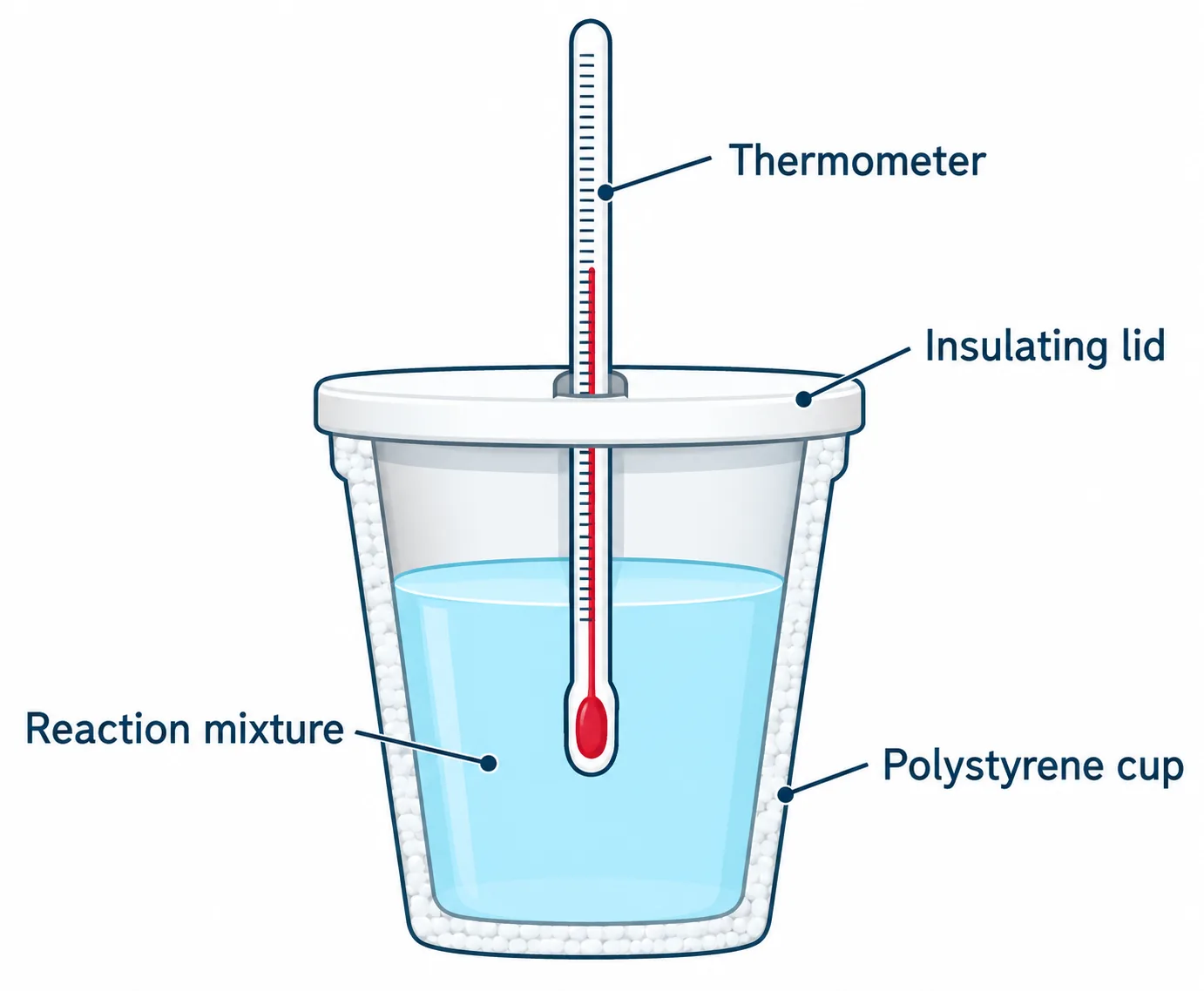
Use
- Use neutralisation and displacement reactions, from the temperature change when solutions are mixed
Insulation
- Insulation use an insulated container such as a polystyrene cup to prevent heat loss
Calorimetry of reactions in solution
Add a fixed volume of one reagent to the calorimeter and record its temperature.
Add an excess of the second reagent while stirring continuously.
Record the maximum temperature and calculate the rise.
Assumption
- Assumption the solution has the density of water, 1 g cm-3, so mass in g equals volume in cm3
Calculation
- Calculation q = m × c × ΔT, then ΔH = q ÷ n in kJ mol-1
Example
- 50 cm3 of 1.00 mol dm-3 HCl and 50 cm3 of NaOH raise the temperature by 12 K, so q = 5016 J, n = 0.05 mol and ΔH = −100.32 kJ mol-1
Temperature units
- Temperature units a change is the same in K and °C
Section 5 of 17Cooling curves
- Problem
- if a reaction is slow, the mixture loses heat before the maximum temperature is reached, so ΔH is inaccurate
1
Place one reactant in the polystyrene cup.
2
Record its temperature every minute for about 4 minutes.
3
Add the second reactant and keep recording every minute for about 6 minutes.
4
Plot temperature against time.
5
Extrapolate the cooling part of the line back to the time when the second reactant was added.
- Result
- the temperature change is taken at the time of mixing from the extrapolated line
Section 6 of 17Required Practical 2: aim and apparatus
Aim
- Aim to find the enthalpy change for converting anhydrous copper(II) sulfate to hydrated copper(II) sulfate, ΔH3
Why indirect
- ΔH3 cannot be measured directly, so it is calculated from ΔH1 and ΔH2 (hydrated to solution)
- (anhydrous to solution)
Apparatus
- Apparatus hydrated and anhydrous copper(II) sulfate, polystyrene cups with lids, 250 cm3 beaker to hold the cup, stand and clamp, thermometer, two 25 cm3 measuring cylinders, two weighing bottles, stopwatch, graph paper, stirrer, distilled water and a digital balance
Safety
- Safety avoid anhydrous copper(II) sulfate on skin, as it can irritate
Section 7 of 17Required Practical 2: method
Experiment 1: ΔH1
- Weigh 3.90–4.10 g of anhydrous copper(II) sulfate and record the mass.
- Measure 25 cm3 of deionised water into a polystyrene cup and record the temperature at t = 0.
- Record the temperature every minute for three minutes.
- At minute 4 add the powder rapidly and stir, without recording the temperature.
- Stir and record the temperature every minute from minute 5 to 15.
Experiment 2: ΔH2
- Weigh 6.20–6.30 g of hydrated copper(II) sulfate and record the mass.
- Use 24 cm3 of deionised water in a polystyrene cup and record the temperature at t = 0.
- Record every minute for three minutes, add the hydrated solid at minute 4 without recording, and record each minute from 5 to 15.
Table
- Table columns for experiment 1 and experiment 2, with minute 4 left blank because the solid is being added
Section 8 of 17Required Practical 2: analysis
1
Plot temperature on the y-axis against time on the x-axis for each experiment.
2
Draw two best-fit lines, one for the points before the solid was added and one after.
3
Extrapolate both lines to minute 4.
4
Read the temperature change at minute 4.
5
Use q = m × c × ΔT and ΔH = q ÷ n for ΔH1 and ΔH2.
6
Calculate ΔH3 = ΔH1 − ΔH2.
- Water mass
- 25 cm3 of water has a mass of 25 g because the density is 1 g cm-3
Section 9 of 17Required Practical 2: example calculation
Experiment 1
- 4.94 g of anhydrous CuSO4 (Mr 159.6) is 0.0310 mol and the temperature rises by 8.4 °C, so q = 25 × 4.2 × 8.4 = 882 J and ΔH1 = −28.45 kJ mol-1
Experiment 2
- 7.72 g of hydrated CuSO4 (Mr 249.6) is 0.0309 mol and the temperature falls by 1.7 °C, so q = 178.5 J and ΔH2 = +5.78 kJ mol-1
Result
- ΔH3 = −28.45 − (+5.78) = −34.2 kJ mol-1
Section 10 of 17Hess’s law
Hess’s law = the total enthalpy change of a reaction is independent of the route taken
Meaning
- Meaning a reaction in one step or several steps has the same total enthalpy change, so the direct route equals the indirect route
Use
- Use it finds enthalpy changes that cannot be measured by calorimetry,
- such as ΔHf of propane from 3C(s) + 4H2(g) → C3H8(g),
- since carbon and hydrogen do not react under standard conditions
Section 11 of 17Finding ΔH<sub>f</sub> from combustion data
- Why
- formation enthalpies are hard to measure, but combustion enthalpies can often be measured
1
Write the equation for the formation of the compound.
2
Write the combustion products beneath.
3
Draw downward arrows from each substance to its combustion products.
4
Write the ΔHc values on the arrows and multiply by the moles.
5
Go from reactants to products, changing the sign when an arrow is followed against its direction.
- Propanone example
- 3C + 3H2 + ½O2 → CH3COCH3 gives ΔHf = −1182 − 858 + 1821 = −219 kJ mol-1, reversing the −1821 value
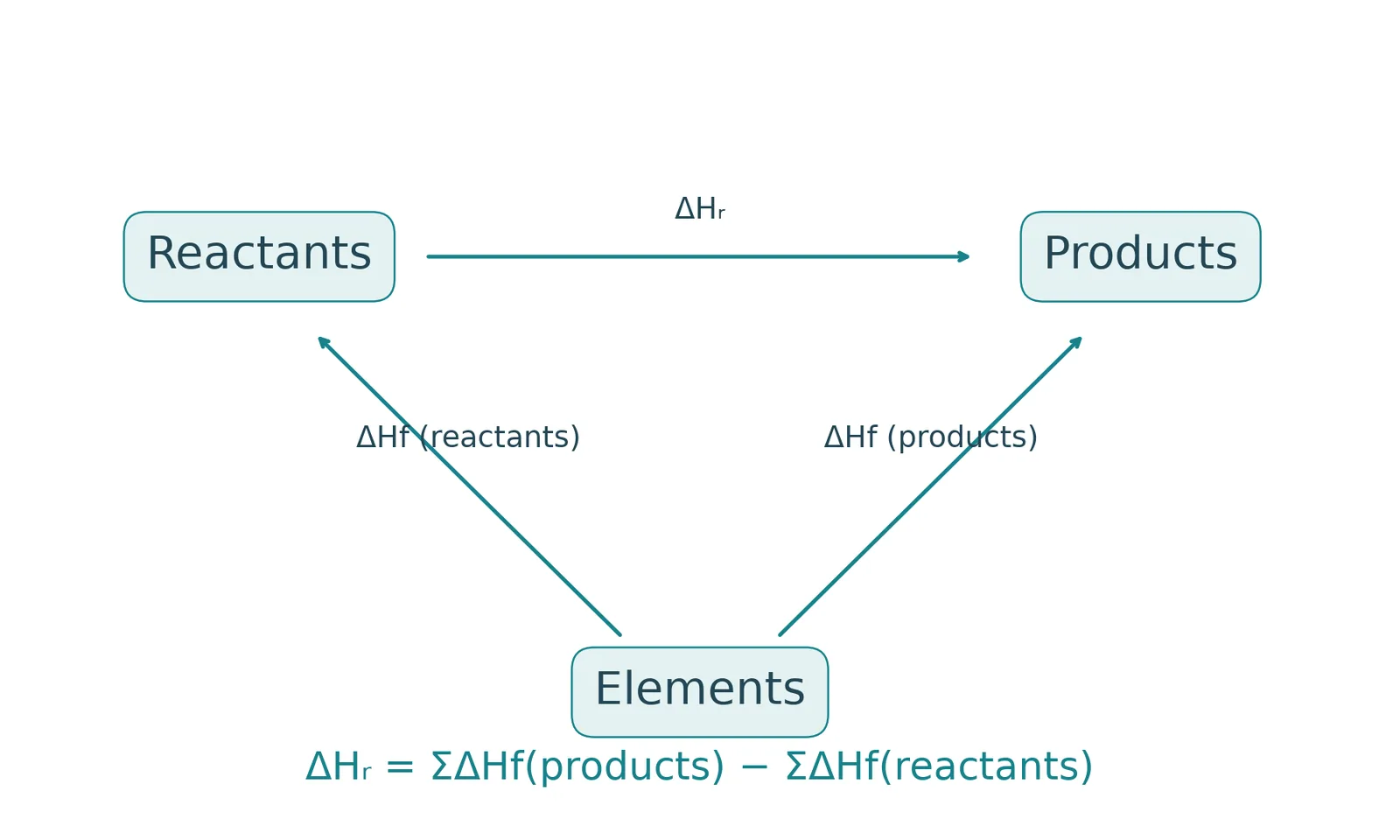
Section 12 of 17Finding ΔH<sub>r</sub> from formation data
1
Write the equation for the reaction.
2
Write the elements, with moles and state symbols, beneath.
3
Draw upward arrows to each compound.
4
Write the ΔHf values on the arrows and multiply by the moles.
5
Go from reactants to products, changing the sign when an arrow is followed against its direction.
Example
- NH4NO3(s) + ½C(s) → N2(g) + 2H2O(g) + ½CO2(g) gives ΔHr = +365 − 484 − 197 = −316 kJ mol-1
Elements
- Elements no arrows are needed for carbon and nitrogen because ΔHf of an element is zero
Section 13 of 17Bond enthalpy: bond breaking and making
Bond breaking
- Bond breaking it is endothermic because energy is needed to overcome the attractive forces between atoms
Bond making
- Bond making it is exothermic because energy is released to the surroundings
Overall
- Overall if more energy is needed to break bonds than is released making bonds, the reaction is endothermic, and the reverse is exothermic
Reality
- Reality only some bonds in the reactants are broken before new ones are formed
Section 14 of 17Bond dissociation and mean bond enthalpy
Bond dissociation enthalpy (bond enthalpy), E = the energy needed to break one mole of a specific covalent bond in the gas phase
Mean bond enthalpy
- Mean bond enthalpy an average over the same bond in different environments, because other atoms in the molecule affect it
Determination
- Determination bond enthalpies cannot be measured directly, so enthalpy cycles are used
Equal and opposite
- Equal and opposite the energy released when a bond forms equals the energy absorbed when it breaks,
- so O=O is +498 kJ mol-1 to break and −498 kJ mol-1 to form
Section 15 of 17Calculating ΔH from mean bond enthalpies
- Equation
- ΔHθ = enthalpy change for bonds broken − enthalpy change for bonds formed, using positive bond enthalpies
1
Write the balanced equation.
2
Set out a balance sheet of bonds broken and bonds formed.
3
Multiply each bond enthalpy by the number of bonds.
4
Total each side and subtract formed from broken.
1Haber process
- N≡N 945, H–H 436 and N–H 391 give 2253 broken and 2346 formed, so ΔH = −93 kJ mol-1
2Ethyne combustion
- Ethyne combustion for one mole of ethyne, C≡C 839, 2 × C–H 828 and 2½ × O=O 1245 give 2912 broken, and 2 × O–H 926 plus 4 × C=O 3216 give 4142 formed,
- so ΔH = −1230 kJ mol-1
3Sign
- Sign a negative result means the reaction is exothermic
4Difference from Hess
- Difference from Hess mean bond enthalpies give different results from Hess cycles, which use data from the actual compounds
Section 16 of 17Key terms
| Term | Meaning |
|---|---|
| Enthalpy change | The heat change at constant pressure, ΔH. |
| Standard enthalpy of combustion | The enthalpy change when one mole of a substance burns completely in oxygen under standard conditions. |
| Standard enthalpy of formation | The enthalpy change when one mole of a compound forms from its elements under standard conditions. |
| Specific heat capacity | The energy needed to raise 1 g of a substance by 1 °C. |
| Calorimetry | Measuring heat changes using the temperature change of a known mass of water. |
| Cooling curve | A graph of temperature against time used to correct for heat loss. |
| Term | Meaning |
|---|---|
| Hess’s law | The total enthalpy change is independent of the route taken. |
| Bond enthalpy | The energy to break one mole of a specific covalent bond in the gas phase. |
| Mean bond enthalpy | An average bond enthalpy over different environments. |
| Enthalpy cycle | A diagram linking reactants and products by alternative routes. |
| Balance sheet | A layout listing bonds broken and bonds formed for a calculation. |
Section 17 of 17Exam technique
1
Using the final temperature instead of the extrapolated value — heat loss makes ΔH too small.
2
Leaving out the lid or insulation — heat loss gives inaccurate values.
3
Giving ΔH for an exothermic reaction as positive — ΔH is negative when temperature rises.
4
Using the mass of the solid instead of the mass of water in q = mcΔT — use the water (or solution).
1
Using ΔHf = products minus reactants for combustion data — use reactants minus products for ΔHc.
2
Not reversing the sign when following an arrow backwards in a cycle — change the sign.
3
Using unmultiplied bond enthalpies — multiply by the number of each bond.
4
Counting the ethyne equation for two moles for ΔHc — ΔHc is per mole of fuel.