Lesson summary
Complete PDF with figures and original page layoutPage 1 Oxford AQA International Your notes A Level (IAL) Chemistry Transition Metals Contents General Properties of Transition Metals Substitution Reactions Shapes of Complex Ions Formation of Coloured I…
Section 1 of 45Definition of transition metals
1
Transition metal = an element with an incomplete d sub-shell, or one that can form at least one stable cation with an incomplete d sub-shell
2d-block
- d-block this definition excludes scandium and zinc, which are d-block but not transition elements
3Scandium
- Scandium it forms only Sc3+, [Ar] 3d0
4Zinc
- Zinc it forms only Zn2+, [Ar] 3d10
5First series
- First series titanium to copper
Section 2 of 45Electronic configurations of the first series

1Order
- Order electrons fill the lowest energy sub-shells first, and 4s fills before 3d because they overlap
2Shorthand
- [Ar] represents 1s to 3p, the argon core
| Element | Configuration |
|---|---|
| Ti | [Ar] 3d2 4s2 |
| V | [Ar] 3d3 4s2 |
| Cr | [Ar] 3d5 4s1 |
| Mn | [Ar] 3d5 4s2 |
| Fe | [Ar] 3d6 4s2 |
| Co | [Ar] 3d7 4s2 |
| Ni | [Ar] 3d8 4s2 |
| Cu | [Ar] 3d10 4s1 |
1
Exceptions
- Chromium is [Ar] 3d5 4s1, not 3d4 4s2.
- Copper is [Ar] 3d10 4s1, not 3d9 4s2.
- One 4s electron moves to 3d to give a half-full or full d sub-shell, which is more stable.
2Cations
- Cations remove the 4s electrons first, so Mn(III) (22 electrons) is 1s2 2s2 2p6 3s2 3p6 3d4
Section 3 of 45General properties of transition metals


1Four distinctive properties
- Four distinctive properties variable oxidation states, complex ion formation, coloured compounds and catalytic activity
2
Variable oxidation states
- They can form more than one positive ion, shown by Roman numerals.
- Sodium forms only Na+, but iron forms Fe2+ (Fe(II)) and Fe3+ (Fe(III)).
3
Coloured ions
- [Fe(H2O)6]2+ is green.
- [Fe(H2O)6]3+ is orange-brown.
4Catalytic activity
- Catalytic activity variable oxidation states let them gain and lose electrons during catalysis,
- and substances can also be adsorbed and activated on their surfaces
Section 4 of 45Complex ions and ligands
Complex ion = a central metal atom or ion surrounded by molecules or ions called ligands, such as aluminium(III) with six water ligands
Variety
- Variety different oxidation states allow different numbers and kinds of ligands, such as [Fe(NH3)6]3+, [Fe(OH)6]3- and [Fe(H2O)6]3+
Ligand = a molecule or ion that forms a co-ordinate bond with a metal by donating a pair of electrons, so it is a Lewis base and a nucleophile
Co-ordination number = the number of co-ordinate bonds to the central metal atom or ion
| Ligand | Formula |
|---|---|
| Water | H2O |
| Ammonia | NH3 |
| Chloride | Cl- |
| Cyanide | CN- |
| Hydroxide | OH- |
| Ethanedioate (ox) | C2O42- |
| 1,2-diaminoethane (en) | H2NCH2CH2NH2 |
Section 5 of 45Monodentate, bidentate and multidentate ligands

Monodentate
- Monodentate one dative bond per ligand
- Examples are H2O, NH3, Cl- and CN-.
- Tetrahedral [CuCl4]2- and square planar [Ni(CN)4]2- have co-ordination number 4.
- Octahedral [Fe(H2O)6]2+ and [Co(NH3)6]2+ have co-ordination number 6.
Bidentate
- Bidentate two dative bonds per ligand, from two atoms with lone pairs
- 1,2-diaminoethane (en) and the ethanedioate ion (ox).
Multidentate
- Multidentate more than two dative bonds
- EDTA4- is hexadentate and forms six dative bonds.
Section 6 of 45Ligand substitution: principles
Ligand exchange (substitution) = one ligand in a complex is replaced by another
Stability
- Stability the new complex is more stable than the original
Extent
- Extent substitution can be complete or incomplete
Possible changes
- Possible changes the charge, the co-ordination number and the shape of the complex
Section 7 of 45Complete substitution of cobalt(II) by ammonia

1Starting complex
- [Co(H2O)6]2+ is pink
2
With ammonia solution
- OH- from the ammonia first partly replaces water, giving a blue precipitate of Co(H2O)4(OH)2.
- Excess ammonia then replaces all the water: [Co(H2O)6]2+ + 6NH3 → [Co(NH3)6]2+ + 6H2O.
- The solution is pale yellow or straw-coloured (yellow-brown).
3No change
- NH3 and H2O are similar in size and uncharged, so the charge, octahedral shape and co-ordination number stay the same
4Excess concentrated ammonia
- Excess concentrated ammonia the solution turns brown because Co(II) is readily oxidised in air to [Co(NH3)6]3+
Section 8 of 45Incomplete substitution by hydroxide
Cobalt(II)
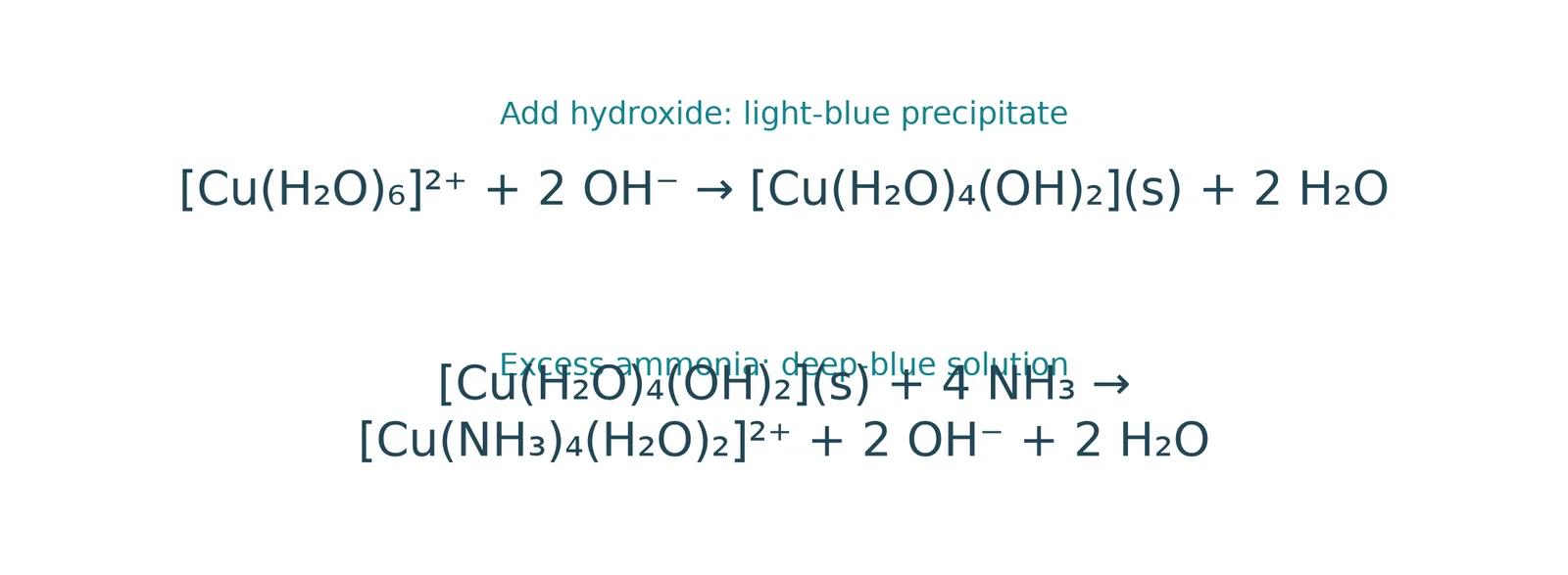
- Cobalt(II) dropwise ammonia or hydroxide gives a blue-green precipitate: [Co(H2O)6]2+ + 2OH- → Co(OH)2(H2O)4(s) + 2H2O
Copper(II)
- Copper(II) blue [Cu(H2O)6]2+ gives a blue precipitate: [Cu(H2O)6]2+ + 2OH- → Cu(OH)2(H2O)4(s) + 2H2O
Change
- Change the charge goes from +2 to 0 because two neutral water ligands are replaced by two negative hydroxides
No change
- No change the octahedral shape and co-ordination number stay the same
Further hydroxide
- Further hydroxide it causes no further change
Section 9 of 45Copper(II) with ammonia
1Precipitate first
- Precipitate first dropwise ammonia gives a blue precipitate, Cu(OH)2(H2O)4
2Excess ammonia
- Excess ammonia the precipitate dissolves to a deep blue solution: Cu(OH)2(H2O)4(s) + 4NH3(aq) → [Cu(NH3)4(H2O)2]2+(aq) + 2H2O(l) + 2OH-(aq)
3Partial substitution
- Partial substitution only four of six water ligands are replaced
4No change
- No change the charge, octahedral shape and co-ordination number stay the same
Section 10 of 45Substitution by chloride ions: general features
Substitution by chloride ions: general features
Size effect
- Size effect chloride is larger than water, so fewer ligands fit around the metal ion, changing the co-ordination number and shape
Charge
- Charge it changes because chloride is charged
Reagent
- Reagent concentrated hydrochloric acid
Equations
- [M(H2O)6]2+ + 4Cl- → [MCl4]2- + 6H2O, and [M(H2O)6]3+ + 4Cl- → [MCl4]- + 6H2O
Reversal
- Reversal adding water displaces the chloride ligands and restores the aqua complex
Section 11 of 45Chloride with cobalt(II), copper(II) and iron(III)
| Complex change | Colour change | Charge | Shape | Co-ordination number |
|---|---|---|---|---|
| [Co(H2O)6]2+ to [CoCl4]2- | Pink to blue | +2 to −2 | Octahedral to tetrahedral | 6 to 4 |
| [Cu(H2O)6]2+ to [CuCl4]2- | Blue to yellow | +2 to −2 | Octahedral to tetrahedral | 6 to 4 |
| [Fe(H2O)6]3+ to [FeCl4]- | Yellow to orange | +3 to −1 | Octahedral to tetrahedral | 6 to 4 |
Copper mixture
- Copper mixture the reaction is reversible, so some blue [Cu(H2O)6]2+ remains and the mixture looks green
Adding water
- Adding water pink [Co(H2O)6]2+, blue [Cu(H2O)6]2+ or yellow [Fe(H2O)6]3+ returns
Section 12 of 45The haem complex
The haem complex
Structure
- Structure a central iron(II) ion with a multidentate haem ligand in a square planar arrangement, with oxygen binding as a further ligand
Oxygen transport
- O2 is a poor ligand, bonding weakly to Fe(II), so it releases easily into cells
Carbon monoxide poisoning
- CO is a better ligand than oxygen and binds strongly and irreversibly to iron(II).
- Oxygen can no longer be carried to the cells.
- Carboxyhaemoglobin gives a darker red colour than oxyhaemoglobin, a sign of poisoning.
Section 13 of 45The chelate effect
Chelate effect = the replacement of monodentate ligands by bidentate or multidentate ligands, which is energetically favourable
Free energy
- ΔG is negative, with ΔG = ΔH − TΔS
Enthalpy
- Enthalpy changes are usually small for ligand exchange between aqueous ions
Entropy
- Entropy it increases strongly because the number of particles rises, and this is the driving force
EDTA example
- [Co(H2O)6]2+ + EDTA4- → [CoEDTA]2- + 6H2O has two reactants and seven product particles
Exam skill
- Exam skill explain it in terms of the balance between entropy and enthalpy
Section 14 of 45Linear, tetrahedral and square planar complexes
Shape
- Shape it depends on the size of the ligands and the number of co-ordinate bonds
Linear
- Linear co-ordination number 2, 180°
- Cu+ or Ag+ with two ammonia ligands.
- Ag+ with ammonia is Tollens’ reagent.
Tetrahedral
- Tetrahedral co-ordination number 4, 109.5°
- Typical of four chloride ligands, because large chloride ions allow only four.
Square planar
- Square planar co-ordination number 4, 90°
- Typical of cyanide ligands.
- Cisplatin is an example.
Section 15 of 45Octahedral complexes and drawing shapes
Octahedral
- Octahedral co-ordination number 6, with 90° and 180° angles
Ways to make six co-ordinate bonds
- Six small monodentate ligands such as water, ammonia, hydroxide or thiocyanate.
- Three bidentate ligands such as en or ethanedioate.
- One multidentate ligand such as EDTA4-.
| Geometry | Co-ordinate bonds | Bond angle | Example ligands |
|---|---|---|---|
| Linear | 2 | 180° | NH3 |
| Tetrahedral | 4 | 109.5° | Cl- |
| Square planar | 4 | 90° | CN- |
| Octahedral | 6 | 90° and 180° | H2O, NH3, OH-, ox, en, EDTA4- |
- Stereochemical drawings
- A solid line is a bond in the plane of the paper.
- A dotted (hatched) line goes behind the plane.
- A solid wedge comes out of the paper.
Section 16 of 45Geometrical (cis–trans) isomerism
Occurrence
- Occurrence it appears in square planar and octahedral complexes that have two pairs of different ligands, as a special case of E–Z isomerism
Cis
- Cis the two different ligands are adjacent
Trans
- Trans the two different ligands are opposite
Square planar example
- Square planar example cisplatin (Z) and transplatin (E)
- Cisplatin binds to DNA in cancer cells and treats cancer.
- Transplatin cannot be used in cancer treatment.
Octahedral examples
- [Cu(NH3)4(H2O)2]2+, where the two water ligands are adjacent in cis and opposite in trans.
- [Ni(en)2Cl2]2+, where the two chlorides are adjacent in cis and opposite in trans.
Section 17 of 45Optical isomerism
Occurrence
- Occurrence octahedral complexes with bidentate ligands can have optical isomers
Optical isomers
- Optical isomers non-superimposable mirror images with no plane of symmetry
Difference
- Difference they rotate the plane of polarised light in opposite directions
Examples
- [Ni(en)3]2+ and [Ni(en)2(H2O)2]2+
Section 18 of 45Colour in transition metal complexes
Occurrence
- Occurrence most transition element complexes are coloured, and the metal ion can often be identified by colour
Light absorbed
- Light absorbed a coloured solution absorbs some wavelengths from the visible region
Observed colour
- Observed colour it is the complementary colour, made of the wavelengths transmitted or reflected
Example
- Example copper(II) ions absorb red-orange light, so the solution appears blue-green (cyan)
Section 19 of 45Electron promotion and d-orbital splitting
Isolated ion
- Isolated ion in an ion with no ligands, all five 3d orbitals have equal energy (degenerate)
With ligands
- With ligands the 3d orbitals split into two non-degenerate sets, separated by an energy difference ΔE
Promotion
- Promotion light of the right frequency lifts an electron from a lower 3d orbital (ground state) to a higher 3d orbital (excited state)
Energy
- ΔE = hv, or ΔE = hc ÷ λ, where h is Planck’s constant (6.626 × 10⁻³⁴), v the frequency, c the speed of light and λ the wavelength
Colour
- Colour the frequencies not absorbed combine to give the complementary colour that is seen
Section 20 of 45Factors that change the colour
Ligand
- Ligand different ligands change ΔE
Ligand effect
- Ligands with greater charge density interact more strongly, causing greater splitting.
- More energy is then needed for promotion, so a different light colour is absorbed.
- [Cu(H2O)6]2+ is light blue, and [Cu(NH3)4(H2O)2]2+ is dark blue, with Cu(II) in both.
Co-ordination number
- Co-ordination number it changes the orientation of ligands relative to the d orbitals, and usually changes the ligand too
Oxidation state
- A higher oxidation state gives a higher effective nuclear charge and stronger interaction with ligands.
- [Mn(H2O)6]2+ absorbs green light and appears pink.
- [Fe(H2O)6]2+ absorbs red light and appears green, while [Fe(H2O)6]3+ absorbs higher-energy blue light and appears orange.
Exam skill
- Exam skill know the factors and give equations as examples of colour changes
Section 21 of 45Visible light spectroscopy
Purpose
- Purpose it uses absorption of visible light to find the concentration of coloured ion solutions
Colorimeter
- Colorimeter it passes light through the sample, using coloured filters and a detector to measure absorption
Filter choice
- Filter choice choose the filter complementary to the solution’s colour, such as a red filter for a blue solution, so absorption is greatest
Section 22 of 45Calibration curve
1
Prepare standard solutions of known concentration.
2
Measure the absorbance of each.
3
Plot absorbance against concentration to make a calibration curve.
4
Measure the absorbance of the unknown solution of the same complex ion.
5
Read across to the curve and down to the concentration.
- Beer–Lambert law
- at low concentrations absorbance is directly proportional to concentration, so the graph is a straight line
Section 23 of 45Why oxidation states vary
Ion formation
- Ion formation transition metals lose 4s electrons first, because electron repulsion raises the 4s above 3d once the orbitals are occupied
Common state
- +2, from the loss of the 4s electrons
| Element | Common oxidation states |
|---|---|
| Ti | +2, +3, +4 |
| V | +2, +3, +4, +5 |
| Cr | +2, +3, +6 |
| Mn | +2, +4, +6, +7 |
| Fe | +2, +3 |
| Co | +2, +3 |
| Ni | +2, +3, +4 |
| Cu | +1, +2 |
- Energy
- the first few ionisation energies are small and close together, so oxidation states can vary easily
Section 24 of 45Trends in oxidation state
Common states
- +2 and +3
Across the series
- +3 is more stable up to chromium and +2 is more stable for later elements
High oxidation states
- High oxidation states ions of +3 and above are polarising, with high charge density, giving bonds with covalent character
Maximum state
- Maximum state it equals the total number of 4s and 3d electrons and is greatest at manganese, as in the powerful oxidising agent MnO4-
Section 25 of 45Redox potential: effect of pH
Dependence
- Dependence the redox potential for a change to a lower oxidation state depends on pH and the ligand
Acid
- MnO4-(aq) + 8H+(aq) + 5e- ⇌ Mn2+(aq) + 4H2O(l), E = +1.51 V, which goes to completion in excess acid as Mn goes from +7 to +2
Neutral solution
- MnO4-(aq) + 2H2O(l) + 3e- ⇌ MnO2(s) + 4OH-(aq), E = +0.59 V, so reduction stops at +4
Conclusion
- Conclusion a change in pH changes E
Section 26 of 45Redox potential: effect of ligand
Example
- [Ni(H2O)6]2+(aq) + 2e- ⇌ Ni(s) + 6H2O(l) has E = −0.26 V, and [Ni(NH3)6]2+(aq) + 2e- ⇌ Ni(s) + 6NH3(aq) has E = −0.49 V
Reason
- Reason ammonia is a stronger ligand than water and binds Ni(II) better, so the equilibrium lies slightly more to the left, giving a more negative E
Section 27 of 45Oxidation states of vanadium
| Oxidation state | Ion | Name | Colour |
|---|---|---|---|
| +2 | V2+ | Vanadium(II) | Violet |
| +3 | V3+ | Vanadium(III) | Green |
| +4 | VO2+ | Oxovanadium(IV) | Blue |
| +5 | VO2+ | Dioxovanadium(V) | Yellow |
Vanadate
- Vanadate vanadium(V) also exists as VO3- in ammonium vanadate, NH4VO3, a reasonably strong oxidising agent
Preparation
- Preparation adding acid to solid ammonium vanadate gives a yellow solution containing VO2+
Section 28 of 45Reduction of vanadium with zinc
Principle
- Principle zinc in acid reduces vanadium(V) successively, with colour changes yellow → blue → green → violet
Mnemonic
- "You Better Get Vanadium"
- (yellow, blue, green, violet)
+5 to +4 (yellow to blue)
- Zn2+(aq) + 2e- → Zn(s) is reversed, and VO2+ + 2H+ + e- → VO2+ + H2O is doubled.
- Overall2VO2+ + 4H+ + Zn → 2VO2+ + Zn2+ + 2H2O.
+4 to +3 (blue to green)
- VO2+ + 2H+ + e- → V3+ + H2O.
- Overall2VO2+ + 4H+ + Zn → 2V3+ + Zn2+ + 2H2O.
+3 to +2 (green to violet)
- V3+ + e- → V2+.
- Overall2V3+ + Zn → 2V2+ + Zn2+.
Method
- Method reverse the zinc half-equation, double the vanadium half-equation to match electrons, then add
Section 29 of 45Predicting the final oxidation state with E values
- Rule
- a reaction is feasible if Ecell is positive, so the reducing agent’s half-equation must be more negative than the vanadium half-equation
| Half-equation | E / V |
|---|---|
| V3+ + e- ⇌ V2+ | -0.26 |
| Sn2+ + 2e- ⇌ Sn | -0.14 |
| VO2+ + 2H+ + e- ⇌ V3+ + H2O | +0.34 |
| S4O62- + 2e- ⇌ 2S2O32- | +0.47 |
| VO2+ + 2H+ + e- ⇌ VO2+ + H2O | +1.00 |
Tin
- Ecell is +1.14 V for +5 to +4, +0.48 V for +4 to +3 and −0.12 V for +3 to +2, so the final state is +3
Thiosulfate
- Ecell is +0.53 V for +5 to +4, −0.13 V for +4 to +3, so the final state is +4
Section 30 of 45Tollens’ reagent
Composition
- Composition the diamminesilver(I) complex, [Ag(NH3)2]+
Stability
- Stability it is unstable, so it is prepared when needed
Tollens’ reagent
Add sodium hydroxide to silver nitrate solution.
Add concentrated ammonia solution.
A brown precipitate forms briefly and redissolves to a colourless solution.
Tollens’ reagent
Use
- Use it distinguishes aldehydes from ketones and detects reducing sugars such as glucose
Test
- Warm a few drops of the aldehyde with Tollens’ reagent in a water bath.
- Aldehydes are reducing agents and reduce Ag+ to silver, giving a silver mirror on the tube.
- Ketones do not react.
Equation
- [Ag(NH3)2]+ + e- → Ag(s) + 2NH3(aq)
Both functional groups
- Both functional groups aldehydes and ketones contain C=O, but in aldehydes it is at the end of the chain
Section 31 of 45Redox titrations: principles
Purpose
- Purpose to find the concentration of ions that change oxidation state
Specified titrations
- Specified titrations ethanedioate (oxalate) with permanganate in acid, and iron(II) with permanganate in acid
Exam scope
- Exam scope similar titrations, such as with dichromate(VI), may be set
Manganate(VII)
- Manganate(VII) it is the oxidising agent, reduced to Mn2+, so the mixture must be acidified with excess acid first
Section 32 of 45Choice of acid
Dilute sulfuric acid
- Dilute sulfuric acid it is used because it does not oxidise under these conditions and does not react with manganate(VII)
Unsuitable acids
- Hydrochloric acid can be oxidised to chlorine by manganate(VII).
- Nitric acid is an oxidising agent and may oxidise the analyte.
- Ethanoic acid is weak, so [H+] may be insufficient.
- Concentrated sulfuric acid may oxidise the analyte.
Section 33 of 45Indicator and end point
Self-indicating
- Self-indicating potassium manganate(VII) is purple and is added from the burette
During titration
- During titration it reacts with the analyte to give Mn2+, which is so dilute that the solution looks colourless
End point
- End point the first permanent pale pink colour in the flask, caused by a slight excess of MnO4- that remains on swirling
Section 34 of 45Manganate(VII) with ethanedioate
Oxidation
- C2O42-(aq) → 2CO2(g) + 2e-, with carbon rising from +3 to +4
Reduction
- MnO4-(aq) + 8H+(aq) + 5e- → Mn2+(aq) + 4H2O(l), with manganese falling from +7 to +2
Manganate(VII) with ethanedioate
Multiply the oxidation half-equation by 5.
Multiply the reduction half-equation by 2.
Add them and cancel the 10 electrons.
Overall
- 5C2O42-(aq) + 2MnO4-(aq) + 16H+(aq) → 2Mn2+(aq) + 8H2O(l) + 10CO2(g)
Autocatalysis
- Autocatalysis the Mn2+ product catalyses the reaction,
- so the reaction speeds up as more forms,
- because transition metal ions can change oxidation state
Section 35 of 45Manganate(VII) with iron(II)
Method
- Method a known volume of Fe2+ solution is titrated with a known concentration of MnO4-
Observation
- Observation the purple MnO4- loses its colour as it reacts
End point
- End point all Fe2+ has reacted and the first trace of permanent pink appears, from a slight excess of MnO4-
Oxidation
- Fe2+(aq) → Fe3+(aq) + e-.
- Iron goes from +2 to +3.
Reduction
- MnO4-(aq) + 8H+(aq) + 5e- → Mn2+(aq) + 4H2O(l).
- Manganese goes from +7 to +2.
Combining
- Combining multiply the oxidation half-equation by 5 to match the electrons
Overall
- 5Fe2+(aq) + MnO4-(aq) + 8H+(aq) → Mn2+(aq) + 4H2O(l) + 5Fe3+(aq)
Section 36 of 45Redox titration calculations
1
Write the half-equations for the oxidant and the reductant.
2
Deduce the overall equation.
3
Calculate the moles of manganate(VII) or dichromate(VI) used.
4
Use the equation to find the ratio of oxidant to reductant.
5
Calculate the moles of reductant in the sample solution.
6
Calculate the moles in the original solution.
- Iron tablet example
- 28.50 cm3 of 0.0180 mol dm-3 MnO4- is 5.13 × 10⁻⁴ mol, the ratio 1 : 5 gives 2.565 × 10⁻³ mol Fe2+,
- which is 0.143 g,
- so 14.9% of a 0.960 g tablet is iron
Section 37 of 45Transition metal catalysts: overview
Transition metal catalysts: overview
Importance
- Importance catalysts let industrial reactions be faster and at lower temperature
Reason
- Reason transition metals and their compounds form ions with more than one stable oxidation state, and have vacant d orbitals
Types
- Types heterogeneous and homogeneous (same phase)
- (different phase from the reactants)
Section 38 of 45Heterogeneous catalysts
Mechanism
- Mechanism the reaction occurs at active sites on the catalyst’s surface
Examples
- Examples solid vanadium(V) oxide in the Contact process, and solid iron in the Haber process
Reducing cost
- Precious metal catalysts are expensive.
- Increase the surface area.
- Coat an inert support, such as a honeycomb matrix, with a thin layer of catalyst.
Catalytic converters
- Catalytic converters they reduce exhaust pollution using finely divided platinum and rhodium on a ceramic base
Section 39 of 45The Contact process catalyst
1Step 1
- S(s) + O2(g) → SO2(g)
2Step 2
- Step 2 the equilibrium 2SO2(g) + O2(g) ⇌ 2SO3(g) is catalysed by V2O5
3
Mechanism using variable oxidation state
- SO2 + V2O5 → V2O4 + SO3, reducing the catalyst.
- O2 + 2V2O4 → 2V2O5, regenerating it.
4Catalyst behaviour
- Catalyst behaviour it is not used up, it speeds up the reaction and it provides an alternative pathway
Section 40 of 45Haber process and adsorption
1Reaction
- N2(g) + 3H2(g) ⇌ 2NH3(g) with iron pellets to give a large surface area
2Adsorption
- Adsorption the iron surface attracts electrons in nitrogen and hydrogen, which form temporary loose attachments to the surface
3Sites
- Sites heterogeneous catalysis takes place at active sites on the catalyst surface
Section 41 of 45Limitations of heterogeneous catalysts
Poisoning
- Poisoning tiny amounts of impurities lodge on the surface and bind to active sites, preventing further catalysis
Lead
- Lead lead additives were removed from petrol because they would poison catalytic converters, and for environmental reasons
Loss of catalyst
- Loss of catalyst the thin coating on the ceramic is gradually lost, reducing efficiency
Temperature
- Temperature converters work poorly when cold, needing about 15 minutes of running, so short journeys do little to reduce pollution
Section 42 of 45Homogeneous catalysts
Homogeneous catalysts
Principle
- Principle transition metal ions readily change oxidation state, so they can act as both oxidising and reducing agents and catalyse redox reactions
Iron
- Fe2+ → Fe3+ + e- (reducing agent), and Fe3+ + e- → Fe2+
- (oxidising agent)
Iodide and peroxodisulfate
- S2O82- + 2I- → I2 + 2SO42-
- It is energetically favourable but slow, because two negative ions repel and rarely collide.
- Fe2+ reduces S2O82-: S2O82- + 2Fe2+ → 2SO42- + 2Fe3+.
- Fe3+ oxidises iodide: 2I- + 2Fe3+ → I2 + 2Fe2+.
- Fe2+ is regenerated, speeding up the reaction by an alternative pathway.
Section 43 of 45Autocatalysis
Autocatalysis = a reaction that speeds up as a catalytic product forms
Graph
- Graph concentration against time becomes steeper as the rate rises, unlike normal reactions where the rate falls
Example
- MnO4- with ethanedioate, 5C2O42- + 2MnO4- + 16H+ → 2Mn2+ + 8H2O + 10CO2
Mechanism
- Mn2+ is absent at the start and forms during the reaction.
- 4Mn2+ + MnO4- + 8H+ → 5Mn3+ + 4H2O.
- 2Mn3+ + C2O42- → 2CO2 + 2Mn2+, regenerating the catalyst.
Monitoring
- Monitoring a colorimeter follows the fall in purple colour, and the rate of colour change increases with time
Section 44 of 45Key terms
| Term | Meaning |
|---|---|
| Transition metal | An element with an incomplete d sub-shell, or that forms an ion with one. |
| Complex ion | A central metal ion bonded to ligands by co-ordinate bonds. |
| Ligand | A molecule or ion that donates a lone pair to a metal ion. |
| Co-ordination number | The number of co-ordinate bonds to the central metal ion. |
| Ligand exchange | The replacement of one ligand by another. |
| Bidentate ligand | A ligand that forms two co-ordinate bonds. |
| Term | Meaning |
|---|---|
| Chelate effect | The favourable replacement of monodentate ligands by bidentate or multidentate ligands. |
| Haem complex | The iron(II) complex with a multidentate ligand in haemoglobin. |
| Cis–trans isomerism | Isomerism where identical ligands are adjacent (cis) or opposite (trans). |
| Optical isomers | Non-superimposable mirror images of a complex. |
| Square planar | A 4-co-ordinate shape with 90° angles in one plane. |
| Octahedral | A 6-co-ordinate shape with 90° and 180° angles. |
| Term | Meaning |
|---|---|
| Complementary colour | The colour made by the wavelengths of light that are not absorbed. |
| Degenerate orbitals | Orbitals of equal energy. |
| Electron promotion | The movement of an electron to a higher energy orbital on absorbing light. |
| Calibration curve | A graph of absorbance against concentration for standard solutions. |
| Beer–Lambert law | Absorbance is proportional to concentration at low concentration. |
| Redox potential | The tendency of a species to be reduced, measured in volts. |
| Term | Meaning |
|---|---|
| Tollens’ reagent | An ammoniacal silver(I) complex used to distinguish aldehydes from ketones. |
| Self-indicating | A titration in which a reactant changes colour at the end point. |
| Autocatalysis | Catalysis of a reaction by one of its products. |
| End point | The point at which a permanent colour change shows the reaction is complete. |
| Oxovanadium(IV) | VO2+, the blue vanadium(IV) ion. |
| Term | Meaning |
|---|---|
| Heterogeneous catalyst | A catalyst in a different phase from the reactants. |
| Homogeneous catalyst | A catalyst in the same phase as the reactants. |
| Adsorption | The temporary attachment of molecules to a surface. |
| Catalyst poisoning | Blocking of active sites by impurities. |
| Autocatalysis | Catalysis by a product of the reaction. |
| Active site | A position on a catalyst surface where reaction occurs. |
Section 45 of 45Exam technique
1
Giving [Cu(H2O)6]2+ a charge change on complete NH3 substitution — NH3 and H2O are both neutral, so the charge stays the same.
2
Calling scandium and zinc transition metals — they do not form ions with incomplete d sub-shells.
3
Removing 3d electrons first when forming cations — remove 4s first.
4
Saying ligands accept electron pairs — they donate pairs.
1
Saying chloride complexes are octahedral — [MCl4] complexes are tetrahedral.
2
Saying carbon monoxide binds weakly to haemoglobin — it binds strongly and irreversibly.
3
Saying the chelate effect is driven by enthalpy — it is driven by the increase in entropy.
4
Saying transplatin is used for cancer — cisplatin is.
1
Saying the observed colour is the colour absorbed — it is the complementary colour.
2
Saying the 3d orbitals are non-degenerate in an isolated ion — they are degenerate until ligands bond.
3
Choosing a filter of the same colour as the solution — choose the complementary colour.
4
Saying Cu(II) complexes have the same colour because the oxidation state is the same — the ligand changes the colour.
1
Using hydrochloric acid to acidify a manganate(VII) titration — it is oxidised by manganate(VII).
2
Giving the end point as colourless — it is the first permanent pale pink.
3
Saying vanadium(V) is blue — it is yellow, and +4 is blue.
4
Forgetting to balance electrons before combining half-equations — match the electrons first.
1
Using the same moles of Fe2+ as MnO4- — the ratio is 5 : 1.
2
Calling iron in the Haber process homogeneous — it is a solid, so heterogeneous.
3
Saying poisoned catalysts are used up — impurities block active sites.
4
Saying autocatalysis slows as products form — the rate rises.