2.6Inorganic Chemistry
Reactions of Ions in Aqueous Solution
5 min read 14 parts Lesson 25 of 27
Lesson summary
Complete PDF with figures and original page layoutPage 1 Oxford AQA International Your notes A Level (IAL) Chemistry Reactions of Ions in Aqueous Solution Contents Reactions of Ions in Aqueous Solution Reactions of Metal-Aqua Ions Identifying Transition Me…
Section 1 of 14Metal-aqua ions

Formation
- Formation soluble transition metal salts dissolve to give metal-aqua complex ions, with water ligands bonded by oxygen lone pairs
Copper(II) sulfate
- CuSO4(s) + aq → [Cu(H2O)6]2+(aq) + SO42-(aq).
- The hexaaqua copper(II) ion makes the solution blue.
| Ion | Colour of solution |
|---|---|
| [Cu(H2O)6]2+ | Blue |
| [Fe(H2O)6]2+ | Green |
| [Fe(H2O)6]3+ | Yellow-orange |
| [Al(H2O)6]3+ | Colourless |
- Structure
- all have six water ligands and a 2+ or 3+ charge
Section 2 of 14Acidity of metal-aqua ions
- Observation
- solutions of metal salts are not neutral, and the 3+ ions are more acidic than 2+ ions
| 0.1 mol dm-3 solution | pH |
|---|---|
| Iron(III) chloride | 2.0 |
| Aluminium chloride | 3.0 |
| Copper(II) nitrate | 4.0 |
- Explanation
- 3+ ions are smaller than 2+ ions, so they have a higher charge density.
- They attract the lone pair of a water ligand more strongly, polarising it.
- The O–H bonds weaken and dissociate, releasing H+ and leaving a hydroxide ligand.
Section 3 of 14Deprotonation reactions
1Equation
- [Fe(H2O)6]3+(aq) → [Fe(H2O)5(OH)]2+(aq) + H+(aq)
2With water
- [Fe(H2O)6]3+ + H2O → [Fe(H2O)5(OH)]2+ + H3O+
3Charge
- Charge the remaining OH- cancels one charge of the 3+ ion
4Steps
- Steps a second deprotonation gives [Fe(H2O)4(OH)2]+, and the third needs a base, giving red-brown Fe(H2O)3(OH)3(s)
5Name
- Name splitting water molecules can be called hydrolysis
Section 4 of 14Hexaaqua iron(II) with bases
Hexaaqua iron(II) with bases
With hydroxide
- Two deprotonation steps give Fe(H2O)4(OH)2(s), a dark green precipitate.
- The green precipitate slowly turns orange-brown as it is oxidised to hydrated iron(III) hydroxide.
- Excess hydroxide causes no further reaction.
With ammonia
- [Fe(H2O)6]2+ + 2NH3 → Fe(H2O)4(OH)2(s) + 2NH4+.
- Ammonia acts as a base and removes protons, giving the same dark green precipitate that oxidises to orange-brown.
- Excess ammonia causes no further reaction.
With carbonate
- [Fe(H2O)6]2+ + CO32- → FeCO3(s) + 6H2O.
- A green precipitate of iron(II) carbonate forms.
Section 5 of 14Hexaaqua copper(II) with bases
Hexaaqua copper(II) with bases
With hydroxide
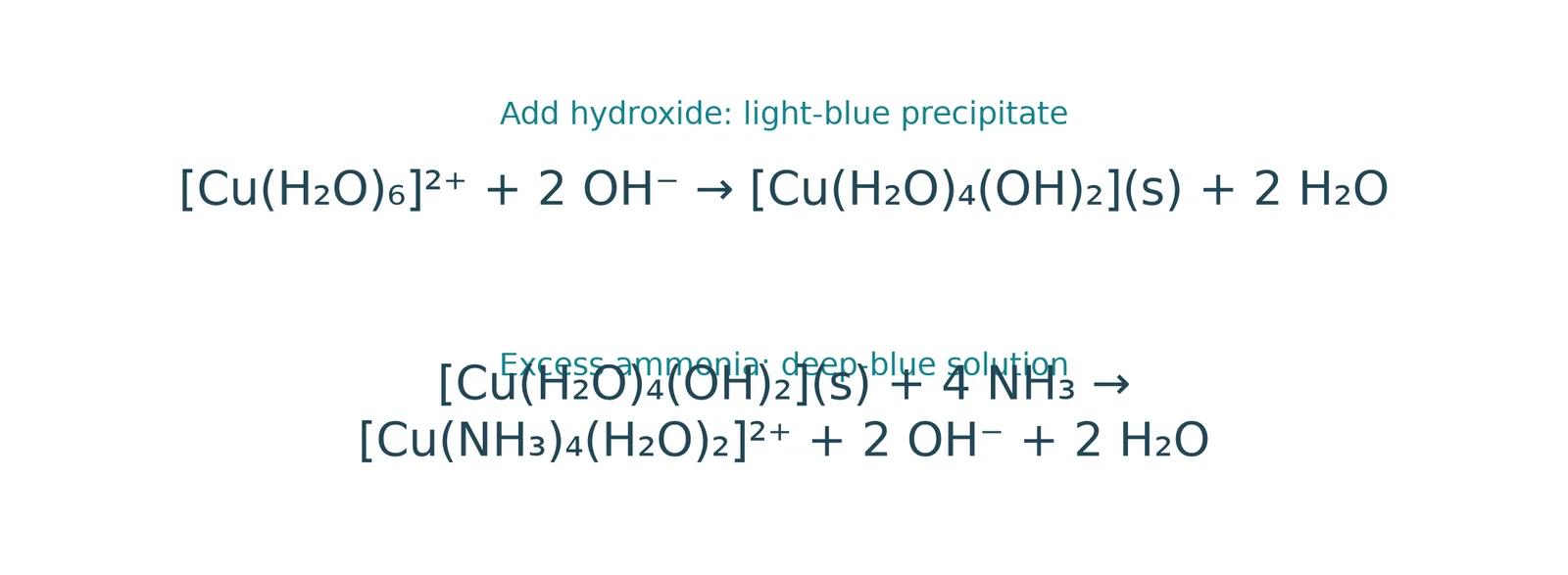
- Two deprotonation steps give a blue precipitate of Cu(H2O)4(OH)2.
- Excess hydroxide causes no further reaction.
With ammonia
- Dropwise ammonia first acts as a base: [Cu(H2O)6]2+ + 2NH3 → Cu(H2O)4(OH)2(s) + 2NH4+.
- Excess ammonia partly substitutes water, as ammonia is a stronger ligand: Cu(H2O)4(OH)2(s) + 4NH3 → [Cu(NH3)4(H2O)2]2+ + 2OH- + 2H2O.
- The precipitate dissolves to a deep blue solution.
With carbonate
- [Cu(H2O)6]2+ + CO32- → CuCO3(s) + 6H2O.
- A green precipitate of copper(II) carbonate forms.
Section 6 of 14Hexaaqua iron(III) with bases
With hydroxide
- Three deprotonation steps give Fe(H2O)3(OH)3(s), a red-brown precipitate.
- Excess hydroxide causes no further reaction.
With ammonia
- [Fe(H2O)6]3+ + 3NH3 → Fe(H2O)3(OH)3(s) + 3NH4+.
- The same red-brown precipitate forms, and excess ammonia causes no further change.
With carbonate
- With carbonate neutralisation of acidic hexaaqua 3+ ions
- The acid equilibrium [Fe(H2O)6]3+ + 3H2O ⇌ Fe(H2O)3(OH)3(s) + 3H3O+ exists.
- H3O+ reacts with carbonate: 2H3O+ + CO32- → CO2 + 3H2O.
- Removing H3O+ shifts the equilibrium right, so the hydroxide precipitates.
- Overall2[Fe(H2O)6]3+ + 3CO32- → 2Fe(H2O)3(OH)3(s) + 3CO2 + 3H2O.
Section 7 of 14Hexaaqua aluminium with bases
Hexaaqua aluminium with bases
With hydroxide
- Three deprotonation steps give a white precipitate of Al(H2O)3(OH)3.
- Excess hydroxide redissolves it by further deprotonation, via [Al(H2O)2(OH)4]- and [Al(H2O)(OH)5]2- to [Al(OH)6]3-, a colourless solution.
With ammonia
- [Al(H2O)6]3+ + 3NH3 → Al(H2O)3(OH)3(s) + 3NH4+.
- A white precipitate forms and excess ammonia does not dissolve it.
With carbonate
- It follows the same acid-equilibrium route as iron(III), forming white Al(H2O)3(OH)3(s) and carbon dioxide.
Section 8 of 14Amphoteric hydroxides
Amphoteric = reacting with both acids and bases
Aluminium hydroxide
- Aluminium hydroxide it is insoluble in water but dissolves in both dilute acid and excess strong base
With acid
- Al(OH)3(H2O)3(s) + 3HCl(aq) → [Al(H2O)6]3+(aq) + 3Cl-(aq)
With base
- Al(OH)3(H2O)3(s) + NaOH(aq) → Na[Al(OH)4](aq) + 3H2O(l), giving sodium tetrahydroxoaluminate
Conditions
- Conditions a strong base is needed, usually hot concentrated NaOH
Equivalent forms
- Al(OH)3(H2O)3 + OH- → [Al(OH)4]- + 3H2O, or Al(OH)3 + OH- → [Al(OH)4]-
Section 9 of 14Required Practical 9: aim and apparatus
Aim
- Aim to identify transition metal ions in aqueous solution by test-tube reactions
Apparatus
- Apparatus solutions Q, R and S, 1.0 mol dm-3 sodium hydroxide, 1.0 mol dm-3 sodium carbonate, 0.05 mol dm-3 silver nitrate, 12 test tubes with rack, 7 dropping pipettes, 250 cm3 beaker, hot water and deionised water
Section 10 of 14Required Practical 9: methods
1
Test 1 part a
- Note the initial colour of solution Q.
- Put 10 drops of Q in a test tube and add NaOH dropwise with gentle shaking until in excess.
- Keep the tube for part b and record observations.
- Repeat with R and S.
2
Test 1 part b
- Half fill a 250 cm3 beaker with freshly boiled water.
- Stand the three tubes in it for about 10 minutes and record observations.
3
Test 2
- Put 10 drops of sodium carbonate in a test tube and add 10 drops of Q.
- Shake gently and record observations.
- Repeat with R and S.
4
Test 3
- Put about 10 drops of Q in a tube and add about 10 drops of silver nitrate.
- Shake gently, repeat with R and S, and let the tubes stand for about 10 minutes.
- Record observations.
Section 11 of 14Required Practical 9: practical tips and results
Tips
- Use clean tubes and pipettes, because the tests are sensitive to contamination.
- Label the tubes, especially in the water bath.
- Use a white background to see colour changes clearly.
Results
- Results record the observations for Q, R and S in tests 1a , 2 (sodium carbonate) and 3 (silver nitrate)
- (initial colour, NaOH, water bath)
Evaluation
- Evaluation use all three tests together to identify the ions
Section 12 of 14Required Practical 9: interpreting results
| Test | Q | R | S |
|---|---|---|---|
| Initial colour | Yellow | Light blue | Pale green |
| NaOH | Orange-brown precipitate | Blue precipitate | Grey-green precipitate |
| Excess NaOH | No change | No change | No change |
| Na2CO3 | Orange-brown precipitate and effervescence | Blue-green precipitate | Grey-green precipitate |
| AgNO3 | No change | White precipitate | No change |
Q
Q yellow solution, orange-brown precipitate unchanged in excess, and effervescence with carbonate give Fe3+, with no halide,
- so the anion cannot be determined (iron(III) nitrate)
R
R light blue solution, blue precipitate unchanged in excess and blue-green carbonate precipitate give Cu2+,
- and the white precipitate with silver nitrate shows chloride (copper(II) chloride)
S
S pale green solution, grey-green precipitate unchanged in excess and a grey-green carbonate precipitate give Fe2+, with no halide,
- so the anion cannot be determined
Section 13 of 14Key terms
| Term | Meaning |
|---|---|
| Metal-aqua ion | A metal ion surrounded by water ligands. |
| Deprotonation | The loss of H+ from a ligand. |
| Charge density | The charge of an ion relative to its size. |
| Amphoteric hydroxide | A hydroxide that dissolves in both acids and excess alkali. |
| Hydrolysis | Splitting of a water molecule, here releasing H+. |
| Term | Meaning |
|---|---|
| Amphoteric | Able to react with both acids and bases. |
| Tetrahydroxoaluminate | The [Al(OH)4]- ion. |
| Precipitate | An insoluble solid formed in a solution. |
| Effervescence | Fizzing caused by gas release. |
| Excess | More reagent than is needed for complete reaction. |
Section 14 of 14Exam technique
1
Saying 2+ and 3+ ions are equally acidic — the 3+ ions are more acidic because of higher charge density.
2
Saying iron(III) carbonate precipitates — the hydroxide precipitates and CO2 is released.
3
Saying aluminium hydroxide stays in excess ammonia — it does not dissolve in excess ammonia, but does in excess hydroxide.
4
Forgetting that green iron(II) hydroxide oxidises in air — it turns orange-brown.
1
Saying iron(III) forms a carbonate precipitate — it forms the hydroxide with CO2.
2
Saying aluminium hydroxide is insoluble in excess NaOH — it redissolves.
3
Saying Cu(OH)2 dissolves in excess NaOH — it dissolves only in excess ammonia.
4
Using dirty glassware — contamination gives wrong observations.
Chemistry 0620 & Edexcel OL
Product Prediction Rules
Aqueous Electrolysis Rules (Inert Electrodes)
- At Cathode (-): Least reactive cation discharged. If metal is more reactive than hydrogen (Na+, K+, Mg2+), H2 gas is produced:
2H+ + 2e- → H2. If Cu2+ or Ag+, the metal coats the cathode. - At Anode (+): If concentrated halide present (Cl-, Br-, I-), halogen is formed (e.g.
2Cl- → Cl2 + 2e-). If sulfate (SO42-) or nitrate (NO3-), O2 gas is discharged:4OH- → O2 + 2H2O + 4e-.