3.4Organic Chemistry
Alkenes
10 min read 20 parts Lesson 14 of 55
Lesson summary
Complete PDF with figures and original page layoutPage 1 Oxford AQA International Your notes A Level (IAL) Chemistry Alkenes Contents Structure, Bonding & Reactivity Addition Reactions of Alkenes Addition Polymers Epoxyethane Pag…
Section 1 of 20Bonding in alkenes


1
Alkenes
- Alkenes unsaturated hydrocarbons with a C=C double bond and general formula CnH2n
2
Carbon
- 1s22s22p2, sharing four electrons in four covalent bonds
3
Bond types
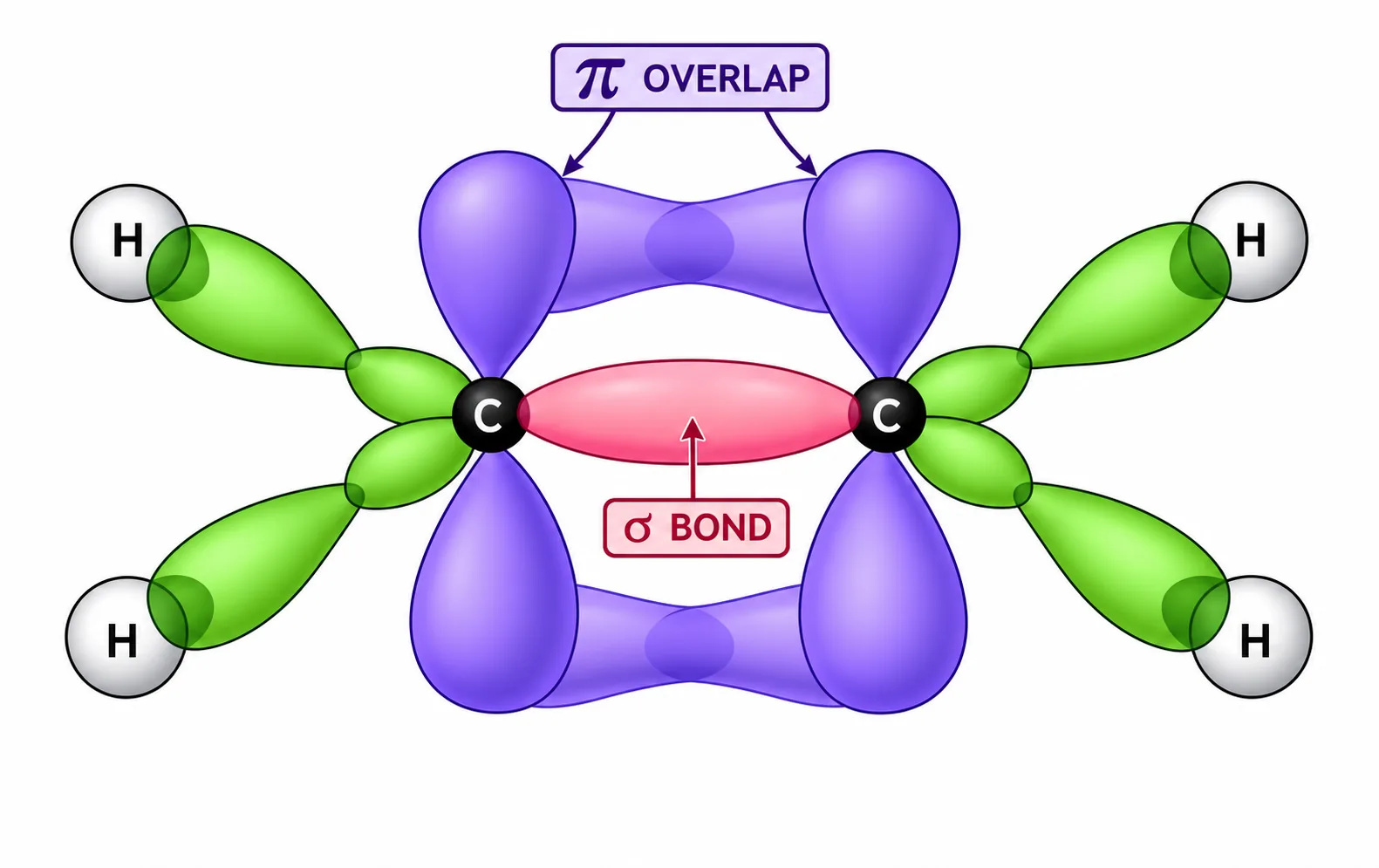
- Bond types sigma (σ) bonds and pi (π) bonds from orbital overlap
4
Pi bond
- Pi bond when carbon uses three electron pairs for σ bonds, its spare p-orbital electron overlaps sideways with the other carbon’s p orbital, with the two lobes above and below the plane of the atoms
5
Ethene
- Ethene each carbon forms two σ bonds to hydrogen and one σ bond to the other carbon, so C=C is one σ and one π bond
6
Shape
- Shape ethene is planar with 120° bond angles
7
Reactivity
- Reactivity the double bond is an area of high electron density
Section 2 of 20Electrophilic addition
Reactivity
- Reactivity alkenes are much more reactive than alkanes, and the C=C attracts electrophiles
Electrophilic addition = the addition of an electrophile to a double bond, in which C=C breaks and a new single bond forms from each carbon
Electrophile
- Electrophile a species that accepts a pair of electrons
Section 3 of 20Reaction with HBr
- Polarity
- in HBr, bromine pulls the electrons, so Br is δ- and H is δ+
1
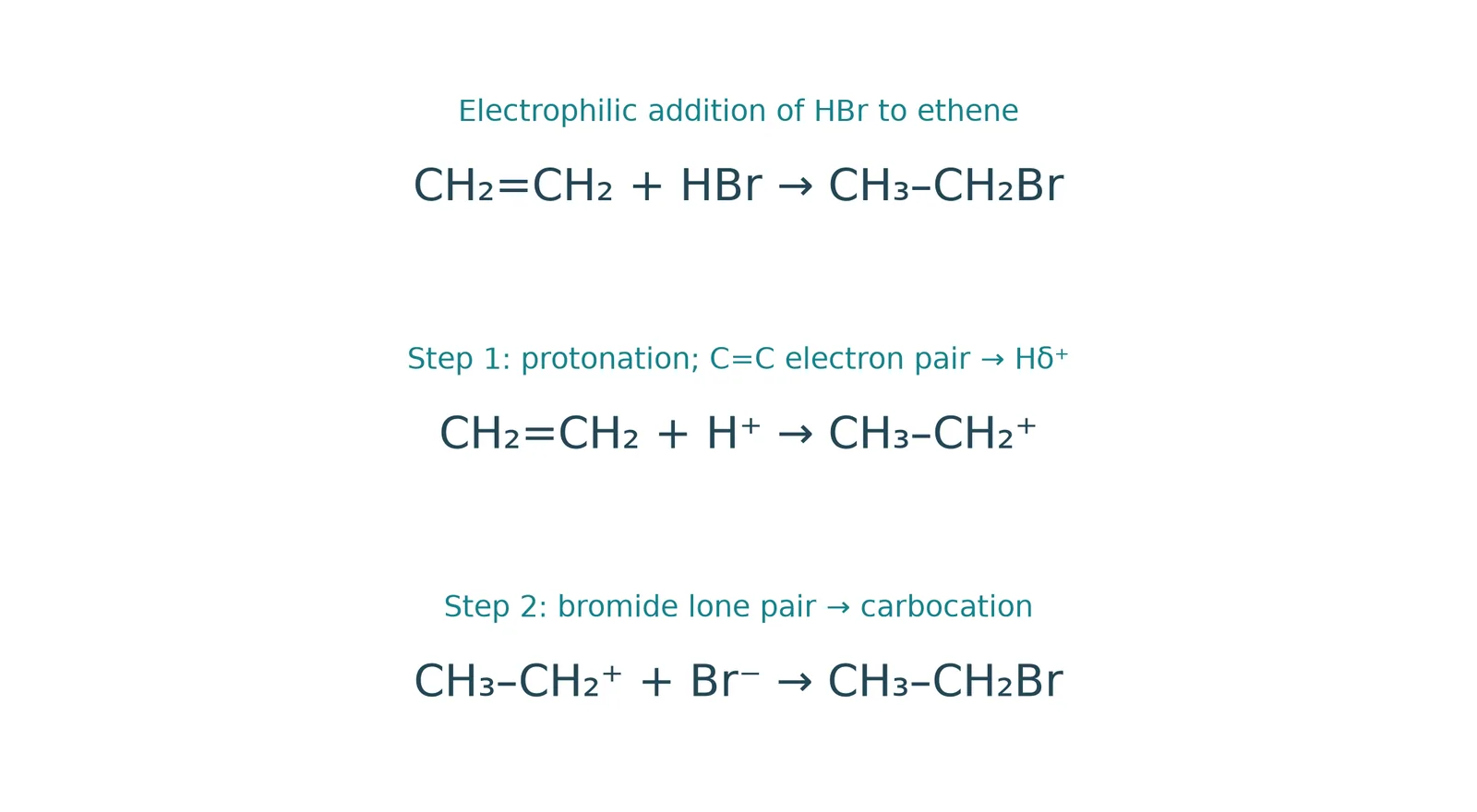
The δ+ hydrogen is the electrophile and accepts a pair of electrons from the C=C.
2
The H–Br bond breaks heterolytically, forming Br-.
3
A reactive carbocation intermediate forms.
4
Br- (the nucleophile) bonds to the carbocation.
- Product
- ethene and HBr give bromoethane
Section 4 of 20Reaction with sulfuric acid

1Electrophile
- Electrophile the δ+ hydrogen of concentrated sulfuric acid
2Steps
- H+ adds to the C=C, the H–O bond breaks heterolytically to HSO4-, and the carbocation reacts with HSO4-
3Hydration
- Hydration the product reacts with water to form an alcohol and regenerate the acid,
- so water adds across the double bond with sulfuric acid as a catalyst
Section 5 of 20Reaction with bromine and the test for unsaturation

- Polarisation of Br2
- Br2 is non-polar, but the electron density of C=C repels the Br–Br electron pair.
- The nearer Br atom becomes δ+ and acts as the electrophile, and the further atom becomes δ-.
1
The nearer Br accepts a pair of electrons from the C=C.
2
The Br–Br bond breaks heterolytically, forming Br-.
3
A carbocation forms.
4
Br- attacks it, giving 1,2-dibromoethane.
- Test for C=C
- Shake the compound with bromine water, which is orange-brown.
- An unsaturated compound causes decolourisation.
- Do not call bromine water red, which is rejected in mark schemes.
Section 6 of 20Carbocations and the inductive effect

1Carbocation
- Carbocation a reaction intermediate with a positive carbon having only three bonds, classed as primary, secondary or tertiary
2Inductive effect
- Inductive effect alkyl groups are electron donating and push electrons towards the positive carbon, which spreads the charge and stabilises the ion
3Stability
- Stability tertiary > secondary (two) > primary (one)
- (three alkyl groups)
4Carbocations as electrophiles
- Carbocations as electrophiles their positive charge makes them electrophiles
Section 7 of 20Markovnikov’s rule
Markovnikov’s rule
Rule for HX
- Rule for HX the halogen bonds to the most substituted carbon
Rule for a halogen
- Rule for a halogen each halogen atom bonds to one of the C=C carbons
Rule for an interhalogen such as Br–Cl
- Rule for an interhalogen such as Br–Cl the more electronegative halogen bonds to the most substituted carbon
Scope
- Scope it applies to unsymmetrical alkenes such as propene and but-1-ene
Major and minor
- Markovnikov addition gives the major product and anti-Markovnikov addition gives the minor product
Section 8 of 20Propene with HBr

Two ways the electrophile can attach
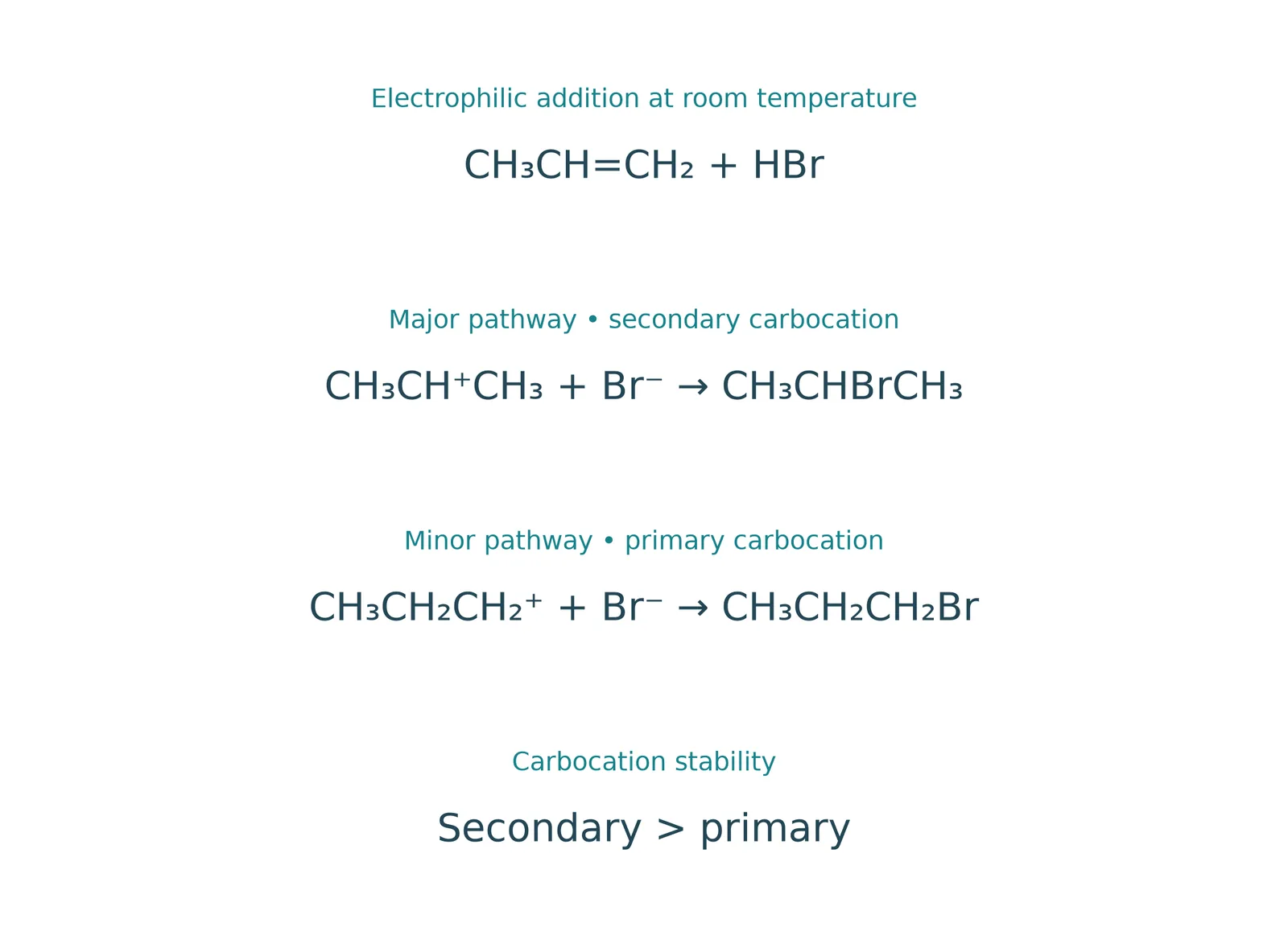
- H adds to the less substituted carbon, giving the more stable secondary carbocation and the major product, 2-bromopropane.
- H adds to the more substituted carbon, giving the less stable primary carbocation and the minor product, 1-bromopropane.
Product choice
- Product choice the more stable carbocation gives the major product
Exam point
- Exam point when more than one carbocation can form, the major product comes from the most stable one
Section 9 of 20Addition polymerisation (start)


1Definition
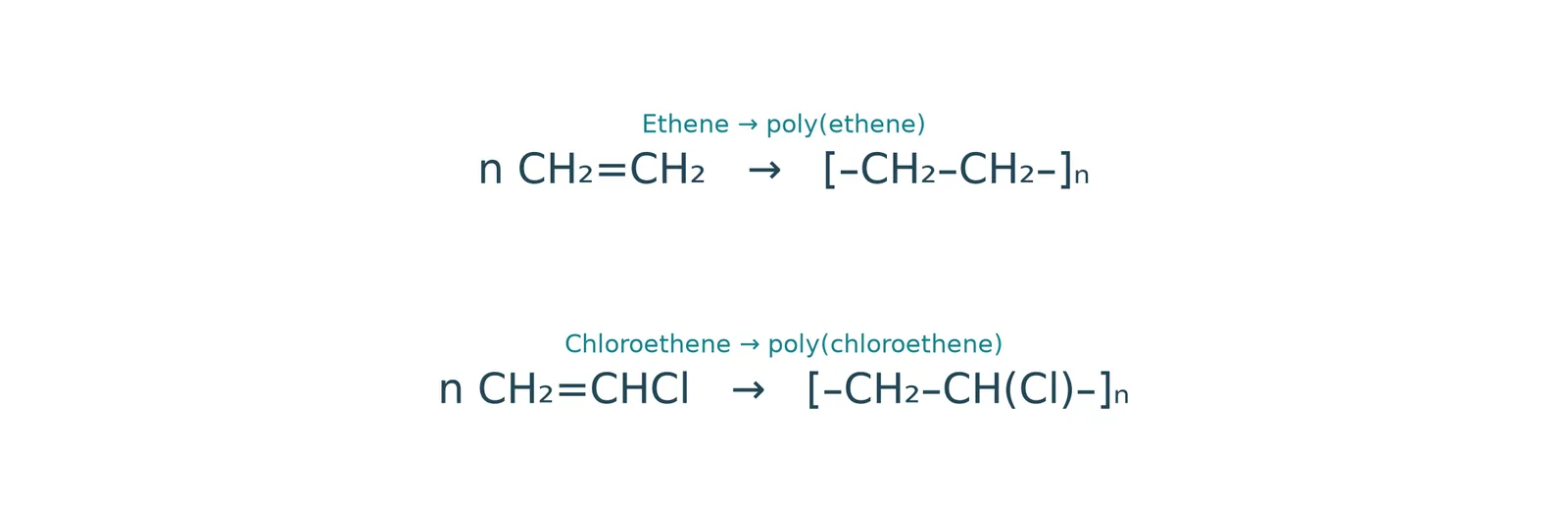
- Definition many monomers containing at least one C=C form long polymer chains as the only product
2Process
- Process the double bond in each monomer opens and the monomers join
3Naming
- Naming poly- followed by the monomer name in brackets, so ethene gives poly(ethene) and chloroethene gives poly(chloroethene)
4Representation
- Representation polymerisation can be shown with general or displayed formulae
5
Repeating unit
- It is the smallest group of atoms that repeats along the chain.
- It is shown in square brackets.
- It is the same as the monomer except that C=C becomes C–C.
Section 10 of 20Deducing monomers from polymer sections
Rule
- Rule a repeating unit has only two carbons in the main chain, and the monomer is that unit with C–C changed back to C=C
Examples
- Ethenol CH(OH)=CH2 gives a repeating unit –CH(OH)–CH2– and the polymer poly(ethenol).
- A unit with a COOH side group on one carbon comes from prop-2-enoic acid.
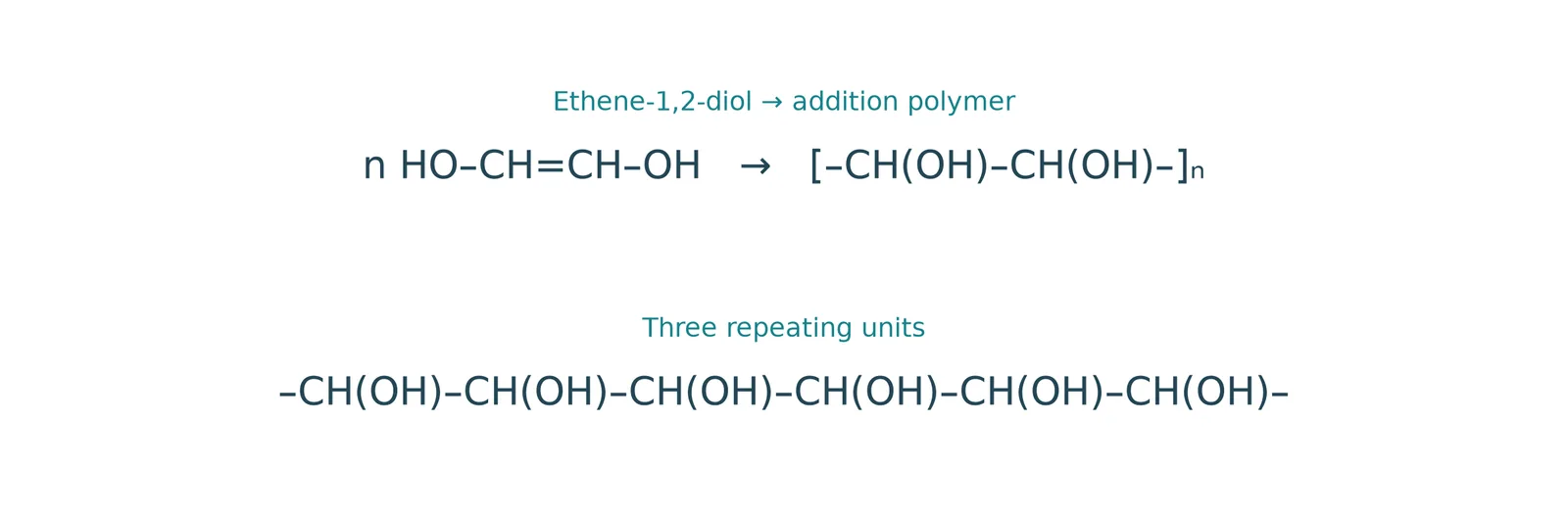
- A unit with an OH on each carbon, –CH(OH)–CH(OH)–, comes from ethene-1,2-diol and gives poly(ethene-1,2-diol).
Exam skills
- Draw the repeat unit from a monomer.
- Draw the repeat unit from a polymer section.
- Draw the monomer from a polymer section.
Section 11 of 20Properties of poly(alkenes)
Saturated
- Saturated addition polymers have only single bonds
Unreactive
- C–H and C–C bonds are non-polar, so they are unreactive and do not biodegrade
Strength
- Strength chains are held by weak van der Waals forces, but there are thousands of them, so the polymer is strong
Conditions control properties
- Low density poly(ethene) forms at high temperature and pressure and is flexible, used in plastic bags.
- High density poly(ethene) forms at lower temperature and pressure with a catalyst and is more rigid, used in bottles.
Section 12 of 20Poly(chloroethene) (PVC)
1Monomer
- Monomer chloroethene (vinyl chloride)
2Properties
- PVC is relatively hard and rigid
3Reason
- Reason chlorine is more electronegative than carbon, giving permanent dipoles that keep the chains closely packed
4Uses
- Uses drainpipes and window frames
Section 13 of 20Plasticisers
Plasticiser
- Plasticiser an additive that makes a polymer more flexible
Action
- Action it keeps chains apart, weakening the van der Waals forces between them
Result
- Result the chains slide over each other more easily
Section 14 of 20Production of epoxyethane
Epoxyethane, C2H4O
- Epoxyethane, C2H4O an important industrial chemical with a three-membered ring
Manufacture
- Manufacture partial oxidation of ethene with a silver catalyst
Why it is very reactive and hazardous
- Bond angles are about 60° instead of 109.5°.
- This causes repulsion between bonding pairs, known as ring strain.
- The ring opens easily to become more stable.
Section 15 of 20Epoxyethane with water
Reaction
- Reaction it forms ethane-1,2-diol, used as antifreeze
Mechanism
- The oxygen in the ring is protonated.
- OH- (from water) attacks the positive carbon, opening the ring.
Further reactions form oligomers of different chain lengths
- n = 1: ethane-1,2-diol, antifreeze.
- n = 2: diethylene glycol, for polyurethanes and polyesters.
- n = 3: triethylene glycol, for plasticisers.
- n = 4 or more: polyethylene glycol (PEG), for detergents, paints and cosmetics.
Section 16 of 20Epoxyethane with alcohols
Reaction
- Reaction an alcohol ROH opens the ring to give an alcohol product, RO–CH2CH2–OH, which still has an OH group
Excess alcohol
- Excess alcohol the reaction continues and forms longer chains
Uses
- Uses solvents, plasticisers, surfactants and detergents
Exam skill
- Exam skill draw the mechanism for each reaction
Section 17 of 20Antifreeze: economic and environmental importance
Economic
- Economic ethane-1,2-diol is the main component of car coolant antifreeze
Mechanism of protection
- Mechanism of protection it disrupts hydrogen bonding in water, lowering the freezing point and preventing ice from cracking the engine block
Environmental
- Environmental it is toxic if swallowed, so spills must be cleaned up and old antifreeze disposed of carefully to protect water supplies and wildlife
Section 18 of 20Surfactants and detergents
Surfactants and detergents
Economic
- Economic longer-chain products of epoxyethane with alcohols make surfactants, the active ingredient of soaps and detergents
Structure
- Structure a hydrophilic ("water-loving") head and hydrophobic ("water-hating") tail break down grease and oil
Environmental
- Environmental modern detergents are designed to be biodegradable so they do not persist or cause foaming in rivers
Section 19 of 20Key terms
| Term | Meaning |
|---|---|
| Electrophile | A species that accepts a pair of electrons. |
| Electrophilic addition | Addition of an electrophile across a C=C bond. |
| Carbocation | An ion with a positively charged carbon bonded to only three groups. |
| Inductive effect | Electron donation by alkyl groups that stabilises a carbocation. |
| Markovnikov’s rule | The halogen of HX bonds to the more substituted carbon. |
| Pi bond | A bond formed by sideways overlap of p orbitals. |
| Term | Meaning |
|---|---|
| Repeat unit | The smallest group of atoms that repeats along a polymer chain. |
| Plasticiser | An additive that makes a polymer more flexible by separating chains. |
| Ring strain | Instability from bond angles being much smaller than normal. |
| Surfactant | A molecule with a hydrophilic head and hydrophobic tail. |
| Antifreeze | Ethane-1,2-diol, added to coolant to lower its freezing point. |
Section 20 of 20Exam technique
1
Calling bromine water red — it is orange or orange-brown.
2
Putting the bromine on the less substituted carbon for HBr — it goes on the more substituted carbon.
3
Saying Br2 is polar — it is non-polar but polarised near C=C.
4
Ordering carbocation stability primary > tertiary — tertiary is the most stable.
1
Saying the repeat unit has a double bond — it has C–C.
2
Saying poly(alkenes) are unreactive because of polar bonds — the bonds are non-polar.
3
Saying epoxyethane is stable — ring strain makes it very reactive.
4
Saying PVC is rigid because of hydrogen bonding — it is due to permanent dipoles.