Section 1 of 9Metals and non-metals
Metals and non-metals
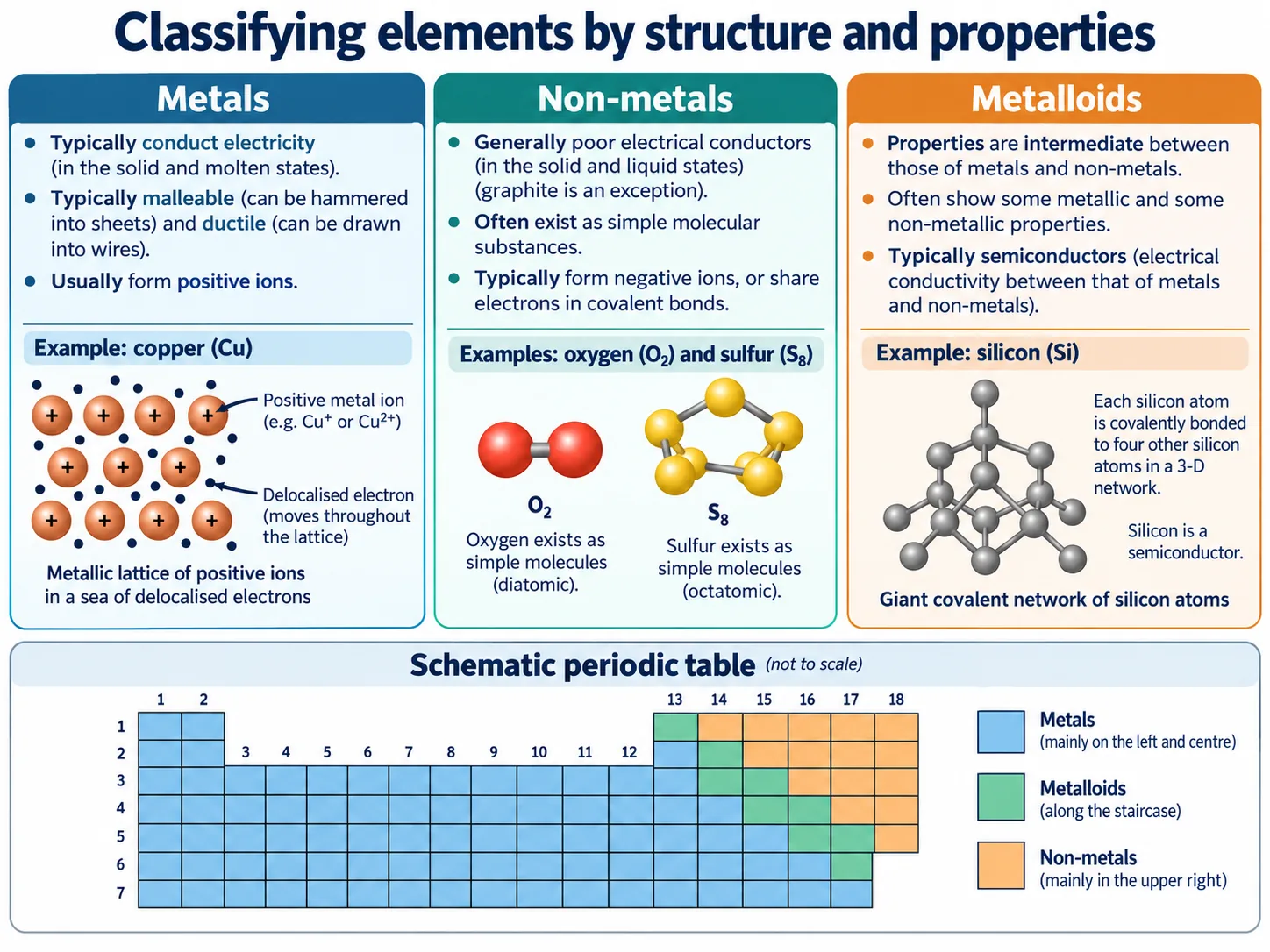
Most elements are metals, and a small number (metalloids or semimetals) show properties of both types.
Metals are on the left and centre of the Periodic Table, and metallic character decreases from left to right across a period.
| Property | Metals | Non-metals |
|---|---|---|
| Melting and boiling points | Usually high | Usually low |
| Electrical conductivity | Good conductors | Poor conductors (except graphite) |
| Thermal conductivity | Good | Poor |
| Malleability and ductility | Malleable and ductile | Brittle when solid |
| Appearance | Shiny (lustrous) | Usually dull |
| Oxides | Basic (Al2O3 and ZnO are amphoteric) | Acidic or neutral |
- Density ρ = m ÷ V, with typical values of 2.7 g/cm3 for aluminium, 7.9 for iron and 8.9 for copper.
Section 2 of 9Explaining the properties of metals

1
Structure: a giant lattice of positive ions in a sea of delocalised electrons.
2
Conduct heat and electricity in the solid and liquid state, because delocalised electrons move through the metal structure.
3
Malleable and ductile, because layers of positive ions slide over one another.
4
High melting and boiling points,
- because the strong electrostatic attraction between positive ions and delocalised electrons needs a lot of energy to break.
- (the metallic bond)
5
Not all metals have high melting points, as sodium and potassium have low melting points.
Section 3 of 9Explaining the properties of non-metals
1
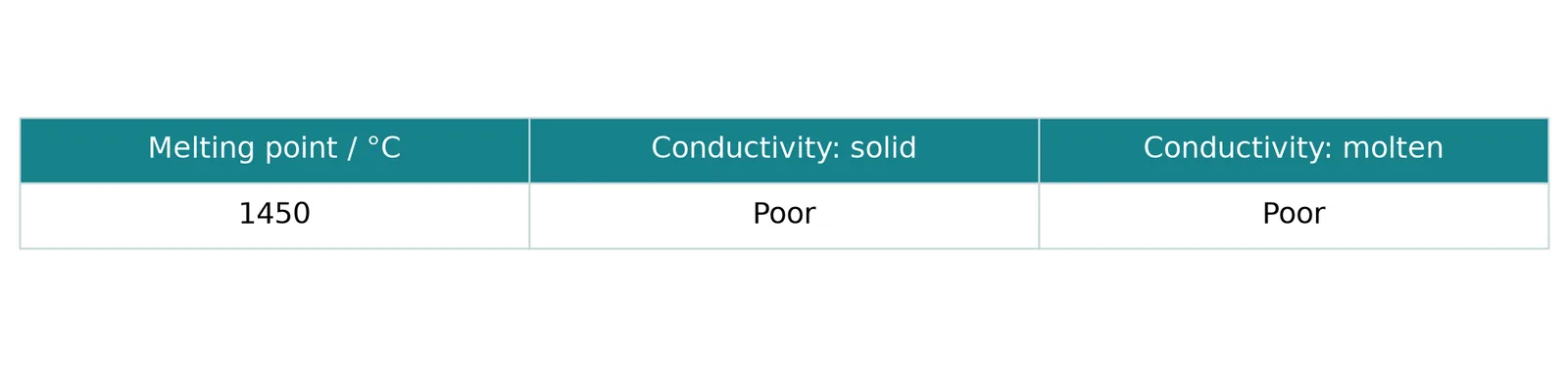
Poor conductors, because all electrons are involved in covalent bonding.
2
Brittle when solid, so they are not malleable or ductile.
3
Low melting and boiling points, because simple molecules have weak intermolecular forces, so many are gases at room temperature.
4
Exceptions: graphite conducts electricity, and diamond and silicon(IV) oxide have very high melting points.
Section 4 of 9Reactions with water and steam
Reactions with water and steam
Cold water: potassium, sodium and calcium form a metal hydroxide and hydrogen, as in Ca(s) + 2H2O(l) → Ca(OH)2(aq) + H2(g).
Steam: magnesium, zinc and iron form a metal oxide and hydrogen, as in Zn(s) + H2O(g) → ZnO(s) + H2(g), but copper does not react.
Hydrogen test: a lighted splint gives a squeaky pop.
Section 5 of 9Reactions with acids and oxygen
Reactions with acids and oxygen
Dilute acids: metal + acid → salt + hydrogen, as in Fe(s) + 2HCl(aq) → FeCl2(aq) + H2(g), and copper, silver and gold do not react.
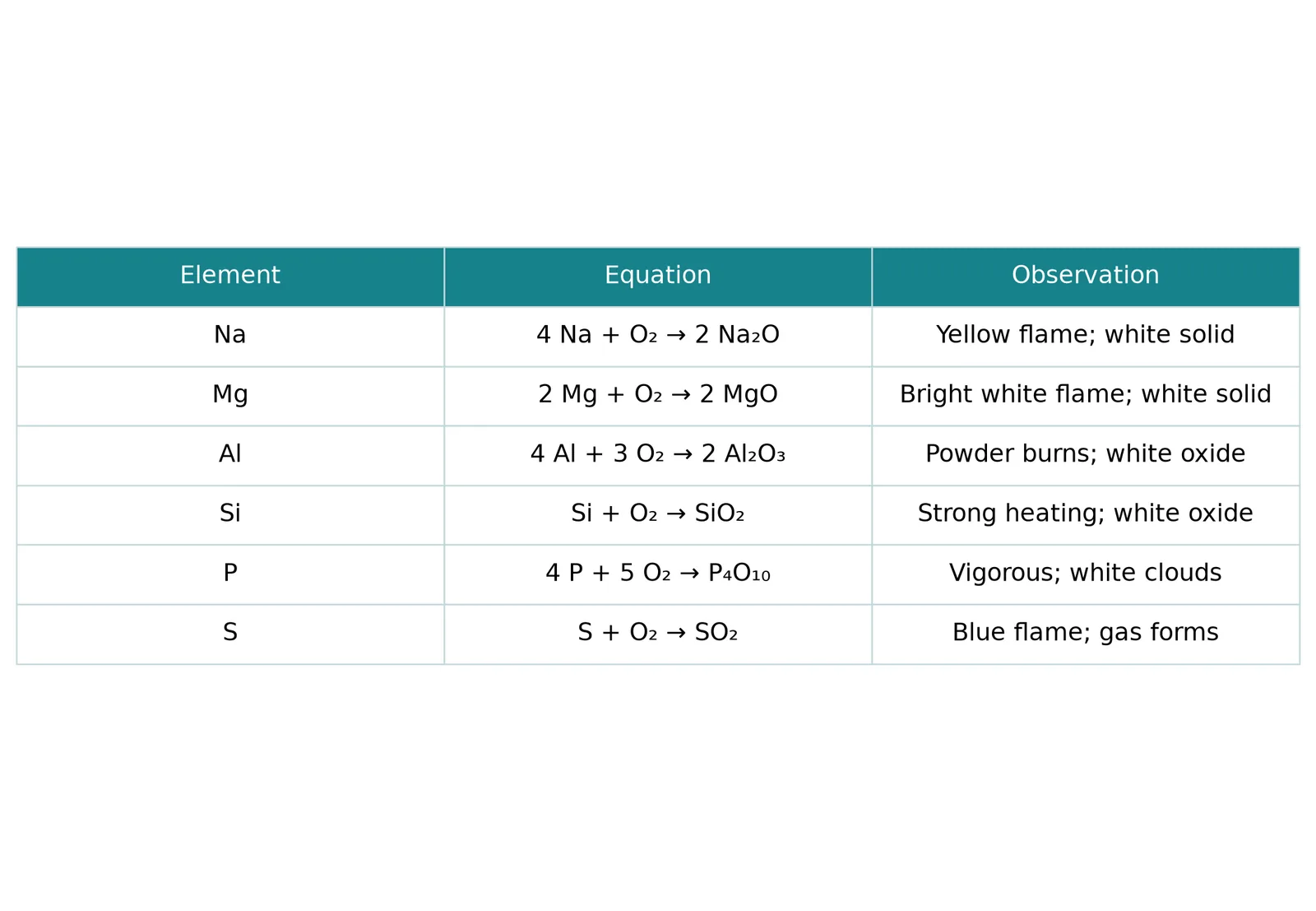
Oxygen: metal + oxygen → metal oxide when heated, and most metals form basic oxides.
- 2Mg + O2 → 2MgO with a bright white flame.
- Copper forms black copper(II) oxide, 2Cu(s) + O2(g) → 2CuO(s).
- Reactive metals such as the alkali metals react easily with oxygen, copper and iron react much more slowly, and gold and platinum do not react.
The reactions give the reactivity order K, Na, Ca, Mg, Al, Zn, Fe, Cu, Ag, Au.
Section 6 of 9Practical comparison of metals
- Method
- Test conductivity in a circuit with a cell and lamp.
- Add a small piece of metal to dilute hydrochloric acid and watch for bubbles.
- Test the gas with a lighted splint, where a squeaky pop confirms hydrogen.
- React the metal with cold water, then steam if there is no reaction.
- Heat the metal in air and see whether it burns and what oxide forms.
- Compare the vigour of the reactions to rank the metals.
Section 7 of 9More from the specification
More from the specification
Structure and Composition of Alloys
- An alloy is a homogeneous physical mixture of a metal with other elements, created to modify and improve physical and chemical properties without chemical bonding.
- (metals or non-metals)
Increased Hardness from Distorted Metallic Lattices
- Introducing atoms of different sizes into a pure metal lattice disrupts the regular layered atomic arrangement, preventing layers of ions from sliding easily past one another when stressed.
Common Industrial Alloys and Corrosion Resistance
- Brass offers high malleability for musical instruments and fittings,
- (copper and zinc)
- while stainless steel forms a self-healing passive oxide layer providing superior corrosion resistance.
- (iron, chromium, nickel, and carbon)
Alloy
- A mixture of a metal with one or more other elements.
Corrosion
- The gradual destruction of a metal by reaction with its surroundings.
Section 8 of 9Key terms
| Term | Meaning |
|---|---|
| Metal | an element with a lattice of positive ions in a sea of delocalised electrons, usually shiny, conductive and malleable. |
| Non-metal | an element that is usually a poor conductor and brittle when solid. |
| Metalloid | an element with properties of both metals and non-metals. |
| Malleable | able to be hammered into shape. |
| Ductile | able to be drawn into wires. |
| Density | mass divided by volume. |
Section 9 of 9Exam technique
1
Saying all non-metals are poor conductorsgraphite conducts electricity.
2
Saying metals conduct because electrons are free: delocalised electrons move through the structure.
3
Writing that metals react with cold water to make an oxide: a hydroxide forms.
4
Saying all metals have high melting points: metals such as sodium and potassium have low melting points.