Section 1 of 6The idea behind the test
Carbonates and acids
- Carbonates and acids Every carbonate contains the carbonate ion, CO32-.
- When a dilute acid is added, the carbonate reacts and releases carbon dioxide gas.
- The fizzing you see is called effervescence.
Identifying the gas
- Identifying the gas Carbon dioxide is colourless, so it must be identified.
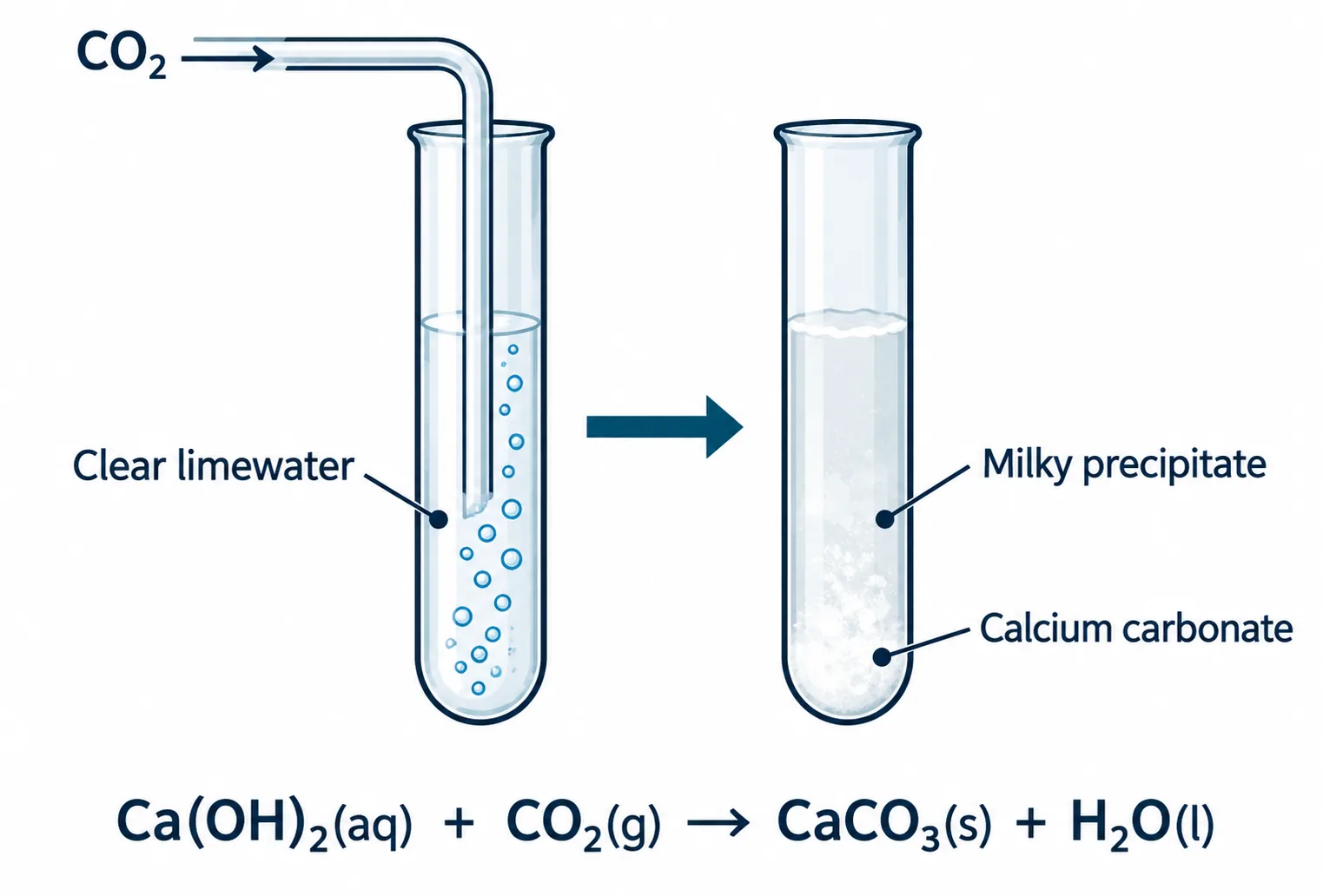
- It turns limewater, a solution of calcium hydroxide, cloudy or milky.
Why limewater goes milky
- Why limewater goes milky Carbon dioxide reacts with calcium hydroxide to make calcium carbonate, which is insoluble.
- Tiny solid particles suspended in the liquid make it look cloudy.
Section 2 of 6Method
1
Put a small amount of the solid or solution being tested into a test tube.
2
Add a few cm3 of dilute acid, such as hydrochloric acid, and look for bubbles.
3
Immediately attach a delivery tube, with a bung, leading into a second test tube containing limewater, so none of the gas escapes.
4
Watch the limewater. If it turns milky, the gas is carbon dioxide and a carbonate was present.
Section 3 of 6Equations
| Stage | Word equation | Symbol equation |
|---|---|---|
| Carbonate and acid (ionic) | carbonate + acid → carbon dioxide + water + salt | CO32-(aq) + 2H+(aq) → CO2(g) + H2O(l) |
| Gas and limewater | calcium hydroxide + carbon dioxide → calcium carbonate + water | Ca(OH)2(aq) + CO2(g) → CaCO3(s) + H2O(l) |
Section 4 of 6Worked example: calcium carbonate with hydrochloric acid

1Add acid
- Add acid Dilute hydrochloric acid is added to a lump of calcium carbonate (marble chip).
2Gas released
- Gas released CaCO3(s) + 2HCl(aq) → CaCl2(aq) + H2O(l) + CO2(g).
3Gas passes into limewater
- Gas passes into limewater The delivery tube carries the carbon dioxide into the second tube.
4Positive result
- Positive result The limewater turns from colourless and clear to milky, confirming carbon dioxide and therefore a carbonate.
Section 5 of 6Key terms
| Term | Meaning |
|---|---|
| Carbonate ion | The negative ion CO32-, found in compounds such as calcium carbonate. |
| Effervescence | Fizzing caused by a gas being released from a liquid. |
| Limewater | A solution of calcium hydroxide used to test for carbon dioxide. |
| Precipitate | A solid formed by a reaction in solution; here, insoluble calcium carbonate. |
| Delivery tube | A tube that carries gas from one container to another. |
Section 6 of 6Exam technique
1
Saying limewater 'turns white'. The correct description is that it turns milky or cloudy.
2
Forgetting to connect the delivery tube quickly. Without a fast connection the carbon dioxide escapes and the test may look negative.
3
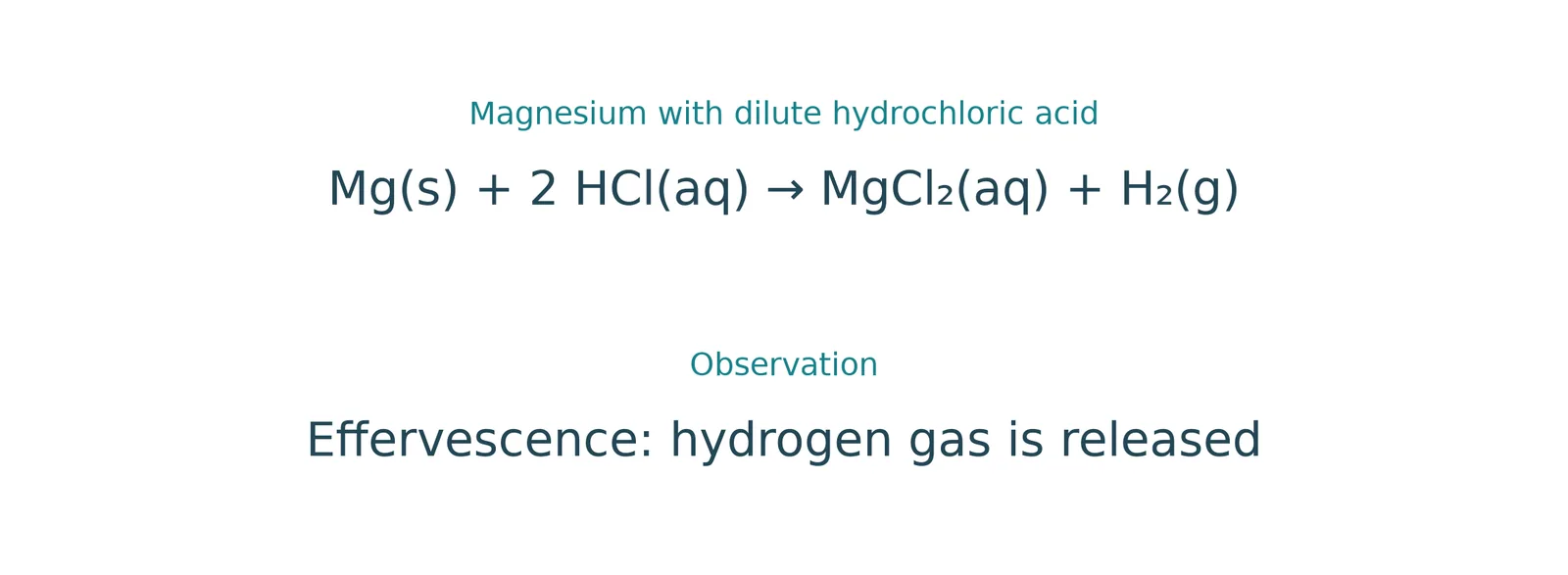
Naming the gas as soon as there is fizzing. Many acid reactions produce bubbles, for example hydrogen from a metal, so the limewater result is needed to prove it is carbon dioxide.
4
Leaving the delivery tube in limewater when the fizzing stops, which can suck the liquid back; remove it first.