Section 1 of 4Transverse Waves
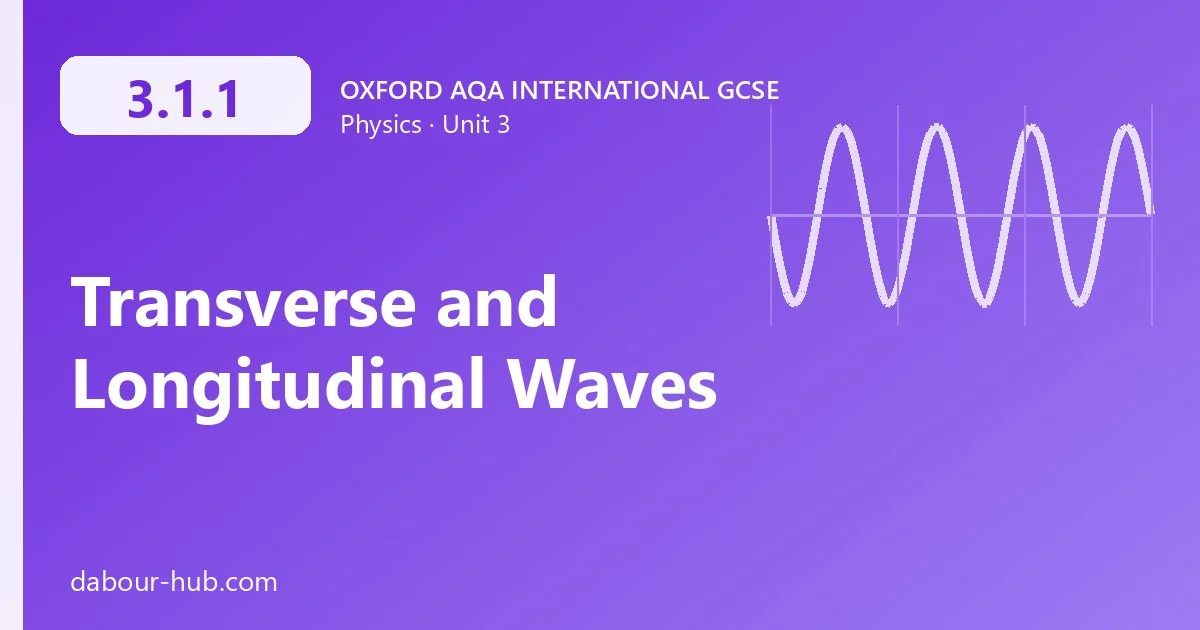
Vibration direction
- Particles vibrate at right angles to the direction in which the wave transfers energy.
Crests and troughs
- The highest points of the wave are crests and the lowest points are troughs, measured from the rest position.
Medium
- Mechanical transverse waves, such as ripples or waves along a rope, need a medium, but electromagnetic waves do not.
Examples
- Light, radio waves, X-rays and S-waves in earthquakes are all transverse waves.
Section 2 of 4Longitudinal Waves
Vibration direction
- Particles vibrate parallel to the direction of energy transfer, moving backwards and forwards about a fixed point.
Compressions
- Regions where particles are close together, with higher density and pressure, are called compressions.
Rarefactions
- Regions where particles are spread apart, with lower density and pressure, are called rarefactions.
Examples
- Sound waves and P-waves in earthquakes are longitudinal and can travel through solids, liquids and gases.
Section 3 of 4Energy Without Matter
The table compares the two types of wave side by side.
Energy Without Matter
Energy transfer
- Both wave types carry energy from the source to an absorber, without carrying the medium along with them.
Demonstration
- A toy duck on water bobs up and down but does not travel with the wave, showing no net movement of matter.
Vacuum
- Only electromagnetic waves can travel through a vacuum, because mechanical waves need particles to pass the vibration on.
Water surfaces
- Particles at the surface of water move in roughly circular paths, combining up-and-down and back-and-forth motion.
| Feature | Transverse | Longitudinal |
|---|---|---|
| Vibration direction | Perpendicular to travel | Parallel to travel |
| Key features | Crests and troughs | Compressions and rarefactions |
| Travels through a vacuum | Electromagnetic waves only | Never |
| Examples | Light, ripples on water, S-waves | Sound, P-waves |
Section 4 of 4Exam Checklist & Tips
3.1.1 – Key Points for the Exam
- Transverse wave A wave in which the vibrations are perpendicular to the direction of energy transfer.
- Longitudinal wave A wave in which the vibrations are parallel to the direction of energy transfer.
- Compression A region of higher particle density in a longitudinal wave.
- Rarefaction A region of lower particle density in a longitudinal wave.
- Medium The substance through which a mechanical wave travels.
- Crest The highest point of a transverse wave above its rest position.
Common Mistakes
- Saying water waves are purely longitudinal, when their surface motion combines both types of vibration.
- Stating that longitudinal waves cannot travel through liquids, when sound passes through liquids as a longitudinal wave.
- Claiming that the particles of the medium travel along with the wave.
- Describing compressions as regions where the particles are far apart.