1.2.7Cells, Organ Systems and Ecosystems
Comparing Inspired and Expired Air
5 min read 11 parts Lesson 18 of 45 1 quiz
Section 1 of 11Inspired and expired air
Inspired air
- Also called inhaled air, it is drawn from the atmosphere so its composition matches atmospheric levels.
Expired air
- Also called exhaled air, its composition differs because gas exchange has taken place in the alveoli.
Gas exchange
- Oxygen enters the blood from the alveoli while carbon dioxide and water vapour pass from the blood into the alveoli.
Section 2 of 11Composition compared
| Gas | Inspired air (%) | Expired air (%) |
|---|---|---|
| Oxygen | 21 | 16 |
| Carbon dioxide | 0.04 | 4 |
| Water vapour | 0.2 – 4 (lower) | 1 – 5 (higher) |
| Nitrogen | 78 | 78 |
Section 3 of 11Reasons for the differences (Supplement)
| Gas | Reason |
|---|---|
| Oxygen | Respiring cells use it, so returning blood has a lower oxygen concentration than alveolar air and oxygen diffuses into the blood |
| Carbon dioxide | Produced by respiration and carried to the lungs, where it diffuses into the alveoli because it is more concentrated in the blood |
| Water vapour | Evaporates from the moist lining of the alveoli because of the warmth of the body |
| Nitrogen | Very stable and cannot be used by the body, so its concentration does not change |
Section 4 of 11Limewater test for carbon dioxide
1
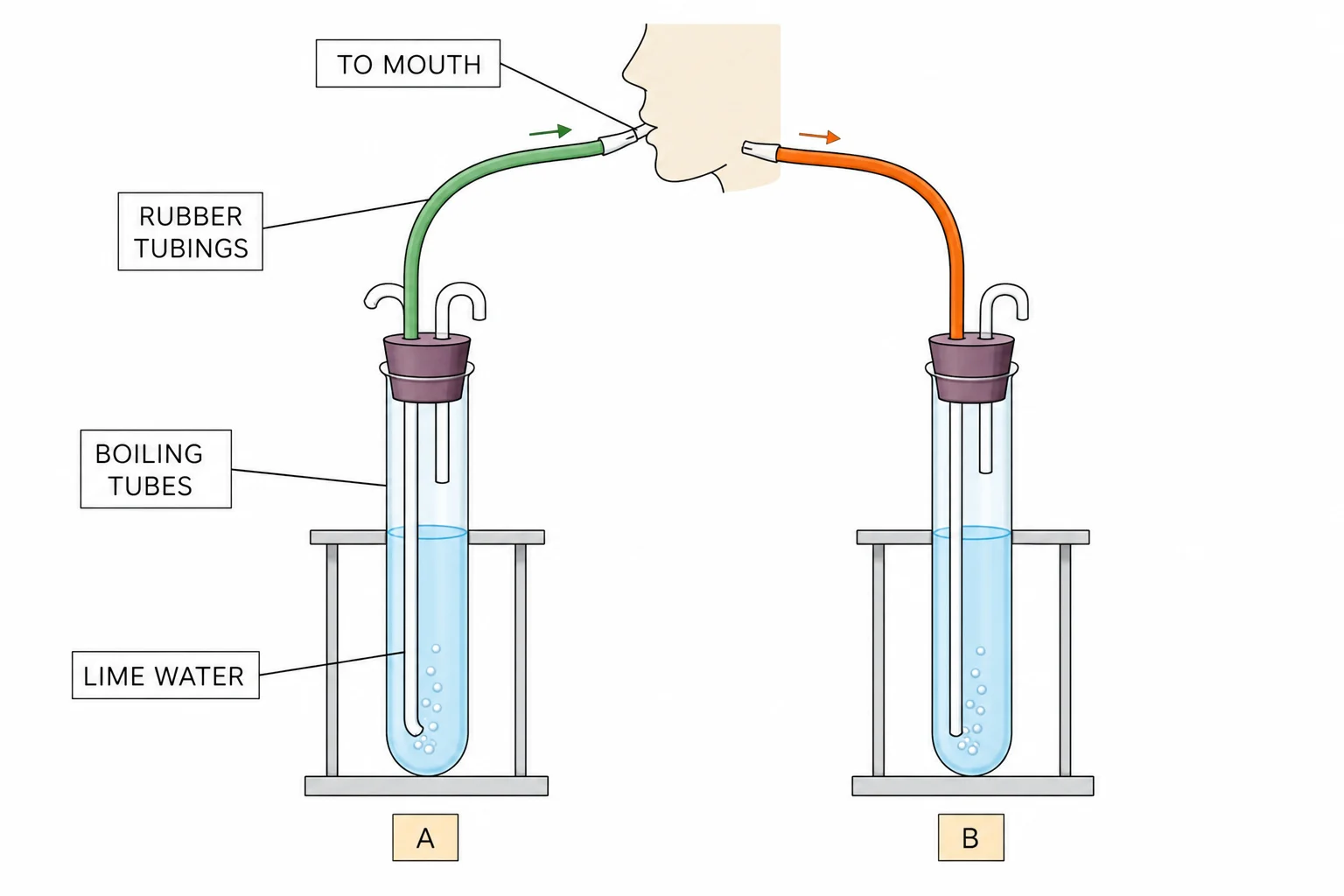
Set up two boiling tubes of limewater, tube A for air breathed in and tube B for air breathed out.
2
Breathe in through tube A so atmospheric air bubbles through it.
3
Breathe out into tube B so expired air bubbles through it.
4
Compare the limewater: it stays clear in tube A and turns cloudy or milky in tube B.
5
Conclude that expired air contains a higher percentage of carbon dioxide than inspired air.
Section 5 of 11Investigating the effect of exercise on breathing
1
Count the breaths taken in 1 minute at rest.
2
Measure the average chest expansion over five breaths with a tape measure held around the chest.
3
Exercise for a set time of at least 3 minutes.
4
Immediately afterwards, count the breaths in one minute and measure chest expansion again.
5
Compare: the number of breaths per minute and the chest expansion both increase after exercise.
Section 6 of 11Effect of exercise
Rate and depth
- Exercise increases both the frequency and the depth of breathing.
Recovery
- Breathing stays raised for a time after exercise and then gradually returns to the resting rate.
Section 7 of 11Why breathing increases (Supplement)
1
Muscle cells respire faster, so carbon dioxide levels in the cells rise.
2
Carbon dioxide diffuses into the blood plasma and makes it slightly more acidic.
3
Chemoreceptors in the brain detect the higher carbon dioxide level.
4
The brain sends impulses to the intercostal muscles and diaphragm.
5
The rate and depth of breathing increase, removing carbon dioxide and supplying more oxygen.
Section 8 of 11Oxygen debt (Supplement)
Anaerobic respiration
- If muscles cannot get enough oxygen they also respire anaerobically and produce lactic acid.
Effect of lactic acid
- It lowers the pH of cells and can denature enzymes, so it must be removed.
Repaying the debt
- Lactic acid is removed using oxygen, which keeps breathing fast and deep after exercise.
Measuring it
- The longer breathing takes to return to normal, the more lactic acid was produced and the greater the debt.
Section 9 of 11More from the specification
More from the specification
Respiratory mucus barrier function
- Respiratory mucus barrier function goblet cells secrete sticky mucus whose primary protective function traps airborne particulates before reaching alveoli.
Volume
- The amount of cytoplasm needing supplies and producing waste.
Feature
- An observable characteristic.
Trachea
- The windpipe, held open by C-shaped cartilage rings.
Thorax
- Chest cavity
Exchange surface
- A surface adapted for efficient movement of substances.
Concentration gradient
- The difference in concentration of a substance between two regions.
Inspiration and expiration
- Inspiration and expiration alternative terms for breathing in (inhalation) and breathing out (exhalation) that you may meet in exam questions.
Section 10 of 11Key terms
| Term | Meaning |
|---|---|
| Inspired air | Air breathed in, with atmospheric composition. |
| Expired air | Air breathed out, with less oxygen and more carbon dioxide and water vapour. |
| Limewater | A clear solution that turns cloudy with carbon dioxide. |
| Chemoreceptor | A cell that detects chemical changes such as carbon dioxide level. |
| Lactic acid | Product of anaerobic respiration in muscles. |
| Oxygen debt | Extra oxygen needed after exercise to remove lactic acid. |
Section 11 of 11Exam technique
1
Saying expired air has no oxygen — it contains about 16% oxygen.
2
Saying nitrogen changes in breathing — it is unused and stays at about 78%.
3
Saying limewater turns cloudy with oxygen — it turns cloudy with carbon dioxide.
4
Saying only depth of breathing changes in exercise — both rate and depth increase.