2.2.3Variation, Homeostasis and Micro-organisms
Uncontrolled Mitosis and Cancer
5 min read 6 parts Lesson 12 of 51 Unit quiz
Section 1 of 6Normal control of mitosis


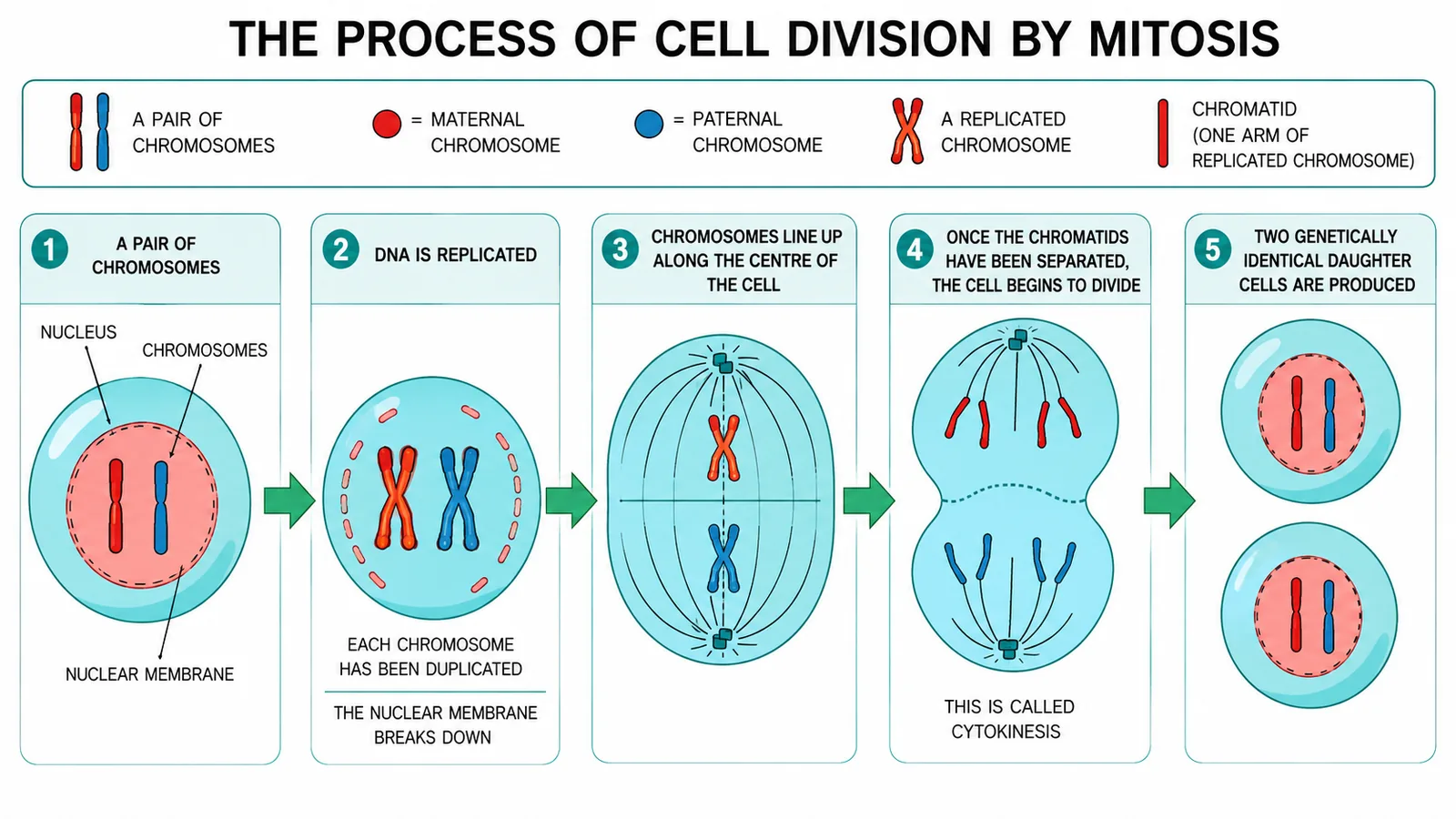
Why cells divide
- Why cells divide Mitosis produces genetically identical cells for growth and for repairing damaged tissue.
Genes regulate division
- Genes regulate division Many genes act as controls, making sure that cells divide only when new cells are needed and stop dividing when they are not.
- In a healthy tissue, the number of cells stays balanced.
Section 2 of 6How cancer develops
1A mutation occurs
- A mutation occurs A change in the DNA happens in a gene that controls cell division.
2Control is lost
- Control is lost The cell no longer responds to the signals that tell it when to stop dividing.
3Uncontrolled mitosis
- Uncontrolled mitosis The cell divides again and again, and its daughter cells do the same.
4A tumour forms
- A tumour forms The growing mass of abnormal cells is a tumour; if it spreads it is cancer.
Section 3 of 6Types of tumour
| Feature | Benign tumour | Malignant tumour (cancer) |
|---|---|---|
| Growth | Grows slowly in one place | Grows rapidly and invades nearby tissue |
| Boundary | Usually enclosed by a membrane | Not enclosed, spreads into surrounding tissues |
| Spread | Does not spread to other parts of the body | Cells break off and travel in the blood to form secondary tumours |
| Danger | Usually not life-threatening, but can press on organs | Can be life-threatening if not treated |
Section 4 of 6What can increase the risk

Risk factors
Mutagens
- Mutagens Substances and radiation that damage DNA, such as chemicals in tobacco smoke and ultraviolet light, increase the chance of mutations.
Inheritance
- Inheritance Some people inherit gene variants that make mutations in control genes more likely.
Lifestyle
- Lifestyle Not smoking, limiting sun exposure and eating a healthy diet lower the risk.
Section 5 of 6Key terms
| Term | Meaning |
|---|---|
| Mitosis | Cell division that produces two genetically identical daughter cells. |
| Mutation | A change in the DNA sequence of a gene. |
| Tumour | A mass of abnormal cells formed by uncontrolled cell division. |
| Benign | A tumour that does not spread to other parts of the body. |
| Malignant | A tumour that invades surrounding tissue and can spread; also called cancer. |
| Mutagen | Something that increases the rate of mutation, such as ionising radiation. |
Section 6 of 6Exam technique
1
Saying that cancer is caused by cells dividing 'too fast' without referring to a mutation that disrupts control of mitosis.
2
Treating all tumours as cancer — only malignant tumours are cancers; benign tumours do not spread.
3
Writing that a mutation always causes cancer — most mutations are harmless, and cancer usually needs several.
4
Confusing mitosis with meiosis — mitosis makes identical body cells, meiosis makes gametes.
5
Saying cancer is infectious — cancer cannot be caught from another person.