1.1.6Chemical Substances, Reactions and Essential Resources
Conservation of Mass
5 min read 7 parts Lesson 7 of 46 1 quiz
Section 1 of 7The law
Atoms are not created or destroyed
- Atoms are not created or destroyed In a chemical reaction the atoms present in the reactants are rearranged into new substances in the products.
- Because the same atoms are present before and after, the total mass of reactants equals the total mass of products.
Balanced equations
- Balanced equations A balanced symbol equation has the same number of atoms of each element on both sides, which reflects this law.
Section 2 of 7Balancing an equation

1
Write the correct formula for every reactant and product. Never change a formula to balance an equation.
2
Count the atoms of each element on both sides.
3
Place numbers in front of formulae (coefficients) to balance one element at a time. Leave oxygen and hydrogen until last if they appear in several substances.
4
Recount all atoms to confirm the equation balances.
5
Add state symbols: (s) solid, (l) liquid, (g) gas, (aq) aqueous solution.
Section 3 of 7Example: magnesium and oxygen
| Stage | Equation | Comment |
|---|---|---|
| Unbalanced | Mg + O2 → MgO | 2 O atoms on left, 1 on right |
| Balance O | Mg + O2 → 2MgO | Now 2 Mg needed on the left |
| Balanced | 2Mg + O2 → 2MgO | 2 Mg and 2 O on each side |
| With states | 2Mg(s) + O2(g) → 2MgO(s) | Complete answer |
Section 4 of 7Why mass seems to change
Open vs closed systems
Mass appears to increase
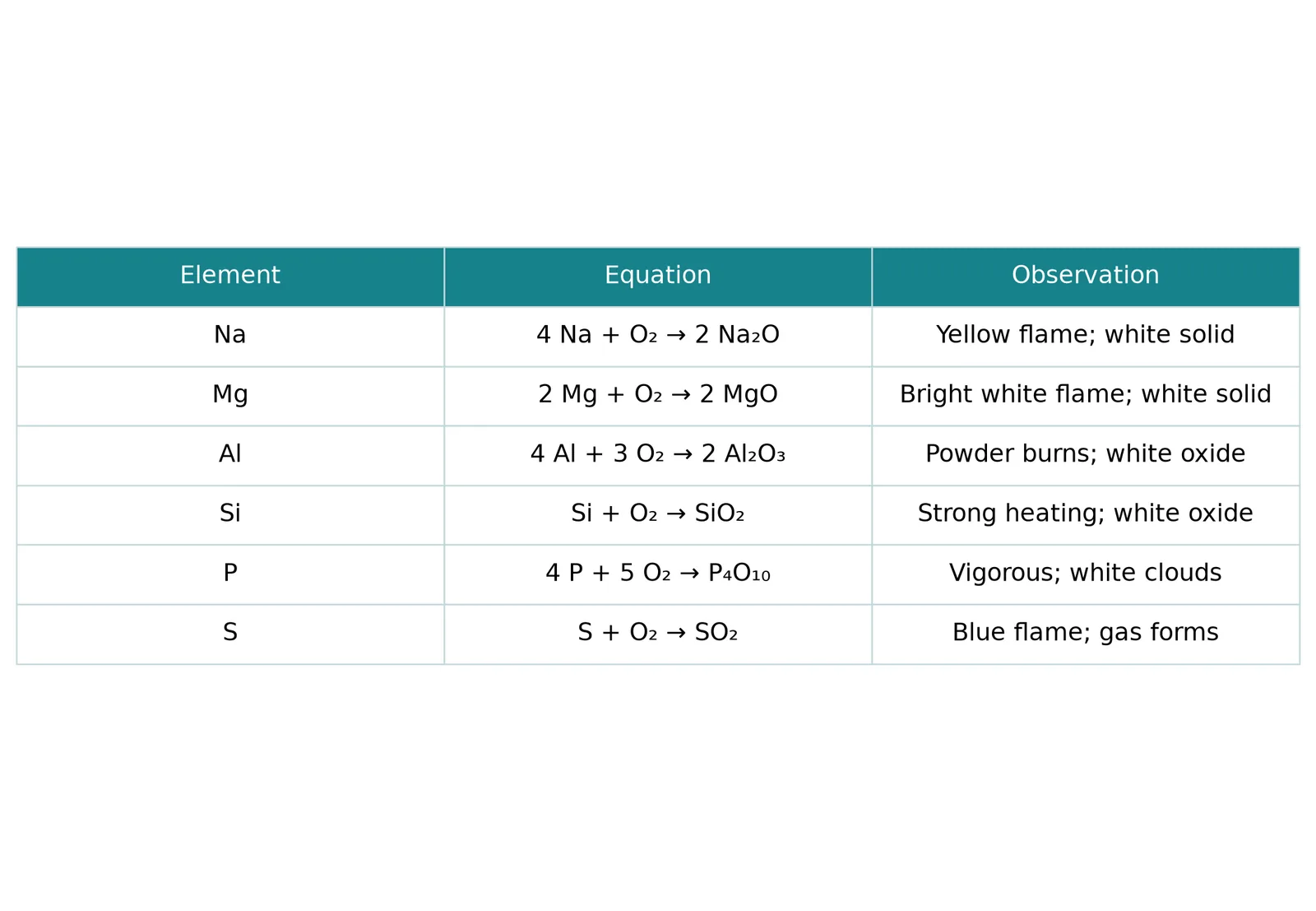
- Mass appears to increase A metal burning in air gains oxygen from the air, so the solid product weighs more than the metal.
Mass appears to decrease
- Mass appears to decrease A reaction that releases a gas, such as carbonate with acid in an open flask, loses mass because the gas escapes.
Closed system
- Closed system In a sealed container, nothing can escape or enter, and the total mass stays the same.
Explanation
- Explanation The missing or extra mass is that of a gas that was not weighed.
- Include it and the masses balance.
Section 5 of 7Using the law in calculations
1Known masses
- Known masses Write down the masses of all substances you know.
2Add reactants
- Add reactants Total mass of reactants = total mass of products.
3Subtract
- Subtract Find the unknown by subtracting the known products from the total of the reactants.
4Example
- Example If 10 g of calcium carbonate gives 5.6 g of calcium oxide, then 4.4 g of carbon dioxide must have been formed.
Section 6 of 7Key terms
| Term | Meaning |
|---|---|
| Law of conservation of mass | In a chemical reaction no atoms are made or lost, so the mass of the products equals the mass of the reactants. |
| Reactant | A substance that is used up in a reaction. |
| Product | A substance that is made in a reaction. |
| Coefficient | The big number in front of a formula showing how many of that substance are involved. |
| State symbol | A letter in brackets showing whether a substance is solid, liquid, gas or aqueous. |
Section 7 of 7Exam technique
1
Changing a subscript, such as writing MgO2, to balance an equation. Only numbers in front of formulae may change.
2
Stating that mass is lost in a reaction because it 'disappears'. It is carried away as a gas.
3
Forgetting that a gas from the air, such as oxygen, adds mass to a solid product.
4
Leaving out state symbols when the question asks for a full equation.