1.1.11Chemical Substances, Reactions and Essential Resources
The Avogadro Constant and the Mole
15 min read 14 parts Lesson 12 of 46 1 quiz
Section 1 of 14Part 1 — Amount of substance and particles

A mole is a unit of amount of substance. One mole contains 6.02 × 10²³ specified particles. Always name the particles: atoms, molecules, ions or electrons. The Avogadro constant has units mol−1.
Amount, n (mol)Start with the number of moles.
→ Multiply by NAN = n × 6.02 × 10²³
Number of particles, NTo reverse the process, divide by NA.
Particles must be specified Sample Particles counted Amount of atoms 1 mol He 6.02 × 10²³ helium atoms 1 mol He atoms 1 mol O2 6.02 × 10²³ oxygen molecules 2 mol O atoms 1 mol H2O 6.02 × 10²³ water molecules 2 mol H atoms and 1 mol O atoms Example 2.0 mol of water contains 2.0 × 6.02 × 1023 = 1.20 × 1024 molecules, to three significant figures.
Section 2 of 14Part 2 — Mass and molar mass

Molar mass is the mass of one mole, in g mol−1. Its numerical value equals the relative atomic mass or relative formula mass. Relative mass has no unit; molar mass does.
Choose the required rearrangement Find Relationship Units Amount n = m / M g divided by g mol−1 gives mol Mass m = n × M mol × g mol−1 gives g Molar mass M = m / n g mol−1 Worked calculation For 8.0 g of O2, M = 2 × 16 = 32 g mol−1. Therefore n = 8.0 / 32 = 0.25 mol. Using 16 would count oxygen atoms instead of oxygen molecules.
Section 3 of 14Part 3 — Gas volumes and solution concentrations


At room temperature and pressure, use a molar gas volume of 24 dm3 mol−1 for these IGCSE calculations. This value applies to gases at the stated conditions; it is not the volume of one mole of a solid or liquid.
Volume calculations and conversions Situation Equation Essential check Gas at r.t.p. n = V / 24 V must be in dm3 Gas measured in cm3 n = V / 24000 Do not mix this volume with 24 Solution n = c × V c in mol dm−3, V in dm3 Concentration c = n / V Use total solution volume Mass concentration g dm−3 = c × M Multiply molar concentration by molar mass Example 50.0 cm3 = 0.0500 dm3. A 0.200 mol dm−3 NaOH solution contains n = 0.200 × 0.0500 = 0.0100 mol in this volume.
Section 4 of 14Part 4 — Reaction ratios and the limiting reactant

The coefficients in a balanced equation give mole ratios. They do not directly give mass ratios. Convert the known quantity into moles before using the ratio.
1 · Known quantityMass, gas volume or concentration and volume.
2 · Known molesUse n = m/M, V/24 or cV.
3 · Equation ratioMultiply by required coefficient / known coefficient.
4 · Required quantityConvert moles to mass, volume or concentration.
For 2H2 + O2 → 2H2O, compare each available amount divided by its coefficient.
- With 4 mol H2 and 1 mol O2, the values are 4/2 = 2 and 1/1 = 1.
- Oxygen gives the smaller value and is limiting.
- It forms 2 mol water, uses 2 mol hydrogen and leaves 2 mol hydrogen unreacted.
The limiting reactant determines the theoretical maximum yield. The excess reactant remains after the limiting reactant is consumed.
- With 4 mol H2 and 1 mol O2, the values are 4/2 = 2 and 1/1 = 1.
Section 5 of 14Part 5 — Formulae, yield and purity

An empirical formula gives the simplest whole-number atom ratio. A molecular formula gives the actual numbers of atoms in a molecule. When percentages are supplied, imagine a 100 g sample so each percentage becomes a mass in grams.
Formula calculation: 40.0% C, 6.7% H, 53.3% O Step C H O Mass in 100 g 40.0 g 6.7 g 53.3 g Divide by Ar 40.0/12 = 3.33 6.7/1 = 6.7 53.3/16 = 3.33 Divide by smallest 1 2 1 The empirical formula is CH2O, with relative formula mass 30. If molecular Mr = 60, the multiplier is 60/30 = 2, giving C2H4O2.
Different percentage calculations Quantity Calculation Interpretation Percentage yield actual yield / theoretical yield × 100 15 g obtained from a theoretical 20 g gives 75% Percentage purity mass of pure substance / sample mass × 100 8 g pure substance in a 10 g sample gives 80% Element composition total Ar contribution / Mr × 100 Use the number of atoms in the formula Yield can be reduced by incomplete reaction, side reactions or product loss during transfer and separation. An apparent yield above 100% indicates a problem such as wet or impure product, or a measurement or calculation error.
Section 6 of 14Part 6 — Titration: measurement to concentration
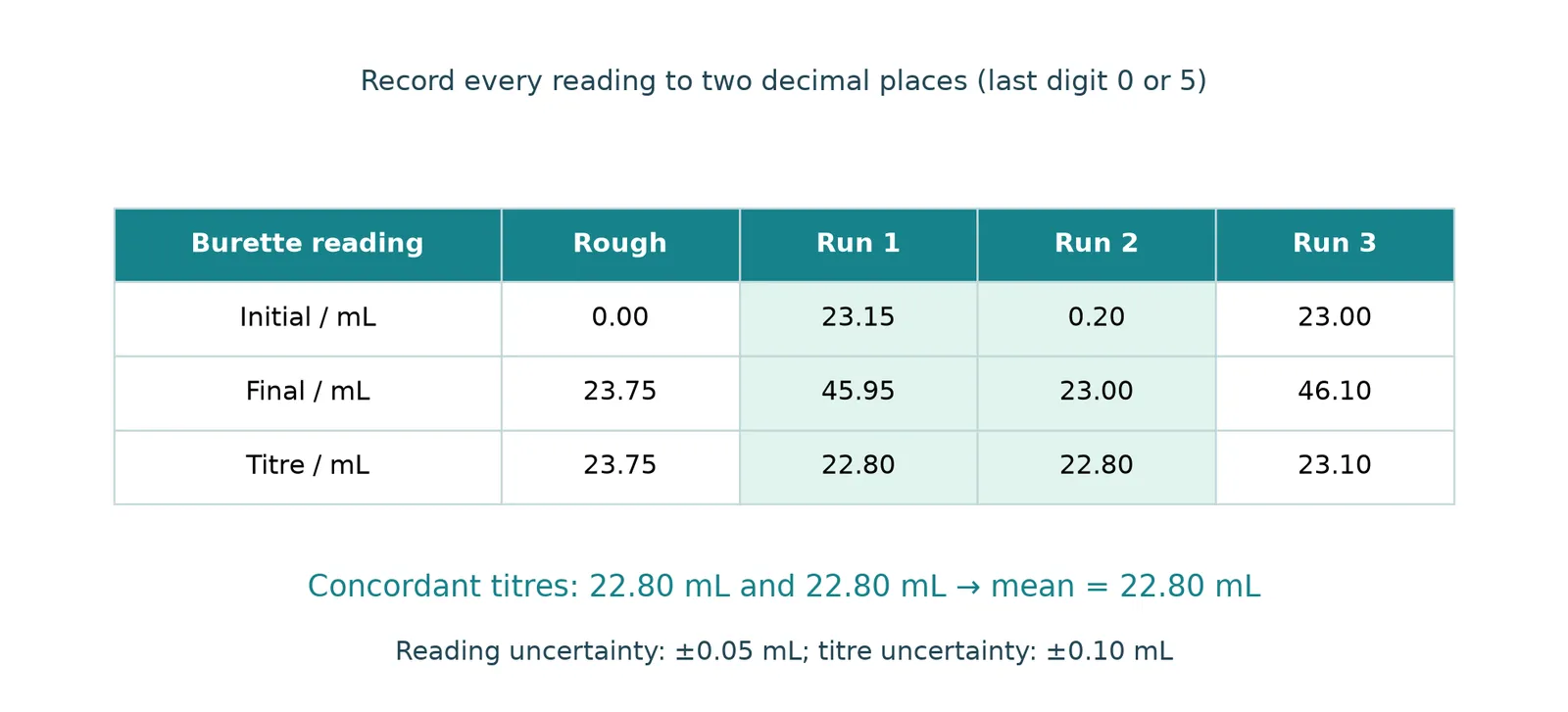

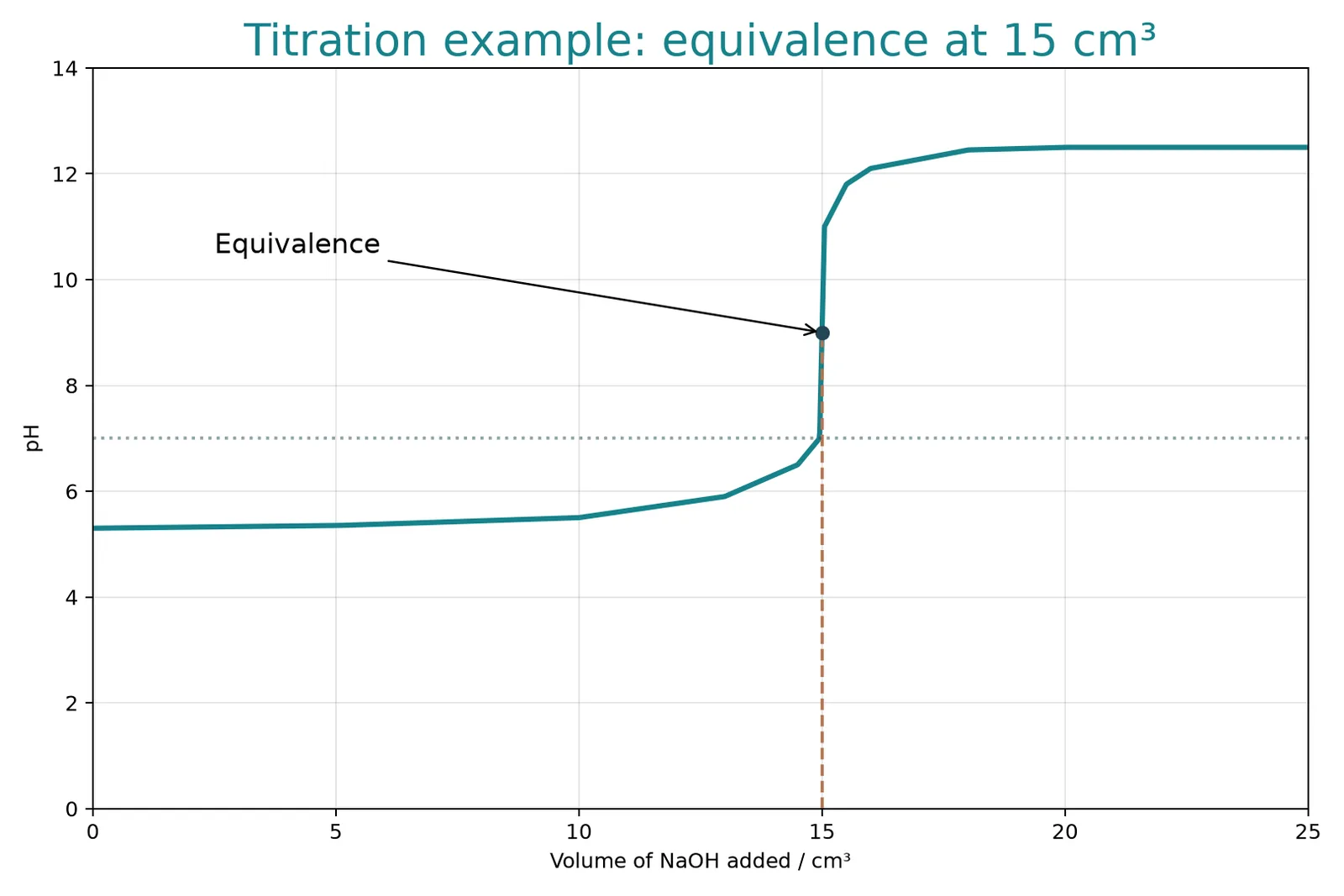

A titration measures the volume of one solution needed to react with a measured volume of another. Use a suitable indicator and approach the end-point dropwise while swirling. Repeat to obtain closely agreeing titres and calculate a mean from the concordant results, excluding the rough trial.
Worked titration calculation Stage Reasoning and calculation Balanced equation 2NaOH + H2SO4 → Na2SO4 + 2H2O Known acid 20.0 cm3 of 0.100 mol dm−3: n = 0.100 × 0.0200 = 0.00200 mol Apply 2:1 ratio n(NaOH) = 2 × 0.00200 = 0.00400 mol Unknown alkali 25.0 cm3 = 0.0250 dm3 Find concentration c(NaOH) = 0.00400 / 0.0250 = 0.160 mol dm−3 Check the equation ratio before calculating concentration: acid and alkali do not always react in a 1:1 ratio. Keep extra digits in intermediate calculations and round the final answer appropriately.
Section 7 of 14The Avogadro Constant and the Mole

- the average mass of the isotopes of an element compared with 1/12 of the mass of a carbon-12 atom.
- It is a ratio, so it has no units;
- e.g. Ar(Mg) = 24 means a magnesium atom is on average twice as heavy as a carbon-12 atom.
- the sum of the Ar values of all the atoms in the formula ("relative formula mass" is used for ionic compounds).
- E.g.
- Mg(OH)2 = 24 + 2 × (16 + 1) = 58.
- Remember to multiply everything inside brackets.
- atoms are only rearranged in a reaction, so total mass of reactants = total mass of products, and reacting masses stay in a fixed ratio.
- E.g.
- 2Mg + O2 → 2MgO: 48 g Mg + 32 g O2 → 80 g MgO, so 12 g Mg gives 20 g MgO (same ratio in kg or tonnes).
- So gas volume ratios equal the mole ratios in the equation: in 2H2(g) + O2(g) → 2H2O(l), 60 cm3 of H2 needs exactly 30 cm3 of O2.
- heat a weighed sample to constant mass;
- mass lost = water.
- Find moles of anhydrous salt and of water, then divide by the smaller.
- E.g.
- 2.50 g CuSO4·xH2O leaves 1.60 g CuSO4 (0.0100 mol);
- 0.90 g water = 0.050 mol, so x = 5.
- then change only the large numbers in front of formulae until each element has the same number of atoms on both sides.
- (never the subscripts)
- E.g.
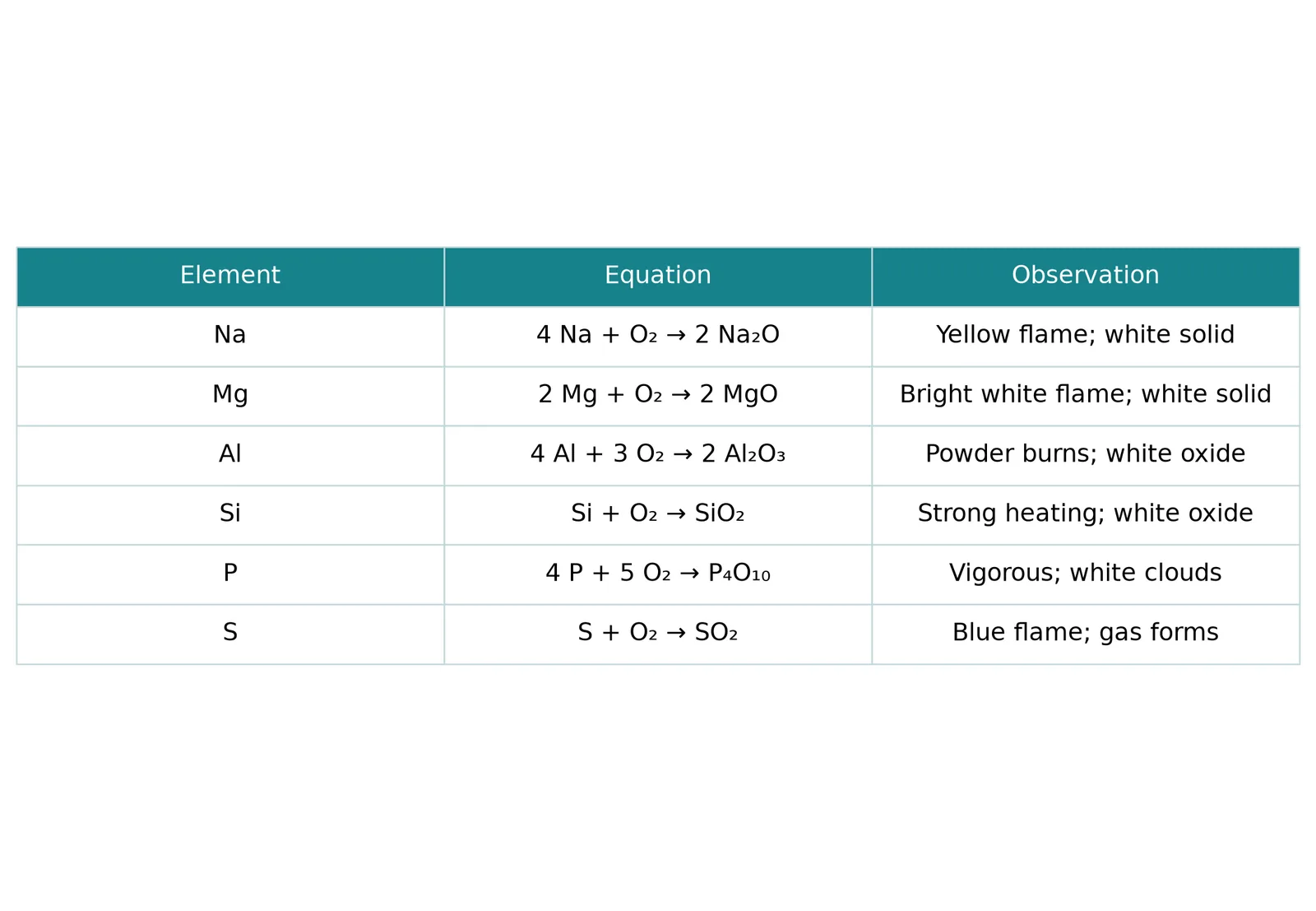
- Al + O2 → Al2O3 becomes 4Al + 3O2 → 2Al2O3.
- and check that atoms and charges balance.
- E.g.
- AgNO3(aq) + KBr(aq) → AgBr(s) + KNO3(aq) gives Ag+(aq) + Br−(aq) → AgBr(s).
Section 8 of 14Process & sequence
- Write the balanced equation for the reaction.
- Calculate moles of the substance you know about (n = m/M, n = V/24 or n = c × V).What the symbols mean: n = amount of substance (mol) · m = mass (g) · M or Mr = molar mass (g mol−1, numerically equal to Mr)
- If two reactant amounts are given, compare mole ratios to find the limiting reactant.
- Use the mole ratio from the balanced equation to find moles of the required substance.
- Convert moles into the quantity asked for (mass = n × M, volume = n × 24 dm3, concentration = n ÷ V).
- Give the answer with a unit and to a sensible number of significant figures (usually 3).
Finding concentration by acid–alkali titrationwrite these steps in this order; each step is a marking point.
- Rinse and fill a burette with acid; pipette 25.0 cm3 of alkali into a conical flask.
- Add a few drops of indicator (e.g. methyl orange or thymolphthalein).
- Add acid from the burette, swirling, dropwise near the end-point until the indicator just changes colour.
- Record the titre; repeat until concordant results (within 0.10 cm3) and average them.
- Calculate moles of known solution (c × V), use the mole ratio, then c = n ÷ V for the unknown.
Section 9 of 14Compare
| To find | Equation | Units |
|---|---|---|
| moles from mass | n = m ÷ M | n in mol, m in g, M in g/mol |
| moles of gas at r.t.p. | n = V ÷ 24 | V in dm3 (or V ÷ 24 000 for cm3) |
| moles in solution | n = c × V | c in mol/dm3, V in dm3 |
| number of particles | N = n × 6.02 × 10²³ | N has no unit |
| concentration in g/dm3 | mass concentration = c (mol/dm3) × M | g/dm3 |
Convert cm3 to dm3 by dividing by 1000.
Section 10 of 14Worked examples
- CaCO3 + 2HCl → CaCl2 + H2O + CO2. n(CaCO3) = 25.0 ÷ 100 = 0.250 mol.
- Ratio 1:1 so n(CO2) = 0.250 mol.
- V = 0.250 × 24 = 6.00 dm3.
- 2NaOH + H2SO4 → Na2SO4 + 2H2O. n(H2SO4) = 0.100 × 20.0/1000 = 0.00200 mol. n(NaOH) = 2 × 0.00200 = 0.00400 mol. c = 0.00400 ÷ (25.0/1000) = 0.160 mol/dm3.
- C: 40.0/12 = 3.33;
- H: 6.7/1 = 6.7;
- O: 53.3/16 = 3.33.
- Divide by 3.33: 1 : 2 : 1 → CH2O (Mr 30).
- 60 ÷ 30 = 2 → molecular formula C2H4O2.
Section 11 of 14Keep going
The Mole & the Avogadro Constant IGCSE Chemistry 0620: what to do next
These The Mole & the Avogadro Constant IGCSE Chemistry 0620 notes covered the key ideas, worked examples and exam technique for this topic. Check your The Mole & the Avogadro Constant IGCSE Chemistry 0620 understanding with the practice questions below, then reread any The Mole & the Avogadro Constant IGCSE Chemistry 0620 point you were unsure about before moving on.
The Mole & the Avogadro Constant IGCSE Chemistry 0620: revision checklist
- Revise the main The Mole & the Avogadro Constant IGCSE Chemistry 0620 definitions until you can write them from memory.
- Practise The Mole & the Avogadro Constant IGCSE Chemistry 0620 exam questions under timed conditions.
- Link each The Mole & the Avogadro Constant IGCSE Chemistry 0620 idea to a diagram or a worked example.
- List the common The Mole & the Avogadro Constant IGCSE Chemistry 0620 mistakes and how to avoid them.
- Explain one The Mole & the Avogadro Constant IGCSE Chemistry 0620 idea out loud as if teaching a friend.
- Summarise The Mole & the Avogadro Constant IGCSE Chemistry 0620 in five key points on a revision card.
- Check which command words appear most often in The Mole & the Avogadro Constant IGCSE Chemistry 0620 questions.
- Come back to The Mole & the Avogadro Constant IGCSE Chemistry 0620 after a week for spaced practice.
- Mark your answers to The Mole & the Avogadro Constant IGCSE Chemistry 0620 questions against the key ideas above.
- Highlight the Mole & the Avogadro Constant IGCSE Chemistry 0620 keywords that examiners expect to see.
- Draw a mind map that connects The Mole & the Avogadro Constant IGCSE Chemistry 0620 to earlier lessons.
- Write a short The Mole & the Avogadro Constant IGCSE Chemistry 0620 recap before you start the next lesson.
- Turn each The Mole & the Avogadro Constant IGCSE Chemistry 0620 heading into a question and answer it without notes.
- Previous lesson: 3.1 Formulae & Relative Masses — 0620 Notes
- Next lesson: 4.2 Applications of Electrolysis — 0620 Notes
- Course: Cambridge IGCSE Chemistry 0620 — all units
- Official syllabus: Cambridge IGCSE Chemistry 0620 syllabus