1.2.7Chemical Substances, Reactions and Essential Resources
Testing for Hydrogen Gas
5 min read 7 parts Lesson 19 of 46 1 quiz
Section 1 of 7The test
1
Collect a sample of the gas in a test tube, held upside down if the gas is lighter than air, and keep your thumb or a bung over the opening.
2
Light a wooden splint.
3
Bring the burning splint to the mouth of the test tube, removing the bung or thumb.
4
Do not push the splint deep inside the tube, because hydrogen needs oxygen from the air to burn.
5
Listen for the result: hydrogen burns with a loud squeaky pop.
Section 2 of 7Why it pops
1Flame meets hydrogen
- Flame meets hydrogen Hydrogen is flammable and ignites at the open end of the tube.
2Mixes with air
- Mixes with air It combines rapidly with oxygen in the air in a small, quick combustion.
3Water is made
- Water is made 2H2(g) + O2(g) → 2H2O(g)
4Sound heard
- Sound heard The rapid burning of the small volume of gas makes the pop.
Section 3 of 7Where the test is used
Alkali metals and water
- Alkali metals and water Sodium or potassium reacting with water gives fizzing.
- Hydrogen is identified by the squeaky pop.
Metals with acids
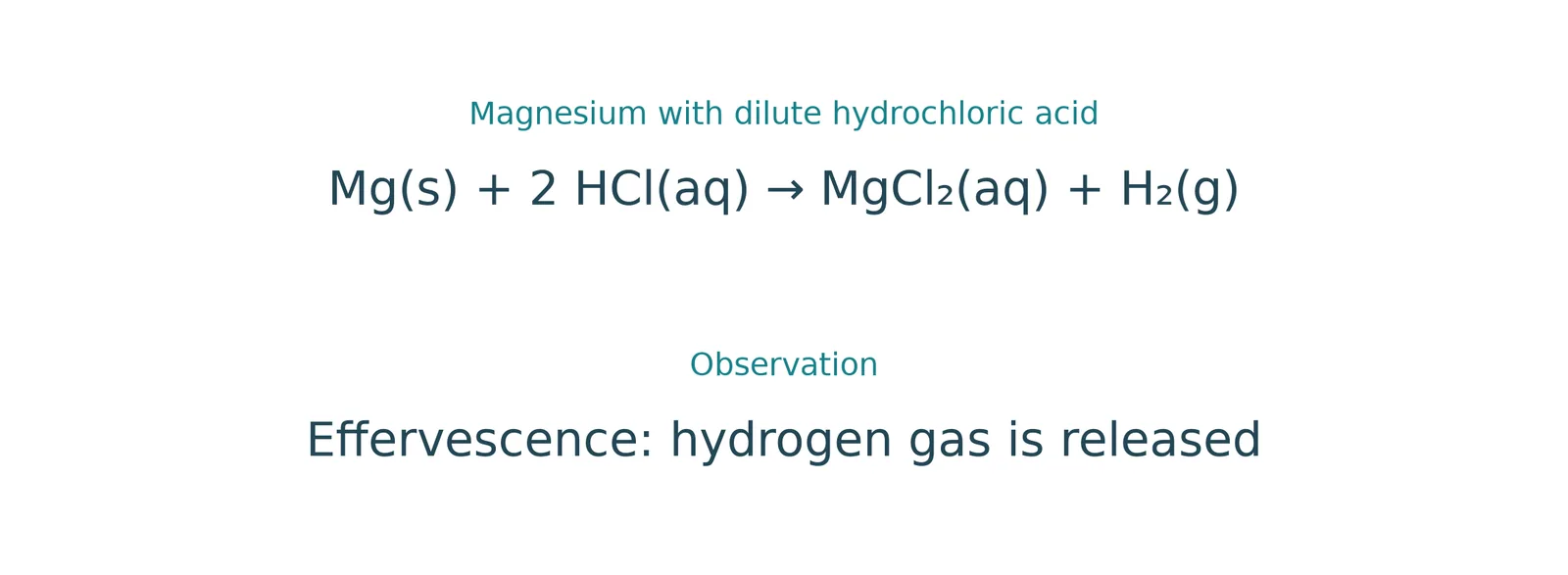
- Metals with acids Magnesium with hydrochloric acid gives hydrogen and a salt. Collect the gas and test it.
Safety
- Safety Use small volumes, wear eye protection and keep flames away from the reaction vessel, as hydrogen is explosive with air.
Section 4 of 7Properties of hydrogen that explain the test
Very low density
- Very low density Hydrogen is the least dense gas, much lighter than air.
- It escapes quickly from an open tube, so the splint should be applied immediately after the bung is removed.
- A tube is therefore collected upside down so that the gas stays trapped against the closed end.
Flammable
- Flammable Hydrogen reacts readily with oxygen and releases a lot of energy.
- A pure sample in a tube burns more quietly than a mixture with air, which is why a mixture gives the sharper pop.
- A positive test needs both hydrogen and oxygen, so a tube full of hydrogen with no air at its mouth will not pop.
Interpreting a negative result
- Interpreting a negative result If the splint simply goes out with no pop, there is probably no hydrogen,
- or too little gas was collected,
- or the sample escaped before testing.
- A conclusion should always say what was seen: 'the lit splint made a squeaky pop, so the gas is hydrogen'.
Section 5 of 7Gas tests compared
| Gas | Test | Positive result |
|---|---|---|
| Hydrogen | Lit splint at the mouth of the tube | Squeaky pop |
| Oxygen | Glowing splint in the gas | Splint relights |
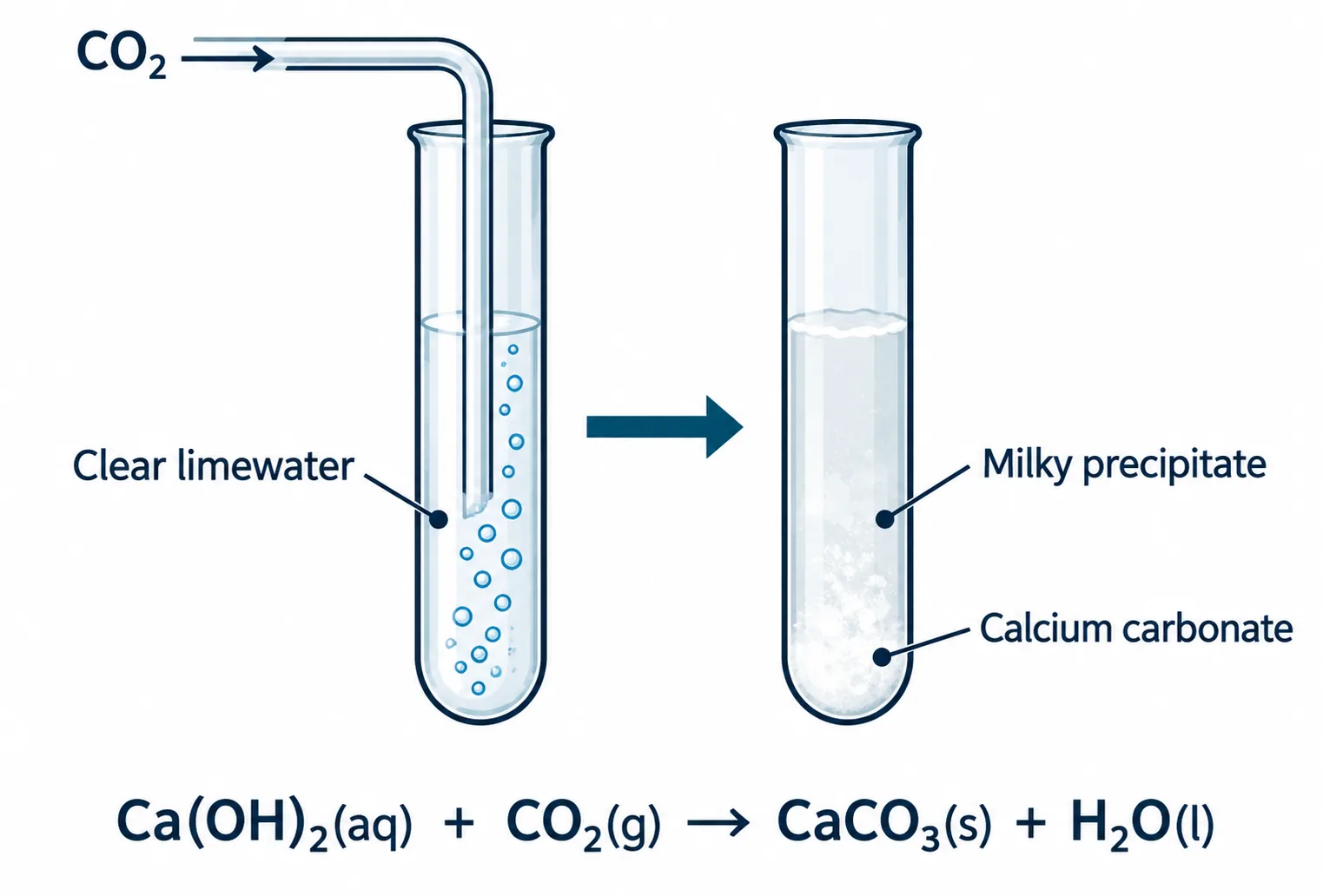
| Carbon dioxide | Bubble through limewater | Limewater turns cloudy |
| Chlorine | Damp blue litmus paper | Paper bleached white |
Section 6 of 7Key terms
| Term | Meaning |
|---|---|
| Squeaky pop | The sound made when hydrogen burns rapidly with oxygen. |
| Lit splint | A burning wooden splint used to test for hydrogen. |
| Glowing splint | A splint with a glowing end but no flame, used to test for oxygen. |
| Combustion | Burning, a reaction with oxygen that releases energy. |
Section 7 of 7Exam technique
1
Confusing the splint tests. A lit splint is for hydrogen, and a glowing splint is for oxygen.
2
Pushing the splint far into the tube so the flame is starved of air.
3
Describing the result as just an explosion instead of a squeaky pop.
4
Forgetting that the product of the burning is water.