1.2.8Chemical Substances, Reactions and Essential Resources
Reactions of Halogens
5 min read 8 parts Lesson 20 of 46 1 quiz
Section 1 of 8Halogens with Group 1 metals
What forms
- What forms A halogen and an alkali metal combine to make an ionic metal halide, which is a salt.
- Each halogen atom gains one electron and each metal atom loses one, so the compound contains M+ and X- ions.
Example equations
- Example equations sodium + chlorine → sodium chloride: 2Na + Cl2 → 2NaCl
- lithium + bromine → lithium bromide: 2Li + Br2 → 2LiBr
- potassium + iodine → potassium iodide: 2K + I2 → 2KI
Flame colours
- Flame colours Lithium compounds burn with a crimson flame, sodium with an orange flame and potassium with a lilac flame, whichever halogen is used.
Safety and trend
- Safety and trend The halogens are toxic, so these reactions must be done in a fume cupboard.
- Reactivity decreases down Group 7, so the reactions become less vigorous from chlorine to bromine to iodine.
Section 2 of 8Halogens with iron
| Halogen | What is seen with heated iron wool | Product |
|---|---|---|
| Fluorine | Even cold iron wool burns | White iron(III) fluoride |
| Chlorine | Hot iron wool burns vigorously | Orange-brown iron(III) chloride |
| Bromine | Hot iron wool burns vigorously | Orange-brown iron(III) bromide |
| Iodine | Hot iron wool reacts slowly with the vapour | Grey iron(III) iodide |
Section 3 of 8Equation and trend for iron

1
Iron reacts with a halogen to make an iron(III) halide, so the formula needs three halogen atoms for each iron atom.
2
Word equation for chlorine: iron + chlorine → iron(III) chloride.
3
Balanced symbol equation: 2Fe + 3Cl2 → 2FeCl3.
4
The reaction is done in a fume cupboard and becomes less vigorous down the group, matching the fall in reactivity.
Section 4 of 8Displacement reactions (HT only)
1Mix
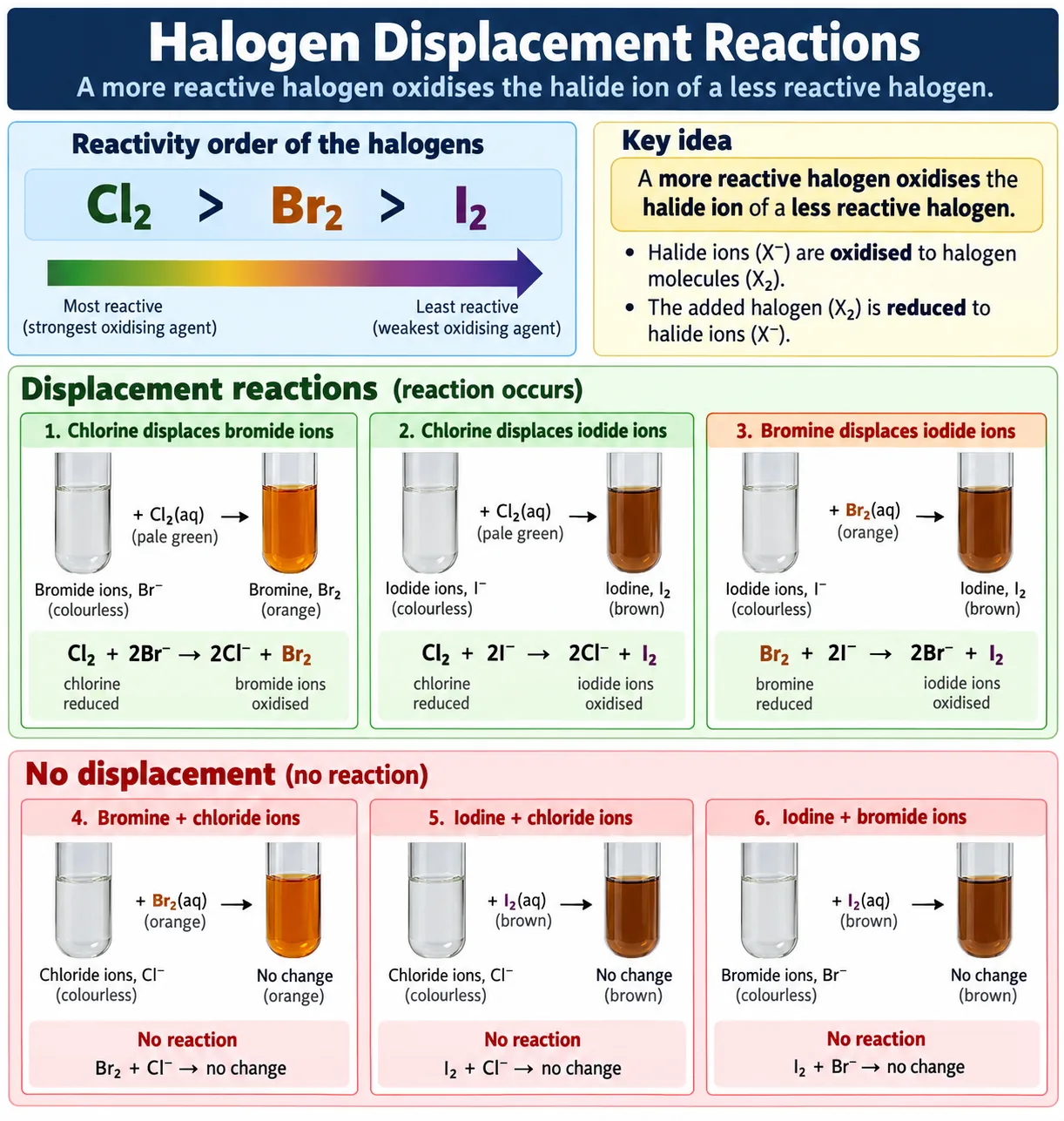
- Mix A halogen solution is added to a colourless solution of a halide salt, such as potassium bromide.
2Compete
- Compete The more reactive halogen takes the place of the less reactive halogen in the compound.
3Observe
- Observe The freed halogen colours the solution: orange for bromine, brown for iodine.
4Conclude
- Conclude A reaction means the added halogen is more reactive; no change means it is less reactive.
Section 5 of 8Displacement results and equations (HT only)
| Reaction | Observation | Equation |
|---|---|---|
| Chlorine + potassium bromide | Solution turns orange | Cl2 + 2KBr → 2KCl + Br2 |
| Chlorine + potassium iodide | Solution turns brown | Cl2 + 2KI → 2KCl + I2 |
| Bromine + potassium iodide | Solution turns brown | Br2 + 2KI → 2KBr + I2 |
| Bromine + potassium chloride | No reaction | Bromine is less reactive than chlorine |
| Iodine + potassium bromide or chloride | No reaction | Iodine is the least reactive of the three |
Section 6 of 8Why displacement is better evidence (HT only) and uses
Predictions
- Predictions Fluorine should displace every other halogen from its compounds, and astatine should be displaced by all of them.
- Astatine is so rare that these predictions cannot be tested.
Stronger evidence
- Stronger evidence The halogens are different states at room temperature, so heating them with iron is not a fair comparison.
- In displacement reactions the halogens compete directly in the same solution, which gives better evidence for the trend.
Chlorine and iodine
- Chlorine and iodine Both are diatomic and toxic,
- but chlorine is a green-yellow gas while iodine is a dark grey solid that gives a purple vapour when warmed.
- Chlorine sterilises drinking water and swimming pools; iodine is used as an antiseptic. Levels must be monitored because both are toxic.
Section 7 of 8Key terms
| Term | Meaning |
|---|---|
| Halogen | An element in Group 7 of the periodic table; they exist as diatomic molecules. |
| Metal halide | An ionic salt made from a metal and a halogen, such as sodium chloride. |
| Displacement reaction | A reaction in which a more reactive element takes the place of a less reactive one in a compound. |
| Diatomic | Made of molecules containing two atoms joined together, such as Cl2. |
| Fume cupboard | A ventilated enclosure that removes toxic gases and vapours during an experiment. |
Section 8 of 8Exam technique
1
Writing chlorine as Cl instead of Cl2 in equations - halogens are diatomic, so the equation will not balance otherwise.
2
Saying reactivity increases down Group 7 - it decreases, so fluorine is the most reactive.
3
Predicting that iodine displaces bromine - a halogen can only displace one below it in the group.
4
Forgetting that iron forms iron(III) halides with halogens, giving FeCl3 rather than FeCl2.