1.4.7Chemical Substances, Reactions and Essential Resources
Testing for Oxygen and Carbon Dioxide
5 min read 8 parts Lesson 40 of 46 1 quiz
Section 1 of 8Test for oxygen

1
Collect the gas in a test tube.
2
Light a wooden splint, then blow out the flame so the end is glowing.
3
Place the glowing splint inside the test tube of gas.
4
Positive result: the glowing splint relights, which shows the gas is oxygen.
Section 2 of 8Test for carbon dioxide
1
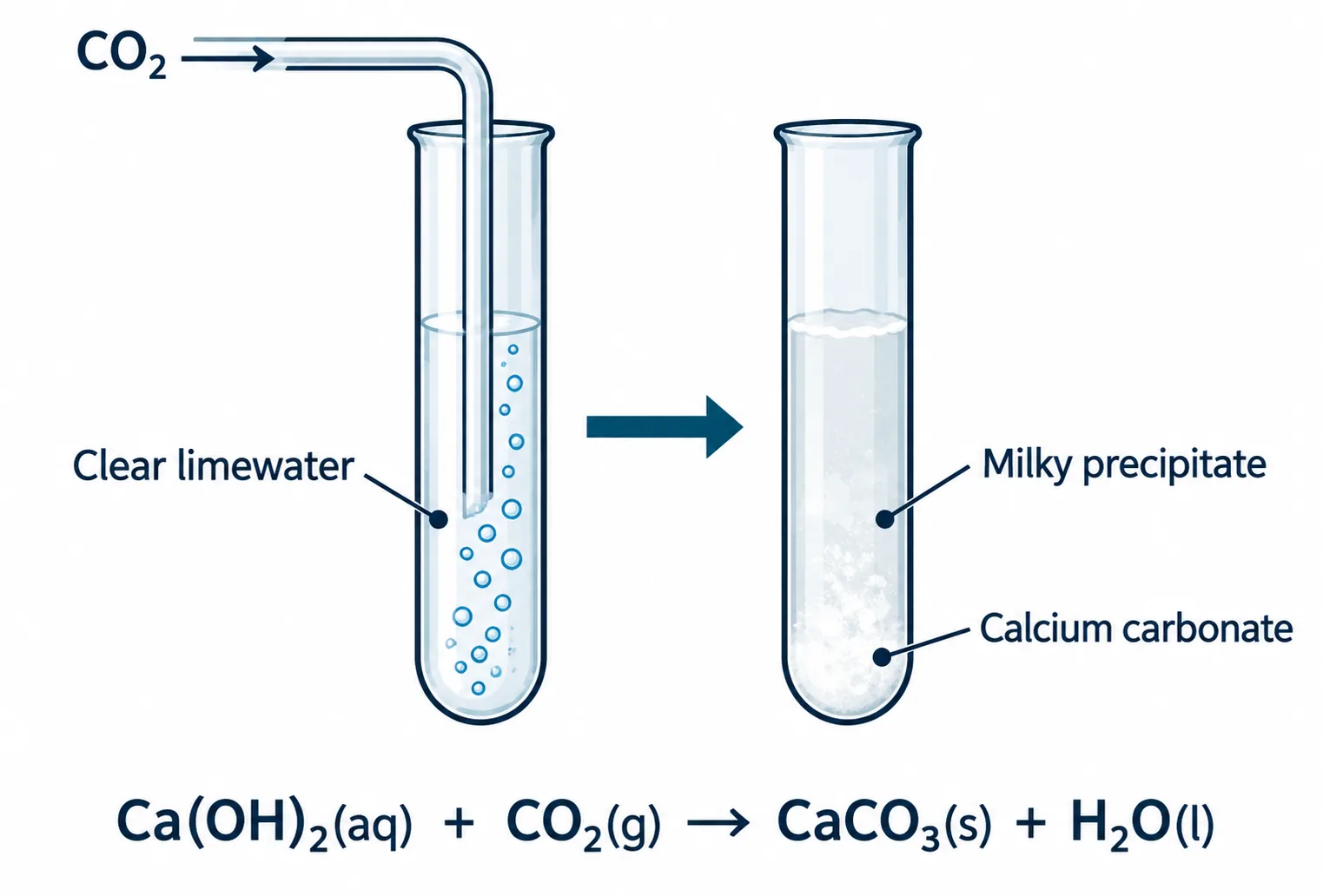
Prepare limewater, which is an aqueous solution of calcium hydroxide.
2
Bubble the gas through the limewater.
3
Positive result: the limewater turns milky or cloudy.
4
The cloudiness is a fine white precipitate of calcium carbonate: Ca(OH)2(aq) + CO2(g) → CaCO3(s) + H2O(l).
Section 3 of 8Results at a glance
| Gas | Test | Positive result |
|---|---|---|
| Oxygen, O2 | Glowing splint placed in the gas | Splint relights |
| Carbon dioxide, CO2 | Gas bubbled through limewater | Limewater turns cloudy or milky |
Section 4 of 8Why each test works
1Oxygen supports burning
- Oxygen supports burning Pure oxygen makes substances burn much more strongly than the oxygen in air, which is only about one-fifth of the mixture.
2Glowing splint reignites
- Glowing splint reignites The extra oxygen at the glowing tip lets the wood burn with a flame again, so the splint relights.
3Carbon dioxide reacts with limewater
- Carbon dioxide reacts with limewater Carbon dioxide reacts with dissolved calcium hydroxide to make calcium carbonate, which is insoluble in water.
4Solid scatters light
- Solid scatters light The tiny particles of calcium carbonate are suspended in the liquid, so it looks milky or cloudy.
Section 5 of 8Carrying out the tests safely
Collecting the gas
- Collecting the gas Gas can be collected in an upturned test tube or a gas syringe, and a bung helps to stop it escaping before you test it.
- Test oxygen straight away because the gas mixes with air quickly.
Limewater care
- Limewater care Limewater is an alkali and mild irritant, so wear eye protection.
- Use a delivery tube that dips well below the surface so the gas has to bubble through the solution.
Excess carbon dioxide
- Excess carbon dioxide If carbon dioxide continues to be bubbled through for a long time the cloudiness can disappear again,
- so look carefully at the first change.
Section 6 of 8Exam wording and common errors
A flame going out proves nothing
- A flame going out proves nothing A burning splint is extinguished by any gas that cannot support combustion, including nitrogen.
- It only shows oxygen is lacking, so never give it as the test for carbon dioxide.
Relighting wording
- Relighting wording Sometimes the splint just glows brighter, which is still a positive result.
- In an exam, state that oxygen relights a glowing splint.
Describing limewater
- Describing limewater Say that it turns cloudy or milky, not that it goes white or that the gas turns it cloudy without naming limewater.
- Make sure you say the gas is bubbled through the solution.
Section 7 of 8Key terms
| Term | Meaning |
|---|---|
| Limewater | A solution of calcium hydroxide used to test for carbon dioxide. |
| Glowing splint | A wooden splint that has been lit and blown out so the end still glows. |
| Precipitate | A fine insoluble solid formed in a solution. |
| Calcium carbonate | The white insoluble solid that makes limewater cloudy. |
Section 8 of 8Exam technique
1
Using a burning splint that goes out as the test for carbon dioxide - other gases such as nitrogen do the same.
2
Using a lit, flaming splint for oxygen instead of a glowing one.
3
Saying limewater turns clear when carbon dioxide is added - it turns cloudy or milky.
4
Not naming the reagent - say the gas is bubbled through limewater, not just 'a test solution'.