1.5.2Chemical Substances, Reactions and Essential Resources
Factors Affecting Rates
5 min read 7 parts Lesson 42 of 46 1 quiz
Section 1 of 7The four factors

Rate of reaction
Concentration or pressure
- Concentration or pressure Raising the concentration of a solution, or the pressure of a gas, increases the rate.
Temperature
- Temperature Raising the temperature of the reacting mixture increases the rate.
Surface area
- Surface area Increasing the surface area of a solid reactant, for example by using powder instead of lumps, increases the rate.
Catalyst
- Catalyst A catalyst speeds up a reaction without being used up.
Section 2 of 7Reading a rate graph

1
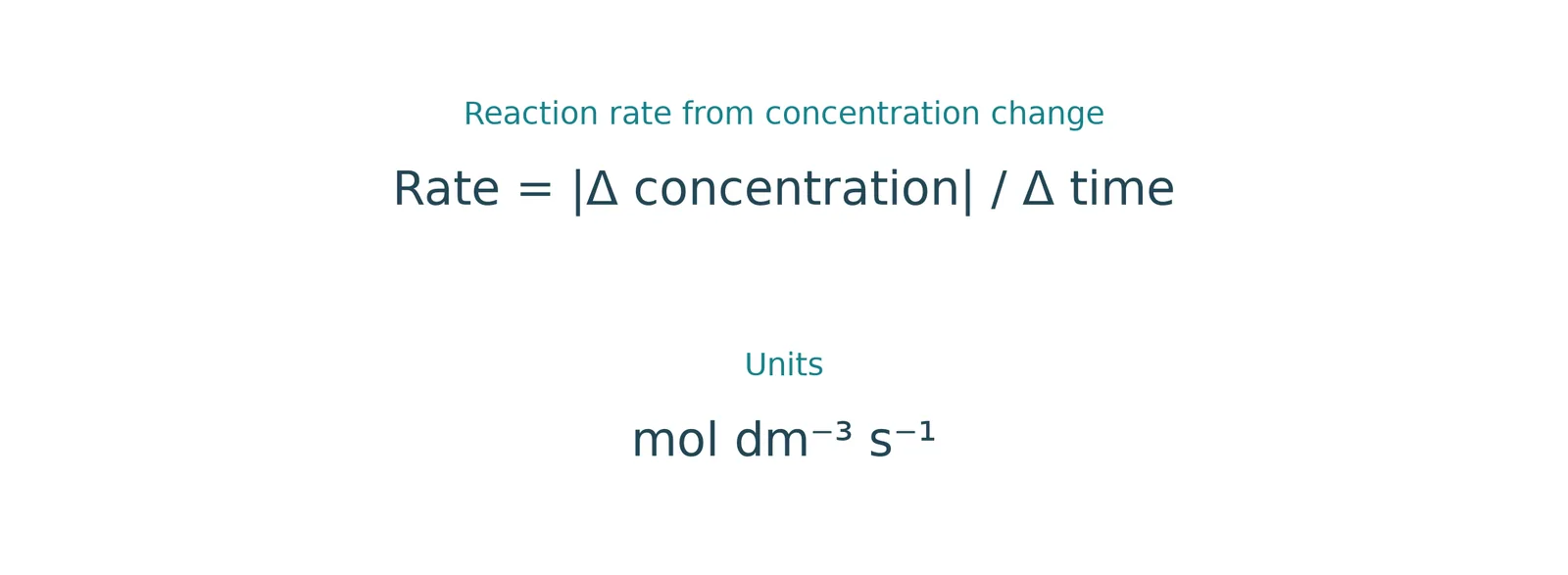
Plot the amount of product (or the mass lost) on the y-axis against time on the x-axis.
2
A faster reaction gives a steeper line at the start, because more product forms each second.
3
A faster reaction reaches a flat line sooner, because the reactants are used up earlier.
4
If the quantities of reactants are the same, the final amount of product is the same for every line.
5
Compare gradients at the same time on each curve to rank the rates.
Section 3 of 7Comparing the graphs
| Change made | Gradient at the start | When the line levels off | Total product |
|---|---|---|---|
| Higher concentration or pressure | Steeper | Sooner | Same |
| Higher temperature | Steeper | Sooner | Same |
| Larger surface area (powder) | Steeper | Sooner | Same |
| Lower concentration, temperature or surface area | Shallower | Later | Same |
Section 4 of 7Surface area and particle size
Smaller pieces
- Smaller pieces Surface area increases as particle size decreases, so smaller pieces react faster.
- Cutting a solid into smaller pieces exposes more of its particles to the other reactant.
Worked example
- Worked example A cube of side 2 cm has 6 faces of 4 cm2, so a surface area of 24 cm2.
- Cut into eight cubes of side 1 cm, the total surface area is 8 × 6 × 1 = 48 cm2, twice as much.
Section 5 of 7Answering questions well
Say per unit volume
- Say per unit volume For concentration or pressure, write that there are more particles per unit volume, usually per cm3, not just more particles.
Apply in reverse
- Apply in reverse Questions may involve decreasing a factor, so a lower temperature, concentration or surface area gives a slower reaction.
Control variables
- Control variables When testing one factor, keep the others the same so the comparison is fair.
Section 6 of 7Key terms
| Term | Meaning |
|---|---|
| Rate of reaction | How quickly reactants are used up or products are formed. |
| Catalyst | A substance that increases the rate of a reaction and is not used up. |
| Surface area | The total area of the outside of a solid that is exposed to other reactants. |
| Gradient | The steepness of a line on a graph; a steep line means a fast reaction. |
Section 7 of 7Exam technique
1
Saying a faster reaction makes more product - the final amount is unchanged if the quantities of reactants are the same.
2
Writing 'more particles' instead of 'more particles per unit volume' for concentration.
3
Believing a catalyst is used up - it is unchanged at the end.
4
Reading the rate from the height of the line - the rate is the steepness of the line.