1.5.4Chemical Substances, Reactions and Essential Resources
Particle Theory
5 min read 7 parts Lesson 44 of 46 1 quiz
Section 1 of 7Collision theory

Reactions need collisions
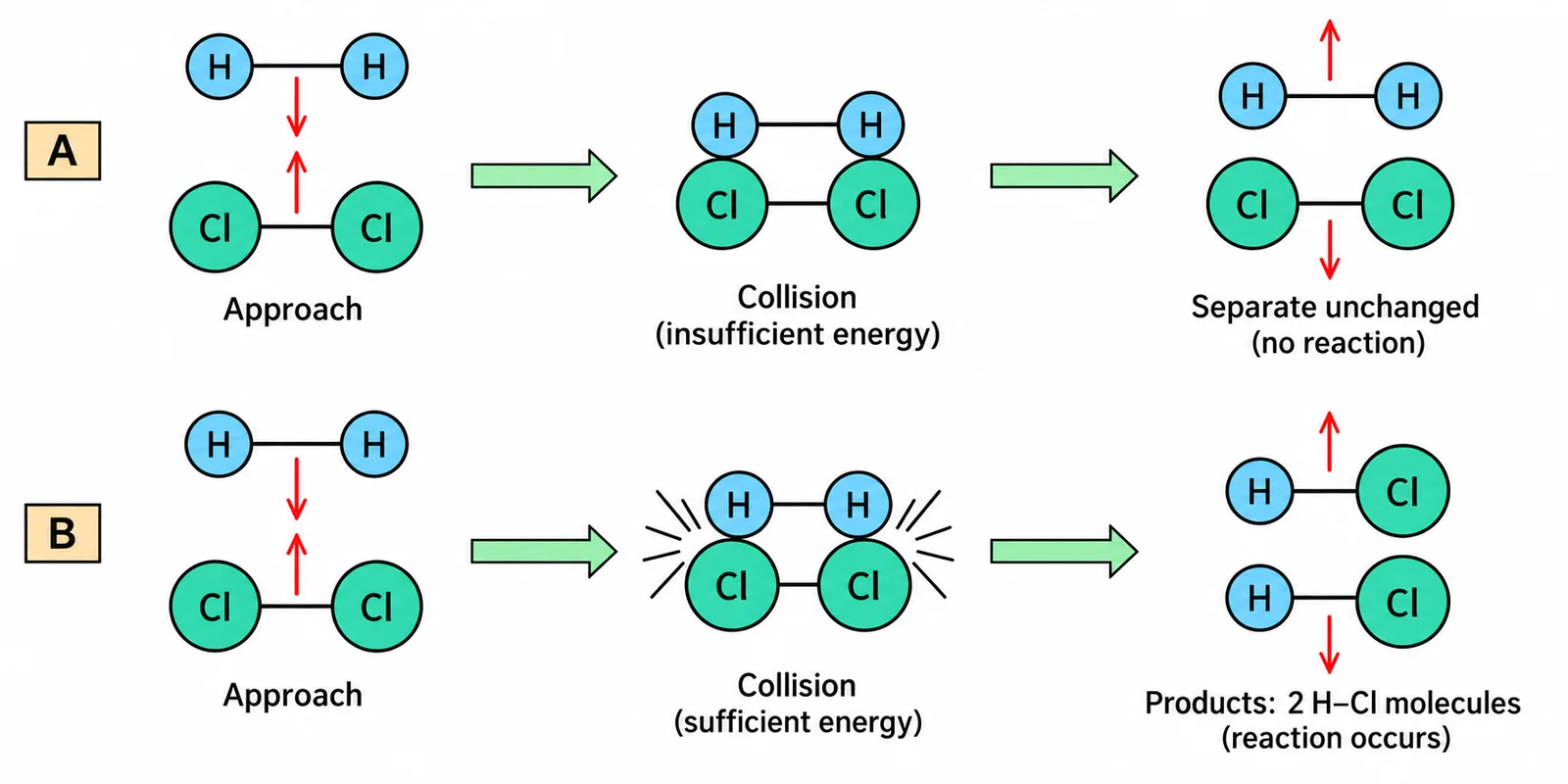
- Reactions need collisions A reaction can only happen when reactant particles collide with each other.
- A successful collision rearranges the atoms to form products, while an unsuccessful one makes the particles bounce apart unchanged.
Rate of reaction
- Rate of reaction The more frequent the successful collisions, the faster the reaction.
- Each factor that raises the rate does so by increasing the number of successful collisions per second.
Section 2 of 7Explaining each factor
| Factor increased | What changes | Result |
|---|---|---|
| Concentration | More particles in each unit volume | More collisions per second, so a faster rate |
| Pressure of a gas | The same particles squeezed into a smaller volume | More collisions per second, so a faster rate |
| Temperature | Particles have more kinetic energy and move faster | More frequent, and more successful, collisions |
| Surface area of a solid | More of the solid exposed to the other reactant | More collisions per second, so a faster rate |
Section 3 of 7Proportionality and temperature
Doubling concentration
- Doubling concentration Doubling the number of particles in a given volume doubles the collisions per second.
- Doubling the surface area likewise doubles the collision rate.
Temperature is different
- Temperature is different A small rise in temperature gives a large rise in rate.
- For aqueous and gaseous systems, a rough guide is that every 10 °C rise approximately doubles the rate of reaction.
Section 4 of 7Activation energy (HT only)

1Energy needed
- Energy needed Particles must collide with at least a minimum energy, called the activation energy, to react.
2Too little energy
- Too little energy Collisions below this energy are unsuccessful and the particles just bounce off.
3Enough energy
- Enough energy Collisions with energy equal to or above it are successful and products form.
4High activation energy
- High activation energy If the activation energy is high, fewer collisions succeed and the reaction is slower.
Section 5 of 7Which factors change energy (HT only)

Rate depends on successful collisions per second
Concentration, pressure and surface area
- Concentration, pressure and surface area These only change the number of collisions, not the energy of each collision.
Temperature
- Temperature It is the only one that directly changes the energy of collisions, because thermal energy becomes kinetic energy.
- It increases both the frequency of collisions and the proportion with energy above the activation energy.
Exam wording
- Exam wording Say 'more frequent successful collisions' rather than just 'more collisions'.
Section 6 of 7Key terms
| Term | Meaning |
|---|---|
| Collision theory | The idea that reactions happen when particles collide with enough energy. |
| Successful collision | A collision that results in the reactants forming products. |
| Activation energy | The minimum energy particles need when they collide in order to react. |
| Kinetic energy | The energy a particle has because it is moving. |
| Frequency of collisions | The number of collisions per second. |
Section 7 of 7Exam technique
1
Saying particles collide harder when concentration increases - only the number of collisions changes, not their energy.
2
Explaining the effect of temperature only by faster particles; also mention the greater proportion of collisions that are successful.
3
Writing 'more particles' instead of 'more particles per unit volume' for concentration and pressure.
4
Thinking every collision causes a reaction - many collisions are unsuccessful.