2.1.4Chemical Bonding, Application Of Chemical Reactions and Organic Chemistry
Giant Ionic Structures
10 min read 8 parts Lesson 5 of 54 1 quiz
Section 1 of 8Giant Ionic Structures
Essential knowledge
In diamond every carbon atom is joined to four others by strong covalent bonds, giving a rigid 3D tetrahedral network.
Diamond is extremely hard, so it is used in cutting tools and drill bits; it does not conduct because all outer electrons are used in bonding.
In graphite each carbon atom is bonded to three others, forming flat layers of hexagonal rings.
The fourth outer electron on each carbon in graphite is delocalised and can move along the layers, so graphite conducts electricity; it is used for electrodes.
Layers in graphite are held together by weak forces, so they slide over one another; graphite is used as a lubricant.
Both allotropes have very high melting points because a lot of energy is needed to break the many strong covalent bonds throughout the structure.
Giant covalent substances are insoluble in water.
(Supplement) Silicon(IV) oxide (e.g. sand, quartz) has a diamond-like structure: hard, very high melting point, does not conduct.
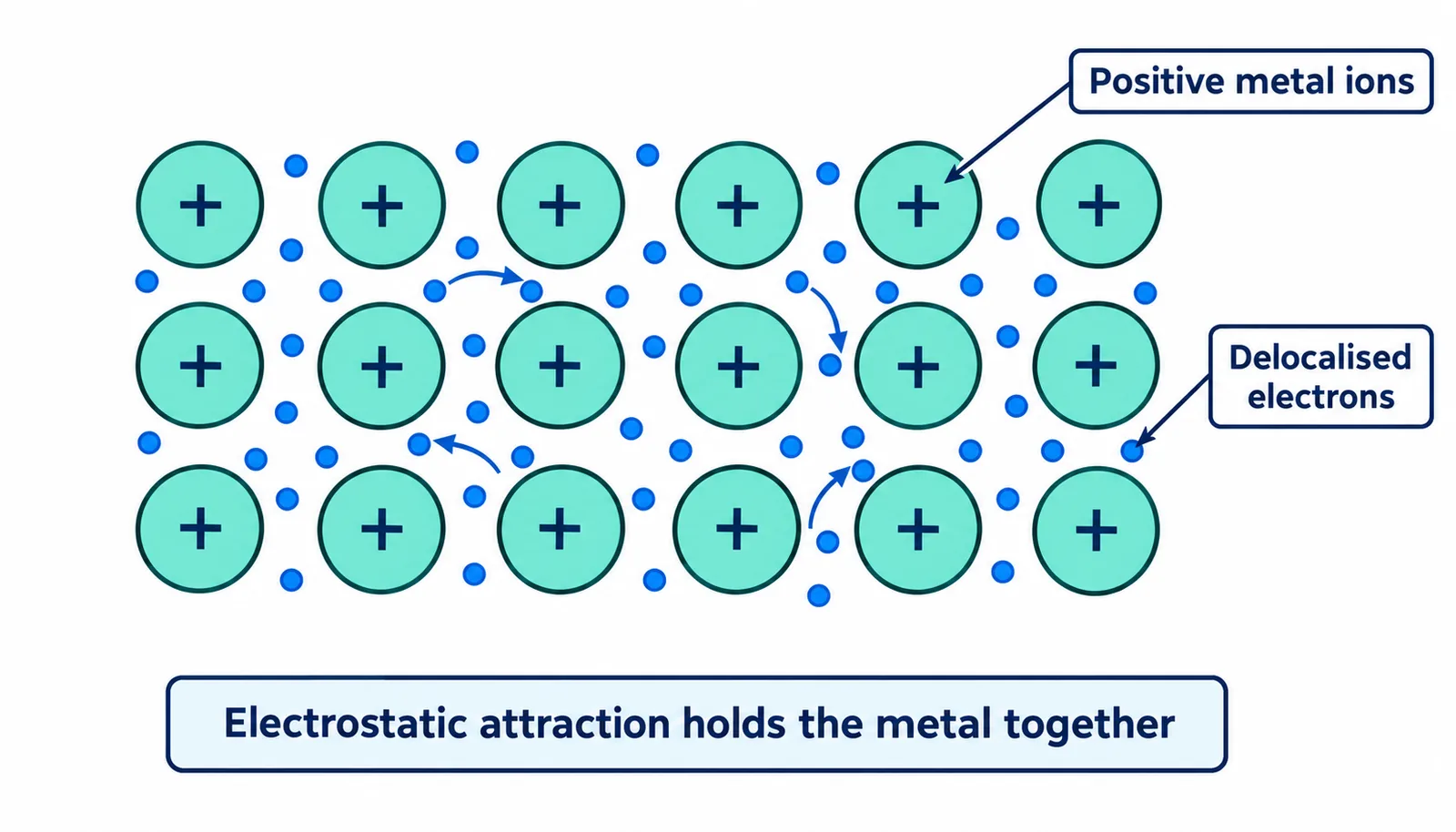
(Supplement) In metallic bonding, metal atoms lose their outer electrons to form positive ions arranged in a regular lattice, surrounded by delocalised electrons.
(Supplement) Metals are good electrical conductors because the delocalised electrons are free to move; they are malleable and ductile because layers of ions can slide while the electron sea keeps them bonded.
Supplement
Because silicon(IV) oxide is hard, cheap (it occurs naturally as sand) and has a very high melting point, it is used as the abrasive on sandpaper and to line furnaces.
Section 2 of 8Process & sequence
- Identify the particles in the substanceions, molecules, atoms or metal ions with electrons.
- Identify the type of bondingionic, covalent (between atoms or only within molecules) or metallic.
- Decide what must be overcome to melt it: strong bonds throughout (giant) or weak intermolecular forces (simple).
- Predict melting pointgiant structures high, simple molecular low.
- Check for mobile charged particles (delocalised electrons or free ions) to predict conductivity.
- Link properties to uses (e.g. hardness → cutting tools; conductivity → electrodes).
Explaining metal properties (Supplement)write these steps in this order; each step is a marking point.
- Metal atoms lose outer electrons, forming positive ions.
- Ions arrange in a regular lattice.
- Released electrons become delocalised, moving freely between ions.
- Electrostatic attraction between ions and electrons = metallic bond.
- Free electrons carry current; layers slide → malleable and ductile.
Section 3 of 8Compare
| Feature | Diamond | Graphite |
|---|---|---|
| Bonds per C atom | 4 (tetrahedral) | 3 (flat hexagonal layers) |
| Delocalised electrons | None | One per C atom, move between layers |
| Hardness | Very hard | Soft, slippery layers |
| Electrical conductivity | Does not conduct | Conducts |
| Melting point | Very high | Very high |
| Uses | Cutting tools, drill tips | Electrodes, lubricant, pencils |
| Structure | Particles | Melting point | Conducts? |
|---|---|---|---|
| Giant ionic | Ions | High | Only molten or aqueous |
| Simple molecular | Molecules | Low | No |
| Giant covalent | Atoms | Very high | No (except graphite) |
| (S) Giant metallic | Positive ions + delocalised electrons | Usually high | Yes, solid and liquid |
Section 4 of 8Worked examples
1Explain why graphite conducts electricity but diamond does not.
- In graphite each C atom forms only 3 covalent bonds,
- so one outer electron per atom is delocalised and free to move through the layers, carrying charge.
- In diamond all 4 outer electrons are used in covalent bonds, so there are no free electrons.
2
(Supplement) Silicon(IV) oxide contains 1.2 × 10²³ silicon atoms. How many oxygen atoms and how many Si–O bonds are present?
- Ratio Si
- O = 1 : 2 → oxygen atoms = 2 × 1.2 × 1023 = 2.4 × 10²³.
- Each Si forms 4 Si–O bonds → bonds = 4 × 1.2 × 1023 = 4.8 × 10²³.
Section 5 of 8Keep going
Giant Structures IGCSE Chemistry 0620: what to do next
These Giant Structures IGCSE Chemistry 0620 notes covered the key ideas, worked examples and exam technique for this topic. Check your Giant Structures IGCSE Chemistry 0620 understanding with the practice questions below, then reread any Giant Structures IGCSE Chemistry 0620 point you were unsure about before moving on.
Giant Structures IGCSE Chemistry 0620: revision checklist
- Revise the main Giant Structures IGCSE Chemistry 0620 definitions until you can write them from memory.
- Practise Giant Structures IGCSE Chemistry 0620 exam questions under timed conditions.
- Link each Giant Structures IGCSE Chemistry 0620 idea to a diagram or a worked example.
- Practice: Giant Structures IGCSE Chemistry 0620 practice questions
- Previous lesson: 2.5 Simple Molecules & Covalent Bonds — 0620 Notes
- Next lesson: 2.7 Metallic bonding — 0620 Notes
- Course: Cambridge IGCSE Chemistry 0620 — all units
- Official syllabus: Cambridge IGCSE Chemistry 0620 syllabus
Section 6 of 8Key terms
Section 7 of 8Command terms
Command terms
State / Name
Give a short answer only; no explanation is needed (1 mark = 1 fact).
Define
Give the precise meaning. Learn the syllabus definitions word-for-word: every keyword in the definition is a marking point.
Describe
Say what happens / what the data show, with key features and figures. Do not give reasons.
Explain
Give reasonswhat happens AND why/how, linked with “because”, “so”, “therefore”.
Suggest
Apply knowledge to an unfamiliar situation; any sensible, scientifically-based answer can score.
Compare
Give similarities AND differences, each as a direct comparison (“X is … whereas Y is …”).
Outline
Set out the main points briefly.
Calculate
Work out from given facts; show working, give the unit and the requested significant figures.
Identify
Name/select from given information.
Predict
Give an expected result without a full justification.
Evaluate
Judge the importance or quality of the evidence/method, with reasons.
Section 8 of 8Exam technique
Keywords the mark scheme looks for in this lesson
Keywords the mark scheme looks for in this lesson
Giant covalent structure · Diamond · Graphite · Allotropes · Silicon(IV) oxide (SiO2) · Metallic bonding · Delocalised electrons · Malleable · Ductile · Lubricant · Electrical conductor
Learn each definition in the Key words tab exactly; a missing keyword in a definition usually loses the mark.
How to get full marks (examiner guidance)
1
Use the exact scientific term and learn syllabus definitions word-for-word.
2
Write “rate of … increases”, not “… increases”.
3
Say “concentration gradient”, never just “gradient”; name particles precisely (atoms, molecules, ions) — never “it”.
4
Give units with every numerical answer and use the significant figures asked for; show all working.
5
Compare = a similarity AND a difference; describe = what happens; explain = why it happens.
6
Repeats let you identify anomalies and calculate a mean — they do not make an experiment “valid”.
Words to avoid
1
diamond has strong intermolecular forcesdiamond has many strong covalent bonds (it has no molecules).
2
graphite conducts because it has free ionsgraphite conducts because it has delocalised electrons.
3
graphite is soft because its covalent bonds are weakgraphite is soft because the forces between layers are weak so the layers slide.
4
metals conduct because ions movemetals conduct because delocalised electrons move through the structure.
5
melting diamond overcomes weak forcesmelting diamond requires breaking many strong covalent bonds.