2.1.7Chemical Bonding, Application Of Chemical Reactions and Organic Chemistry
Diamond and Graphite
5 min read 7 parts Lesson 8 of 54 1 quiz
Section 1 of 7Allotropes of carbon
Same element, different structure
- Same element, different structure Diamond and graphite are allotropes: different structural forms of carbon, each made only of carbon atoms.
- Their very different physical properties come entirely from how the atoms are arranged and bonded.
Giant covalent structures
- Giant covalent structures Both contain a huge number of atoms joined by covalent bonds in a continuous lattice.
Section 2 of 7Structure of diamond

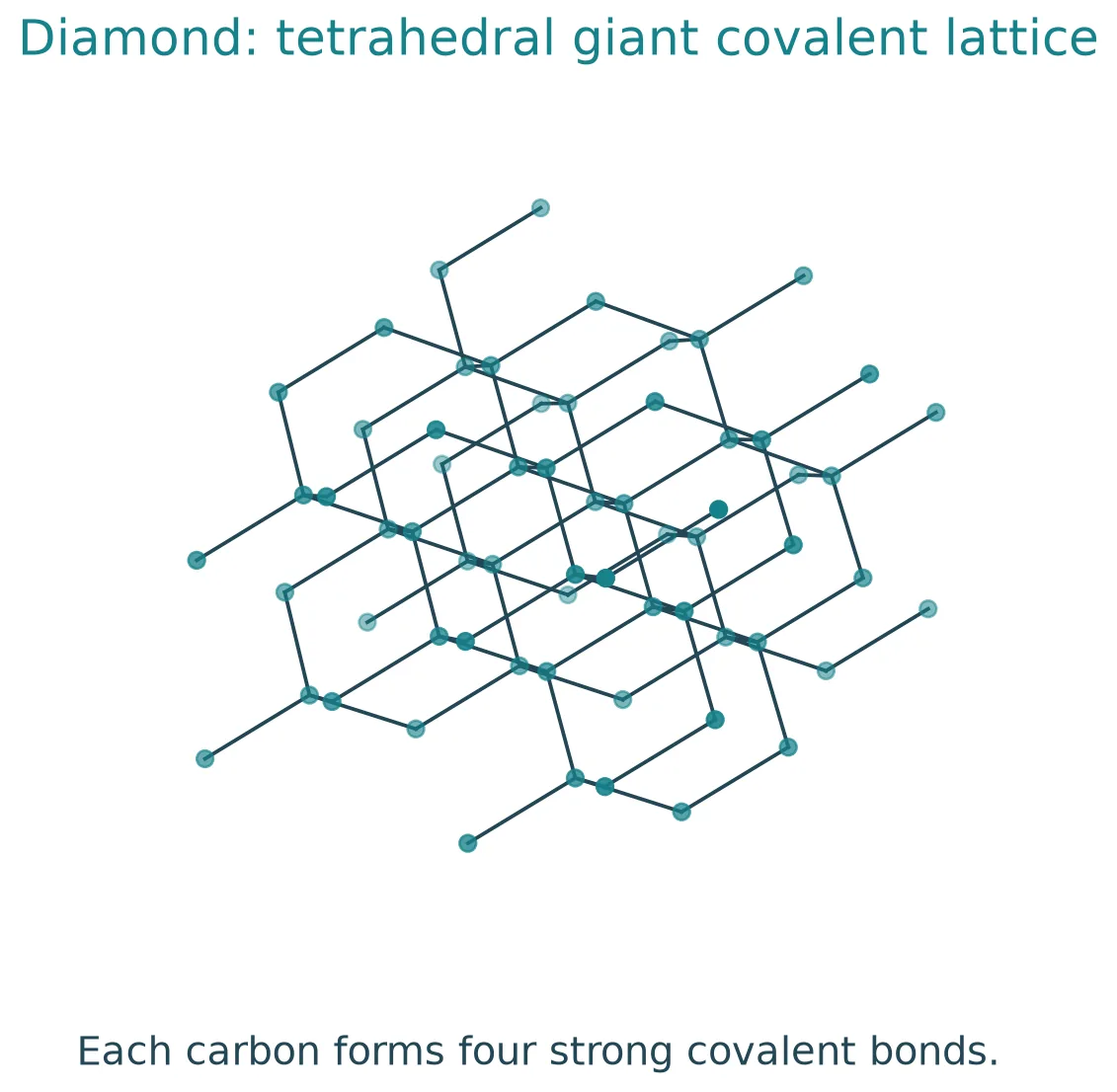
Four bonds per atom
- Four bonds per atom Each carbon atom forms four strong covalent bonds to four other carbon atoms in a tetrahedral arrangement.
- All the bonds are identical and there are no weak forces between layers, because there are no layers.
Properties
- Properties Extremely hard, because the rigid network of strong bonds resists any movement of atoms.
- Very high melting point, because a great deal of energy is needed to break so many strong covalent bonds.
- Does not conduct electricity, because all four outer electrons of each carbon are used in bonds, so there are no free charge carriers.
Uses
- Uses Cutting tools and drill tips, where hardness matters, and as gemstones.
Section 3 of 7Structure of graphite

Three bonds per atom
- Three bonds per atom Each carbon atom bonds to three others, forming flat layers of interlocking hexagons.
- The fourth outer electron of each atom is delocalised and lies between the layers.
Between the layers
- Between the layers Only weak intermolecular forces hold neighbouring layers together.
Properties
- Properties Soft and slippery, as the layers slide over each other easily.
- High melting point, since the covalent bonds within each layer are strong.
- Conducts electricity and heat, as delocalised electrons can move through the structure carrying charge.
Uses
- Uses Pencil 'leads', a lubricant for machinery and, as it conducts, electrodes.
Section 4 of 7Side-by-side comparison
| Feature | Diamond | Graphite |
|---|---|---|
| Bonds per carbon atom | 4 | 3 |
| Arrangement | Three-dimensional tetrahedral lattice | Flat hexagonal layers |
| Hardness | Very hard | Soft and slippery |
| Electrical conductivity | None | Good, through delocalised electrons |
| Melting point | Very high | Very high |
Section 5 of 7Answering explanation questions
1
State the property being asked about, for example high melting point.
2
Name the structure type: a giant covalent lattice of carbon atoms.
3
Say what must be overcome: strong covalent bonds, or in graphite's softness the weak forces between layers.
4
Link that to the energy or movement involved, such as 'a lot of energy is needed'.
5
For conductivity, name the charge carriers: delocalised electrons in graphite, none in diamond.
Section 6 of 7Key terms
| Term | Meaning |
|---|---|
| Allotrope | One of two or more different structural forms of the same element. |
| Tetrahedral | Arranged with four bonds pointing to the corners of a pyramid-shaped solid. |
| Delocalised electron | An electron that is free to move through a structure rather than being fixed in a bond. |
| Giant covalent structure | A huge lattice of atoms joined by covalent bonds. |
| Lubricant | A substance that reduces friction between moving surfaces. |
Section 7 of 7Exam technique
1
Confusing 'hard' with 'strong' — diamond is hard but can still shatter; the opposite of hard is soft.
2
Saying graphite is slippery because its covalent bonds are weak — the bonds within layers are strong; it is the forces between layers that are weak.
3
Mixing up pencil lead with the metal lead — pencils contain graphite.
4
Stating that diamond conducts because it has electrons — all its outer electrons are held in bonds.
5
Explaining the melting point of graphite by breaking layers apart only; the strong covalent bonds must also be broken.