2.5.12Chemical Bonding, Application Of Chemical Reactions and Organic Chemistry
Addition Polymerisation
5 min read 7 parts Lesson 52 of 54 2 quizzes
Section 1 of 7Monomers and polymers
Monomer
- Monomer A monomer is a small, reactive molecule containing a carbon-carbon double bond, C=C.
- Alkenes are the usual monomers.
Polymer
- Polymer A polymer is a very long molecule made of thousands of monomer units joined end to end.
Why they join
- Why they join The reactivity comes from the double bond.
- One of the two bonds in each C=C breaks open, and each carbon can then bond to a neighbouring monomer.
The product
- The product Only single bonds remain, so a polymer made from an alkene is saturated and usually unreactive.
Section 2 of 7What happens during the reaction
1Double bond opens
- Double bond opens One bond of each C=C breaks, leaving each carbon with a free bond.
2Monomers link
- Monomers link The free bonds join to the next monomer's carbons, forming a C−C single bond between units.
3Chain grows
- Chain grows This repeats thousands of times to build a long chain.
4No other product
- No other product Nothing is lost, so the polymer is the only product;
- this is why the process is called addition.
Section 3 of 7Common addition polymers

| Monomer | Polymer |
|---|---|
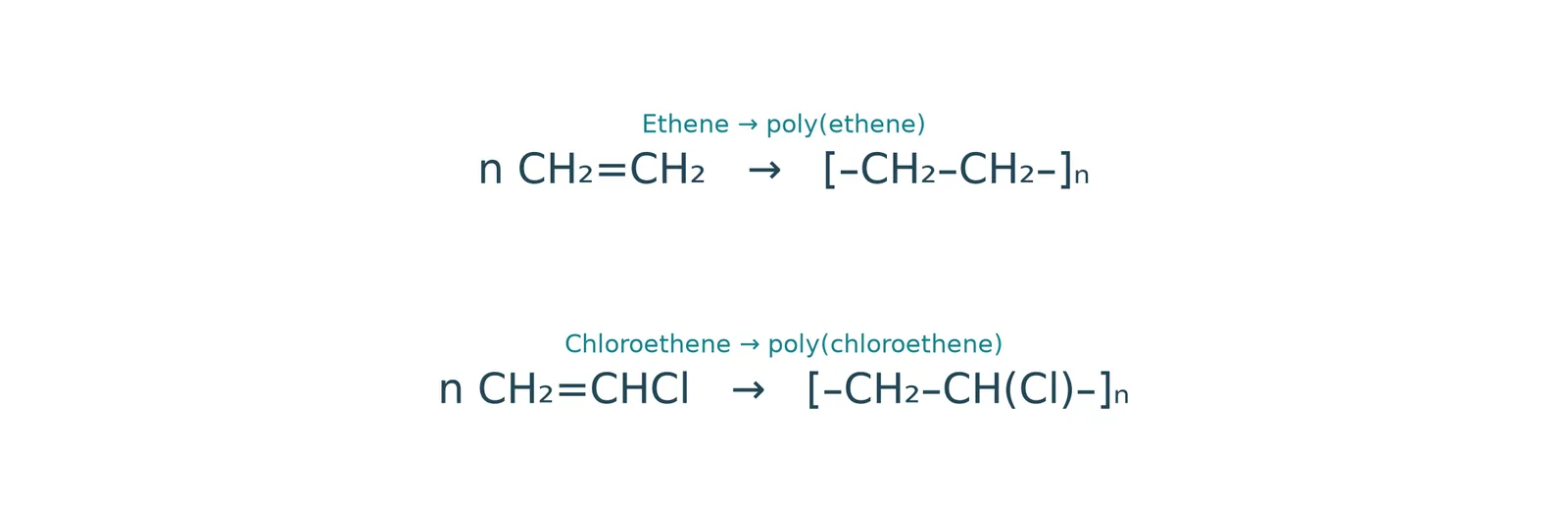
| ethene | poly(ethene), usually called polythene |
| propene | poly(propene) |
| chloroethene (vinyl chloride) | poly(chloroethene), also called PVC |
| tetrafluoroethene | poly(tetrafluoroethene), also called PTFE |
Section 4 of 7Writing an equation
1
Draw the monomer's structural formula with the C=C shown, and put a lower-case n in front of it to show that many molecules react.
2
Write an arrow, then draw the same atoms as the repeat unit, but with a single C−C bond between the two carbons.
3
Put large brackets around the repeat unit.
4
Extend one single bond from each carbon through the bracket; these are the continuation bonds.
5
Write a small n after the closing bracket to show the unit is repeated n times.
Section 5 of 7Naming and examples
Poly(...)
Naming rule
- Naming rule Put the monomer's name in brackets after the prefix poly-.
- The one exception is poly(ethene), which is usually called polythene.
Ethene
- Ethene n CH2=CH2 → (−CH2−CH2−)n
Propene
- Propene n CH3−CH=CH2 → (−CH(CH3)−CH2−)n, with a methyl group on every other carbon.
Check yourself
- Check yourself Know the structural formulae of ethene, propene, chloroethene and tetrafluoroethene, and be able to show each reacting as n molecules.
Section 6 of 7Key terms
| Term | Meaning |
|---|---|
| Monomer | A small molecule, with a C=C bond, that can join with many others to form a polymer. |
| Polymer | A long molecule made from many repeating monomer units. |
| Addition polymerisation | A reaction in which many alkene monomers join together without any other product. |
| Repeat unit | The section of a polymer chain that is repeated along its length. |
| Continuation bonds | The bonds drawn through the brackets showing the chain carries on in both directions. |
Section 7 of 7Exam technique
1
Leaving the double bond in the polymer. The polymer contains only single bonds.
2
Forgetting the continuation bonds through the brackets, or the n outside them.
3
Writing the product as a small molecule. The polymer repeat unit has the same atoms as the monomer, just rearranged.
4
Naming the polymer after the wrong molecule; poly(propene) comes from propene, not propane.