2.5.14Chemical Bonding, Application Of Chemical Reactions and Organic Chemistry
Plastics
5 min read 4 parts Lesson 54 of 54 1 quiz
Section 1 of 4Addition polymerisation

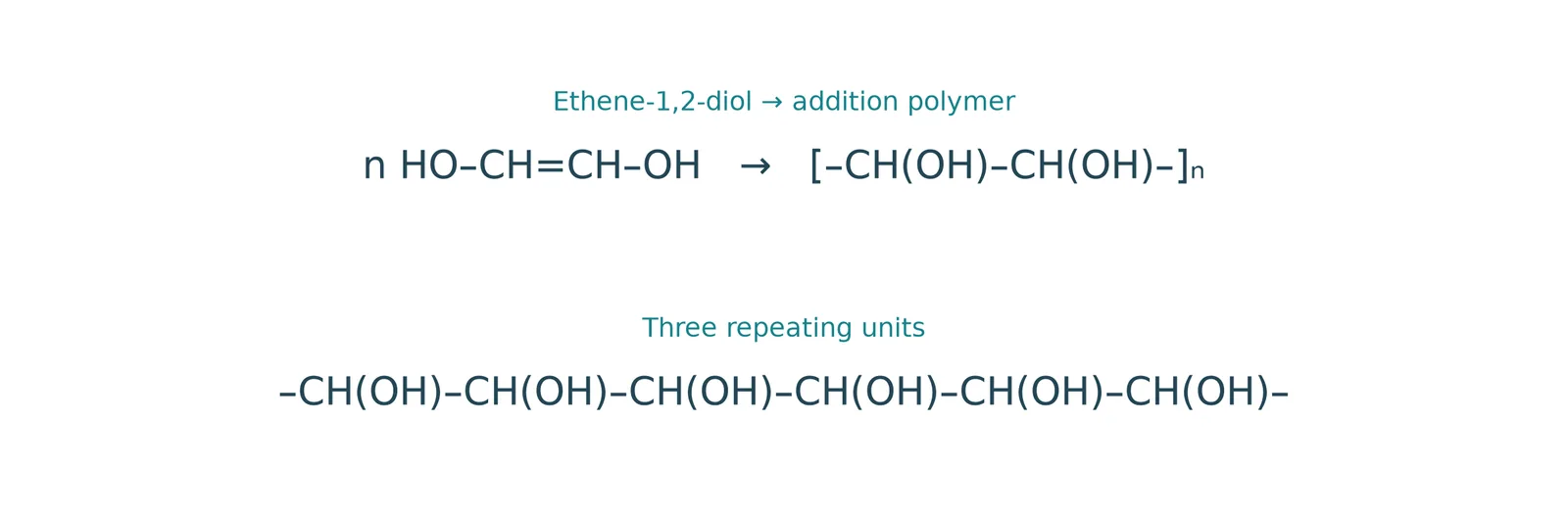

1Polymers
Polymers are long-chain molecules formed by joining together many small reactive molecules called monomers.
2Addition polymerisation
- Monomers must contain a carbon-carbon double bond (C=C) (alkenes).
- During polymerisation, the double bond opens up to form single bonds linking adjacent monomer units.
- ExamplePoly(ethene) from ethene: n(CH2=CH2) → -[CH2-CH2]n-
3Naming polymers
Place the monomer name in brackets prefixed by "poly":
- Ethene → Poly(ethene)
- Propene → Poly(propene)
- Phenylethene (styrene) → Poly(phenylethene) / Polystyrene
4Deducing monomer from repeating unit
Replace the single C-C bond with a double C=C bond and remove the extension bonds.
Section 2 of 4Types of plastics and environmental impact
| Type | Structure | Thermal Behavior | Common Uses |
|---|---|---|---|
| Thermoplastic (thermosoftening) | Linear polymer chains held by weak intermolecular forces; no cross-links | Melts and softens when heated; can be reshaped repeatedly | Polythene bags, drink bottles (PET), food tubs |
| Thermosetting | Polymer chains permanently interconnected by strong covalent cross-links | Does not melt on heating; chars and decomposes at high temperature | Electrical plug sockets, saucepan handles, epoxy resins |
- Disposal issues
- Most synthetic plastics are non-biodegradable and persist in landfills or oceans for centuries.
- Incineration can produce toxic gases like hydrogen chloride or carbon monoxide.
- Biodegradable plastics made from plant starches offer eco-friendly alternatives.
Section 3 of 4Key terms
| Term | Meaning |
|---|---|
| Monomer | A small unsaturated molecule that can bond to others to form a polymer chain. |
| Repeating unit | The smallest atomic segment of a polymer chain that repeats continuously. |
| Thermoplastic | A plastic that can be softened by heating and reshaped multiple times. |
| Thermosetting | A plastic containing permanent cross-links that cannot be melted or reshaped once formed. |
Section 4 of 4Exam technique
Avoid these mistakes
Drawing double bonds in the polymer repeating unit — the double bond always becomes a single bond in the polymer.
Omitting the open-ended extension bonds outside brackets in the repeating unit structure.