Curriculum
Login

Curriculum

Chemistry

Chapter 1 - Transition Elements and Iron Metallurgy

0/28

Chapter 4 - Electrochemistry

0/33

Chapter 5 - Organic Chemistry

0/72

More lessons

0/23
Text lesson

Lesson 1 Questions: First Transition Series, Electronic Configuration and Iron Extraction

Chemistry

Lesson 1 Questions: First Transition Series, Electronic Configuration and Iron Extraction

مقدمة الدرس

مقدمة الدرس

  • ★ Comprehensive Study & Detailed Pedagogical Guide ★
  • Comprehensive Explanation Arithmetic and Geometric Sequences, Series and Summation Notation
  • Mathematics (Pure Mathematics – 2nd Secondary) | Grade 11 (2nd Secondary) | 2026 / 2027 Official Curriculum | Unit 1: Sequences & Series
  • • Define mathematical sequences formally as discrete functions whose domain is positive integers ℤ+.
  • • Determine the general term (Tn), common difference (d), and partial sums (Sn) of Arithmetic Progressions (A.P.).
  • • Insert arithmetic means between two non-equal real numbers.
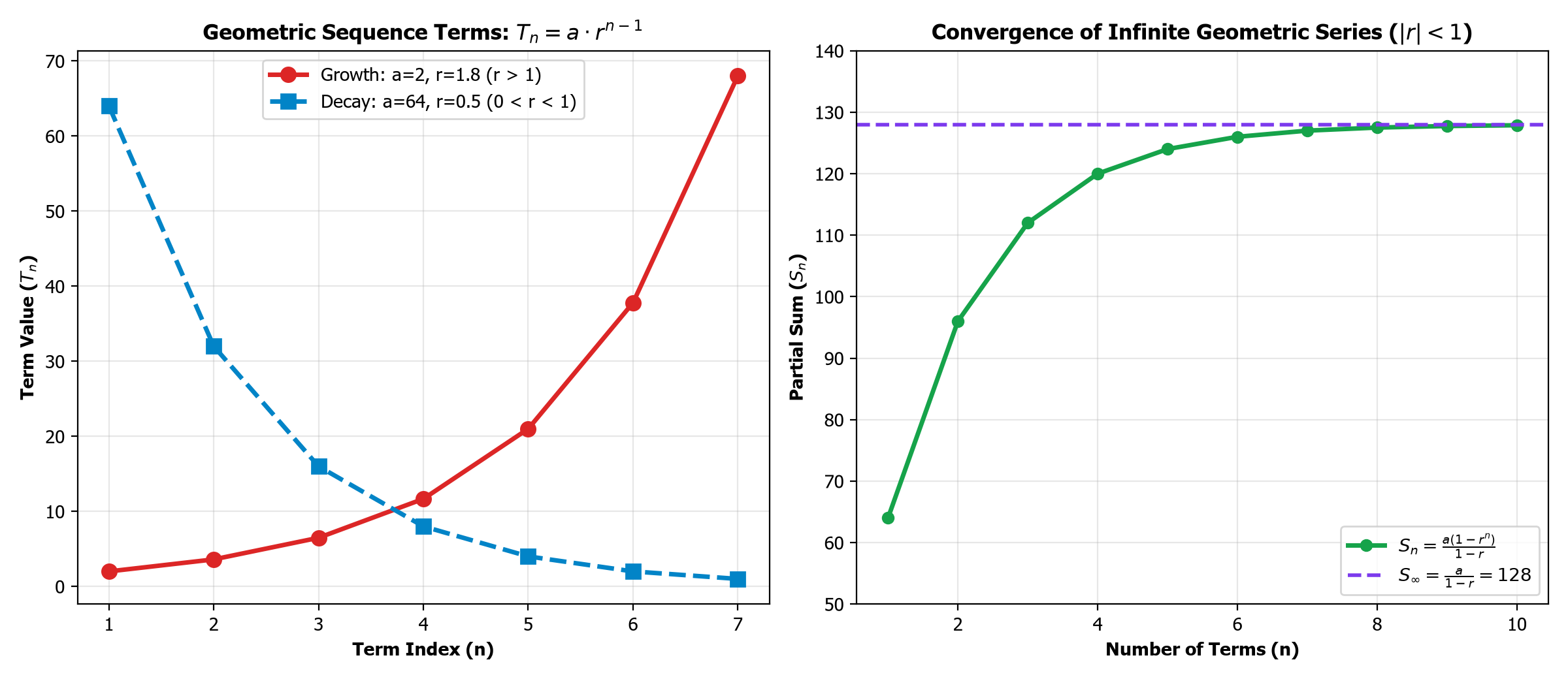
  • • Analyze Geometric Progressions (G.P.), common ratio (r), and deduce convergence to infinity (S_∞ for |r| < 1).
Figure 1 – Arithmetic Sequence Formulations and Common Difference
  • • Insert geometric means and resolve alternating and oscillating sequence behaviors.
  • • Evaluate sigma series summation notation (∑) using analytical algebraic theorems.
Lesson 1 Questions: First Transition Series, Electronic Configuration and Iron Extraction · 1 / 6
المفاهيم والمصطلحات الأساسية

المفاهيم والمصطلحات الأساسية

📖 📖 Core Terminology, Scientific Definitions & Glossaries:

Comparison aspectMain ideaKeywords
Sequence
  • A function whose domain is the set of positive integers ℤ+ = {1
  • …} and whose range is a subset of real numbers ℝ. Its terms are denoted T1
functionwhosedomainpositive
Arithmetic Sequence (A.P.)
  • A sequence in
  • the difference between any term and its immediate predecessor is a constant real number d
differencebetweentermimmediate
Geometric Sequence (G.P.)
  • A sequence in
  • the ratio of any term to its immediate predecessor is a constant non-zero real number r
ratiotermimmediatepredecessor
Arithmetic Mean
  • The arithmetic mean of two real numbers a and b is (a + b) / 2. If three numbers form an A.P. (a
  • then b = (a + c) / 2
realnumbersthreeform
Geometric Mean
  • The geometric mean of two numbers a and b of the same sign is ±√(ab). If three numbers form a G.P. (a
  • then b2 = ac
numberssamesignthree
Lesson 1 Questions: First Transition Series, Electronic Configuration and Iron Extraction · 2 / 6
الشرح والتفصيل العلمي الشامل

الشرح والتفصيل العلمي الشامل

Comparison aspectMain ideaKeywords
قانون وعلاقة حاكمة
  • ⚖️ Governing Scientific Laws
  • Theorems & Mathematical Models
GoverningScientificLawsTheorems
★ General Term of an Arithmetic Progression
  • [ Formula: Tn = a + (n – 1)d ] Where a is the first term
  • d is the common difference
  • and n is the term rank (n ∈ ℤ+)
Formulafirstcommondifference
★ Sum of First n Terms of an Arithmetic Progression[ Formula: Sn = (n / 2)[2a + (n – 1)d] = (n / 2)[a + l] ] Where l is the last term (l = Tn). Represents the area under the linear sequence staircaseFormulalastRepresentsarea
★ General Term and Infinite Sum of a Geometric Progression
  • [ Formula: Tn = a · rn – 1
  • S_∞ = a / (1 – r) (valid if and only if |r| < 1) ] If the common ratio satisfies -1 < r < 1
  • the infinite geometric series converges to a finite limiting value S_∞
Formulavalidcommonratio
  • 📌 Exhaustive In-Depth Pedagogical Breakdown:
  • ◄ 1. Sequence Foundations and Theory of Arithmetic Progressions (A.P.)
  • A sequence is formally defined as a mathematical mapping f ℤ+ -> ℝ. Unlike continuous real functions defined on intervals, a sequence consists exclusively of discrete, ordered elements. The functional value f(n) is universally designated as the n-th term, denoted Tn.
  • An Arithmetic Progression (A.P.) is defined by the invariant linear recurrence relation: T_(n+1) – Tn = d (constant common difference).
  • If d > 0, the progression is strictly increasing; if d < 0, it is strictly decreasing; if d = 0, it is a constant sequence.
Comparison aspectMain ideaKeywords
General Term Formula
  • By mathematical induction
  • T1 = a
  • T2 = a + d
  • T3 = a + 2d
  • yielding the universal general term: Tn = a + (n – 1)d. Notice that Tn is a linear polynomial in n whose leading coefficient equals d
mathematicalinductionyieldinguniversal
•Summation of an A.P. (Gauss Formula): The sum Sn = T1 + T2 + … + Tn of the first n terms can be written forwards and backwards, summing pairs to yield: 2 Sn = n(a + l) -> Sn = (n / 2)[a + l] = (n / 2)[2a + (n – 1)d], where l = Tn is the last term.SummationGaussFormulafirst
Arithmetic Means
  • When k terms are inserted between two numbers A and B to form an A.P
  • the total number of terms becomes n = k + 2. The common difference is: d = (B – A) / (k + 1). The first inserted mean is T2 = A + d
  • and the last inserted mean is T_(n-1) = B – d
termsinsertedbetweennumbers
  • Figure (Figure 1 – Arithmetic Sequence Formulations and Common Difference.png): Graphical linear plot of an arithmetic sequence showing constant slope d.
  • ◄ 2. Theory of Geometric Progressions (G.P.) and Convergence to Infinity
  • A Geometric Progression (G.P.) is characterized by an invariant multiplicative factor: T_(n+1) / Tn = r (constant common ratio, r ≠ 0).
  • General Term: T1 = a, T2 = ar, T3 = ar2, giving: Tn = a · rn – 1.
  • Partial Sum Formula Multiplying the partial sum Sn = a + ar + ar2 + … + arn−1 by r and subtracting gives: Sn – r Sn = a – a rn -> Sn = [a(1 – rn)] / (1 – r) = (a – l r) / (1 – r), where r ≠ 1.
Comparison aspectMain ideaKeywords
Infinite Series & Convergence
  • What happens when the number of terms n approaches infinity? If |r| < 1 (i.e
  • -1 < r < 1)
  • the term rn decays asymptotically to zero: lim_{n -> ∞} rn = 0. Therefore
  • the infinite sum converges to: S_∞ = lim_{n -> ∞} Sn = a / (1 – r). If |r| ≥ 1
  • rn diverges
  • and the sum to infinity does NOT exist
Whathappensnumberterms
Geometric MeansInserting k geometric means between A and B produces a G.P. of n = k + 2 terms. Common ratio: r = (B / A)1 / (k + 1))Insertingbetweenproducesterms
•Figure (Figure 2 – Geometric Sequences and Convergence to Infinity.png): Exponential decay curve of geometric sequences with ratio |r| < 1 converging to zeroFigureGeometricSequencesConvergence
Comparison aspectMain ideaKeywords
•◄ 3. Sigma Notation (∑) and Analytical Summation TheoremsSigmaNotationAnalyticalSummation
•The Greek capital letter Sigma (∑) is used to denote series sums compactly: ∑_{r=1}n Tr = T1 + T2 + … + Tn.GreekcapitalletterSigma
Analytical Summation Theorems
  • (1) Sum of a constant: ∑_{r=1}n c = c × n. (2) Linearity: ∑_{r=1}n [c · f(r)] = c · ∑_{r=1}n f(r)
  • and ∑ [f(r) ± g(r)] = ∑ f(r) ± ∑ g(r)
constantLinearity
(3) Sum of the first n positive integers∑_{r=1}n r = 1 + 2 + … + n = [n(n + 1)] / 2. (4) Sum of the first n squares: ∑_{r=1}n r2 = 12 + 22 + … + n2 = [n(n + 1)(2n + 1)] / 6squares
Index Shift Property
  • To evaluate ∑_{r=k}n Tr where k > 1
  • apply: ∑_{r=k}n Tr = ∑_{r=1}n Tr – ∑_{r=1}k−1 Tr
evaluateapply
Comparison aspectMain ideaKeywords
قانون وعلاقة حاكمةFigure (Table 1 – Summation Formulas and Mathematical Induction Rules.png): Complete reference table for arithmetic and geometric series sums and sigma algebra rulesFigureTableSummationFormulas
•🧮 Exemplary Step-by-Step Worked Problems & Applied ExercisesExemplaryStepWorkedProblems
Worked Example 1Finding the Maximum Partial Sum of an Arithmetic SequenceFindingMaximumPartialArithmetic
Problem Statement
  • Given the arithmetic progression (35
  • …): (1) Find the number of positive terms
  • (2) Calculate the maximum sum of this sequence and state how many terms must be taken to achieve it
GivenarithmeticprogressionFind
Detailed Solution & Derivation
  • Step 1: First term a = 35. Common difference d = 31 – 35 = -4. Step 2: To find the number of positive terms
  • solve Tn > 0: a + (n – 1)d > 0 -> 35 + (n – 1)(-4) > 0 -> 35 – 4n + 4 > 0 -> 39 > 4n -> n < 39/4 = 9.75. Because n ∈ ℤ+
  • the sequence has exactly 9 positive terms (T9 is positive
  • T10 is negative). Step 3: The maximum sum occurs when adding all positive terms (adding negative terms would reduce the sum). Therefore
  • n = 9 terms give the maximum sum. Step 4: Calculate S9: S9 = (9/2)[2(35) + (9 - 1)(-4)] = 4.5 [70 + 8(-4)] = 4.5 [70 - 32] = 4.5 × 38 = 171. (Note: S10 gives 171 + (-1) = 170)
StepFirsttermCommon
Comparison aspectMain ideaKeywords
Worked Example 2Geometric Sequence Formulation from ConditionsGeometricSequenceFormulationConditions
Problem Statement
  • A geometric sequence with positive terms has its second term equal to 6
  • and the sum of its third and fourth terms equals 36. Find the sequence and calculate the sum of its first 6 terms
geometricsequencepositiveterms
Detailed Solution & DerivationStep 1: T2 = a·r = 6 -> a = 6/rStep
Comparison aspectMain ideaKeywords
Step 2
  • T3 + T4 = a·r2 + a·r3 = 36 -> a·r2(1 + r) = 36. Step 3: Substitute a = 6/r: (6/r)·r2(1 + r) = 36 -> 6r(1 + r) = 36 -> r2 + r – 6 = 0. Step 4: Factor: (r + 3)(r – 2) = 0. Since terms are positive
  • r > 0
  • so r = 2 (reject r = -3)
SubstituteFactorSinceterms
Step 5a = 6/2 = 3. The sequence is: (3sequence
Step 6Sum of first 6 terms: S6 = [a(r6 – 1)] / (r – 1) = [3(26 – 1)] / (2 – 1) = 3(64 – 1) = 3 × 63 = 189firstterms
•💡 Master Teacher Insights & Critical Exam CautionsMasterTeacherInsightsCritical
★ Exam Secret
  • To find the rank of the first negative term in an A.P
  • solve Tn < 0. The first integer strictly greater than the resulting decimal fraction is the rank
findrankfirstnegative
Figure 2 – Geometric Sequences and Convergence to Infinity
  • ★ Crucial Property In any A.P., Tn = Sn – S_(n-1) for all n ≥ 2. For n = 1, T1 = S1.
  • ★ Remember that an alternating geometric sequence (r < 0) oscillates between positive and negative values.
  • If |r| < 1, it still converges to S_∞ = a / (1 - r).
  • 🌍 Practical Real-World, Industrial & Societal Connections:
  • ✔ Financial Mathematics & Compound Interest Bank investments compounding annually at interest rate i form a geometric progression: An = P(1 + i)n.
  • ✔ Nuclear Chain Reactions In uranium fission, each neutron generates 2 or 3 secondary neutrons, causing nuclear power output to expand geometrically.
  • ✔ Depreciation of Capital Assets Equipment book values diminishing at a constant annual depreciation percentage d follow a geometric decay curve: Vt = V0(1 – d)t.
Table 1 – Summation Formulas and Mathematical Induction Rules
قانون وعلاقة حاكمة→Figure (Table 1 – Summation Formulas and Mathematical Induction Rules.png): Complete reference table for arithmetic and geometric series sums and sigma algebra rules.
Geometric_Sequence_and_Infinite_Series
Comparison aspectMain ideaKeywords
★ General Term and Infinite Sum of a Geometric Progression
  • [ Formula: Tn = a · rn – 1
  • S_∞ = a / (1 – r) (valid if and only if |r| < 1) ] If the common ratio satisfies -1 < r < 1
  • the infinite geometric series converges to a finite limiting value S_∞
Formulavalidcommonratio
•Figure (Figure 2 – Geometric Sequences and Convergence to Infinity.png): Exponential decay curve of geometric sequences with ratio |r| < 1 converging to zeroFigureGeometricSequencesConvergence
Comprehensive Explanation
  • Arithmetic and Geometric Sequences
  • Series and Summation Notation
ArithmeticGeometricSequencesSeries
Lesson 1 Questions: First Transition Series, Electronic Configuration and Iron Extraction · 3 / 6
المقارنات وخريطة المفاهيم الجوهرية

المقارنات وخريطة المفاهيم الجوهرية

🗺️ ★ High-Yield Summary, Mind Maps & Comparison Tables ★

  • Summary Arithmetic and Geometric Sequences, Series and Summation Notation
  • Mathematics (Pure Mathematics – 2nd Secondary) | Grade 11 (2nd Secondary) | 2026 / 2027 Official Curriculum | Unit 1: Sequences & Series
  • 🗺️ Core Concept Map & Knowledge Architecture:
  • ✔ Sequence Definition Discrete function f: ℤ+ -> ℝ.
  • ✔ Arithmetic Sequence (A.P.): Common difference d = T_(n+1) – Tn; Tn = a + (n-1)d; Sn = (n/2)[2a + (n-1)d].
  • ✔ Geometric Sequence (G.P.): Common ratio r = T_(n+1)/Tn; Tn = a rn−1; Sn = a(1-rn)/(1-r); S_∞ = a/(1-r).
  • ✔ Sigma Calculus ∑c = cn; ∑r = n(n+1)/2; ∑r2 = n(n+1)(2n+1)/6.
  • 📊 Classification & Comparative Summary Tables:
  • Table Comprehensive Summary: Arithmetic vs. Geometric Progressions
  • 💡 Exam Flashcard Capsules & High-Yield Secrets:
  • ★ To find the number of positive terms in an A.P., solve the inequality: Tn > 0 for n ∈ ℤ+.
  • ★ The geometric mean of two numbers with opposite signs does NOT exist in the set of real numbers ℝ.
  • ★ If an arithmetic sequence has d > 0, it is strictly increasing; if d < 0, it is strictly decreasing; if d = 0, it is constant.
Characteristic Arithmetic Progression (A.P.) Geometric Progression (G.P.)
Defining Recurrence T_(n+1) – Tn = d (Constant difference) T_(n+1) / Tn = r (Constant ratio)
General n-th Term Tn = a + (n – 1)d Tn = a · rn – 1
Sum of First n Terms Sn = (n/2)[2a + (n – 1)d] Sn = [a(1 – rn)] / (1 – r)
Sum to Infinity Does not exist (Divergent series) S_∞ = a / (1 – r), valid only when |r| < 1
Mean between a and b Arithmetic Mean = (a + b) / 2 Geometric Mean = ±√(ab)
Lesson 1 Questions: First Transition Series, Electronic Configuration and Iron Extraction · 4 / 6
أمثلة ومسائل محلولة بالخطوات

أمثلة ومسائل محلولة بالخطوات

  • مثال تطبيقي نموذجي:
  • مسألة شاملة على قوانين Lesson 1 – Arithmetic and Geometric Sequences and Series مع بيان خطوات الحل والتعويض المباشر والوحدات الدولية.
Lesson 1 Questions: First Transition Series, Electronic Configuration and Iron Extraction · 5 / 6
تريكات الامتحان وكبسولة التفوق الوزاري

تريكات الامتحان وكبسولة التفوق الوزاري

كبسولة التفوق لطلاب الثانوية والإعدادية→احرص على حفظ الوحدات بدقة، والانتباه للرسومات البيانية والمحاور والتحويلات، ومراجعة بنك الأسئلة أدناه.
Lesson 1 Questions: First Transition Series, Electronic Configuration and Iron Extraction · 6 / 6