Curriculum
Mathematics
Unit 1
0/12
1.1Key terms1.2Laws and key relationships1.3Rigorous Derivation of Reciprocal Trigonometric Functions1.4Logarithmic and General Exponential Differentiation Techniques1.5Parametric and Implicit Second-Order Derivatives1.6Worked examples1.7Exam tips1.8Real-world applications1.9Key Scientific Tables & Anatomical Diagrams Extracted from Official Curricula1.10📌 Comprehensive Scientific Terminology Dictionary:1.11🔍 In-Depth Explanations, Deductions & Multi-Book Insights:1.12Lesson summary
Unit 2
0/141.1The counting principle1.2Permutations (nPr)1.3Combinations (nCr)1.4Worked examples on counting, permutations and combinations1.5Recall: counting principle, permutations and combinations1.61-1 (a) Pascal's triangle and the binomial expansion1.71-1 (b) The general term1.81-1 (c) The middle term1.91-2 The term containing xk and the term free of x1.101-3 (a) The ratio between two consecutive terms1.111-3 (b) The greatest term1.12Key Scientific Tables & Anatomical Diagrams Extracted from Official Curricula1.13Lesson 1 - Counting Principle, Permutations and Combinations and the Binomial Theorem1.14Lesson summary
Unit 3
0/131.1Key terms1.2Laws and key relationships1.3Geometry of 3D Vectors and Scalar/Cross Product Physics1.4Equations of Straight Lines in Three Dimensions1.5Equations of Planes and Perpendicular Distance Formulas1.6Worked examples1.7Exam tips1.8Real-world applications1.9Key Scientific Tables & Anatomical Diagrams Extracted from Official Curricula1.10📌 Comprehensive Scientific Terminology Dictionary:1.11⚖️ Governing Physical Laws & Mathematical Relations:1.12🔍 In-Depth Explanations, Deductions & Multi-Book Insights:1.13Lesson summary
Unit 4
0/81.11 Smooth and rough surfaces1.22 Properties of the static friction force1.33 Kinetic friction force1.44 The resultant reaction R′1.55 The angle of friction1.66 Equilibrium of a body on a rough horizontal plane1.77 Equilibrium of a body on a rough inclined plane1.88 Conditions of equilibrium and rigid bodies with friction
Unit 5
0/121.13-1 (a) Indefinite integrals of exponential functions1.23-1 (b) Indefinite integrals of logarithmic functions1.33-2 (a) The differential and the standard integrals1.43-2 (b) Integration by substitution1.53-2 (c) Integration by parts1.63-2 (d) Applications of the indefinite integral1.73-3 (a) The definite integral and the fundamental theorem of calculus1.83-3 (b) Properties of the definite integral1.93-3 (c) Definite integral by substitution, odd and even functions1.103-4 (a) Area of a plane region1.113-4 (b) Volumes of solids of revolution1.12Key Scientific Tables & Anatomical Diagrams Extracted from Official Curricula
Unit 6
0/81.12-1 (a) Polar coordinates and the Argand plane1.22-1 (b) Modulus, amplitude and principal amplitude1.32-1 (c) The trigonometric (polar) form of a complex number1.42-1 (d) Product and quotient in trigonometric form1.52-1 (e) The exponential (Euler) form1.62-2 (a) De Moivre's theorem for a positive integer power1.72-2 (b) De Moivre's theorem for a rational power and the roots of a complex number1.82-3 The cube roots of unity
Unit 7
0/101.11 Momentum and its change1.22 Newton's first law, inertia and force1.33 Newton's second law, the equation of motion and variable mass1.44 Newton's third law, lifts and scales1.55 Bodies connected by a string over a smooth pulley1.66 Impulse1.77 Work1.88 Kinetic energy and the work-energy principle1.99 Potential energy and conservation of energy1.1010 Power
Text lesson
Couples and the Resultant Couple
Couples and the Resultant Couple
Overview
Overview
- This lesson covers lessons 3-1 and 3-2 of the statics unit "Couples". After it you should be able to:
define a couple and find its moment;
- decide when two couples are equivalent or in equilibrium;
- show that a system of forces is equivalent to a couple, and find the resultant of several couples.
🌳 Concept tree
Couples and the Resultant Couple
- ├── 3-1 (a) What is a couple?
│ ├── From the previous lesson
│ ├── Definition
│ └── Experiment
├── 3-1 (b) The moment of a couple
│ ├── Definition
│ ├── The moment is a constant vector
│ └── Observations
├── 3-1 (c) Equilibrium under coplanar couples
│ └── Condition
├── 3-1 (d) Equivalent couples
│ └── Definition
├── 3-2 (a) Systems equivalent to a couple
│ └── Two conditions
- ├── 3-2 (b) Forces represented by the sides of a triangle
│ ├── Rule
│ ├── Why
│ └── Generalisation to polygons
├── 3-2 (c) The three-point test
│ ├── Rule
│ └── Why
├── 3-2 (d) The resultant couple
│ └── Definition
└── 3-2 (e) Summary
├── Comparison
└── Key points
Couples and the Resultant Couple · 1 / 10
3-1 (a) What is a couple?
3-1 (a) What is a couple?
From the previous lesson
- Two unlike parallel forces of unequal size have a resultant .
- If the two forces become equal, the resultant force is zero, but the body does not stay still: it turns.
- Such a pair cannot be replaced by a single force, nor by two non-parallel forces; it has its own name.
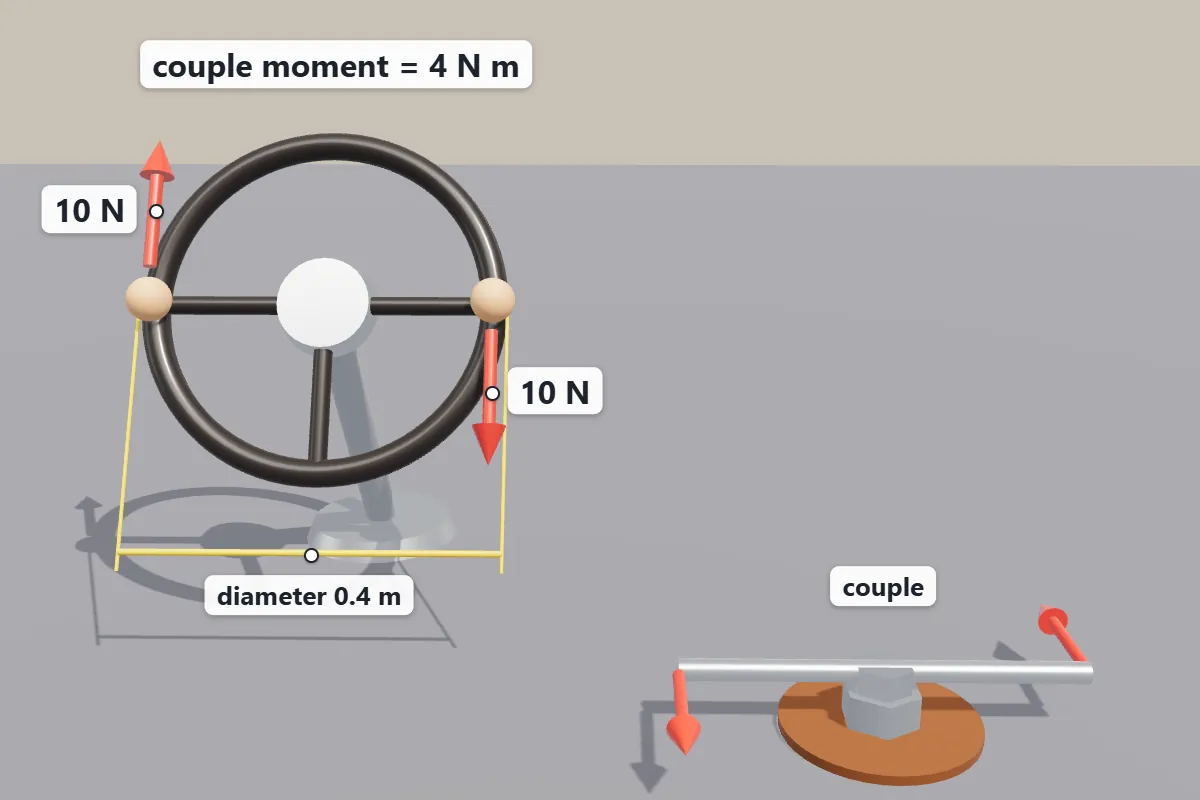
- A couple is a system of two forces of equal magnitude, opposite directions and different lines of action.
- Examples turning a tap, a screwdriver or the steering wheel with two hands, a key in a lock.
- The perpendicular distance between the two lines of action is the arm of the couple.
- Two forces of 15 N act in opposite directions at the ends of a graduated ruler. Take the sum of their moments about different points of the ruler.
- You find the same number at every point the turning effect does not depend on the point chosen.
Couples and the Resultant Couple · 2 / 10
3-1 (b) The moment of a couple
3-1 (b) The moment of a couple
Definition
- The moment of a couple is the sum of the moments of its two forces about any point in space.
- Its magnitude is the product of one force and the arm M=F×L where F is the magnitude of each force and L is the arm.
- Its direction is perpendicular to the plane of the couple, given by the right-hand rule. In a plane we use a sign: anticlockwise positive, clockwise negative.
- Units N·m, N·cm, kg·wt·cm, dyne·cm.
The moment is a constant vector
- Let the forces and act at and , and let be any point.
- .
- The point O has vanished from the result the moment is the same about every point.
Observations
- If the arm becomes larger, the same moment needs a smaller force.
- Only the moment (size and sense) matters; the couple can be moved anywhere in its plane or into a parallel plane without changing its effect.
- A couple can be rotated in its own plane, and its forces and arm can be changed, provided the moment stays the same.
✍️ Worked examples
- Example 1:
- Forces of 40 N form a couple with arm 4 cm in one case, and forces of 20 N form a couple with arm 8 cm in another.
- Compare the moments.
- Solution:
- First couple 40×4=160 N·cm.
- Second couple 20×8=160 N·cm.
- The moments are equal in magnitude halving the force while doubling the arm leaves the turning effect unchanged.
- Example 2:
- Two forces of 20 N act in opposite directions at the ends of a rod 50 cm long, each making an angle of with the rod.
- Find the moment of the couple they form.
- Solution:
- The arm is the perpendicular distance between the two lines of action: cm.
- N·cm.
- Example 3 The forces at and at form a couple. Find , and the moment.
- Solution:
- For a couple F⃗2=−F⃗1 a=−2 and b=5, so F⃗1=(2,5).
- Moment about B BA→×F⃗1 with BA→=(−3,1).
- (−3)(5)−(1)(2)=−17, so M⃗=−17k^ a clockwise couple of magnitude 17 units.
- Example 4 Forces and N act at and m. Show that they form a couple and find its moment.
- Solution:
- The forces are equal and opposite, and the points differ so the lines of action are not the same: it is a couple.
- ; moment .
- N·m (clockwise, magnitude 10 N·m).
Couples and the Resultant Couple · 3 / 10
3-1 (c) Equilibrium under coplanar couples
3-1 (c) Equilibrium under coplanar couples
Condition
- A body acted on only by coplanar couples is in equilibrium if the sum of their moments is zero:
- The sum is algebraic anticlockwise couples positive, clockwise negative.
- A couple can never be balanced by a single force; only by another couple.
✍️ Worked examples
- Example 5:
- A light rod is acted on by a pair of 10 N forces (arm 7 m), a pair of N forces (making with a line of 3 m between them), and a pair of 250 N forces (arm 1 m).
- Show that the rod is in equilibrium (given the senses the first two clockwise, the third anticlockwise).
- Solution:
- N·m.
- N·m.
- N·m.
- Sum , so the rod is in equilibrium.
- Example 6:
- A light rod , 30 cm long, is pivoted at its midpoint.
- Forces of 7.5 N act at its ends, one up and one down, and a string with tension 10 N pulls at to the rod at a point .
- What force acting with these keeps the rod horizontal?
- Solution:
- The two 7.5 N forces form a couple of moment N·cm.
- The additional force must form a couple with the tension. It equals the tension, N, in the opposite direction, parallel, and the sum of moments must be .
- The arm is where is the point of application along the rod: .
- cm, so is cm from along the rod.
- Example 7:
- A thin square lamina (side 60 cm, weight 200 gf at its centre) is hung from a pin at corner .
- A couple of moment gf·cm acts in its plane.
- Find the angle makes with the vertical in equilibrium.
- Solution:
- The pin reaction and the weight form a couple (they are equal, opposite and parallel); it must balance the external couple.
- Distance AM from the pin to the centre AM=302 cm.
- If is the angle of with the vertical, the arm of the weight/reaction couple is .
- , so .
- Hence (or on the other side of the vertical).
Couples and the Resultant Couple · 4 / 10
3-1 (d) Equivalent couples
3-1 (d) Equivalent couples
Definition
- Two couples in the same plane are equivalent if their moments are equal (in size and in sense).
- Equivalent couples have the same effect on a rigid body even if their forces and arms are different.
✍️ Worked examples
- Example 8:
- is a rectangle with cm and cm.
- Equal forces of 96 N act along and (opposite directions).
- Find the equal forces acting at and parallel to whose couple is equivalent to this one.
- Solution:
- First couple arm =BC=AD=16 cm, moment 96×16=1536 N·cm (clockwise).
- cm.
- The distance of from is cm, and the same for on the other side, so the arm of the second couple is cm.
- Equal moments F×19.2=1536, so F=80 N, acting clockwise.
- Example 9:
- A square has side 10 cm.
- Forces of 60 N act along and .
- Find the equal forces at and parallel to forming an equivalent couple.
- Solution:
- First couple arm =10, moment =600 N·cm.
- Diagonal ; the distance from to is , so the arm of the new couple is .
- , so N.
Couples and the Resultant Couple · 5 / 10
3-2 (a) Systems equivalent to a couple
3-2 (a) Systems equivalent to a couple
Two conditions
- A system of coplanar forces is equivalent to a couple if both hold:
- the resultant force is zero (the sum of components along any direction is zero);
- the sum of the moments about a point is not zero.
- If the first condition holds but the moments also sum to zero, the system is in equilibrium, not a couple.
- If concurrent forces have a zero resultant, they are in equilibrium and cannot be a couple.
✍️ Worked examples
- Example 10:
- A light rod carries a 15 N force at and opposite forces of 8 N at ( cm) and 7 N at ( cm).
- Show that the system is equivalent to a couple and find its moment.
- Solution:
- Take the 15 N direction as positive R=15−8−7=0.
- Moments about A −8×5−7×14=−40−98=−138 N·cm.
- The resultant is zero but the moment is not, so it is equivalent to a clockwise couple of moment N·cm.
- Check about B −15×14+8×9=−138, the same value, as it must be for a couple.
- Example 11:
- Points , , lie on a line in that order with cm and cm.
- Parallel forces of 5 N up at , 9 N down at and 4 N up at act on a rod.
- Show that the system is equivalent to a couple.
- Solution:
- Upward positive R=5−9+4=0.
- Moments about (anticlockwise positive, force times distance to the right): N·cm.
- Moments about C 5×(−10)+(−9)(−4)=−50+36=−14 N·cm.
- The resultant is zero and the moment is the non-zero constant N·cm: a clockwise couple of moment 14 N·cm.
Couples and the Resultant Couple · 6 / 10
3-2 (b) Forces represented by the sides of a triangle
3-2 (b) Forces represented by the sides of a triangle
Rule
- If three coplanar forces acting on a rigid body are completely represented (in magnitude, direction and line of action) by the sides , , of a triangle taken in one cyclic order, the system is equivalent to a couple.
- The magnitude of its moment is
where is the force that represents one unit of length.
- The vector sum , so the resultant force is zero.
- Replace at and at by their resultant at ; together with at they form a couple.
- Its arm is the altitude from to , so .
✍️ Worked examples
- Example 12:
- is isosceles with cm and cm.
- Forces of 340, 340 and 320 N act along , , .
- Show the system is a couple and find its moment.
- Solution:
- The ratios are equal, so the forces are represented by the sides at N per cm.
- They act in one cyclic order, so the system is equivalent to a couple.
- Altitude from B 172−82=15 cm; area =12×16×15=120 cm2.
- N·cm.
- Example 13 is right-angled at with cm and cm. Forces of 3, 4 and 5 N act along , , . Find the moment of the equivalent couple.
- Solution:
- , and N per cm, so .
- Area cm.
- N·cm.
Generalisation to polygons
- If a system of coplanar forces is completely represented by the sides of a closed polygon taken in one cyclic order, the system is equivalent to a couple of moment .
✍️ Worked examples
- Example 14 A square of side 10 cm has forces of 10 N along , , and (in that cyclic order). Find the moment.
- Solution:
- N per cm and the area is cm.
- N·cm.
- Check by moments about A the forces along AB and DA pass through A (zero moment); the force along BC has arm 10 and the force along CD has arm 10, both in the same sense: 100+100=200.
- Example 15:
- is a quadrilateral with cm, cm and angle .
- Forces represented by , , , give a couple of moment N·cm.
- Find the forces.
- Solution:
- By symmetry bisects the angle at , so ngle BAC = 60^°.
- Cosine rule in triangle ABC (107)2=202+AC2−2(20)(AC)cos60∘, so 700=400+AC2−20 AC.
- gives , so cm.
- Area of cm.
- , so N per cm.
- Forces AB→,DA→: 0.3×20=6 N; BC→,CD→: 0.3×107=37 N.
Couples and the Resultant Couple · 7 / 10
3-2 (c) The three-point test
3-2 (c) The three-point test
Rule
- If the sum of the moments of a system of coplanar forces about three non-collinear points in its plane has the same non-zero value , the system is equivalent to a couple of moment .
- A coplanar system reduces to a single force, a single couple, or equilibrium.
- It is not in equilibrium (the moments are non-zero).
- If it reduced to a single force at distances from the three points, then , so the three points would lie on a line parallel to the force; they do not. So it must be a couple.
✍️ Worked examples
| Comparison aspect | Main idea | Keywords |
|---|---|---|
| Example 16 | A square of side 10 cm is acted on by the forces in Example 14. Use the test to confirm that it is a couple. | squareABCDsideacted |
| • | Solution | Solution |
| Moments about A | +200 (computed above) | computedabove |
| Moments about B |
| forcesalongpassthrough |
| Moments about C | similarly +200 | similarly |
| • | Equal non-zero values at three non-collinear points, so the system is a couple of moment N·cm. | Equalzerovaluesthree |
Couples and the Resultant Couple · 8 / 10
3-2 (d) The resultant couple
3-2 (d) The resultant couple
Definition
- The sum of two or more coplanar couples is a single couple whose moment is the algebraic sum of the moments:
- It is called the resultant couple. If the couples are in equilibrium.
✍️ Worked examples
- Example 17:
- Three couples act on a plate 200 N forces with arm 0.8 m (anticlockwise), 500 N forces with arm 2.3 m (clockwise), and 100 N forces with arm 4 cm (clockwise).
- Find the resultant couple.
- Solution:
- N·m.
- N·m.
- N·m.
- M=160−1150−4=−994 N·m a clockwise couple of magnitude 994 N·m.
- Example 18:
- A square of side 10 cm is acted on by 40 kg·wt forces along and (a couple) and 70 kg·wt forces along and (a second couple, opposite in sense).
- Find the resultant couple.
- Solution:
- kg·wt·cm.
- kg·wt·cm.
- kg·wt·cm (clockwise, magnitude 300).
- Example 19 What force applied in the opposite sense with arm 12 cm balances a resultant couple of 300 kg·wt·cm?
- Solution:
- The balancing couple must have moment , so and kg·wt for each force.
Couples and the Resultant Couple · 9 / 10
3-2 (e) Summary
3-2 (e) Summary
| Point of comparison | Single force | Couple |
|---|---|---|
| Resultant force | the force itself | zero |
| Effect | translates (and may rotate) | pure rotation |
| Moment | depends on the point chosen | the same about every point |
| Can it be balanced? | by an equal opposite force on the same line | only by another couple of opposite moment |
Key points
- A couple is two equal, opposite, non-collinear parallel forces; its moment is .
- A couple’s moment is a constant vector, so its position in the plane does not matter.
- Couples are equivalent when their moments are equal, in equilibrium when their moments sum to zero, and combine by adding moments.
- A system is equivalent to a couple if its resultant force is zero while its moment is not zero.
Couples and the Resultant Couple · 10 / 10
Well done! You finished this lesson
What would you like to do next?