Curriculum
Mathematics
Unit 1
0/12
1.1Key terms1.2Laws and key relationships1.3Rigorous Derivation of Reciprocal Trigonometric Functions1.4Logarithmic and General Exponential Differentiation Techniques1.5Parametric and Implicit Second-Order Derivatives1.6Worked examples1.7Exam tips1.8Real-world applications1.9Key Scientific Tables & Anatomical Diagrams Extracted from Official Curricula1.10📌 Comprehensive Scientific Terminology Dictionary:1.11🔍 In-Depth Explanations, Deductions & Multi-Book Insights:1.12Lesson summary
Unit 2
0/141.1The counting principle1.2Permutations (nPr)1.3Combinations (nCr)1.4Worked examples on counting, permutations and combinations1.5Recall: counting principle, permutations and combinations1.61-1 (a) Pascal's triangle and the binomial expansion1.71-1 (b) The general term1.81-1 (c) The middle term1.91-2 The term containing xk and the term free of x1.101-3 (a) The ratio between two consecutive terms1.111-3 (b) The greatest term1.12Key Scientific Tables & Anatomical Diagrams Extracted from Official Curricula1.13Lesson 1 - Counting Principle, Permutations and Combinations and the Binomial Theorem1.14Lesson summary
Unit 3
0/131.1Key terms1.2Laws and key relationships1.3Geometry of 3D Vectors and Scalar/Cross Product Physics1.4Equations of Straight Lines in Three Dimensions1.5Equations of Planes and Perpendicular Distance Formulas1.6Worked examples1.7Exam tips1.8Real-world applications1.9Key Scientific Tables & Anatomical Diagrams Extracted from Official Curricula1.10📌 Comprehensive Scientific Terminology Dictionary:1.11⚖️ Governing Physical Laws & Mathematical Relations:1.12🔍 In-Depth Explanations, Deductions & Multi-Book Insights:1.13Lesson summary
Unit 4
0/81.11 Smooth and rough surfaces1.22 Properties of the static friction force1.33 Kinetic friction force1.44 The resultant reaction R′1.55 The angle of friction1.66 Equilibrium of a body on a rough horizontal plane1.77 Equilibrium of a body on a rough inclined plane1.88 Conditions of equilibrium and rigid bodies with friction
Unit 5
0/121.13-1 (a) Indefinite integrals of exponential functions1.23-1 (b) Indefinite integrals of logarithmic functions1.33-2 (a) The differential and the standard integrals1.43-2 (b) Integration by substitution1.53-2 (c) Integration by parts1.63-2 (d) Applications of the indefinite integral1.73-3 (a) The definite integral and the fundamental theorem of calculus1.83-3 (b) Properties of the definite integral1.93-3 (c) Definite integral by substitution, odd and even functions1.103-4 (a) Area of a plane region1.113-4 (b) Volumes of solids of revolution1.12Key Scientific Tables & Anatomical Diagrams Extracted from Official Curricula
Unit 6
0/81.12-1 (a) Polar coordinates and the Argand plane1.22-1 (b) Modulus, amplitude and principal amplitude1.32-1 (c) The trigonometric (polar) form of a complex number1.42-1 (d) Product and quotient in trigonometric form1.52-1 (e) The exponential (Euler) form1.62-2 (a) De Moivre's theorem for a positive integer power1.72-2 (b) De Moivre's theorem for a rational power and the roots of a complex number1.82-3 The cube roots of unity
Unit 7
0/101.11 Momentum and its change1.22 Newton's first law, inertia and force1.33 Newton's second law, the equation of motion and variable mass1.44 Newton's third law, lifts and scales1.55 Bodies connected by a string over a smooth pulley1.66 Impulse1.77 Work1.88 Kinetic energy and the work-energy principle1.99 Potential energy and conservation of energy1.1010 Power
Text lesson
Motion with Variable Acceleration and Force
Motion with Variable Acceleration and Force
Overview
Overview
- This lesson develops lesson 2-1 of the dynamics unit "Applications on Newton’s Laws of Motion" using calculus.
- After it you should be able to:
- write Newton’s second law in three differential forms and choose the right one;
- solve motion in a straight line when the force or acceleration depends on time, position or velocity;
- work with vector forces, momentum change and a mass that varies with time.
🌳 Concept tree
Motion with Variable Acceleration and Force
- ├── 2-1 (a) Newton's second law as a differential equation
│ ├── The law
│ ├── Three forms of the acceleration
│ ├── Integrals that follow
│ └── General method
├── 2-1 (b) Acceleration as a function of time
│ ├── Method
│ └── Change of momentum
- ├── 2-1 (c) Acceleration as a function of position
│ └── Method
- ├── 2-1 (d) Acceleration as a function of velocity
│ └── Method
- ├── 2-1 (e) Vector form of the equation of motion
│ └── Method
├── 2-1 (f) Momentum and a variable mass
│ └── Rules
- └── 2-1 (g) Apparent weight with changing acceleration
├── Idea
└── Common mistakes
Motion with Variable Acceleration and Force · 1 / 12
2-1 (a) Newton’s second law as a differential equation
2-1 (a) Newton’s second law as a differential equation
The law
- The rate of change of momentum is proportional to the force and in its direction: .
- When the mass is constant this gives with the units chosen so that the constant of proportionality is 1 (newton for in kg and in m/s; dyne for g and cm/s).
- 1\ kg·wt = 9.8 N and dyne.
- Acceleration is , and by the chain rule with we also have
- Which form to use depends on what the force depends on.
| Point of comparison | Force depends on time | Force depends on position | Force depends on velocity |
|---|---|---|---|
| Equation used | or | ||
| Variables separated | or | ||
| First answer | (speed at a place) | or | |
| Then | integrate again for | for | integrate for the other variable |
Impulse–momentum∫t1t2F dt=m(v2−v1).
Work–energy∫s1s2F ds=12m(v22−v12).
Constant acceleration is a special casea=c gives v=v0+ct, s=v0t+12ct2 and v2=v02+2cs.
- Draw the body and the forces; take the direction of motion as positive.
- Write the equation of motion and choose the form of .
- Separate the variables and integrate between the initial and final values (limits), or integrate indefinitely and find the constant from the initial condition.
- Keep units consistent.
Motion with Variable Acceleration and Force · 2 / 12
2-1 (b) Acceleration as a function of time
2-1 (b) Acceleration as a function of time
Method
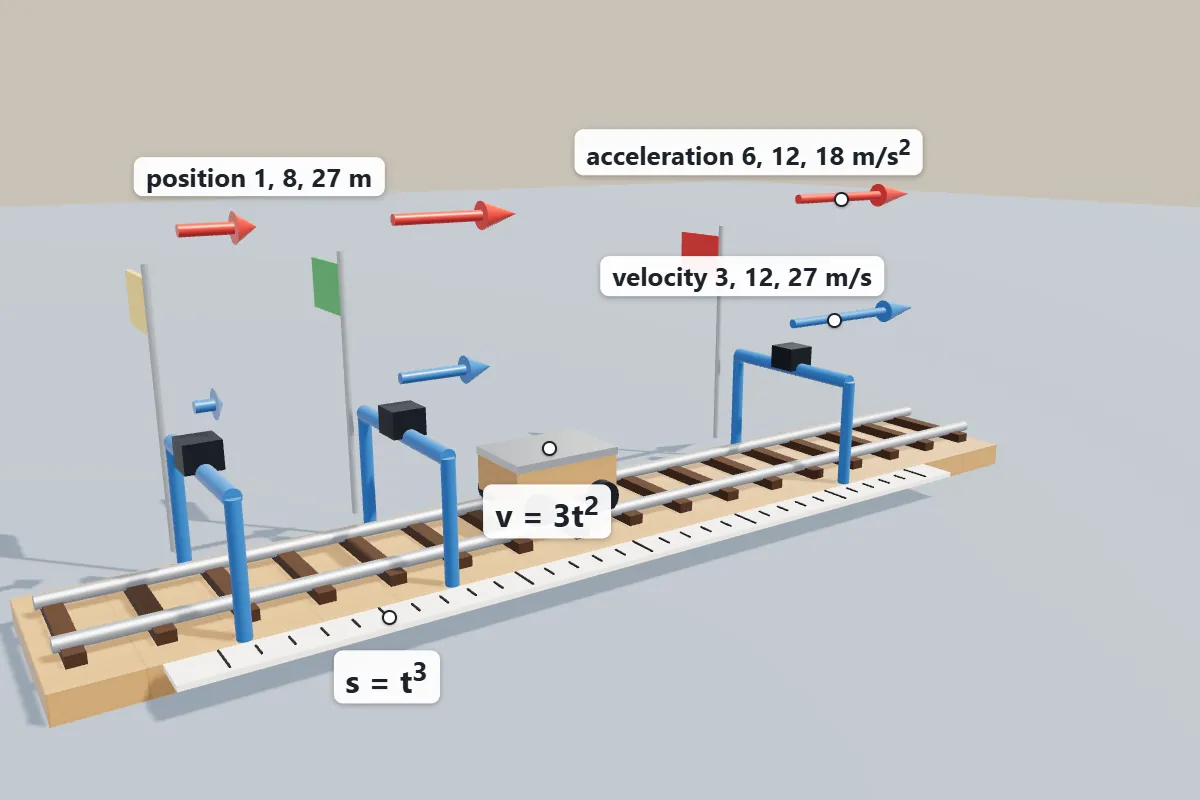
- If , then and .
✍️ Worked examples
- Example 1:
- A particle has acceleration m/s and starts from the origin with velocity 2 m/s.
- Find and at time and their values at .
- Does the particle ever stop?
- Solution:
- .
- .
- At t=3 v=27−12+2=17 m/s and s=27−18+6=15 m.
- v=0 needs 3t2−4t+2=0, with discriminant 16−24<0 there is no solution, so the particle never stops.
- Example 2:
- A force N acts on a body of mass 3 kg at rest.
- Find its velocity after 4 s and the distance travelled in that time (the body moves in a straight line).
- Solution:
- .
- ; at , m/s.
- ; at , m.
- Note v<0 for 0<t<1, so the body first moves backwards; the displacement is not the distance if the direction reverses.
- Example 3:
- A force N acts on a particle of mass 2 kg which has velocity 3 m/s at .
- Find the impulse during the interval and the velocity at .
- Solution:
- Impulse N·s.
- Velocity at t=1 v1=3+12∫01(6+12t) dt=3+12(6+6)=9 m/s.
- Velocity at t=3 2v3=2v1+60, so v3=9+30=39 m/s.
Change of momentum
- The change of momentum in is .
✍️ Worked examples
- Example 4 A car of mass 1.5 tonnes has acceleration m/s. Find the change of momentum in the first 6 s and in the interval .
- Solution:
- kg. An antiderivative of is .
- First 6 s 6(36)−2163=216−72=144, so ΔH=1500×144=216 000 kg·m/s.
- Interval [2,14] at 14: 6(196)−27443=1176−914.67=261.33; at 2: 24−83=21.33.
- Difference , so kg·m/s.
- Example 5 A body of mass 8 kg has . Find the change of momentum between and .
- Solution:
- kg·m/s.
Motion with Variable Acceleration and Force · 3 / 12
2-1 (c) Acceleration as a function of position
2-1 (c) Acceleration as a function of position
Method
- If the force depends on the distance from a fixed point, use .
- Separate ∫v0vv dv=1m∫r0rF dr, i.e. 12(v2−v02)=1m∫F dr.
- To find the time afterwards, use and integrate .
✍️ Worked examples
- Example 6:
- A body of mass 2 kg starts from rest at the origin under the force N along the -axis ( in metres).
- Find in terms of , the greatest speed, and where the body first stops.
- Solution:
- , so .
- gives , so .
- The speed is greatest where , i.e. m: , so m/s.
- The body stops when v=0 x(8−x)=0, so x=8 m. There the force is −8 N, so it turns back.
- Example 7:
- A body of mass 1 kg is released from rest at the origin and acted on by N, with in metres.
- Find when m, and when m/s.
- Solution:
- , so (the constant is 0 since at ).
- At r=4 v22=40+24=64, so v2=128 and v=82≈11.3 m/s.
- At v=9 812=52r2+6r, so 5r2+12r−81=0 and (5r+27)(r−3)=0.
- m (the root is rejected).
- Example 8:
- A particle of mass 1 kg moves along a line under an attractive force towards the origin of magnitude N at distance .
- At its speed is 6 m/s.
- Show that it stops at m.
- Solution:
- The force is towards the origin, so a=−4x vdvdx=−4x.
- , so .
- when , i.e. m.
- The motion is an oscillation between and (simple harmonic with period s).
- Example 9 A body falls from rest with acceleration where is the distance fallen. (Take and m.) Find its speed when m.
- Solution:
- , so .
- At : , so .
- , so m/s.
Motion with Variable Acceleration and Force · 4 / 12
2-1 (d) Acceleration as a function of velocity
2-1 (d) Acceleration as a function of velocity
Method
- If a=f(v), separate in time dvf(v)=dt, or in distance: v dvf(v)=ds.
- A resistance proportional to the velocity gives and an exponential decay.
✍️ Worked examples
- Example 10:
- A boat of mass moving at experiences a resistance (where is constant) and no other horizontal force.
- Show that and that the distance travelled before it is brought to rest is .
- Solution:
- , so .
- , so .
- Using we get , so .
- when . The velocity tends to zero only as , but the distance is finite.
- Example 11:
- A body of mass 3 kg moves in a line with initial velocity 2 m/s under the force N, being its velocity.
- Find the time to reach 6 m/s and the distance travelled meanwhile.
- Solution:
- , so .
- Integrate v2+v=6t+C. At t=0, v=2: C=6.
- At v=6 36+6=6t+6, so t=6 s.
- For the distance use , so .
- .
- m.
- Example 12:
- A car of mass 1000 kg has an engine force N and resistance N.
- Starting from rest, find in terms of and its limiting speed.
- Solution:
- , so .
- Integrate −ln(60−v)=t20+C. At t=0, v=0 gives C=−ln60.
- , so .
- As the speed approaches the limiting speed m/s (where driving force equals resistance).
Motion with Variable Acceleration and Force · 5 / 12
2-1 (e) Vector form of the equation of motion
2-1 (e) Vector form of the equation of motion
Method
- If and are given as vectors in , then , and component by component.
- To find and from , integrate each component separately, using the initial conditions.
- If the resultant force is zero, the acceleration is zero and the velocity is constant (Newton’s first law).
✍️ Worked examples
- Example 13 A body of mass 2 kg moves under three forces , , N, with displacement m. Find and .
- Solution:
- and .
- .
- Sum of the forces (a+5)i^+(b−2)j^.
- gives ; gives .
- Example 14 A body moving with is acted on by , and . Find .
- Solution:
- is constant, so and the resultant force is zero.
- .
- force units.
- Example 15 A force N acts on a body of mass 2 kg at rest at the origin. Find , and the speed at .
- Solution:
- .
- .
- .
- At t=2 v⃗=(6+4)i+16j^=10i+16j^ and the speed is 100+256=356≈18.9 m/s.
Motion with Variable Acceleration and Force · 6 / 12
2-1 (f) Momentum and a variable mass
2-1 (f) Momentum and a variable mass
Rules
- The momentum is and the force is .
- If the velocity is constant and the mass changes, .
- If the mass is constant, .
- A constant rate of gain or loss gives .
✍️ Worked examples
- Example 16 A body of mass kg moves with velocity m/s along a line. Find the momentum and the force at .
- Solution:
- .
- ; at , N.
- Check by the product rule mdvdt+vdmdt=(4)(3)+(6)(1)=18 N.
- Example 17:
- A metal ball of mass 100 g moves at constant 10 m/s through dusty air; dust sticks to it at 0.6 g/s.
- Find its mass and the force on it at time .
- Solution:
- Mass m=100+0.6t g.
- Force F=vdmdt=(1000 cm/s)(0.6 g/s)=600 dyne, constant.
- Example 18 The displacement of a body of variable mass g is cm. Find the momentum and the force at .
- Solution:
- ; g·cm/s.
- ; at , dyne.
Motion with Variable Acceleration and Force · 7 / 12
2-1 (g) Apparent weight with changing acceleration
2-1 (g) Apparent weight with changing acceleration
Idea
- A person in a lift presses on the floor with force when the lift accelerates upward with acceleration .
- If varies with time, so does ; just replace by the function.
✍️ Worked examples
- Example 19:
- A lift accelerates upwards with m/s.
- A man of mass 60 kg stands in it.
- Find the pressure on the floor at s in kg·wt, and the speed of the lift at that time (starting from rest).
- Solution:
- At t=5 a=1 m/s2.
- N kg·wt.
- m/s.
Common mistakes
- Using when the acceleration is not constant.
- Forgetting the constant of integration, or using the wrong initial condition.
- Mixing the forms and .
- Confusing displacement with distance when the velocity changes sign.
- Mixing units (grams with newtons, or cm with m).
Motion with Variable Acceleration and Force · 8 / 12
Part 9
Part 9
- 📖
Motion with Variable Acceleration and Force · 9 / 12
📌 Comprehensive Scientific Terminology Dictionary:
📌 Comprehensive Scientific Terminology Dictionary:
- Motion (الحركة):
- The continuous change in an object's position over time relative to a fixed reference point.
- Motion in a straight line in one direction is the simplest type of motion.
- Uniform Speed (السرعة المنتظمة):
- The speed at which an object covers equal distances in equal intervals of time, regardless of how small these time intervals are.
- Average Speed (السرعة المتوسطة:
- v̄) The total distance traveled by a moving object divided by the total time taken to cover that distance: vavg = dtotal / ttotal.
- Relative Speed (السرعة النسبية):
- The speed of a moving object relative to a specific observer, which changes depending on whether the observer is stationary or moving in the same or opposite direction.
- Uniform Acceleration (العجلة المنتظمة:
- a) The acceleration in which the speed of an object changes (increases or decreases) by equal amounts in equal intervals of time: a = (v2 – v1) / (Δ t), measured in $m/s2$.
Motion with Variable Acceleration and Force · 10 / 12
⚖️ Governing Physical Laws & Mathematical Relations:
⚖️ Governing Physical Laws & Mathematical Relations:
| Comparison aspect | Main idea | Keywords |
|---|---|---|
| Fundamental Speed Equation |
| الصيغةUnitsconversionfactor |
| Relative Speed Rules | [ الصيغة: 1) Stationary observer: Relative Speed = Real Speed | الصيغةStationaryobserverReal |
| 2) Opposite direction | Relative Speed = Real Speed + Observer Speed (appears faster) | RelativeSpeedRealObserver |
| 3) Same direction | Relative Speed = Real Speed – Observer Speed (appears slower) | RelativeSpeedRealObserver |
| 4) Same direction and same speed | Relative Speed = 0 (appears at rest). ] | Relativeappearsrest |
| Uniform Acceleration Formula |
| الصيغةinitialvelocityfinal |
Motion with Variable Acceleration and Force · 11 / 12
🔍 In-Depth Explanations, Deductions & Multi-Book Insights:
🔍 In-Depth Explanations, Deductions & Multi-Book Insights:
★ كتاب الشرح والتفصيل العلمي الشامل المعتمد ★
كتاب الشرح المفصل→Motion in One Direction, Speed, Graphical Representation, and Uniform Acceleration
| | 2026/2027 |
- 🎯 أهداف التعلم والمخرجات التعليمية المقررة بالتفصيل:
- • Define motion in one direction along a straight line as the simplest form of motion.
- • Derive and calculate regular speed, irregular speed, average speed, and relative speed under different observer conditions.
- • Graphically represent uniform speed using distance-time and speed-time Cartesian graphs.
- • Formulate uniform acceleration (a = (Δ v) / (Δ t)), distinguishing between accelerating (positive) and decelerating (negative) motion.
- ◄ 1. Mechanics of Motion in One Direction & Speed Classification
- Motion is the most ubiquitous physical phenomenon in our universe.
- In classical Newtonian kinematics, motion in one direction along a straight line represents the fundamental baseline for all mechanical systems, exemplified by metro transit systems and railway trains travelling between fixed stations.
- The rate of motion depends strictly on two independent physical variables: the spatial trajectory distance (d) and the elapsed temporal duration (t).
- In real-world traffic dynamics, vehicles almost never maintain a perfectly uniform speed due to road conditions, topography, traffic signals, and variable congestion.
- Therefore, physics introduces the concept of average speed (v̄), which represents the hypothetical constant velocity that would cover the identical gross distance over the identical total timeframe.
- شكل توضيحي (figure_diagram_1.png): شكل ومخطط تحليلي معتمد لدرس: Motion in One Direction
- Speed
- Graphical Representation
- and Uniform Acceleration
◄ 2. Graphical Modeling & Acceleration Dynamics
- Graphical analysis converts kinematic data into visual geometric functions.
- On a distance-time (d-t) graph, uniform speed yields a straight linear incline passing through the origin (slope = v).
- On a speed-time (v-t) graph, uniform speed is depicted as a horizontal line parallel to the time axis (slope = a = 0).
- When an object undergoes acceleration, its velocity vector changes over time.
- If a vehicle starts from rest (v1 = 0), its acceleration is strictly positive.
- Conversely, when a driver applies the mechanical brakes, the car decelerates until it reaches complete standstill (v2 = 0), resulting in a negative acceleration sign.
- 🧮 التطبيقات والمسائل النموذجية المحلولة بالخطوات (Step-by-Step Worked Examples):
- مثال نموذجي 1:
- نص المسألة / السؤال A racing sports car starts from rest and reaches a velocity of 90 km/h in 5 seconds. Later, the driver steps on the brake pedal to avoid an obstacle, bringing the car to a full stop in 2.5 seconds. Calculate: 1) The acceleration during the first stage in m/s2. 2) The deceleration during braking in m/s2.
- خطوات الحل والشرح النموذجي Step 1: Convert 90 km/h to m/s: v2 = 90 * (5/18) = 25 m/s. Initial velocity v1 = 0 m/s. Elapsed time Δt1 = 5 s.
- Acceleration a1 = (v2 – v1) / Δt1 = (25 – 0) / 5 = +5 m/s2 (Uniform positive acceleration).
- Braking stage: Initial velocity v1 = 25 m/s, final velocity v2 = 0 m/s, Δt2 = 2.5 s.
- Acceleration a2 = (v2 – v1) / Δt2 = (0 – 25) / 2.5 = -10 m/s2 (Uniform negative acceleration / deceleration).
- 💡 أسرار وتكات التفوق وملاحظات خبير المادة (Expert Notes & Exam Secrets):
- ★ ('Unit Conversion Trap (km/h vs m/s)', 'Never plug km/h directly into an acceleration formula with time in seconds!
- You must multiply by 5/18 first to convert km/h to m/s.')
- "Calculate the deceleration", and you write "Deceleration = -10 m/s2", it is a double negative trap. You should write: "Acceleration = -10 m/s2" or "Deceleration = 10 m/s2".')
- ★ ('Zero Acceleration Condition', 'When an object moves at a constant uniform speed, its acceleration is strictly ZERO because Δv = 0.')
- 🌍 التطبيقات الحياتية والصناعية والتكنولوجية (Real-World Applications):
- ✔ ('Automotive Safety & Advanced Driver Assistance Systems (ADAS)', 'Modern autonomous vehicles and radar-guided cruise control systems compute relative speed and braking acceleration in real time using high-frequency Doppler radar to maintain safe headway distances.')
- ✔ ('High-Speed Electric Rail Network (Egypt Monorail & High-Speed Train)', 'The Egyptian national high-speed train project utilizes precise kinematic acceleration and deceleration modeling to optimize power consumption and passenger comfort during transit.')
Motion with Variable Acceleration and Force · 12 / 12
Well done! You finished this lesson
What would you like to do next?