Curriculum
Mathematics
Unit 1
0/12
1.1Key terms1.2Laws and key relationships1.3Rigorous Derivation of Reciprocal Trigonometric Functions1.4Logarithmic and General Exponential Differentiation Techniques1.5Parametric and Implicit Second-Order Derivatives1.6Worked examples1.7Exam tips1.8Real-world applications1.9Key Scientific Tables & Anatomical Diagrams Extracted from Official Curricula1.10📌 Comprehensive Scientific Terminology Dictionary:1.11🔍 In-Depth Explanations, Deductions & Multi-Book Insights:1.12Lesson summary
Unit 2
0/141.1The counting principle1.2Permutations (nPr)1.3Combinations (nCr)1.4Worked examples on counting, permutations and combinations1.5Recall: counting principle, permutations and combinations1.61-1 (a) Pascal's triangle and the binomial expansion1.71-1 (b) The general term1.81-1 (c) The middle term1.91-2 The term containing xk and the term free of x1.101-3 (a) The ratio between two consecutive terms1.111-3 (b) The greatest term1.12Key Scientific Tables & Anatomical Diagrams Extracted from Official Curricula1.13Lesson 1 - Counting Principle, Permutations and Combinations and the Binomial Theorem1.14Lesson summary
Unit 3
0/131.1Key terms1.2Laws and key relationships1.3Geometry of 3D Vectors and Scalar/Cross Product Physics1.4Equations of Straight Lines in Three Dimensions1.5Equations of Planes and Perpendicular Distance Formulas1.6Worked examples1.7Exam tips1.8Real-world applications1.9Key Scientific Tables & Anatomical Diagrams Extracted from Official Curricula1.10📌 Comprehensive Scientific Terminology Dictionary:1.11⚖️ Governing Physical Laws & Mathematical Relations:1.12🔍 In-Depth Explanations, Deductions & Multi-Book Insights:1.13Lesson summary
Unit 4
0/81.11 Smooth and rough surfaces1.22 Properties of the static friction force1.33 Kinetic friction force1.44 The resultant reaction R′1.55 The angle of friction1.66 Equilibrium of a body on a rough horizontal plane1.77 Equilibrium of a body on a rough inclined plane1.88 Conditions of equilibrium and rigid bodies with friction
Unit 5
0/121.13-1 (a) Indefinite integrals of exponential functions1.23-1 (b) Indefinite integrals of logarithmic functions1.33-2 (a) The differential and the standard integrals1.43-2 (b) Integration by substitution1.53-2 (c) Integration by parts1.63-2 (d) Applications of the indefinite integral1.73-3 (a) The definite integral and the fundamental theorem of calculus1.83-3 (b) Properties of the definite integral1.93-3 (c) Definite integral by substitution, odd and even functions1.103-4 (a) Area of a plane region1.113-4 (b) Volumes of solids of revolution1.12Key Scientific Tables & Anatomical Diagrams Extracted from Official Curricula
Unit 6
0/81.12-1 (a) Polar coordinates and the Argand plane1.22-1 (b) Modulus, amplitude and principal amplitude1.32-1 (c) The trigonometric (polar) form of a complex number1.42-1 (d) Product and quotient in trigonometric form1.52-1 (e) The exponential (Euler) form1.62-2 (a) De Moivre's theorem for a positive integer power1.72-2 (b) De Moivre's theorem for a rational power and the roots of a complex number1.82-3 The cube roots of unity
Unit 7
0/101.11 Momentum and its change1.22 Newton's first law, inertia and force1.33 Newton's second law, the equation of motion and variable mass1.44 Newton's third law, lifts and scales1.55 Bodies connected by a string over a smooth pulley1.66 Impulse1.77 Work1.88 Kinetic energy and the work-energy principle1.99 Potential energy and conservation of energy1.1010 Power
Text lesson
Definite Integration, Areas and Volumes of Revolution
Definite Integration, Areas and Volumes of Revolution
Overview
Overview
- Evaluate definite integrals exactly using the fundamental theorem of calculus.
- Use definite integrals to find the area under a curve and the area between two curves.
- Find the volume of a solid of revolution about the x-axis and the y-axis.
🌳 Concept tree
Definite Integration and Applications
├── The definite integral
│ ├── Notation and the fundamental theorem
│ └── Evaluating with limits
├── Properties
│ ├── Additivity over intervals
│ └── Reversal and zero-width limits
├── Area
│ ├── Area under a curve
│ └── Area between two curves
└── Volumes of revolution
├── About the x-axisV = π∫y2dx
└── About the y-axisV = π∫x2dy
Definite Integration, Areas and Volumes of Revolution · 1 / 9
The definite integral
The definite integral
Definition and notation
| Comparison aspect | Main idea | Keywords |
|---|---|---|
| • | The definite integral of f from a to b is written ∫ab f(x) dx, where a is the lower limit and b is the upper limit. | definiteintegralwrittenlower |
| Fundamental theorem | if F is any antiderivative of f, then ∫ab f(x) dx = F(b) − F(a). | antiderivativethen |
| The constant of integration cancels | (F(b) + C) − (F(a) + C) = F(b) − F(a). So never write + C in a definite integral | neverwritedefiniteintegral |
- ∫02 (3x2 + 2x) dx = [x3 + x2]02 = (8 + 4) − 0 = 12
- ∫14 x−1/2 dx = [2√x]14 = 4 − 2 = 2
- ∫0π/2 cos x dx = [sin x]0π/2 = 1 − 0 = 1
- ∫01 e2x dx = [½e2x]01 = ½(e2 − 1) ≈ 3.19
- Either change the limits to the new variable, or substitute back before applying the original limits.
- Example ∫01 2x(x2 + 1)3 dx. Let u = x2 + 1, du = 2x dx; limits become 1 and 2: ∫12 u3 du = [u4/4]12 = 4 − ¼ = 15/4.
Definite Integration, Areas and Volumes of Revolution · 2 / 9
Properties of the definite integral
Properties of the definite integral
| Property | Statement | Use |
|---|---|---|
| Zero width | ∫aa f(x) dx = 0 | Limits equal → the integral vanishes |
| Reversal | ∫ab f = −∫ba f | Swapping limits changes the sign |
| Additivity | ∫ab f + ∫bc f = ∫ac f | Split at a point where the rule changes (e.g. |x|) |
| Constant multiple | ∫ k·f = k∫ f | Take constants outside |
| Linearity | ∫ (f ± g) = ∫ f ± ∫ g | Integrate term by term |
| Even and odd | ∫−aa f = 0 if f is odd; 2∫0a f if f is even | Saves a full evaluation |
- ∫−12 |x| dx = ∫−10 (−x) dx + ∫02 x dx = ½ + 2 = 5/2.
- Splitting at x = 0 is compulsory; integrating |x| as if it were x gives the wrong value.
Definite Integration, Areas and Volumes of Revolution · 3 / 9
Area under and between curves
Area under and between curves
Area under a curve
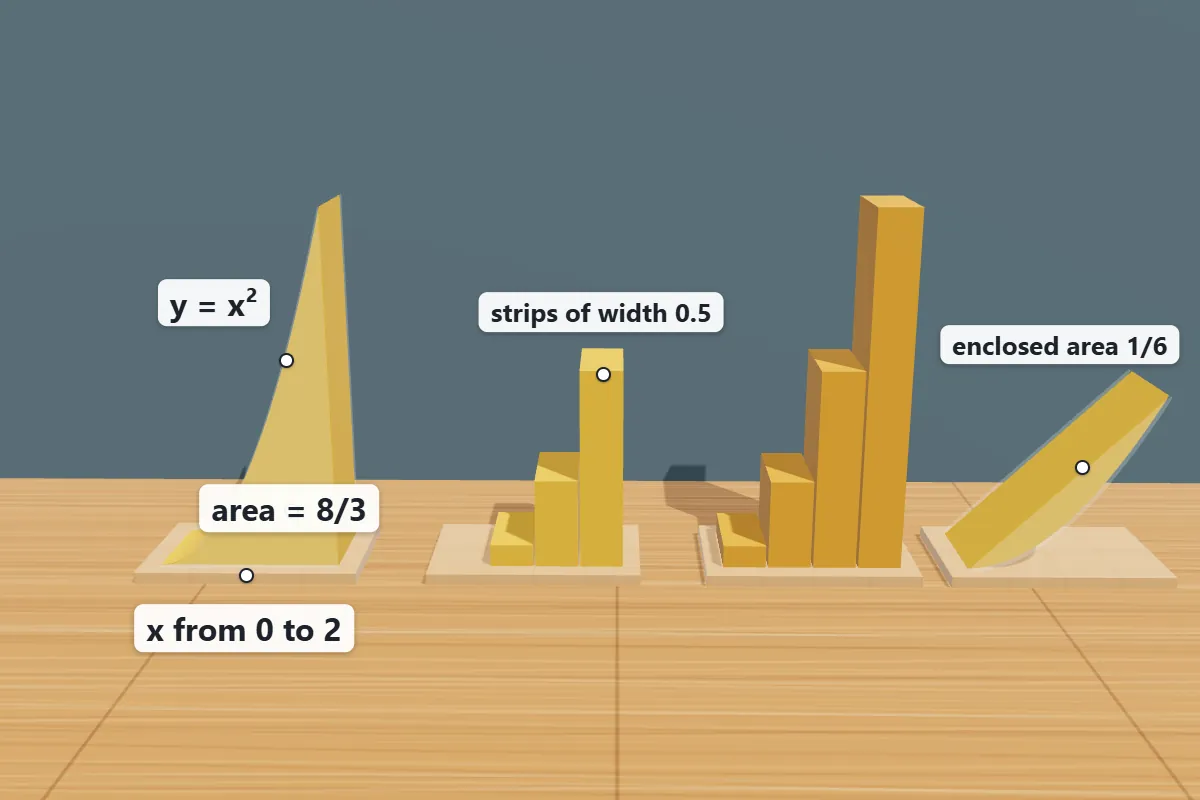
- If y = f(x) is above the x-axis on [a, b], the area is A = ∫ab y dx.
- If the curve dips below the x-axis, integrate the absolute value, or split the interval and take the magnitude of the negative part.
- Example the area under y = x2 from x = 0 to x = 3 is ∫03 x2 dx = [x3/3]03 = 9.
Area between two curves
| Comparison aspect | Main idea | Keywords |
|---|---|---|
| • | A = ∫ab (upper curve − lower curve) dx, where a and b are the x-coordinates of the intersection points. | uppercurvelowercoordinates |
| Example |
| areabetweenIntersections |
| Example | between y = 4 − x2 and the x-axis. Intersections at x = ±2: A = ∫−22 (4 − x2) dx = [4x − x3/3]−22 = 32/3 | betweenaxisIntersections |
Choosing the variable
- If the region is easier to describe as x as a function of y, use A = ∫ (right curve − left curve) dy.
- Example between x = y2 and x = y + 2 → intersections y = −1, y = 2 → A = ∫−12 (y + 2 − y2) dy = 9/2.
Definite Integration, Areas and Volumes of Revolution · 4 / 9
Volumes of revolution
Volumes of revolution
About the x-axis
| Comparison aspect | Main idea | Keywords |
|---|---|---|
| • | V = π ∫ab y2 dx, where y is the height of the curve above the axis of rotation. | heightcurveaboveaxis |
| Example | y = x2 rotated about the x-axis from x = 0 to x = 1: V = π ∫01 x4 dx = π/5 | rotatedaxis |
| Example | y = √x from x = 0 to x = 4: V = π ∫04 x dx = π[ x2/2 ]04 = 8π |
- V = π ∫cd x2 dy; the curve must be written as x = g(y).
- Example x = y2 from y = 0 to y = 2: V = π ∫02 y4 dy = 32π/5.
- V = π ∫ (R2 − r2) dx, where R is the outer radius and r the inner radius.
- Example the region between y = x and y = x2 for 0 ≤ x ≤ 1 rotated about the x-axis: V = π ∫01 (x2 − x4) dx = π(⅓ − ⅕) = 2π/15.
Definite Integration, Areas and Volumes of Revolution · 5 / 9
Practice with full answer key
Practice with full answer key
- ∫01 (6x2 − 4x + 1) dx → 2 − 2 + 1 = 1
- ∫1e (1/x) dx → [ln x]1e = 1
- ∫01 x ex² dx → u = x2, du = 2x dx → ½(e − 1)
- ∫−21 |x| dx → 2 + ½ = 5/2
- Area between y = x2 and y = 2x → intersections 0 and 2, A = ∫(2x − x2) = 4/3
- Area bounded by y = √x, y = 0, x = 4 → ∫04 √x dx = 16/3
- Volume of y = x3 about the x-axis, 0 ≤ x ≤ 2 → π∫x6 dx = 128π/7
- Volume of y = 1/x about the x-axis, 1 ≤ x ≤ 3 → π(1 − ⅓) = 2π/3
- ∫0π sin x dx → [−cos x]0π = 2
- If ∫03 f(x) dx = 7 and ∫35 f(x) dx = 2, find ∫05 f = 9 and ∫50 f = −9
Definite Integration, Areas and Volumes of Revolution · 6 / 9
Exam traps and key takeaways
Exam traps and key takeaways
💡 High-yield traps
- Forgetting to substitute the new limits after a u-substitution — the single most common lost mark.
- Reversing limits changes the sign; a negative area is a sign error, not a negative area.
- Area is ∫(upper − lower); volume uses y2 (or x2), never y — squaring is what makes a solid.
- A curve crossing the x-axis splits the area into separate integrals; integrating straight across gives a signed sum.
- In volume between curves use R2 − r2, not (R − r)2.
- Write the final answer exactly (π/5, 32/3); a decimal-only answer loses the exact-mark.
Definite Integration, Areas and Volumes of Revolution · 7 / 9
Lesson 1 – Integration Techniques and Definite Integrals and Volumes of Revolution
Lesson 1 – Integration Techniques and Definite Integrals and Volumes of Revolution
- ★ Comprehensive Study & Detailed Pedagogical Guide ★
- Comprehensive Explanation Advanced Integration Techniques (Substitution and By Parts), Definite Integrals, and Volumes of Revolution
- 🎯 Targeted Learning Outcomes & Pedagogical Objectives:
- • Apply the Integration by Parts formula (∫ u dv = uv – ∫ v du) strategically using the LIATE rule.
- • Solve integrals using trigonometric and algebraic substitution methods.
- • Evaluate definite integrals and apply the Fundamental Theorem of Calculus.
- • Calculate exact areas between curves and volumes of solid revolution about the x-axis and y-axis.
- 📖 Core Terminology, Scientific Definitions & Glossaries:
| Comparison aspect | Main idea | Keywords |
|---|---|---|
| 🔹 Antiderivative (Indefinite Integral) |
| inverseoperationdifferentiationfamily |
| 🔹 Integration by Parts | A powerful integration technique derived from the product rule of differentiation: ∫ u dv = uv – ∫ v du | powerfultechniquederivedproduct |
| 🔹 Definite Integral |
| signedareabetweengraph |
| 🔹 Solid of Revolution |
| threedimensionalfigureobtained |
| 🔹 LIATE Rule |
| prioritymnemonicselectingintegration |
| Comparison aspect | Main idea | Keywords |
|---|---|---|
| • |
| GoverningScientificLawsTheorems |
| ★ Integration by Parts Formula |
| SelectfollowingLIATEpriority |
| ★ Basic Standard Integrals | [ Formula: ∫ xn dx = (xn+1) / (n+1) + C (n ≠ -1) | ∫ 1 / x dx = ln |x| + C∫ ekx dx = 1 / k ekx + C | ∫ akx dx = akx / (k ln a) + C∫ sec 2 x dx = tan x + C | ∫ sec x tan x dx = sec x + C. ] | Formula |
| ★ Area Between Two Curves |
| FormulaUpperminuslower |
| ★ Volume of Revolution Formulas | [ Formula: About x-axis: Vx = π ∫ab [y(x)]2 dx = π ∫ab [(yupper)2 – (ylower)2] dx.About y-axis: Vy = π ∫cd [x(y)]2 dy = π ∫cd [(xright)2 – (xleft)2] dy. ] | axisyupperylowerxright |
- 📌 Exhaustive In-Depth Pedagogical Breakdown:
- ◄ I. Strategic Execution of Integration by Parts and the LIATE Hierarchy
- Integration by Parts arises from integrating the product rule d(uv) = u dv + v du.
- Rearranging yields ∫ u dv = uv – ∫ v du.
- The success of this technique hinges upon choosing u such that its derivative \(du\) is simpler than u, while $dvis readily integrable.
- Mathematicians establish the LIATE hierarchy for choosing u 1. L – Logarithmic functions (ln x, log x)2. I – Inverse trigonometric functions (\arcsin x, \arctan x)3. A – Algebraic polynomials (x, x2, x3)4. T – Trigonometric functions (sin x, cos x)5. E – Exponential functions (ex, 2x)For tabular integration (repeated parts), a polynomial u differentiated to zero against an alternating sign sequence (+, -, +, -$) allows rapid evaluation without cumbersome nested brackets.
- Figure (integration_areas_and_volumes_of_revolution.png): Figure (6): Disk and washer methods for computing 3D volumes of revolution about coordinate axes
- ◄ II. Fundamental Properties of Definite Integrals
- Definite integrals obey powerful algebraic symmetries 1. Additivity: ∫ab f(x) dx = ∫ac f(x) dx + ∫cb f(x) dx.2. Reversal: ∫ba f(x) dx = -∫ab f(x) dx and ∫aa f(x) dx = 0.3. Even Function Symmetry: If f(-x) = f(x), then ∫-aa f(x) dx = 2 ∫0a f(x) dx.4. Odd Function Symmetry: If f(-x) = -f(x), then ∫-aa f(x) dx = 0 (Net cancellation of symmetric positive and negative lobes).
- Recognizing odd symmetry instantaneously evaluates otherwise formidable integrals, such as ∫-ππ x3 cos x dx = 0.
- ◄ III. Geometric Determination of Areas and Volumes of Revolution
- To find the volume generated by revolving the region under y = f(x) from x = a to x = b through a complete revolution (2π radians) about the x-axis, we slice the solid into infinitesimally thin circular disks of radius r = y and thickness \(dx\).
- Each disk has differential volume dV = π r2 dx = π y2 dx.
- Integrating across the interval gives V = π ∫ab y2 dx.
- When the region is bounded between two curves y1 and y2 (y1 gt; y2), revolving about the x-axis creates circular washers with outer radius R = y1 and inner hole radius r = y2.
- The volume is given by the Washer Method: V = π ∫ab (y12 – y22) dx.
- Be careful: (y12 – y22) ≠ (y1 – y2)2!
| Comparison aspect | Main idea | Keywords |
|---|---|---|
| • | 🧮 Exemplary Step-by-Step Worked Problems & Applied Exercises | ExemplaryStepWorkedProblems |
| Worked Example 1 | Worked Problem 4 – Integration by Parts and Solid Volume of Revolution | ProblemIntegrationPartsSolid |
| Problem Statement |
| EvaluateindefiniteintegralCalculate |
| Comparison aspect | Main idea | Keywords |
|---|---|---|
| • | 💡 Master Teacher Insights & Critical Exam Cautions | MasterTeacherInsightsCritical |
| ★ Washer Method Alert |
| volumerevolutionbetweencurves |
| ★ Odd Function Shortcut |
| Alwayscheckintegrandsymmetric |
| ★ Integral of ln x | Remember to use integration by parts with u = ln x and dv = dx: ∫ ln x dx = xln x – x + C | Rememberintegrationparts |
| • |
| PracticalRealWorldIndustrial |
| ✔ Mechanical Engineering & Fluid Tanks |
| Calculatingexactvolumescapacities |
✔ Naval Architecture & Hydrodynamics→Determining center of buoyancy and submerged hull displacement volumes for supertankers and container ships.
Definite Integration, Areas and Volumes of Revolution · 8 / 9
Lesson summary
Lesson summary
| Comparison aspect | Main idea | Keywords |
|---|---|---|
| • |
| HighYieldSummaryMind |
| Summary |
| AdvancedIntegrationTechniquesSubstitution |
| • | 🗺️ Core Concept Map & Knowledge Architecture | CoreConceptKnowledgeArchitecture |
| ✔ Integration Techniques |
| SubstitutionPartsLIATE |
| ✔ Standard Forms | ∫ u’/u = ln |u| | ∫ u’ eu = eu | ∫ u’ un = un+1/(n+1) | |
| ✔ Definite Integrals |
| AreaundercurveProperties |
| ✔ Volumes of Revolution | Disk Method Vx = π ∫ y2 dx | Washer Method V = π ∫ (y12 – y22) dx | DiskMethodWasher |
| • | 📊 Classification & Comparative Summary Tables | ClassificationComparativeSummaryTables |
| Table | Master Summary Table of Advanced Integration Formulas and Geometric Applications | MasterSummaryAdvancedIntegration |
| Form / Operation | Mathematical Formula | Conditions & Practical Application Notes |
|---|---|---|
| Integral of Derivative Over Function | ∫ (f'(x)) / (f(x)) dx = ln |f(x)| + C | Applicable whenever the numerator is the exact derivative of the denominator |
| Integration by Parts | ∫ u dv = uv – ∫ v du | Choose u following LIATE (Log, Inverse trig, Algebraic, Trig, Exp) |
| Area Between Two Curves | A = ∫ab [y1(x) – y2(x)] dx | Requires determining intersection points a and b; y1 ≥ y2 on interval |
| Volume of Revolution (x-axis) | Vx = π ∫ab [y(x)]2 dx | Revolving region under curve about x-axis (Disk Method) |
| Volume Between Curves (Washer) | Vx = π ∫ab [youter2 – yinner2] dx |
|
- 💡 Exam Flashcard Capsules & High-Yield Secrets:
- ★ ∫ tan x dx = ∫ (sin x) / (cos x) dx = -ln |cos x| + C = ln |sec x| + C.
- ★ ∫-aa odd function dx = 0 saves minutes of tedious algebra on exams.
- ★ When revolving about the y-axis, express x in terms of y and integrate with respect to y: V = π ∫ x2 dy.
- ★ Constant of integration C must be included on all indefinite integrals.
Definite Integration, Areas and Volumes of Revolution · 9 / 9
Well done! You finished this lesson
What would you like to do next?