Curriculum
Mathematics
Unit 1
0/12
1.1Key terms1.2Laws and key relationships1.3Rigorous Derivation of Reciprocal Trigonometric Functions1.4Logarithmic and General Exponential Differentiation Techniques1.5Parametric and Implicit Second-Order Derivatives1.6Worked examples1.7Exam tips1.8Real-world applications1.9Key Scientific Tables & Anatomical Diagrams Extracted from Official Curricula1.10📌 Comprehensive Scientific Terminology Dictionary:1.11🔍 In-Depth Explanations, Deductions & Multi-Book Insights:1.12Lesson summary
Unit 2
0/141.1The counting principle1.2Permutations (nPr)1.3Combinations (nCr)1.4Worked examples on counting, permutations and combinations1.5Recall: counting principle, permutations and combinations1.61-1 (a) Pascal's triangle and the binomial expansion1.71-1 (b) The general term1.81-1 (c) The middle term1.91-2 The term containing xk and the term free of x1.101-3 (a) The ratio between two consecutive terms1.111-3 (b) The greatest term1.12Key Scientific Tables & Anatomical Diagrams Extracted from Official Curricula1.13Lesson 1 - Counting Principle, Permutations and Combinations and the Binomial Theorem1.14Lesson summary
Unit 3
0/131.1Key terms1.2Laws and key relationships1.3Geometry of 3D Vectors and Scalar/Cross Product Physics1.4Equations of Straight Lines in Three Dimensions1.5Equations of Planes and Perpendicular Distance Formulas1.6Worked examples1.7Exam tips1.8Real-world applications1.9Key Scientific Tables & Anatomical Diagrams Extracted from Official Curricula1.10📌 Comprehensive Scientific Terminology Dictionary:1.11⚖️ Governing Physical Laws & Mathematical Relations:1.12🔍 In-Depth Explanations, Deductions & Multi-Book Insights:1.13Lesson summary
Unit 4
0/81.11 Smooth and rough surfaces1.22 Properties of the static friction force1.33 Kinetic friction force1.44 The resultant reaction R′1.55 The angle of friction1.66 Equilibrium of a body on a rough horizontal plane1.77 Equilibrium of a body on a rough inclined plane1.88 Conditions of equilibrium and rigid bodies with friction
Unit 5
0/121.13-1 (a) Indefinite integrals of exponential functions1.23-1 (b) Indefinite integrals of logarithmic functions1.33-2 (a) The differential and the standard integrals1.43-2 (b) Integration by substitution1.53-2 (c) Integration by parts1.63-2 (d) Applications of the indefinite integral1.73-3 (a) The definite integral and the fundamental theorem of calculus1.83-3 (b) Properties of the definite integral1.93-3 (c) Definite integral by substitution, odd and even functions1.103-4 (a) Area of a plane region1.113-4 (b) Volumes of solids of revolution1.12Key Scientific Tables & Anatomical Diagrams Extracted from Official Curricula
Unit 6
0/81.12-1 (a) Polar coordinates and the Argand plane1.22-1 (b) Modulus, amplitude and principal amplitude1.32-1 (c) The trigonometric (polar) form of a complex number1.42-1 (d) Product and quotient in trigonometric form1.52-1 (e) The exponential (Euler) form1.62-2 (a) De Moivre's theorem for a positive integer power1.72-2 (b) De Moivre's theorem for a rational power and the roots of a complex number1.82-3 The cube roots of unity
Unit 7
0/101.11 Momentum and its change1.22 Newton's first law, inertia and force1.33 Newton's second law, the equation of motion and variable mass1.44 Newton's third law, lifts and scales1.55 Bodies connected by a string over a smooth pulley1.66 Impulse1.77 Work1.88 Kinetic energy and the work-energy principle1.99 Potential energy and conservation of energy1.1010 Power
Text lesson
Determinants, Matrices and Solving Linear Equations
Determinants, Matrices and Solving Linear Equations
Overview
Overview
- Evaluate 2×2 and 3×3 determinants and use their properties.
- Add, multiply and transpose matrices, and find the inverse of a non-singular matrix.
- Solve systems of linear equations by the inverse-matrix method and by Cramer's rule.
🌳 Concept tree
- Determinants, Matrices and Linear Equations
- ├── Determinants
- │ ├── 2×2 rule ad − bc
- │ ├── 3×3 expansion by minors
- │ └── Properties of determinants
- ├── Matrix operations
- │ ├── Addition and scalar multiplication
- │ ├── Matrix multiplication and transposition
- │ └── Identity matrix
- ├── Inverse of a matrix
- │ ├── Condition det A ≠ 0
- │ └── 2×2 formula with the adjugate
- └── Solving AX = B
- ├── X = A−1B
- └── Cramer's rule
Determinants, Matrices and Solving Linear Equations · 1 / 7
Determinants
Determinants
The 2×2 determinant
- For A = [[a, b], [c, d]], det A = |A| = ad − bc.
- Example det [[3, 5], [2, 4]] = (3)(4) − (5)(2) = 12 − 10 = 2.
- The determinant is a number, never a matrix.
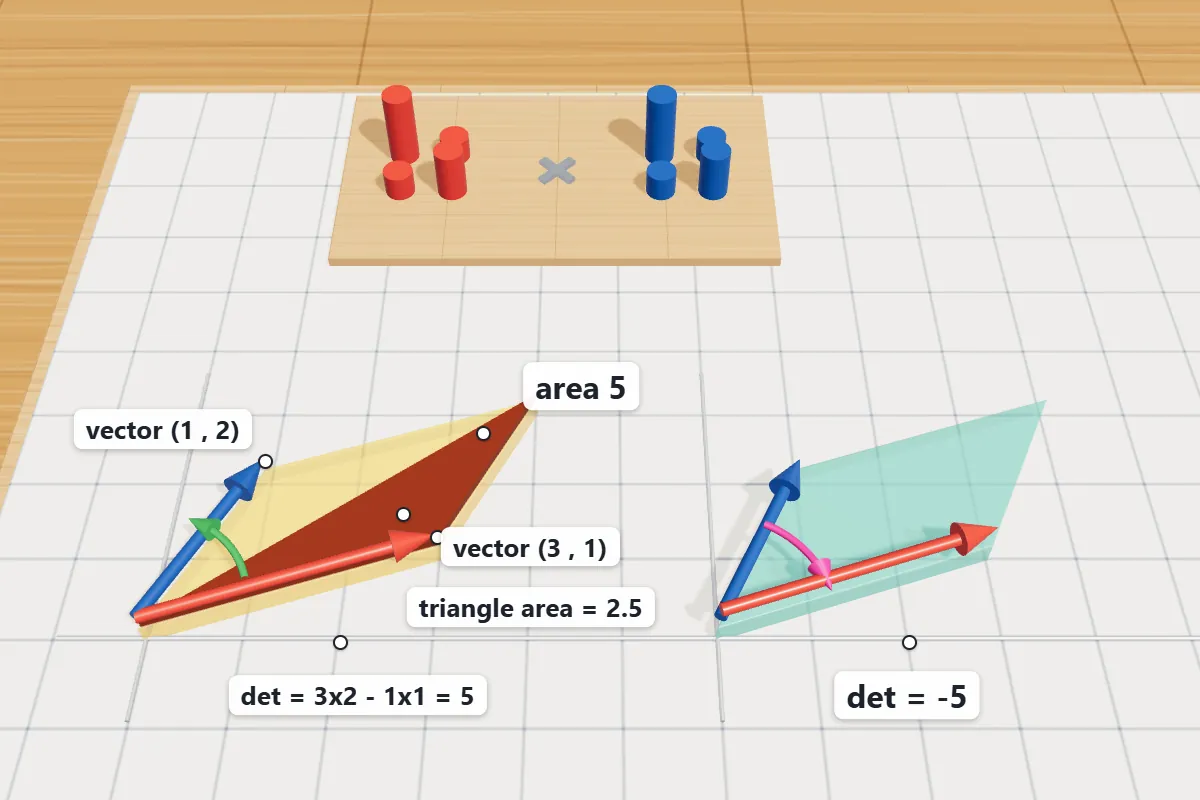
The 3×3 determinant
| Comparison aspect | Main idea | Keywords |
|---|---|---|
| • | Expand along any row or column using cofactors with alternating signs (+ − +) | Expandalongcolumnusing |
| Expanding along the first row | |A| = a(ei − fh) − b(di − fg) + c(dh − eg) | |
| Example |
| |
| Practical tip | expand along the row or column containing the most zeros — it shortens the work without changing the answer | expandalongcolumncontaining |
| Property | Statement |
|---|---|
| Zero row or column |
|
| Identical rows | Two identical rows (or columns) → determinant 0 |
| Row swap | Swapping two rows changes the sign of the determinant |
| Scalar multiple | Multiplying one row by k multiplies the determinant by k |
| Product rule | |AB| = |A|·|B| |
| Transpose | |Aᵀ| = |A| |
| Triangular matrix | Determinant equals the product of the diagonal entries |
Determinants, Matrices and Solving Linear Equations · 2 / 7
Matrix operations
Matrix operations
Addition and scalar multiplication
Matrices of the same order are added entry by entry(A + B)ij = aij + bij.
Scalar multiplication multiplies every entry(kA)ij = k·aij.
Different orders cannot be addeda 2×3 plus a 3×2 is undefined.
- A (m×n) can multiply B (n×p) only when the inner dimensions agree; the product is m×p.
- Entry (i, j) of AB = row i of A · column j of B.
- Example [[1, 2], [3, 4]] × [[2, 0], [1, 5]] = [[1·2 + 2·1, 1·0 + 2·5], [3·2 + 4·1, 3·0 + 4·5]] = [[4, 10], [10, 20]].
- Matrix multiplication is not commutative AB ≠ BA in general.
- Aᵀ is formed by turning rows into columns; (AB)ᵀ = BᵀAᵀ.
- The identity matrix I has 1s on the diagonal and 0s elsewhere, and AI = IA = A.
Determinants, Matrices and Solving Linear Equations · 3 / 7
Inverse of a matrix
Inverse of a matrix
When an inverse exists
- A square matrix A has an inverse A−1 only if det A ≠ 0; such a matrix is called non-singular.
- If det A = 0 the matrix is singular and has no inverse.
- Definition AA−1 = A−1A = I.
| Comparison aspect | Main idea | Keywords |
|---|---|---|
| For A = [[a, b], [c, d]] with det A ≠ 0 |
| |
| • |
| matrixadjugatetransposecofactor |
| Example |
| |
| Check |
|
- (A−1)−1 = A · (AB)−1 = B−1A−1 · (Aᵀ)−1 = (A−1)ᵀ · det(A−1) = 1/det A.
Determinants, Matrices and Solving Linear Equations · 4 / 7
Solving systems of linear equations
Solving systems of linear equations
The inverse-matrix method
- Write the system as AX = B, then X = A−1B, provided det A ≠ 0.
- Example 2x + 3y = 7 and x − 2y = −7.A = [[2, 3], [1, −2]], det A = −4 − 3 = −7, A−1 = (−1/7)[[−2, −3], [−1, 2]].
- X = A−1B = (−1/7)[[−2·7 + (−3)(−7)], [−1·7 + 2(−7)]] = (−1/7)[[7], [−21]] = [[−1], [3]], so x = −1 and y = 3.
- For AX = B with det A ≠ 0 x = Dx/D, y = Dy/D, z = Dz/D, where D = det A and Dx is D with the x-column replaced by B.
- Same system D = −7, Dx = |[[7, 3], [−7, −2]]| = −14 + 21 = 7 → x = 7/(−7) = −1.
- Dy = |[[2, 7], [1, −7]]| = −14 − 7 = −21 → y = (−21)/(−7) = 3.
- Both methods give the same answer; Cramer's rule is faster for a single unknown, the inverse method is better when several right-hand sides share the same A.
| det A | System AX = B |
|---|---|
| ≠ 0 | Unique solution |
| = 0 and consistent | Infinitely many solutions |
| = 0 and inconsistent | No solution |
Determinants, Matrices and Solving Linear Equations · 5 / 7
Practice with full answer key
Practice with full answer key
- det [[5, 2], [3, 1]] → 5 − 6 = −1
- det [[1, 0, 2], [3, 1, 0], [0, 4, 1]] → 1(1 − 0) − 0 + 2(12 − 0) = 25
- For which k is [[k, 4], [2, k]] singular? → k2 − 8 = 0 → k = ±2√2
- A = [[1, 2], [3, 4]]; find A−1 → det = −2 → [[−2, 1], [1.5, −0.5]]
- If |A| = 3 and |B| = 5, find |AB| and |2A| for 2×2 matrices → 15 and 12
- Solve 3x + y = 9, x − y = −1 by Cramer → D = −4, Dx = −8, Dy = −12 → x = 2, y = 3
- Solve x + 2y + z = 4, 2x − y + 3z = 9, 3x + y − z = 2 → x = 1, y = 1, z = 1
- If AB = I, what is B in terms of A? → B = A−1
Determinants, Matrices and Solving Linear Equations · 6 / 7
Exam traps and key takeaways
Exam traps and key takeaways
💡 High-yield traps
- The adjugate swaps the diagonal entries and changes the sign of the off-diagonal ones: [[d, −b], [−c, a]], not [[a, −c], [−b, d]].
- In Cramer's rule, the column of the unknown being found is the one replaced — replacing the wrong column is the classic error.
- |kA| = kn|A| for an n×n matrix, so for a 2×2 matrix |2A| = 4|A|, not 2|A|.
- AB ≠ BA; never reorder a product.
- det A = 0 → no inverse; writing A−1 anyway is an automatic zero on the item.
- Three unknowns need all three of D, Dx, Dy, Dz; a missing D gives an unverifiable answer.
Determinants, Matrices and Solving Linear Equations · 7 / 7
Well done! You finished this lesson
What would you like to do next?