Curriculum
Mathematics
Unit 1
0/12
1.1Key terms1.2Laws and key relationships1.3Rigorous Derivation of Reciprocal Trigonometric Functions1.4Logarithmic and General Exponential Differentiation Techniques1.5Parametric and Implicit Second-Order Derivatives1.6Worked examples1.7Exam tips1.8Real-world applications1.9Key Scientific Tables & Anatomical Diagrams Extracted from Official Curricula1.10📌 Comprehensive Scientific Terminology Dictionary:1.11🔍 In-Depth Explanations, Deductions & Multi-Book Insights:1.12Lesson summary
Unit 2
0/141.1The counting principle1.2Permutations (nPr)1.3Combinations (nCr)1.4Worked examples on counting, permutations and combinations1.5Recall: counting principle, permutations and combinations1.61-1 (a) Pascal's triangle and the binomial expansion1.71-1 (b) The general term1.81-1 (c) The middle term1.91-2 The term containing xk and the term free of x1.101-3 (a) The ratio between two consecutive terms1.111-3 (b) The greatest term1.12Key Scientific Tables & Anatomical Diagrams Extracted from Official Curricula1.13Lesson 1 - Counting Principle, Permutations and Combinations and the Binomial Theorem1.14Lesson summary
Unit 3
0/131.1Key terms1.2Laws and key relationships1.3Geometry of 3D Vectors and Scalar/Cross Product Physics1.4Equations of Straight Lines in Three Dimensions1.5Equations of Planes and Perpendicular Distance Formulas1.6Worked examples1.7Exam tips1.8Real-world applications1.9Key Scientific Tables & Anatomical Diagrams Extracted from Official Curricula1.10📌 Comprehensive Scientific Terminology Dictionary:1.11⚖️ Governing Physical Laws & Mathematical Relations:1.12🔍 In-Depth Explanations, Deductions & Multi-Book Insights:1.13Lesson summary
Unit 4
0/81.11 Smooth and rough surfaces1.22 Properties of the static friction force1.33 Kinetic friction force1.44 The resultant reaction R′1.55 The angle of friction1.66 Equilibrium of a body on a rough horizontal plane1.77 Equilibrium of a body on a rough inclined plane1.88 Conditions of equilibrium and rigid bodies with friction
Unit 5
0/121.13-1 (a) Indefinite integrals of exponential functions1.23-1 (b) Indefinite integrals of logarithmic functions1.33-2 (a) The differential and the standard integrals1.43-2 (b) Integration by substitution1.53-2 (c) Integration by parts1.63-2 (d) Applications of the indefinite integral1.73-3 (a) The definite integral and the fundamental theorem of calculus1.83-3 (b) Properties of the definite integral1.93-3 (c) Definite integral by substitution, odd and even functions1.103-4 (a) Area of a plane region1.113-4 (b) Volumes of solids of revolution1.12Key Scientific Tables & Anatomical Diagrams Extracted from Official Curricula
Unit 6
0/81.12-1 (a) Polar coordinates and the Argand plane1.22-1 (b) Modulus, amplitude and principal amplitude1.32-1 (c) The trigonometric (polar) form of a complex number1.42-1 (d) Product and quotient in trigonometric form1.52-1 (e) The exponential (Euler) form1.62-2 (a) De Moivre's theorem for a positive integer power1.72-2 (b) De Moivre's theorem for a rational power and the roots of a complex number1.82-3 The cube roots of unity
Unit 7
0/101.11 Momentum and its change1.22 Newton's first law, inertia and force1.33 Newton's second law, the equation of motion and variable mass1.44 Newton's third law, lifts and scales1.55 Bodies connected by a string over a smooth pulley1.66 Impulse1.77 Work1.88 Kinetic energy and the work-energy principle1.99 Potential energy and conservation of energy1.1010 Power
Text lesson
Proportion, Ratio and Drawing Scale
Proportion, Ratio and Drawing Scale
Overview
Overview
- Compare quantities by ratio and divide an amount in a given ratio.
- Form and solve a proportion, and tell direct from inverse proportion.
- Use a drawing scale to convert between a plan (or map) length and the real length.
- Relate lengths, areas and volumes on a scaled drawing to the real ones.
🌳 Concept tree
Ratio & Proportion
├── Ratio
│ ├── a→b, same units only
│ ├── Equivalent ratios (× or ÷ both terms)
│ └── Dividing a quantity in the ratio a : b
├── Proportion
| Comparison aspect | Main idea | Keywords |
|---|---|---|
| │ ├── a | b = c : d ⟹ a d = b c | |
| • | │ ├── Fourth proportional / third proportional / mean proportional | Fourthproportionalthirdmean |
| │ └── Continued proportion a | b = b : c |
├── Variation
│ ├── Directx ∝ y ⟹ x = k y
│ └── Inversex ∝ 1/y ⟹ x y = k
└── Drawing scale
| Comparison aspect | Main idea | Keywords |
|---|---|---|
| ├── scale = drawing length | real length | real |
| ├── 1 | n ⟹ real = drawing × n | realdrawing |
| • |
| areaplanrealvolume |
Proportion, Ratio and Drawing Scale · 1 / 7
Ratio
Ratio
Definition and rules
- The ratio of two quantities of the same kind and same units is a : b = a/b; it is a pure number, it has no unit.
- Multiplying or dividing both terms by the same non-zero number gives an equivalent ratio, so 12 : 18 = 2 : 3.
- The ratio is always written in its lowest terms, and the order of the terms matters: the ratio of a to b is not the ratio of b to a.
Dividing a quantity in a given ratio
To divide Q in the ratio a→b : c, find the total number of parts a + b + c, then the share of each part is Q ÷ (a + b + c); multiply by a, b, c.
Divide 240 feddans in the ratio 35. Parts = 8, one part = 30, so the shares are 90 and 150 feddans.
Divide EGP 1,200 in the ratio 23 : 7. Parts = 12, one part = 100, so 200, 300, 700.
The ratio of the ages of two friends is 45 and the difference of their ages is 6 years. One part = 6, so their ages are 24 and 30 years.
If ab = 2 : 3 and b : c = 4 : 5, make b common: a : b : c = 8 : 12 : 15.
Proportion, Ratio and Drawing Scale · 2 / 7
Proportion
Proportion
Definition
Four quantities a, b, c, d are in proportion when a→b = c : d, written a : b :: c : d. Then a and d are the extremes, b and c are the means, and the fundamental property is:
product of extremes = product of means⟹ a × d = b × c.
From ab = c : d we may also write b : a = d : c, a : c = b : d and (a + b) : b = (c + d) : d.
Fourth proportionalto a, b, c: the number x with a : b = c : x, so x = b c / a. For 2, 5, 8 → x = 5 × 8 / 2 = 20.
Third proportionalto a, b: the number x with a : b = b : x, so x = b2/a. For 4, 6 → x = 36/4 = 9.
Mean proportionalbetween a and b: the number x with a : x = x : b, so x = √(a b). Between 4 and 9 → x = 6.
Continued proportion
Three quantities are in continued proportion when a→b = b : c, i.e. b2 = a c; then b is the mean proportional and a : c = a2 : b2.
If a→b = 2 : 3 and b : c = 3 : 7, then a : b : c = 2 : 3 : 7 and a : c = 2 : 7.
Proportion, Ratio and Drawing Scale · 3 / 7
Direct and inverse proportion
Direct and inverse proportion
Direct proportion
- Two quantities are in direct proportion when they increase (or decrease) together at a constant ratio: x ∝ y ⟹ x = k y, k constant.
- The graph is a straight line through the origin and its slope is k.
- Cost ∝ number of metres of cloth. If 15 m costs EGP 450, the constant is 30 EGP/m, so 24 m cost 24 × 30 = EGP 720.
- At constant speed, distance ∝ time; at constant width, the area of a rectangle ∝ its length.
Inverse proportion
- Two quantities are in inverse proportion when one increases as the other decreases so that their product stays constant: x ∝ 1/y ⟹ x y = k.
- The graph is a hyperbola.
- For a fixed distance, speed × time = constant. A car covers a distance in 3 h at 80 km/h; at 60 km/h the time = 240/60 = 4 h.
- Work problem number of workers × number of days = constant for the same job. 12 workers finish in 20 days, so 15 workers finish in 12 × 20 / 15 = 16 days.
Choosing between them
Ask→when one quantity doubles, does the other double (direct) or halve (inverse)? Mixing the two is the most common error in this topic.
Proportion, Ratio and Drawing Scale · 4 / 7
Drawing scale (مقياس الرسم)
Drawing scale (مقياس الرسم)
Definition
- The scale of a drawing
- map or plan is the ratio:
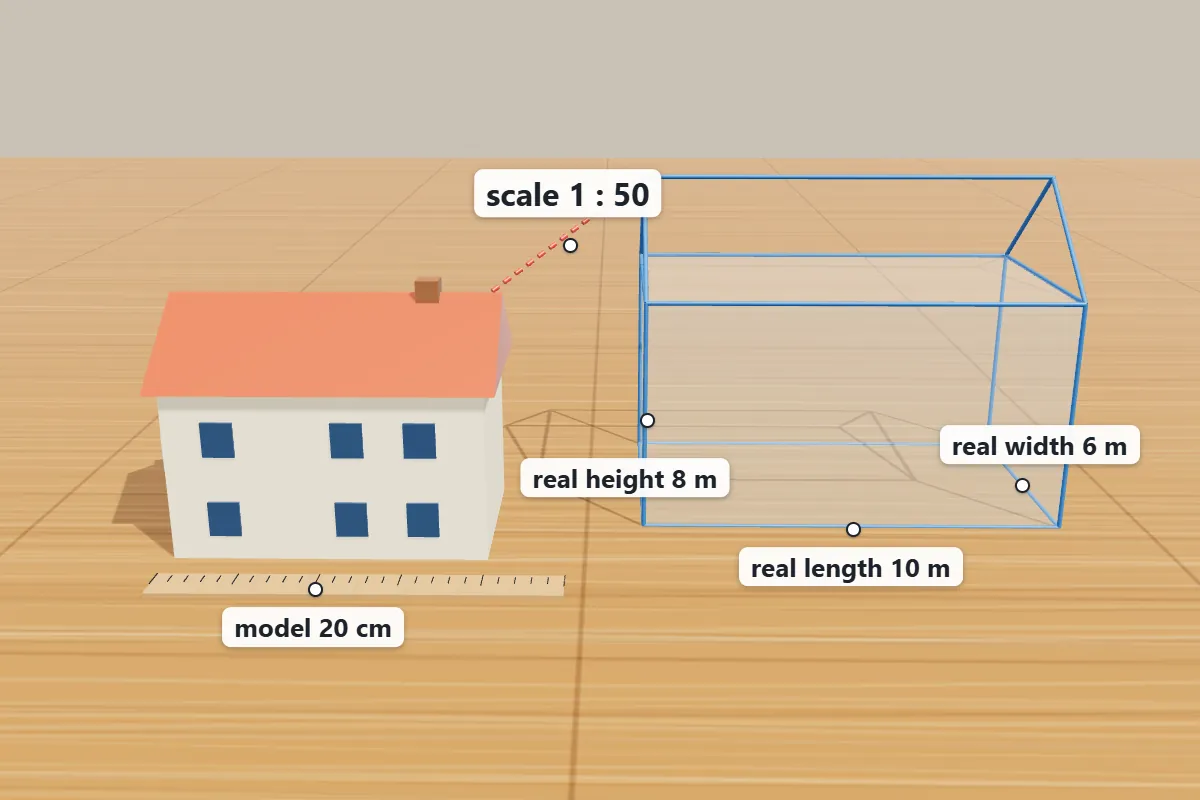
| Comparison aspect | Main idea | Example | Keywords |
|---|---|---|---|
| scale = length on the drawing : the corresponding real length | both in the same units | — | bothsameunits |
| A scale of 1 |
| — | meansrepresentsground |
| A scale of 1 | 100 means 1 cm on the plan = 100 cm = 1 m in reality | — | meansplanreality |
| • |
| 20 : 1 — drawing : real | enlargingscalemachinepart |
Real length = drawing length × the second term(for a 1 : n scale). A field measures 4 cm × 6 cm on a plan of scale 1 : 2,000 ⟹ real sides 80 m and 120 m.
Drawing length = real length ÷ n. A road 3.6 km long = 360,000 cm appears on a 1 : 20,000 map as 360,000 ÷ 20,000 = 18 cm.
Scale = drawing ÷ realafter converting the real length to the same unit.
Area and volume on a scaled drawing
| Comparison aspect | Main idea | Keywords |
|---|---|---|
| • |
| Lengthsmultipliedareasvolumes |
| A plot drawn as 4 cm × 6 cm at scale 1 |
| realareadrawingcheck |
| So |
| realareaplanfeddan |
Worked map example
Two cities are 7 cm apart on a map of scale 1→250,000. The real distance = 7 × 250,000 = 1,750,000 cm = 17.5 km. A train covering it in 15 minutes travels 17.5 ÷ 0.25 = 70 km/h.
Proportion, Ratio and Drawing Scale · 5 / 7
Practice with answers
Practice with answers
- 36 : 48, 2.5 : 7.5, 150 p : 1 EGP (1 EGP = 100 p). — 3 : 4, 1 : 3, 3 : 2 after converting to the same unit.
- 5. — 1,200 and 1,500 (parts 9, one part 300).
- 3 : 4. Find them. — Parts 9, one part = 180/9 = 20° ⟹ 40°, 60°, 80°.
- Find the fourth proportional to 3, 7, 12. — x = 7 × 12 / 3 = 28.
- Find the mean proportional between 8 and 18. — √144 = 12.
- If x ∝ y and x = 10 when y = 4, find x when y = 7. — k = 2.5 ⟹ x = 17.5.
- A job takes 9 days at 8 hours a day. How many days at 6 hours a day? — 72 hours of work ⟹ 12 days.
- 400,000. Find the real distance in km. — 2,000,000 cm = 20 km.
- 1,500. Find its dimensions on the plan. — 9,000 ÷ 1,500 = 6 cm and 6,000 ÷ 1,500 = 4 cm.
- 1,000 shows a garden of area 12 cm2. Find the real area in m2. — 12 × 1,0002 = 12,000,000 cm2 = 1,200 m2.
- A machine part 4 mm long is drawn 8 cm. Find the scale. — 80 : 4 = 20 : 1 (an enlarging scale).
Proportion, Ratio and Drawing Scale · 6 / 7
Exam traps
Exam traps
| Comparison aspect | Main idea | Keywords |
|---|---|---|
| Different units. |
| Neverwriteratioconvert |
| Order of the terms. |
| ratioboysgirlsmeans |
| Area is n2, not n. |
| classicmultiplechoicetrap |
| Enlarging versus reducing scales. |
| Mapsdrawingsmallpart |
| Direct versus inverse. |
| workproblemsnumberworkers |
| Continued proportion. |
| givesstudentsoftenwrite |
Proportion, Ratio and Drawing Scale · 7 / 7
Well done! You finished this lesson
What would you like to do next?