Curriculum
Mathematics
Unit 1
0/12
1.1Key terms1.2Laws and key relationships1.3Rigorous Derivation of Reciprocal Trigonometric Functions1.4Logarithmic and General Exponential Differentiation Techniques1.5Parametric and Implicit Second-Order Derivatives1.6Worked examples1.7Exam tips1.8Real-world applications1.9Key Scientific Tables & Anatomical Diagrams Extracted from Official Curricula1.10📌 Comprehensive Scientific Terminology Dictionary:1.11🔍 In-Depth Explanations, Deductions & Multi-Book Insights:1.12Lesson summary
Unit 2
0/141.1The counting principle1.2Permutations (nPr)1.3Combinations (nCr)1.4Worked examples on counting, permutations and combinations1.5Recall: counting principle, permutations and combinations1.61-1 (a) Pascal's triangle and the binomial expansion1.71-1 (b) The general term1.81-1 (c) The middle term1.91-2 The term containing xk and the term free of x1.101-3 (a) The ratio between two consecutive terms1.111-3 (b) The greatest term1.12Key Scientific Tables & Anatomical Diagrams Extracted from Official Curricula1.13Lesson 1 - Counting Principle, Permutations and Combinations and the Binomial Theorem1.14Lesson summary
Unit 3
0/131.1Key terms1.2Laws and key relationships1.3Geometry of 3D Vectors and Scalar/Cross Product Physics1.4Equations of Straight Lines in Three Dimensions1.5Equations of Planes and Perpendicular Distance Formulas1.6Worked examples1.7Exam tips1.8Real-world applications1.9Key Scientific Tables & Anatomical Diagrams Extracted from Official Curricula1.10📌 Comprehensive Scientific Terminology Dictionary:1.11⚖️ Governing Physical Laws & Mathematical Relations:1.12🔍 In-Depth Explanations, Deductions & Multi-Book Insights:1.13Lesson summary
Unit 4
0/81.11 Smooth and rough surfaces1.22 Properties of the static friction force1.33 Kinetic friction force1.44 The resultant reaction R′1.55 The angle of friction1.66 Equilibrium of a body on a rough horizontal plane1.77 Equilibrium of a body on a rough inclined plane1.88 Conditions of equilibrium and rigid bodies with friction
Unit 5
0/121.13-1 (a) Indefinite integrals of exponential functions1.23-1 (b) Indefinite integrals of logarithmic functions1.33-2 (a) The differential and the standard integrals1.43-2 (b) Integration by substitution1.53-2 (c) Integration by parts1.63-2 (d) Applications of the indefinite integral1.73-3 (a) The definite integral and the fundamental theorem of calculus1.83-3 (b) Properties of the definite integral1.93-3 (c) Definite integral by substitution, odd and even functions1.103-4 (a) Area of a plane region1.113-4 (b) Volumes of solids of revolution1.12Key Scientific Tables & Anatomical Diagrams Extracted from Official Curricula
Unit 6
0/81.12-1 (a) Polar coordinates and the Argand plane1.22-1 (b) Modulus, amplitude and principal amplitude1.32-1 (c) The trigonometric (polar) form of a complex number1.42-1 (d) Product and quotient in trigonometric form1.52-1 (e) The exponential (Euler) form1.62-2 (a) De Moivre's theorem for a positive integer power1.72-2 (b) De Moivre's theorem for a rational power and the roots of a complex number1.82-3 The cube roots of unity
Unit 7
0/101.11 Momentum and its change1.22 Newton's first law, inertia and force1.33 Newton's second law, the equation of motion and variable mass1.44 Newton's third law, lifts and scales1.55 Bodies connected by a string over a smooth pulley1.66 Impulse1.77 Work1.88 Kinetic energy and the work-energy principle1.99 Potential energy and conservation of energy1.1010 Power
Text lesson
Implicit and Parametric Differentiation and Connected Rates of Change
Implicit and Parametric Differentiation and Connected Rates of Change
Overview
Overview
- Differentiate an equation in x and y without solving for y, using d/dx of every term.
- Find dy/dx and d2y/dx2 for a curve given parametrically.
- Write the tangent and the normal to implicit and parametric curves at a given point.
- Model connected (related) rates of change and evaluate the required rate at an instant.
🌳 Concept tree
Beyond explicit differentiation
├── Implicit differentiation
- │ ├── Differentiate term by term, treating y as a function of x
- │ ├── Every y-term is multiplied by dy/dx (chain rule)
│ └── Collect dy/dx and isolate it
├── Second derivative
- │ ├── d2y/dx2 from implicit dy/dx (quotient rule again)
- │ └── Horizontal tangent dy/dx = 0 · Vertical tangent: denominator = 0
├── Parametric equations x = f(t), y = g(t)
│ ├── dy/dx = (dy/dt) ÷ (dx/dt)
│ ├── d2y/dx2 = [d/dt(dy/dx)] ÷ (dx/dt)
- │ └── Tangent
- normal
- area
- and motion interpretation
└── Connected rates
├── Relation linking the variables
├── Differentiate with respect to time t
└── Substitute the instant’s values, then solve
Implicit and Parametric Differentiation and Connected Rates of Change · 1 / 7
Implicit differentiation
Implicit differentiation
- When y is not isolated — for example x2 + y2 = 25 — differentiate both sides with respect to x, remembering that y is a function of x, so every term containing y is multiplied by dy/dx (chain rule).
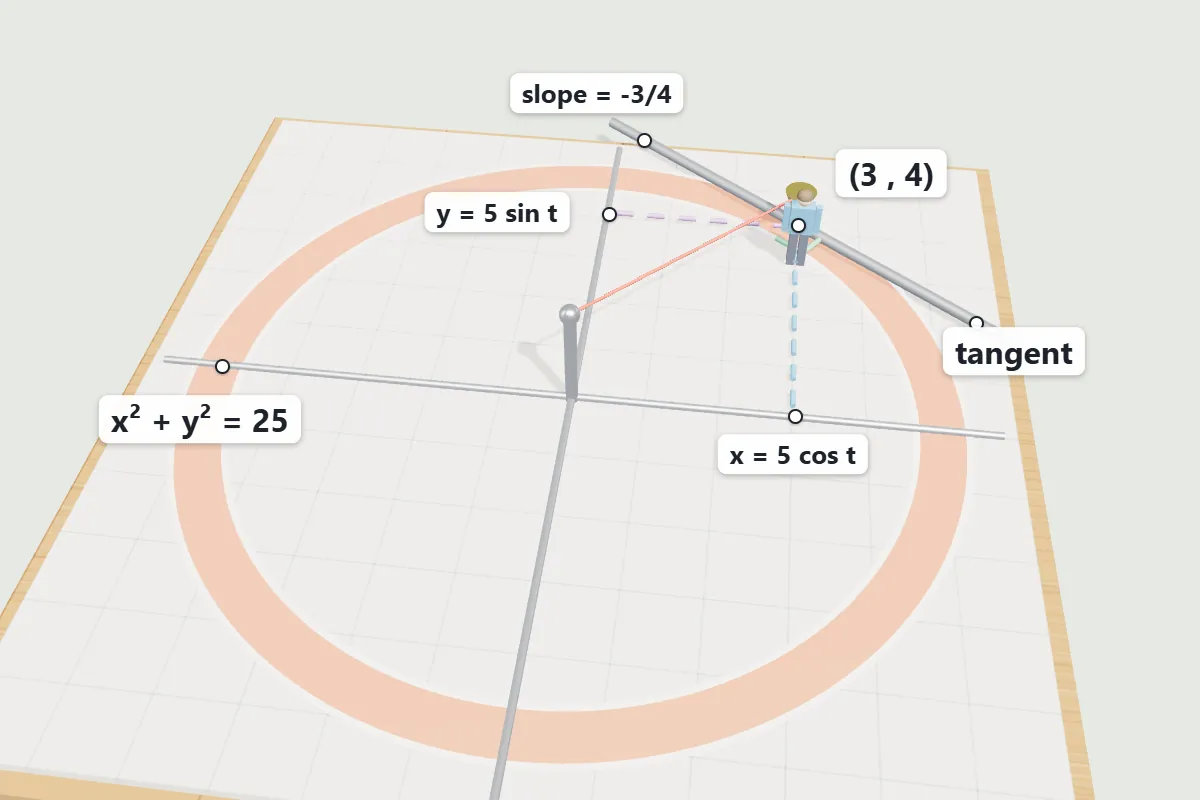
x2 + y2 = r22x + 2y·y′ = 0 ⟹ y′ = −x/y. At (3, 4) on x2 + y2 = 25 the slope is −3/4, so the tangent is 3x + 4y = 25 and the normal is 4x − 3y = 0.
x3 + y3 = 6xy(the folium of Descartes): 3x2 + 3y2y′ = 6y + 6xy′ ⟹ y′(3y2 − 6x) = 6y − 3x2 ⟹ y′ = (2y − x2)/(y2 − 2x).
xy + y2 = 5y + xy′ + 2yy′ = 0 ⟹ y′ = −y/(x + 2y).
sin(x + y) = x⟹ cos(x + y)(1 + y′) = 1 ⟹ y′ = sec(x + y) − 1.
Products require the product rule first→d/dx(xy) = x·y′ + y.
Implicit and Parametric Differentiation and Connected Rates of Change · 2 / 7
The second derivative implicitly
The second derivative implicitly
- To find d2y/dx2 differentiate the expression for y′ again with respect to x, using the quotient rule, and substitute the value of y′ obtained before.
Worked example
- For x2 + y2 = 25
- y′ = −x/y. Then
- y″ = −[y − x·y′]/y2 = −[y − x(−x/y)]/y2 = −(x2 + y2)/y3 = −25/y3 (using x2 + y2 = 25).
- At (3, 4) y′ = −3/4 and y″ = −25/64 < 0, so the curve is concave down there — consistent with the upper half of a circle.
| Comparison aspect | Main idea | Keywords |
|---|---|---|
| Horizontal | tangent where dy/dx = 0: the numerator vanishes (and the denominator does not) | tangentnumeratorvanishesdenominator |
| Vertical | tangent where dy/dx is undefined: the denominator vanishes (and the numerator does not) | tangentundefineddenominatorvanishes |
| • |
| numeratorgiveshorizontaltangents |
Implicit and Parametric Differentiation and Connected Rates of Change · 3 / 7
Parametric differentiation
Parametric differentiation
- If x = f(t) and y = g(t)
- then by the chain rule
dy/dx = (dy/dt) ÷ (dx/dt), provided dx/dt ≠ 0.
d2y/dx2 = [d/dt (dy/dx)] ÷ (dx/dt)a frequent error is to divide d2y/dt2 by d2x/dt2, which is wrong.
Worked example 1 — a circle
- x = 5 cos t, y = 5 sin t. dx/dt = −5 sin t, dy/dt = 5 cos t ⟹ dy/dx = −cot t.
- At t = π/3: dy/dx = −cot(π/3) = −1/√3 at the point (2.5, 4.33).
Worked example 2 — a parabola
- x = t2, y = t3 − 3t. dy/dx = (3t2 − 3)/(2t). At t = 1 the slope is 0 (horizontal tangent at (1, −2)); the tangent is y = −2.
- d/dt(dy/dx) = d/dt[(3/2)(t − t−1)] = (3/2)(1 + t−2); at t = 1 this is 3, and dx/dt = 2 ⟹ d2y/dx2 = 3/2 > 0, so (1, −2) is a local minimum.
Motion reading
- With t as time
- dx/dt and dy/dt are the velocity components
- the speed is √[(dx/dt)2 + (dy/dt)2]
- and the slope dy/dx is the direction of motion.
Implicit and Parametric Differentiation and Connected Rates of Change · 4 / 7
Connected (related) rates of change
Connected (related) rates of change
Method→(1) draw and label the variables as functions of time; (2) write a relation linking them; (3) differentiate both sides with respect to t; (4) substitute the values at the instant asked for; (5) solve and give the sign and units.
| Comparison aspect | Main idea | Keywords |
|---|---|---|
| Expanding circle | A = πr2 ⟹ dA/dt = 2πr·dr/dt. When dr/dt = 3 cm/s and r = 10 cm: dA/dt = 60π ≈ 188.5 cm2/s | |
| Ladder sliding |
| leansagainstwallfoot |
| Filling cone |
| waterconicaltankπr2h |
| Two ships |
| sailsnorthporteast |
| Shadow / angle |
| planeflieshorizontallyaltitude |
Implicit and Parametric Differentiation and Connected Rates of Change · 5 / 7
Practice with answers
Practice with answers
- Find dy/dx for x2 + 3xy + y2 = 7. — (2x + 3y) + (3x + 2y)y′ = 0 ⟹ y′ = −(2x + 3y)/(3x + 2y).
- Find dy/dx for y3 = x2 + y. — 3y2y′ = 2x + y′ ⟹ y′ = 2x/(3y2 − 1).
- For x = t3 − t, y = t2 + 1 find dy/dx at t = 2. — (2t)/(3t2 − 1) = 4/11 ⟹ 4/11.
- Find the tangent to x2y + y3 = 8 at (2, 2). — y′ = −(2xy)/(x2 + 3y2) = −4/(4 + 12) = −1/4 ⟹ x + 4y = 10.
- A spherical balloon grows at 10 cm3/s. How fast is the radius increasing when r = 5? — dV/dt = 4πr2·dr/dt ⟹ dr/dt = 10/(100π) = 1/(10π) ≈ 0.0318 cm/s.
- A 10 m ladder’s top slides down at 0.5 m/s when the foot is 6 m from the wall. Find the foot’s speed. — x·dx/dt + y·dy/dt = 0 with y = 8: 6·dx/dt = 8(0.5) ⟹ 2/3 m/s.
- For the ellipse x2/9 + y2/4 = 1 find the points with a horizontal tangent. — y′ = −(4x)/(9y) = 0 ⟹ x = 0 ⟹ (0, ±2); vertical tangents at (±3, 0).
Implicit and Parametric Differentiation and Connected Rates of Change · 6 / 7
Exam traps
Exam traps
| Comparison aspect | Main idea | Keywords |
|---|---|---|
| Forgetting dy/dx on y-terms. |
| singleslipinvalidateswhole |
| Second parametric derivative. |
| |
| Sign of the rate. | A decreasing quantity has a negative derivative (the ladder top: −0.75 m/s). State “decreasing at 0.75 m/s” only if words are asked for | decreasingquantitynegativederivative |
| Use the instant, not a general value. |
| Substitutegivenratemoment |
| Units. |
| mixingthempenalisedseparately |
| Implicit curve points must satisfy the equation. | Check the given point lies on the curve before differentiating | Checkgivenliesbefore |
Implicit and Parametric Differentiation and Connected Rates of Change · 7 / 7
Well done! You finished this lesson
What would you like to do next?