Curriculum
Mathematics
Unit 1
0/12
1.1Key terms1.2Laws and key relationships1.3Rigorous Derivation of Reciprocal Trigonometric Functions1.4Logarithmic and General Exponential Differentiation Techniques1.5Parametric and Implicit Second-Order Derivatives1.6Worked examples1.7Exam tips1.8Real-world applications1.9Key Scientific Tables & Anatomical Diagrams Extracted from Official Curricula1.10📌 Comprehensive Scientific Terminology Dictionary:1.11🔍 In-Depth Explanations, Deductions & Multi-Book Insights:1.12Lesson summary
Unit 2
0/141.1The counting principle1.2Permutations (nPr)1.3Combinations (nCr)1.4Worked examples on counting, permutations and combinations1.5Recall: counting principle, permutations and combinations1.61-1 (a) Pascal's triangle and the binomial expansion1.71-1 (b) The general term1.81-1 (c) The middle term1.91-2 The term containing xk and the term free of x1.101-3 (a) The ratio between two consecutive terms1.111-3 (b) The greatest term1.12Key Scientific Tables & Anatomical Diagrams Extracted from Official Curricula1.13Lesson 1 - Counting Principle, Permutations and Combinations and the Binomial Theorem1.14Lesson summary
Unit 3
0/131.1Key terms1.2Laws and key relationships1.3Geometry of 3D Vectors and Scalar/Cross Product Physics1.4Equations of Straight Lines in Three Dimensions1.5Equations of Planes and Perpendicular Distance Formulas1.6Worked examples1.7Exam tips1.8Real-world applications1.9Key Scientific Tables & Anatomical Diagrams Extracted from Official Curricula1.10📌 Comprehensive Scientific Terminology Dictionary:1.11⚖️ Governing Physical Laws & Mathematical Relations:1.12🔍 In-Depth Explanations, Deductions & Multi-Book Insights:1.13Lesson summary
Unit 4
0/81.11 Smooth and rough surfaces1.22 Properties of the static friction force1.33 Kinetic friction force1.44 The resultant reaction R′1.55 The angle of friction1.66 Equilibrium of a body on a rough horizontal plane1.77 Equilibrium of a body on a rough inclined plane1.88 Conditions of equilibrium and rigid bodies with friction
Unit 5
0/121.13-1 (a) Indefinite integrals of exponential functions1.23-1 (b) Indefinite integrals of logarithmic functions1.33-2 (a) The differential and the standard integrals1.43-2 (b) Integration by substitution1.53-2 (c) Integration by parts1.63-2 (d) Applications of the indefinite integral1.73-3 (a) The definite integral and the fundamental theorem of calculus1.83-3 (b) Properties of the definite integral1.93-3 (c) Definite integral by substitution, odd and even functions1.103-4 (a) Area of a plane region1.113-4 (b) Volumes of solids of revolution1.12Key Scientific Tables & Anatomical Diagrams Extracted from Official Curricula
Unit 6
0/81.12-1 (a) Polar coordinates and the Argand plane1.22-1 (b) Modulus, amplitude and principal amplitude1.32-1 (c) The trigonometric (polar) form of a complex number1.42-1 (d) Product and quotient in trigonometric form1.52-1 (e) The exponential (Euler) form1.62-2 (a) De Moivre's theorem for a positive integer power1.72-2 (b) De Moivre's theorem for a rational power and the roots of a complex number1.82-3 The cube roots of unity
Unit 7
0/101.11 Momentum and its change1.22 Newton's first law, inertia and force1.33 Newton's second law, the equation of motion and variable mass1.44 Newton's third law, lifts and scales1.55 Bodies connected by a string over a smooth pulley1.66 Impulse1.77 Work1.88 Kinetic energy and the work-energy principle1.99 Potential energy and conservation of energy1.1010 Power
Text lesson
Moments, General Equilibrium, the Couple and the Centre of Gravity
Moments, General Equilibrium, the Couple and the Centre of Gravity
Overview
Overview
- Compute the moment of a force about a point and use Varignon’s theorem.
- State and apply the three conditions of equilibrium of a rigid body under coplanar forces.
- Replace a system by a single resultant or by a couple, and find the moment of a couple.
- Find the centre of gravity of composite laminae and of systems of parallel weights, and solve beam and ladder problems.
🌳 Concept tree
Statics of a Rigid Body
├── Moment of a force
│ ├── M = F × (perpendicular distance), unit N·m
| Comparison aspect | Main idea | Keywords |
|---|---|---|
| │ ├── Sign |
| anticlockwiseclockwise |
| │ └── Varignon | moment of the resultant = sum of moments | momentresultantmoments |
| • | ├── Equilibrium of a rigid body (coplanar forces) | Equilibriumrigidbodycoplanar |
│ ├── ΣFx = 0 , ΣFy = 0 , ΣM(any point) = 0
- │ └── Three unknowns maximum from three equations
├── Support reactions
│ ├── Smooth hinge → two components (Rx, Ry)
│ ├── Smooth peg / string → one known direction
- │ └── Rough surface → reaction R and friction F
- tan λ = μ
├── The couple
- │ ├── Two equal
- opposite
- parallel
- non-collinear forces
│ ├── Moment = F × d, the same about every point
│ └── No resultant→it can only be balanced by another couple
├── Centre of gravity
| Comparison aspect | Main idea | Keywords |
|---|---|---|
| • | │ ├── Uniform rod / lamina / sphere → centre of symmetry | Uniformlaminaspherecentre |
| │ ├── Composite | x̄ = Σ(mᵢxᵢ)/Σmᵢ | mᵢxᵢ |
| │ └── Removal of a part | treat it as negative mass | treatnegativemass |
| └── Applications |
| beamscranesladderspoint |
Moments, General Equilibrium, the Couple and the Centre of Gravity · 1 / 9
Moment of a force
Moment of a force
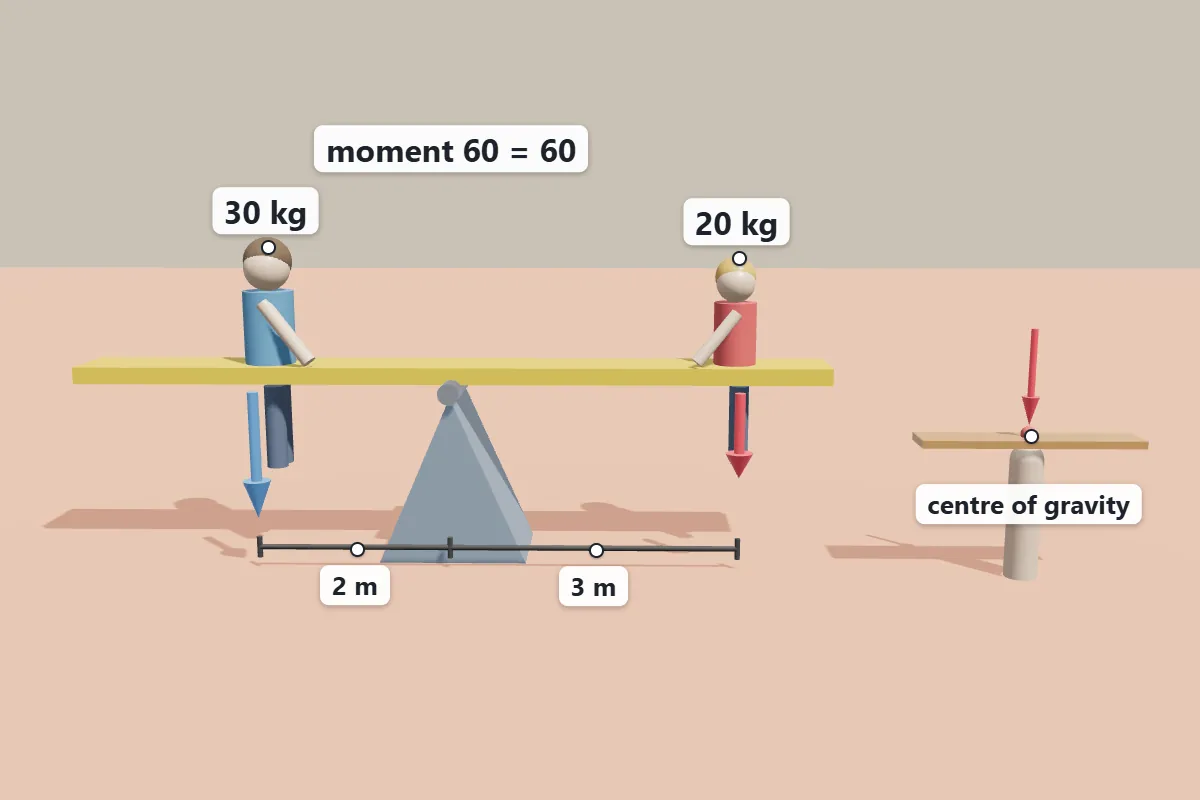
- The moment (torque) of a force F about a point O is M = F × d, where d is the perpendicular distance from O to the line of action of the force. Unit: N·m.
- Only the perpendicular component contributes if F makes an angle θ with the arm of length r, then M = F·r·sin θ.
- Moment is a turning effect; the sign convention is anticlockwise positive.
- A force has zero moment about any point on its own line of action.
Varignon’s theorem
- The moment of the resultant of a system of coplanar forces about any point equals the algebraic sum of the moments of its components about the same point.
Worked example
- A force of 20 N acts at the end of a 0.5 m arm making 30° with the arm: M = 20 × 0.5 × sin 30° = 5 N·m.
- If instead the force is perpendicular to the arm, M = 20 × 0.5 = 10 N·m.
Moments, General Equilibrium, the Couple and the Centre of Gravity · 2 / 9
Equilibrium of a rigid body under coplanar forces
Equilibrium of a rigid body under coplanar forces
- A rigid body is in equilibrium when it has no tendency to translate or to rotate.
- For coplanar forces this requires three independent conditions:
| Comparison aspect | Main idea | Keywords |
|---|---|---|
| ΣFx = 0 | no resultant force horizontally | resultantforcehorizontally |
| ΣFy = 0 | no resultant force vertically | resultantforcevertically |
| ΣM = 0 about any point | no resultant turning effect | resultantturningeffect |
| • |
| Choosepointtakingmoments |
Worked example — a uniform beam on two supports
- A uniform rod of weight 60 N and length 4 m rests on supports at its ends
- a 100 N load hangs 1 m from the left end.
Moments about the left endR₂ × 4 = 60 × 2 + 100 × 1 = 220 ⟹ R₂ = 55 N.
ΣFy = 0R₁ = 160 − 55 = 105 N.
Check with moments about the right endR₁ × 4 = 60 × 2 + 100 × 3 = 420 ⟹ R₁ = 105 N ✓.
Three-force bodies
- If a body is in equilibrium under three non-parallel forces, their lines of action are concurrent (meet at one point) and coplanar — this fact is used to find the direction of an unknown reaction.
Moments, General Equilibrium, the Couple and the Centre of Gravity · 3 / 9
Rods with hinges, strings and smooth pegs
Rods with hinges, strings and smooth pegs
- A smooth hinge exerts two unknown components Rx, Ry (three unknowns with the direction being arbitrary); take moments about the hinge to eliminate both.
- A smooth peg or a light string over it transmits the same tension on both sides and the reaction is along the bisector of the angle between the two parts.
- A smooth wall / floor gives a reaction perpendicular to the surface only.
Worked example — hinged rod with a string
- A uniform rod AB of weight W and length 2 m is hinged at A and held by a vertical string at B inclined 30° to the horizontal wall.
- Moments about A: T × 2 cos 30° = W × 1 ⟹ T = W/(2 cos 30°) = 0.577 W; then Ry = W − T and Rx = 0 for a vertical string.
Worked example — limiting position
- A rod of length L rests with one end on a rough floor and leans against a smooth wall at angle θ.
- The wall reaction is horizontal, the floor gives R (vertical) and F (horizontal, F ≤ μR).
- Equilibrium gives F = Rwall, R = W, and moments about the floor end: Rwall·L sin θ = W·(L/2)cos θ ⟹ Rwall = (W/2)cot θ.
- Slipping impends when (W/2)cot θ = μW ⟹ tan θ = 1/(2μ).
Moments, General Equilibrium, the Couple and the Centre of Gravity · 4 / 9
The couple
The couple
- A couple is the system of two equal, opposite and parallel forces whose lines of action do not coincide.
- Its resultant force is zero, so it produces pure rotation; its moment is M = F × d, where d is the perpendicular distance between the two lines of action.
- The moment of a couple is the same about every point in the plane — this is what distinguishes it from an ordinary force system.
- A couple can only be balanced by another couple of equal moment and opposite sense; a single force can never equilibrium a couple.
Worked example
- Two forces of 12 N act along parallel lines 0.4 m apart in opposite senses: M = 12 × 0.4 = 4.8 N·m.
- The same value is obtained about any point, including a point outside the strip between the lines.
Resultant of a system with a couple
- A force F together with a couple of moment M in the same plane is equivalent to a single force F displaced perpendicular to itself by d = M/F, because moving the force off the original line creates exactly the couple M.
Moments, General Equilibrium, the Couple and the Centre of Gravity · 5 / 9
The centre of gravity
The centre of gravity
- The centre of gravity (C.G.) is the point through which the resultant of all the gravitational forces on the body passes, whatever the body’s position.
| Comparison aspect | Main idea | Keywords |
|---|---|---|
| • | Uniform rod → its midpoint. Uniform rectangular lamina → intersection of the diagonals. Uniform circle → the centre. Uniform triangle → the intersection of the medians (1/3 of the way up any median) | Uniformmidpointrectangularlamina |
| For parallel weights W₁, W₂, … at positions x₁, x₂, … |
| Wᵢxᵢsame |
| Composite laminae |
| dividestandardshapestabulate |
| Suspended-body method |
| hangsfreelypointlies |
Worked example — a lamina with a cut-out
- A circular disc of radius 6 cm has a circular hole of radius 2 cm cut from it, the hole’s centre 3 cm from the disc’s centre.
- Taking moments of area about the disc centre: x̄ = [π(36)(0) − π(4)(3)]/[π(36) − π(4)] = −12π/32π = −0.375 cm, i.e. the C.G. of the remaining part is 0.375 cm from the centre on the side opposite the hole.
Worked example — two masses on a rod
- A light rod 1.2 m long carries 4 kg at one end and 8 kg at the other.
- The C.G. is at x = (4×0 + 8×1.2)/12 = 0.8 m from the 4 kg end.
Moments, General Equilibrium, the Couple and the Centre of Gravity · 6 / 9
Stability and the angle of friction
Stability and the angle of friction
- The angle of friction λ satisfies tan λ = μ, and the resultive reaction of a rough surface makes the angle λ with the normal (the cone of friction).
- A body on an inclined plane begins to slide when the plane’s angle exceeds λ, i.e. when tan θ = μ.
- A body on the point of toppling (rather than sliding) when its C.G. passes vertically beyond the edge of its base: for a cuboid of base width 2b and C.G. height h on a rough plane, toppling impends when tan θ = b/h.
- Lowering the C.G. and widening the base increase stability — the reason a racing car is low and a lamp has a heavy base.
Worked example
- A cube of side 10 cm rests on a rough plane with μ = 0.4.
- Slipping impends at tan θ = 0.4 ⟹ θ = 21.8°; toppling would need tan θ = 5/5 = 1 ⟹ θ = 45°.
- Since 21.8° < 45°, the cube slides before it topples.
Moments, General Equilibrium, the Couple and the Centre of Gravity · 7 / 9
Practice with answers
Practice with answers
- Find the moment of a 30 N force applied at 0.6 m from a pivot, at 60° to the arm. — 30 × 0.6 × sin 60° = 15.6 N·m.
- A uniform 5 m beam of weight 200 N carries 300 N at one end. It balances on a prop 2 m from that end. Verify by taking moments about the prop. — 300×2 = 600, weight acts 0.5 m on the other side: 200×0.5=100 ⟹ not balanced; the prop must be at x with 300x = 200(2.5 − x) ⟹ x = 4/3 m.
- Two forces of 9 N form a couple with lines 25 cm apart. Find the moment. — 9 × 0.25 = 2.25 N·m.
- Find the C.G. of a T-shaped lamina made of a 10×2 rectangle (top) on a 2×8 rectangle (stem) centred below it. — Areas 20 and 16; take the top edge as y = 0: ȳ = (20×1 + 16×6)/36 = 116/36 ≈ 3.22 cm below the top.
- A 12 kg mass hangs from two strings making 30° and 60° with the ceiling. Find the tensions. — Horizontal balance T₁cos30 = T₂cos60 and vertical T₁sin30 + T₂sin60 = 12g ⟹ T₁ = 6g√3 ≈ 101.8 N, T₂ = 6g ≈ 58.8 N (with g = 9.8).
- A body just slides down a rough 30° plane. Find μ. — μ = tan 30° = 0.577.
Moments, General Equilibrium, the Couple and the Centre of Gravity · 8 / 9
Exam traps
Exam traps
| Comparison aspect | Main idea | Keywords |
|---|---|---|
| Perpendicular distance, not the slant distance. |
| Momentshortestlineaction |
| Uniform bodies keep their own weight. |
| lightactingmiddlevery |
| Moment about the wrong point. |
| Takemomentsmostunknowns |
| A couple has no resultant force. |
| doesfollowalonecannot |
| Hinge reactions have two components. |
| assumesmoothalongforce |
| Negative area for holes. | A cut-out is subtracted in both the numerator and the denominator of x̄ = Σ(Aᵢxᵢ)/ΣAᵢ | subtractedbothnumeratordenominator |
| Friction direction. |
| opposesimpendingmotionlimiting |
Moments, General Equilibrium, the Couple and the Centre of Gravity · 9 / 9
Well done! You finished this lesson
What would you like to do next?