Curriculum
Mathematics
Unit 1
0/12
1.1Key terms1.2Laws and key relationships1.3Rigorous Derivation of Reciprocal Trigonometric Functions1.4Logarithmic and General Exponential Differentiation Techniques1.5Parametric and Implicit Second-Order Derivatives1.6Worked examples1.7Exam tips1.8Real-world applications1.9Key Scientific Tables & Anatomical Diagrams Extracted from Official Curricula1.10📌 Comprehensive Scientific Terminology Dictionary:1.11🔍 In-Depth Explanations, Deductions & Multi-Book Insights:1.12Lesson summary
Unit 2
0/141.1The counting principle1.2Permutations (nPr)1.3Combinations (nCr)1.4Worked examples on counting, permutations and combinations1.5Recall: counting principle, permutations and combinations1.61-1 (a) Pascal's triangle and the binomial expansion1.71-1 (b) The general term1.81-1 (c) The middle term1.91-2 The term containing xk and the term free of x1.101-3 (a) The ratio between two consecutive terms1.111-3 (b) The greatest term1.12Key Scientific Tables & Anatomical Diagrams Extracted from Official Curricula1.13Lesson 1 - Counting Principle, Permutations and Combinations and the Binomial Theorem1.14Lesson summary
Unit 3
0/131.1Key terms1.2Laws and key relationships1.3Geometry of 3D Vectors and Scalar/Cross Product Physics1.4Equations of Straight Lines in Three Dimensions1.5Equations of Planes and Perpendicular Distance Formulas1.6Worked examples1.7Exam tips1.8Real-world applications1.9Key Scientific Tables & Anatomical Diagrams Extracted from Official Curricula1.10📌 Comprehensive Scientific Terminology Dictionary:1.11⚖️ Governing Physical Laws & Mathematical Relations:1.12🔍 In-Depth Explanations, Deductions & Multi-Book Insights:1.13Lesson summary
Unit 4
0/81.11 Smooth and rough surfaces1.22 Properties of the static friction force1.33 Kinetic friction force1.44 The resultant reaction R′1.55 The angle of friction1.66 Equilibrium of a body on a rough horizontal plane1.77 Equilibrium of a body on a rough inclined plane1.88 Conditions of equilibrium and rigid bodies with friction
Unit 5
0/121.13-1 (a) Indefinite integrals of exponential functions1.23-1 (b) Indefinite integrals of logarithmic functions1.33-2 (a) The differential and the standard integrals1.43-2 (b) Integration by substitution1.53-2 (c) Integration by parts1.63-2 (d) Applications of the indefinite integral1.73-3 (a) The definite integral and the fundamental theorem of calculus1.83-3 (b) Properties of the definite integral1.93-3 (c) Definite integral by substitution, odd and even functions1.103-4 (a) Area of a plane region1.113-4 (b) Volumes of solids of revolution1.12Key Scientific Tables & Anatomical Diagrams Extracted from Official Curricula
Unit 6
0/81.12-1 (a) Polar coordinates and the Argand plane1.22-1 (b) Modulus, amplitude and principal amplitude1.32-1 (c) The trigonometric (polar) form of a complex number1.42-1 (d) Product and quotient in trigonometric form1.52-1 (e) The exponential (Euler) form1.62-2 (a) De Moivre's theorem for a positive integer power1.72-2 (b) De Moivre's theorem for a rational power and the roots of a complex number1.82-3 The cube roots of unity
Unit 7
0/101.11 Momentum and its change1.22 Newton's first law, inertia and force1.33 Newton's second law, the equation of motion and variable mass1.44 Newton's third law, lifts and scales1.55 Bodies connected by a string over a smooth pulley1.66 Impulse1.77 Work1.88 Kinetic energy and the work-energy principle1.99 Potential energy and conservation of energy1.1010 Power
Text lesson
Indefinite Integration of Trigonometric, Exponential and Logarithmic Functions
Indefinite Integration of Trigonometric, Exponential and Logarithmic Functions
Overview
Overview
- Treat indefinite integration as the reverse process of differentiation, with its properties and the table of standard integrals.
- Integrate exponential, logarithmic and trigonometric functions and use them in geometric and physical applications.
- Use differentials, integration by substitution and integration by parts, and recover a curve from the slope of its tangent.
Indefinite Integration of Trigonometric, Exponential and Logarithmic Functions
├── Antiderivatives and the indefinite integral
│   ├── Definition of the antiderivative
│   ├── Properties of the indefinite integral
│   └── Standard (tabular) integrals
├── Integrals of exponential functions
├── Integrals of logarithmic functions
│   ├── The function 1/x
│   └── Multiples of the logarithmic function
├── Applications of indefinite integration
│   ├── Geometric applications
│   └── Physical applications
├── Differentials
├── Integration by substitution
└── Integration by parts (LIATE)
Indefinite Integration of Trigonometric, Exponential and Logarithmic Functions · 1 / 11
The antiderivative and the indefinite integral
The antiderivative and the indefinite integral
Definition
- An antiderivative (inverse derivative) of f(x) on an interval is a function F(x) whose derivative is f(x), that is F′(x) = f(x) for every x in the interval.
- Adding any constant to an antiderivative gives another antiderivative, so every function has infinitely many antiderivatives.
- The set of all antiderivatives is called the indefinite integral and is written ∫ f(x) dx: ∫ f(x) dx = F(x) + C.
- Geometrically the indefinite integral is a family of parallel curves differing only by the constant, so at the same value of x their tangents all have the same slope.
- C is the constant of integration (arbitrary constant); it is fixed when a point on the curve is known.
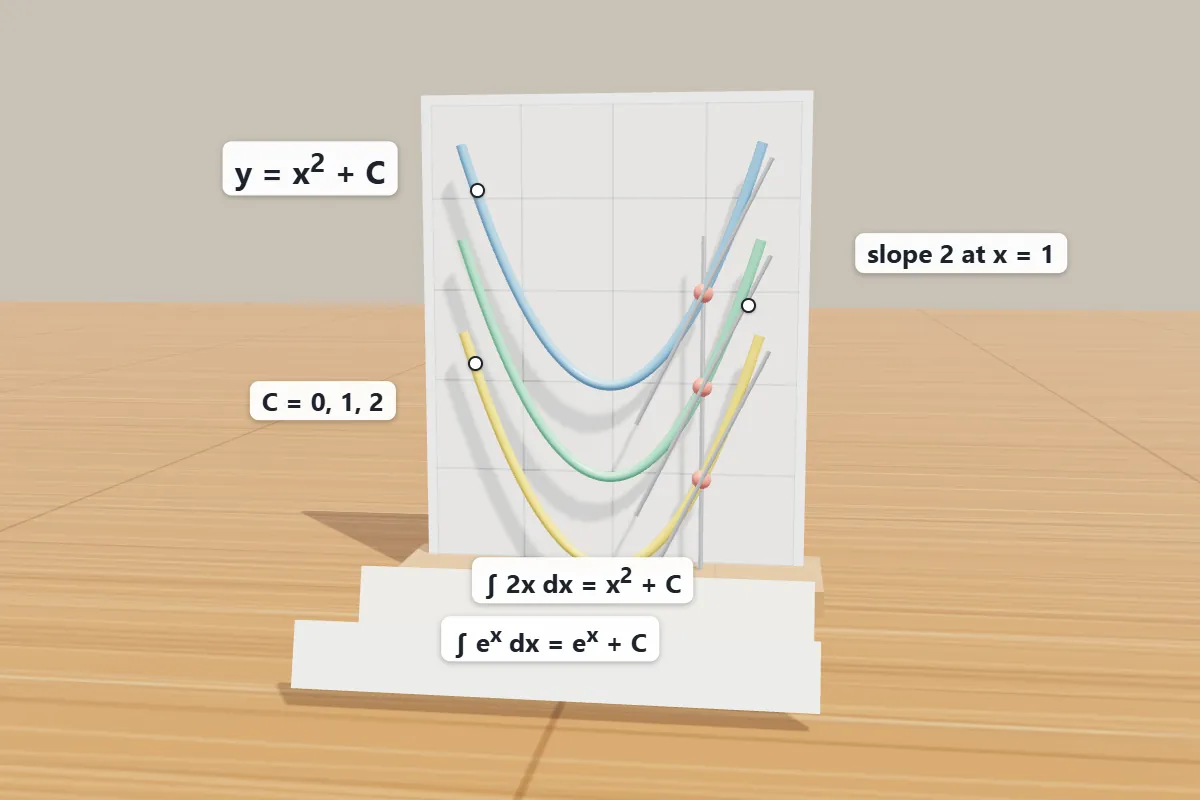
Properties
Integral of a sum or difference∫ [f(x) ± g(x)] dx = ∫ f(x) dx ± ∫ g(x) dx.
Constant factor∫ k f(x) dx = k ∫ f(x) dx, where k is a fixed real number.
Power rule∫ xn dx = xn+1/(n + 1) + C, n ≠ −1. The excluded case is exactly the logarithmic one: ∫ dx/x = ln|x| + C.
Check any result by differentiatingd/dx of the answer must return the integrand.
- ∫ (3x2 + 4x + 5) dx = x3 + 2x2 + 5x + C.
- ∫ (x2 + 2x − 3) dx = x3/3 + x2 − 3x + C.
- ∫ (√x + 1/√x) dx = ∫ (x1/2 + x−1/2) dx = (2/3)x3/2 + 2x1/2 + C.
- substitution is the efficient route (section 07) — u = x2 − 3, du = 2x dx → ½∫ u2 du = (x2 − 3)3/6 + C. Expanding first also works: ∫ (x5 − 6x3 + 9x) dx = x6/6 − 3x4/2 + 9x2/2 + C, which differs from the factored form only by a constant.
Indefinite Integration of Trigonometric, Exponential and Logarithmic Functions · 2 / 11
The table of standard integrals (including trigonometric)
The table of standard integrals (including trigonometric)
| Integrand | Integral | Comes from |
|---|---|---|
| cos x | sin x + C | d/dx(sin x) = cos x |
| sin x | −cos x + C | d/dx(−cos x) = sin x |
| sec2 x | tan x + C | d/dx(tan x) = sec2 x |
| cosec2 x | −cot x + C | d/dx(−cot x) = cosec2 x |
| sec x tan x | sec x + C | d/dx(sec x) = sec x tan x |
| cosec x cot x | −cosec x + C | d/dx(−cosec x) = cosec x cot x |
| tan x | ln|sec x| + C | write tan x = sin x/cos x, u = cos x |
| cot x | ln|cosec x| + C | write cot x = cos x/sin x, u = sin x |
| ex | ex + C | self-derivative |
| 1/x | ln|x| + C | d/dx ln|x| = 1/x |
- Whenever the angle is (ax + b), divide by a ∫ cos(ax + b) dx = sin(ax + b)/a + C, ∫ sin(ax + b) dx = −cos(ax + b)/a + C.
- ∫ sec2(2x) dx = tan(2x)/2 + C and ∫ e3x dx = e3x/3 + C — the same rule.
- Squares of trig functions are reduced with the double-angle identities first: sin2x = (1 − cos 2x)/2, cos2x = (1 + cos 2x)/2.
- Example ∫ sin2x dx = ∫ (1 − cos 2x)/2 dx = x/2 − sin 2x/4 + C.
Indefinite Integration of Trigonometric, Exponential and Logarithmic Functions · 3 / 11
Integrals of exponential functions
Integrals of exponential functions
The two rules
| Comparison aspect | Main idea | Keywords |
|---|---|---|
| Natural base |
| linearexponent |
| Any positive base a ≠ 1 |
| |
| Reason |
| thereforefactormustdivided |
| • | If the exponent is a function g(x), the chain rule must be undone: ∫ eg(x) g′(x) dx = eg(x) + C. | exponentfunctionchainrule |
- ∫ e2x − 1 dx = e2x − 1/2 + C.
- ∫ 3x dx = 3x/ln 3 + C.
- let u = x2, du = 2x dx → ½∫ eu du = ex2/2 + C.
- ∫ (ex + 2x) dx = ex + 2x/ln 2 + C — integrate term by term, different rules for each.
Indefinite Integration of Trigonometric, Exponential and Logarithmic Functions · 4 / 11
Integrals of logarithmic functions (the 1/x rule)
Integrals of logarithmic functions (the 1/x rule)
The rule
∫ dx/x = ln|x| + C.The modulus is compulsory: for x < 0, d/dx ln(−x) = (−1)/(−x) = 1/x, so ln|x| is an antiderivative on both sides of zero.
Linear argument∫ dx/(ax + b) = ln|ax + b|/a + C.
Numerator equal to the derivative of the denominator∫ f′(x)/f(x) dx = ln|f(x)| + C.
Multiples and powers∫ k·dx/x = k ln|x| + C = ln|x|k + C, and ∫ dx/x2 = −1/x + C (a power, not a logarithm).
- ∫ dx/(3x − 5) = ln|3x − 5|/3 + C.
- numerator is the derivative of the denominator → ln(x2 + x + 4) + C (the quadratic is always positive, so the modulus may be dropped).
- ∫ dx/x3 = ∫ x−3 dx = x−2/(−2) + C = −1/(2x2) + C. Do not use the log rule unless the power of x in the denominator is exactly one.
- ∫ tan x dx = ∫ sin x/cos x dx = −ln|cos x| + C = ln|sec x| + C.
- ∫ ln x dx = x ln x − x + C (by parts, section 08).
Indefinite Integration of Trigonometric, Exponential and Logarithmic Functions · 5 / 11
Applications of the indefinite integral
Applications of the indefinite integral
Geometric: a curve from its slope
- If a curve y = f(x) passes through a known point and the slope of its tangent at any point is given, integrate the slope to get y = ∫ (slope) dx, then substitute the point to find C.
- Example dy/dx = 2x − 3 and the curve passes through (2, 5). y = x2 − 3x + C; 5 = 4 − 6 + C → C = 7, so y = x2 − 3x + 7.
- The slope of the tangent is dy/dx; if instead the normal is given, use dy/dx = −1/(normal slope).
| Comparison aspect | Main idea | Keywords |
|---|---|---|
| • |
| Accelerationvelocityintegrationneeds |
| Example |
| bodystartsrest |
| Work done by a variable force |
| changemomentumvectorfunctions |
- A curve has second derivative d2y/dx2 = 12x − 2 and passes through (0, 1) with tangent slope 4 there. dy/dx = 6x2 − 2x + C₁ → C₁ = 4. y = 2x3 − x2 + 4x + C₂ → C₂ = 1. y = 2x3 − x2 + 4x + 1.
Indefinite Integration of Trigonometric, Exponential and Logarithmic Functions · 6 / 11
Differentials
Differentials
The differential of a function
- For y = f(x) the differential is dy = f′(x) dx the differential of the function equals its derivative multiplied by the differential of the independent variable.
- dx is the increment of x; dy is the corresponding change along the tangent, not along the curve. For small increments dy ≈ Δy, and the error shrinks as Δx → 0.
- Second differential d2y = f″(x) dx2 (only when x is the independent variable, so that dx is constant).
- Rewriting a differential equation in differential form is what makes direct integration legal: dy/dx = g(x)h(y) → dy/h(y) = g(x) dx, then integrate both sides.
- y = x3 ln x → dy = (3x2 ln x + x2) dx.
- y = sin(2x + 1) → dy = 2 cos(2x + 1) dx.
- a cube of side 5 cm grows by 0.1 cm. V = x3, dV = 3x2 dx = 3(25)(0.1) = 7.5 cm3 (the true increase is 7.31 cm3).
- dy/dx = x/y with y(0) = 3 → y dy = x dx → y2/2 = x2/2 + C → C = 9/2, so y2 = x2 + 9.
Indefinite Integration of Trigonometric, Exponential and Logarithmic Functions · 7 / 11
Integration by substitution
Integration by substitution
The idea
| Comparison aspect | Main idea | Keywords |
|---|---|---|
| It reverses the chain rule |
| integrandcontainsfunctiontogether |
| Steps |
| chooseusuallyinnerfunction |
| • |
| definiteintegraleitherconvert |
- ∫ f′(x)/f(x) dx = ln|f(x)| + C.
- ∫ [f(x)]n f′(x) dx = [f(x)]n+1/(n + 1) + C, n ≠ −1.
∫ 2x(x2 + 1)5 dxu = x2 + 1, du = 2x dx → ∫ u5 du = u6/6 + C = (x2 + 1)6/6 + C.
∫ cos4x sin x dxu = cos x, du = −sin x dx → −∫ u4 du = −cos5x/5 + C.
∫ dx/(x ln x)u = ln x, du = dx/x → ∫ du/u = ln|ln x| + C.
∫ √(2x + 3) dxu = 2x + 3, du = 2 dx → ½·(2/3)u3/2 = (2x + 3)3/2/3 + C.
Indefinite Integration of Trigonometric, Exponential and Logarithmic Functions · 8 / 11
Integration by parts
Integration by parts
The rule
- ∫ u dv = uv − ∫ v du, taken from the product rule d(uv) = u dv + v du.
- Choose u by LIATE Logarithmic, Inverse trig, Algebraic (powers of x), Trigonometric, Exponential — the first type in this list becomes u; everything left, including dx, becomes dv.
- Use it when the integrand is a product of two unlike factors, e.g. x ex, x sin x, x ln x, or a single logarithm or inverse trig function.
| Comparison aspect | Main idea | Keywords |
|---|---|---|
| ∫ x ex dx |
| exdx |
| ∫ x cos x dx |
| |
| ∫ ln x dx |
| |
| ∫ x2 ex dx needs parts twice | x2ex − 2x ex + 2ex + C | x2ex |
| • | Choosing the wrong u (for instance u = ex in (1)) makes the new integral harder — always test whether ∫ v du is simpler than the original. | Choosingwronginstancemakes |
| Shape of integrand | Method | Example |
|---|---|---|
| Sum of powers of x | Power rule, term by term | ∫ (3x2 + 4x + 5) dx |
| Composite function × derivative of the inner | Substitution | ∫ 2x(x2 + 1)5 dx |
| Derivative over the function itself | Logarithm | ∫ (2x + 1)/(x2 + x + 4) dx |
| Product of two unlike factors | Parts (LIATE) | ∫ x ln x dx |
| sin2x or cos2x | Double-angle identity first | ∫ sin2x dx |
Indefinite Integration of Trigonometric, Exponential and Logarithmic Functions · 9 / 11
Test yourself
Test yourself
- ∫ (4x3 − 2x + 7) dx = x4 − x2 + 7x + C
- ∫ sin(3x + 1) dx = −cos(3x + 1)/3 + C
- ∫ sec2(4x) dx = tan(4x)/4 + C
- ∫ e−x/2 dx = −2e−x/2 + C
- ∫ dx/(5 − 2x) = −ln|5 − 2x|/2 + C
- ∫ cosec x cot x dx = −cosec x + C
- ∫ cot x dx = ln|sin x| + C (compare with ∫ tan x dx = ln|sec x| + C)
- ∫ x e2x dx = (x e2x)/2 − e2x/4 + C
- y = x3 − 2x + 1
- (2x sin x + x2 cos x) dx
Indefinite Integration of Trigonometric, Exponential and Logarithmic Functions · 10 / 11
Exam traps and key takeaways
Exam traps and key takeaways
💡 High-yield traps
- ∫ sin x dx = −cos x + C; the sign is the most-marked error in this lesson. ∫ cos x dx = +sin x.
- Never write ∫ dx/x as ln x — it is ln|x|, and the modulus is a marked step.
- ∫ dx/x2 is not a logarithm it is −1/x + C. The log rule only applies when the power of x is exactly one.
- For ax you must divide by ln a; forgetting it is the classic mistake on 2x and 3x.
- Divide by the coefficient of x after integrating cos(ax + b) or eax + b; forgetting the factor a or 1/a is worth half the mark.
- Always append + C to an indefinite integral; a definite integral has no constant at all.
- Expand the product before integrating (e.g. (x − 1)(x + 3)); substitution is only worth the effort when a matching derivative appears.
- In parts, if the new integral ∫ v du is harder than the original you chose u wrongly — swap and retry.
- A differential dy = f′(x) dx is not the same as Δy; use it for approximation only when the increment is small.
Indefinite Integration of Trigonometric, Exponential and Logarithmic Functions · 11 / 11
Well done! You finished this lesson
What would you like to do next?