Curriculum
Mathematics
Unit 1
0/12
1.1Key terms1.2Laws and key relationships1.3Rigorous Derivation of Reciprocal Trigonometric Functions1.4Logarithmic and General Exponential Differentiation Techniques1.5Parametric and Implicit Second-Order Derivatives1.6Worked examples1.7Exam tips1.8Real-world applications1.9Key Scientific Tables & Anatomical Diagrams Extracted from Official Curricula1.10📌 Comprehensive Scientific Terminology Dictionary:1.11🔍 In-Depth Explanations, Deductions & Multi-Book Insights:1.12Lesson summary
Unit 2
0/141.1The counting principle1.2Permutations (nPr)1.3Combinations (nCr)1.4Worked examples on counting, permutations and combinations1.5Recall: counting principle, permutations and combinations1.61-1 (a) Pascal's triangle and the binomial expansion1.71-1 (b) The general term1.81-1 (c) The middle term1.91-2 The term containing xk and the term free of x1.101-3 (a) The ratio between two consecutive terms1.111-3 (b) The greatest term1.12Key Scientific Tables & Anatomical Diagrams Extracted from Official Curricula1.13Lesson 1 - Counting Principle, Permutations and Combinations and the Binomial Theorem1.14Lesson summary
Unit 3
0/131.1Key terms1.2Laws and key relationships1.3Geometry of 3D Vectors and Scalar/Cross Product Physics1.4Equations of Straight Lines in Three Dimensions1.5Equations of Planes and Perpendicular Distance Formulas1.6Worked examples1.7Exam tips1.8Real-world applications1.9Key Scientific Tables & Anatomical Diagrams Extracted from Official Curricula1.10📌 Comprehensive Scientific Terminology Dictionary:1.11⚖️ Governing Physical Laws & Mathematical Relations:1.12🔍 In-Depth Explanations, Deductions & Multi-Book Insights:1.13Lesson summary
Unit 4
0/81.11 Smooth and rough surfaces1.22 Properties of the static friction force1.33 Kinetic friction force1.44 The resultant reaction R′1.55 The angle of friction1.66 Equilibrium of a body on a rough horizontal plane1.77 Equilibrium of a body on a rough inclined plane1.88 Conditions of equilibrium and rigid bodies with friction
Unit 5
0/121.13-1 (a) Indefinite integrals of exponential functions1.23-1 (b) Indefinite integrals of logarithmic functions1.33-2 (a) The differential and the standard integrals1.43-2 (b) Integration by substitution1.53-2 (c) Integration by parts1.63-2 (d) Applications of the indefinite integral1.73-3 (a) The definite integral and the fundamental theorem of calculus1.83-3 (b) Properties of the definite integral1.93-3 (c) Definite integral by substitution, odd and even functions1.103-4 (a) Area of a plane region1.113-4 (b) Volumes of solids of revolution1.12Key Scientific Tables & Anatomical Diagrams Extracted from Official Curricula
Unit 6
0/81.12-1 (a) Polar coordinates and the Argand plane1.22-1 (b) Modulus, amplitude and principal amplitude1.32-1 (c) The trigonometric (polar) form of a complex number1.42-1 (d) Product and quotient in trigonometric form1.52-1 (e) The exponential (Euler) form1.62-2 (a) De Moivre's theorem for a positive integer power1.72-2 (b) De Moivre's theorem for a rational power and the roots of a complex number1.82-3 The cube roots of unity
Unit 7
0/101.11 Momentum and its change1.22 Newton's first law, inertia and force1.33 Newton's second law, the equation of motion and variable mass1.44 Newton's third law, lifts and scales1.55 Bodies connected by a string over a smooth pulley1.66 Impulse1.77 Work1.88 Kinetic energy and the work-energy principle1.99 Potential energy and conservation of energy1.1010 Power
Text lesson
Differentiation and Integration of Vector Functions and Newton’s Laws of Motion
Differentiation and Integration of Vector Functions and Newton’s Laws of Motion
Overview
Overview
- Express the position, displacement, velocity and acceleration of a particle as functions of time — or of position — and pass from one to another by differentiation and integration.
- Analyse motion along a straight line graphically from the (position–time) and (velocity–time) curves, and obtain the distance travelled.
- Use momentum, Newton’s three laws, the units of force, and the equations of motion for bodies of constant and of variable mass.
Vector Functions, Calculus and Newton's Laws
├── Momentum and its change
├── Newton's first and third laws
├── Position vector, displacement and distance
├── Average and instantaneous velocity
├── Acceleration (average, instantaneous, as a function of position)
├── Vector functions in the plane → differentiate component by component
├── Integration to recover velocity and position
├── Graphical analysis of motion
├── Newton's second law and the equation of motion
│   ├── Constant mass: F = m a
│   └── Units of force: newton, dyne, kg-wt, g-wt
├── Variable-mass motion: F = m dv/dt + v dm/dt
└── Integration with the second law: Δp = ∫ F dt
Differentiation and Integration of Vector Functions and Newton’s Laws of Motion · 1 / 14
Momentum and its change
Momentum and its change
Momentum
- The momentum of a body is the product of its mass and its velocity vector: p = m v; it is a vector quantity pointing in the direction of the velocity.
- Its unit is kg·m/s in the absolute system, and g·cm/s in the centimetric (C.G.S.) system.
- The change of momentum is the final momentum minus the initial one: Δp = m v₂ − m v₁.
- In motion along a straight line choose one direction as positive; velocities in the opposite direction enter the calculation with a negative sign.
- A body of mass 2 kg moves at 3 m/s to the right, strikes a wall and returns at 5 m/s to the left. Taking right as positive: v₁ = +3, v₂ = −5, so Δp = 2(−5) − 2(3) = −10 − 6 = −16 kg·m/s, i.e. a change of 16 kg·m/s directed to the left.
- Note that the change is not 2 × (5 − 3) = 4; ignoring the reversal of direction is the standard error.
Differentiation and Integration of Vector Functions and Newton’s Laws of Motion · 2 / 14
Newton’s first and third laws
Newton’s first and third laws
First law (law of inertia)
| Comparison aspect | Main idea | Keywords |
|---|---|---|
| • |
| bodyremainsrestcontinues |
| Converse use | if a body moves with uniform velocity then the resultant force on it is zero — this is how resistance to motion is found from the engine force | bodymovesuniformvelocity |
| Inertia |
| propertybodyresistschange |
- For every action there is a reaction equal in magnitude and opposite in direction.
- Action and reaction act on two different bodies, which is why they never cancel each other.
- Example the Earth’s reaction to a body resting on it equals the pressure the body exerts on the Earth.
Differentiation and Integration of Vector Functions and Newton’s Laws of Motion · 3 / 14
Position vector, displacement and distance
Position vector, displacement and distance
Motion along a straight line
- We describe motion of a particle on a line with all quantities written in terms of the time t.
- The position vector r(t) locates the particle from the origin; its magnitude is measured in units of length. We use s (or x) for the algebraic measure of the position, so its sign gives the side of the origin.
- The displacement vector is the change of position between two instants: s = r(t₂) − r(t₁).
- Distance is the actual length of the path travelled; it is scalar and is never negative, whereas displacement may be positive, negative or zero.
- A body that returns to its starting point has zero displacement but non-zero distance.
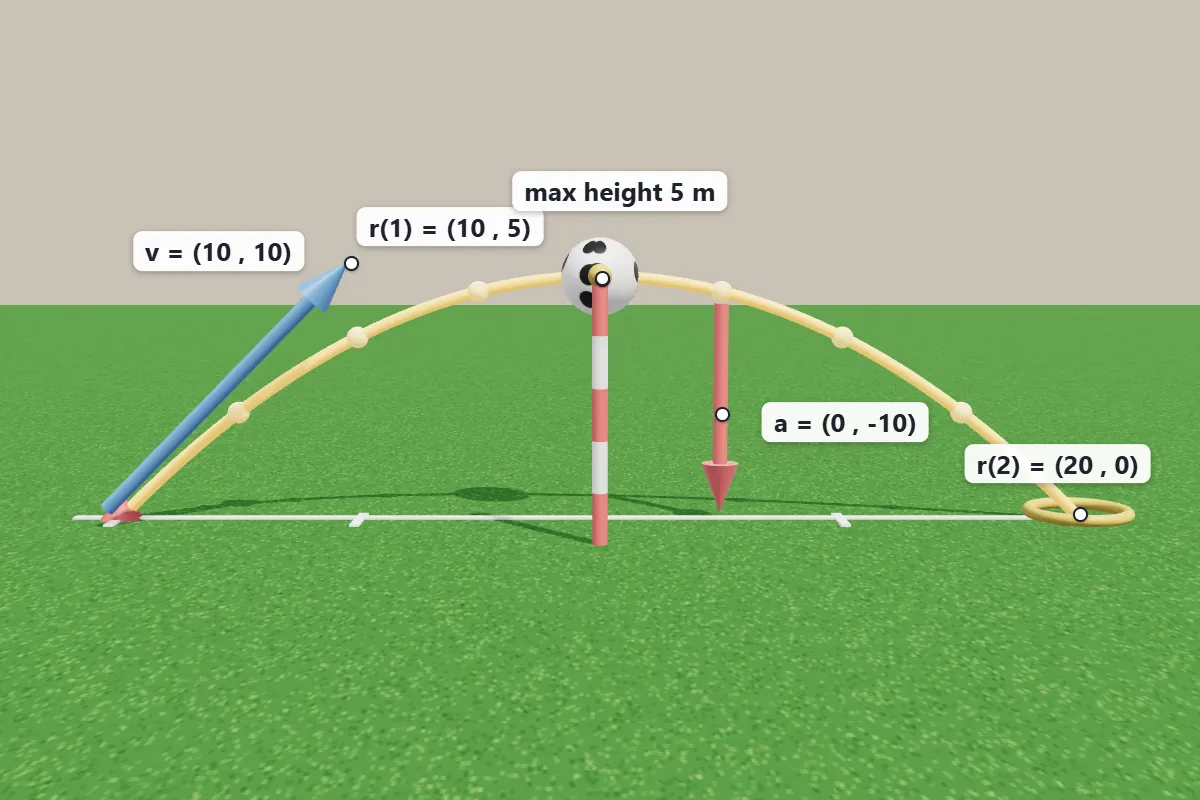
| Point of comparison | Displacement | Distance |
|---|---|---|
| Type of quantity | Vector | Scalar |
| Sign | positive, negative or zero | always positive (or zero) |
| Depends on | only the initial and final points | the whole path |
Differentiation and Integration of Vector Functions and Newton’s Laws of Motion · 4 / 14
Average and instantaneous velocity
Average and instantaneous velocity
Average velocity
- vav = displacement ÷ elapsed time = [s(t₂) − s(t₁)]/(t₂ − t₁).
- Geometrically it is the slope of the chord joining the two points of the (position–time) curve.
- v = limΔt→0 [s(t + Δt) − s(t)]/Δt = ds/dt velocity is the first derivative of position, i.e. the slope of the tangent to the (position–time) curve.
- The (scalar) speed is the magnitude |v| and is never negative. v > 0 means motion in the positive direction, v < 0 the opposite.
- The velocity vanishes at the instant the particle reverses its direction of motion.
- Average speed = total distance ÷ total time, and it is generally different from the magnitude of the average velocity.
- Distance in [t₁, t₂] is the area between the (velocity–time) curve and the time axis: d = ∫t₁t₂ |v| dt.
- When the sign of v changes, split the interval at the instants where v = 0 and add the absolute values.
- A stone is thrown vertically upward so that its height after t seconds is s = 49t − 4.9t2. Find the greatest height and the velocity when the height is 78.4 m.
v = ds/dt = 49 − 9.8t. At the top v = 0 → t = 5 s, smax = 245 − 122.5 = 122.5 m.
49t − 4.9t2 = 78.4 → divide by 4.9: t2 − 10t + 16 = 0 → (t − 2)(t − 8) = 0 → t = 2 or 8.
v(2) = 49 − 19.6 = +29.4 m/s (rising), v(8) = 49 − 78.4 = −29.4 m/s (falling); the speed is 29.4 m/s in both cases.
Differentiation and Integration of Vector Functions and Newton’s Laws of Motion · 5 / 14
Acceleration
Acceleration
Average and instantaneous
- aav = Δv/Δt; the instantaneous acceleration is a = dv/dt = d2s/dt2, the slope of the tangent to the (velocity–time) curve. Unit: m/s2 (or cm/s2).
- From s(t) differentiate once for v, twice for a.
When v is given in terms of s, use the chain rule→a = dv/dt = (dv/ds)(ds/dt) = v dv/ds, equivalently a = d/ds (½v2).
- Motion is accelerated when |v| increases — that is when v and a have the same sign.
- Motion is decelerated (retarded) when |v| decreases — when v and a have opposite signs.
- a may be zero at an instant while the body is still moving that happens at a maximum or a minimum velocity.
- A particle moves on a line with s = t3 − 6t2 + 9t (metres). v = 3t2 − 12t + 9 = 3(t − 1)(t − 3), a = 6t − 12.
(a) v = 0 at t = 1 and t = 3: a(1) = −6 m/s2, a(3) = +6 m/s2.
(b) a = 0 at t = 2: v = 12 − 24 + 9 = −3 m/s, so the speed is 3 m/s.
(c) Direction changes at t = 1 and t = 3 with s(0) = 0, s(1) = 4, s(3) = 0, s(4) = 4, so distance = 4 + 4 + 4 = 12 m. - A particle moves with v = 2s + 1. Find a when s = 3 m: a = v dv/ds = (2s + 1)(2), so at s = 3, a = 7 × 2 = 14 m/s2.
- if v = √(2s + 1), then ½v2 = s + ½ and a = d/ds(½v2) = 1 m/s2, the same at every position.
Differentiation and Integration of Vector Functions and Newton’s Laws of Motion · 6 / 14
Vector functions in the plane
Vector functions in the plane
Differentiation component by component
- If the position vector is r(t) = x(t) i + y(t) j, its derivative is found by differentiating each component: v = dr/dt = ẋ i + ẏ j and a = dv/dt = ẍ i + ÿ j.
- The magnitude of velocity is |v| = √(ẋ2 + ẏ2); the magnitude of acceleration is found the same way.
- Integration is also done component by component, and each component needs its own constant — together they form a constant vector.
- A particle moves so that r = (t3 − 3t) i + 2t2 j. Then v = (3t2 − 3) i + 4t j and a = 6t i + 4 j.
At t = 2: v = 9 i + 8 j and a = 12 i + 4 j.
|v| = √(81 + 64) = √145 ≈ 12.04 m/s. - from x = t3 − 3t and y = 2t2 the trajectory can be studied by eliminating t; differentiating is usually far quicker than finding the cartesian path.
Differentiation and Integration of Vector Functions and Newton’s Laws of Motion · 7 / 14
Integration to find velocity and position
Integration to find velocity and position
From acceleration to velocity to position
- Integration undoes differentiation v = ∫ a dt and s = ∫ v dt.
- Between two instants v(t₂) − v(t₁) = ∫t₁t₂ a dt, and displacement = ∫t₁t₂ v dt.
- The two constants of integration come from the initial conditions (initial velocity and initial position at t = 0).
- When a is constant these relations reduce to the familiar equations of motion: v = v₀ + at, s = v₀t + ½at2, v2 = v₀2 + 2as.
- A particle has a = 6t − 4 m/s2, initial velocity 2 m/s and initial position 1 m.
v = ∫(6t − 4)dt = 3t2 − 4t + C; at t = 0, v = 2 → C = 2, so v = 3t2 − 4t + 2.
s = ∫v dt = t3 − 2t2 + 2t + C′; at t = 0, s = 1 → C′ = 1, so s = t3 − 2t2 + 2t + 1.
At t = 2: v = 12 − 8 + 2 = 6 m/s and s = 8 − 8 + 4 + 1 = 5 m.
Differentiation and Integration of Vector Functions and Newton’s Laws of Motion · 8 / 14
Graphical analysis of motion
Graphical analysis of motion
Reading the curves
- (position–time) curve the slope of the tangent gives the velocity; a point with a horizontal tangent is an instant of zero velocity.
- (velocity–time) curve the slope of the tangent gives the acceleration, and the area under the curve gives the displacement.
- If the velocity graph is a straight (inclined) line the acceleration is constant; if it is a horizontal line the velocity is uniform and the acceleration is zero.
- Area above the time axis is positive displacement, area below it is negative displacement; to get distance add the areas with their absolute values.
- The intersection of two (velocity–time) curves marks the instant when the two bodies have equal velocities — not necessarily when they meet.
| Curve | Slope gives | Area gives |
|---|---|---|
| s–t | velocity | — |
| v–t | acceleration | displacement (signed), |area| sum = distance |
| a–t | rate of change of acceleration | change in velocity |
Differentiation and Integration of Vector Functions and Newton’s Laws of Motion · 9 / 14
Newton’s second law and the equation of motion
Newton’s second law and the equation of motion
Statement
- The rate of change of momentum of a body is proportional to the resultant force acting on it and takes place in the direction of that force. With suitable units the constant of proportionality is 1: F = d(mv)/dt.
- If the mass is constant, the equation of motion becomes F = m dv/dt = m a: the resultant force produces an acceleration in its own direction, directly proportional to the force and inversely proportional to the mass.
- Mass is a constant scalar measuring inertia; weight is the force of the Earth’s attraction and changes with position: W = m g, with g ≈ 9.8 m/s2.
| Unit | Definition | Value |
|---|---|---|
| newton (N) | force giving 1 kg an acceleration of 1 m/s2 | 1 kg·m/s2 |
| dyne | force giving 1 g an acceleration of 1 cm/s2 | 1 g·cm/s2 |
| kg-wt (kgf) | weight of a mass of 1 kg | 9.8 N |
| g-wt (gf) | weight of a mass of 1 g | 980 dyne |
- Between the two absolute units 1 N = 105 dyne.
- In F = ma only absolute units are used, so a force given in kg-wt or g-wt must first be converted.
- A constant force of 12 N acts on a 3 kg body at rest. a = 12/3 = 4 m/s2; v = v₀ + at = 0 + 4(5) = 20 m/s after 5 s.
- A force of 2 kg-wt acts on a 5 kg body. F = 2 × 9.8 = 19.6 N, so a = 19.6/5 = 3.92 m/s2.
Differentiation and Integration of Vector Functions and Newton’s Laws of Motion · 10 / 14
Motion of bodies of variable mass
Motion of bodies of variable mass
The general equation
- When the mass changes with time (a body collecting dust or burning fuel) we must not write F = m a; the product must be differentiated: F = d(mv)/dt = m dv/dt + v dm/dt.
- The term v dm/dt appears only because the mass changes; it vanishes for constant mass and we return to F = m a.
- Procedure write m as a function of t, get v by differentiating s, form p = m v, then differentiate p to get F.
- A body of mass (2t + 1) kg moves on a line with s = t2 metres. v = ds/dt = 2t m/s, so p = m v = (2t + 1)(2t) = 4t2 + 2t and F = dp/dt = 8t + 2.
At t = 3: p = 36 + 6 = 42 kg·m/s and F = 24 + 2 = 26 N. - A metal ball of mass 100 g moves with uniform velocity 10 m/s through dust that sticks to it at 2 g/s. Then m = 100 + 2t grams. Uniform velocity means a = 0, so F = v dm/dt. With v = 10 m/s = 1000 cm/s and dm/dt = 2 g/s: F = 1000 × 2 = 2000 dyne, constant and in the direction of motion.
- Reading the phrase “collects dust at a constant rate” as dm/dt = 0 is wrong: it is precisely what makes dm/dt a positive constant.
Differentiation and Integration of Vector Functions and Newton’s Laws of Motion · 11 / 14
Using integration with the second law
Using integration with the second law
From force or acceleration to the change of momentum
- Because F = dp/dt, the change of momentum between two instants is the integral of the force over time: Δp = p₂ − p₁ = ∫t₁t₂ F dt.
- For a body of constant mass Δp = m∫a dt = m Δv.
- Use this whenever the force or the acceleration is given as a function of time.
- A force F = 6t newtons acts on a body along a line. Δp = ∫04 6t dt = [3t2]04 = 48 kg·m/s.
- A 5 kg body moves with acceleration a = 4t m/s2. F = ma = 20t N, so at t = 2, F = 40 N; and Δp = ∫03 20t dt = [10t2]03 = 90 kg·m/s.
- When several forces act, the resultant R is their vector sum, then R = m a.
- In vector form the law is applied to each component separately: Rx = m ẍ, Ry = m ÿ.
Differentiation and Integration of Vector Functions and Newton’s Laws of Motion · 12 / 14
Test yourself
Test yourself
- s = t3 − 3t2 + 4 (m). v at t = 2 = 0 m/s; a at t = 2 = 6 m/s2
- v = 2s2 + 3. a = v dv/ds = (2s2 + 3)(4s), so at s = 1: a = 20 m/s2
- m = 3t + 2 kg, s = t2/2 m. v = t, so p = m v = 3t2 + 2t; at t = 2, p = 16 kg·m/s and F = dp/dt = 6t + 2 = 14 N
- r = (2t2 − t) i + (t3) j. v at t = 1 = 3 i + 3 j, |v| = 3√2
- A 4 kg body has v = 6 m/s and a force F = 2t N acts for 5 s. Δp = 25 kg·m/s, final velocity = 12.25 m/s
- 3 kg-wt expressed in newtons = 29.4 N; in dynes = 2.94 × 10⁶ dyne
- Uniform motion in a straight line implies the resultant force = zero
- v vanishes at t = 1 and t = 3; ∫v = t3/3 − 2t2 + 3t gives +4/3 on [0, 1] and −4/3 on [1, 3], so the distance is 8/3 m while the displacement is 0
Differentiation and Integration of Vector Functions and Newton’s Laws of Motion · 13 / 14
Exam traps and key takeaways
Exam traps and key takeaways
💡 High-yield traps
- Momentum is a vector assign a positive direction first, otherwise a rebound gives Δp = m(v₂ − v₁) with the wrong sign.
- Distance is the integral of |v|, not of v; split the interval where v changes sign.
- Zero velocity at an instant does not mean zero acceleration (a ball at its highest point still has a = 9.8 m/s2).
- Accelerated versus decelerated is decided by the signs of v and a, not by the sign of a alone.
- For variable mass, F = m dv/dt + v dm/dt; using F = ma alone is marked wrong.
- Convert kg-wt and g-wt to newtons or dynes before F = ma, and cm/s2 with grams gives dynes, not newtons (1 N = 105 dyne).
- Weight changes with position, mass never does — a common “give a reason” question.
- On a (v–t) graph, slope = acceleration and area = displacement; on an (s–t) graph, slope = velocity. Mixing the two axes loses the whole part.
- When integrating twice, introduce two constants and use both initial conditions; losing the constant of position is a frequent half-mark.
- Action and reaction never cancel because they act on different bodies.
Differentiation and Integration of Vector Functions and Newton’s Laws of Motion · 14 / 14
Well done! You finished this lesson
What would you like to do next?