
 1. 2-1 The quadratic function: definition, values and pointsExplanation
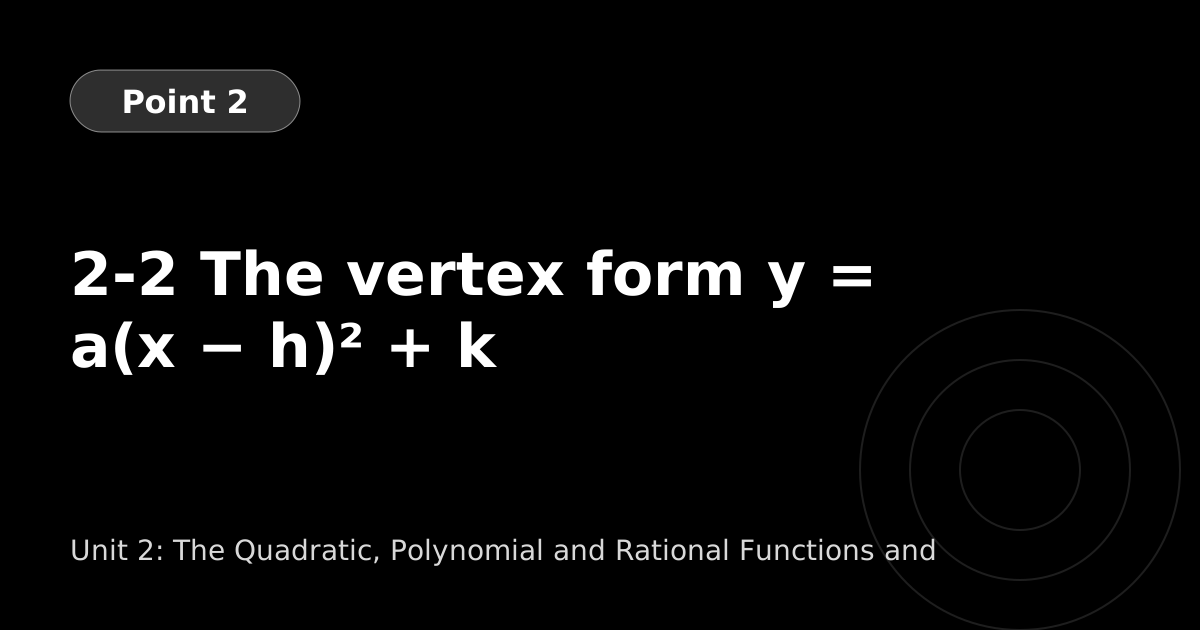 2. 2-2 The vertex form y = a(x − h)² + kExplanation
 3. 2-3 The vertex from the general formExplanation
 4. 2-4 Sketching the parabolaExplanation
 5. 2-5 Maximum and minimum applicationsExplanation
 6. 2-6 Polynomial functions and their degreeExplanation
 7. 2-7 Zeros of a polynomial functionExplanation
 8. 2-8 The rational algebraic function, its domain and simplifyingExplanation
 9. 2-9 Common domain of two functions and equality of functionsExplanation
 10. 2-10 Addition, subtraction, multiplication and divisionExplanation
 11. 2-11 Additive and multiplicative inverses, and propertiesExplanation
- Define the quadratic function, find its vertex in both forms and sketch its graph.
- Use the maximum or minimum value in real-life optimisation.
- Find the zeros of polynomial functions by factoring, completing the square or reading the graph.
- Determine the domain of a rational function, simplify it, and perform the four operations with their restrictions.
🌳 Concept tree
Quadratic, Polynomial and Rational Functions
├── 2-1 The quadratic function
│   ├── definition, values, points on the curve
│   ├── vertex form y = a(x - h)² + k
│   ├── equation from the vertex and one point
│   ├── sketch and vertex from the general form
│   └── maximum and minimum applications
├── 2-2 Polynomial functions
│   ├── degree and leading term
│   └── zeros: factoring, completing the square, from the graph
├── 2-3 Rational algebraic functions
│   ├── domain, simplifying
│   └── zeros of a rational function
├── 2-4 Common domain of two functions and equality of functions
└── 2-5 Operations on functions
    ├── addition and subtraction
    ├── multiplication and division
    ├── additive and multiplicative inverses
    └── properties of the operations
01 2-1 The quadratic function: definition, values and points
- A quadratic function is f(x) = ax² + bx + c with a, b, c real and a ≠ 0; its graph is a parabola.
- The function value at x = k is f(k): substitute and compute — a point (k, m) lies on the curve exactly when f(k) = m.
- To find an unknown coefficient from a point on the curve, substitute the point and solve the resulting linear equation.
- The y-intercept is (0, c); the x-intercepts are the zeros of f.
02 2-2 The vertex form y = a(x − h)² + k
- In vertex form the vertex is (h, k) and the axis of symmetry is the line x = h.
- a > 0 the parabola opens upward and k is the minimum value; a < 0 it opens downward and k is the maximum value.
- Watch the sign inside the bracket: y = (x − 3)² + 2 has vertex (3, 2), while y = (x + 3)² − 2 has vertex (−3, −2).
Equation from the vertex and one point
- Write y = a(x − h)² + k with the given vertex, then substitute the other point to obtain a.
- Vertex (1, −4) through (3, 0): 0 = a(3 − 1)² − 4 → 4a = 4 → a = 1, so y = (x − 1)² − 4 = x² − 2x − 3.
03 2-3 The vertex from the general form
- For f(x) = ax² + bx + c: h = −b/(2a) and k = f(h) = (4ac − b²)/(4a).
- Completing the square converts between the two forms: x² + 6x + 5 = (x + 3)² − 4, vertex (−3, −4).
- Zeros from the general form: solve ax² + bx + c = 0; the axis x = h is exactly halfway between the two zeros.
04 2-4 Sketching the parabola
- Plot, in order: the vertex, the y-intercept (0, c), the reflection of the y-intercept across the axis (2h, c), and the x-intercepts when they exist.
- Δ = b² − 4ac tells how many x-intercepts: two if Δ > 0, one (the vertex touches the axis) if Δ = 0, none if Δ < 0.
- Draw a smooth symmetric curve, never a "V" — the parabola is curved everywhere.
- Translations: y = a(x − h)² + k is the image of y = ax² shifted h right and k up.
05 2-5 Maximum and minimum applications
- A quantity modelled by a quadratic reaches its extremum at the vertex, i.e. at x = −b/(2a); the extremum value is k.
- Fenced area: with a fixed perimeter the area A(x) is quadratic in x and maximal at the vertex — the answer is always a square.
- Profit: revenue minus cost is quadratic; the maximum profit is the vertex value, and break-even points are its zeros.
- Projectile height: h(t) = −16t² + v₀t + h₀ opens downward, so the vertex gives the greatest height and its time.
- Reject any value of the variable that the situation forbids (negative time, negative price).
06 2-6 Polynomial functions and their degree
- A polynomial function is f(x) = aₙxⁿ + … + a₁x + a₀ with aₙ ≠ 0; n is the degree and aₙ the leading coefficient.
- Names by degree: 1 linear, 2 quadratic, 3 cubic; constants have degree 0.
- The end behaviour follows the leading term: even degree with a positive coefficient rises on both sides; odd degree with a positive coefficient falls to the left and rises to the right.
07 2-7 Zeros of a polynomial function
By factoring
- Set f(x) = 0 and factor completely; each factor gives a zero. x³ − 4x = x(x − 2)(x + 2) → zeros 0, 2, −2.
By completing the square
- x² − 6x + 4 = 0 → (x − 3)² = 5 → x = 3 ± √5.
From the graph
- A zero is an x-intercept. If the curve crosses the axis the multiplicity is odd; if it only touches and turns the multiplicity is even.
- A polynomial of degree n has at most n real zeros, and the sum of the multiplicities equals n.
08 2-8 The rational algebraic function, its domain and simplifying
- A rational function is f(x) = P(x)/Q(x), Q ≠ 0, where P and Q are polynomials.
- Domain: all reals except the values that make Q(x) = 0. Example: Q(x) = x² − 9 excludes x = ±3, so the domain is ℝ − {−3, 3}.
- Simplifying: factor numerator and denominator, cancel only common factors, and keep the excluded values as restrictions. (x² − 1)/(x² + x) = (x − 1)(x + 1)/[x(x + 1)] = (x − 1)/x, x ≠ 0, ±1… restrictions x ≠ 0, x ≠ −1.
- Zeros of a rational function: the zeros of the numerator that belong to the domain — a value that also vanishes the denominator is not a zero.
09 2-9 Common domain of two functions and equality of functions
- The common domain of two or more functions is the intersection of their domains; any operation between them is defined only there.
- Two functions are equal when they have the same domain and the same value for every element of it — identical simplified formulas on different domains are not the same function.
- When asked for the domain of a sum, product or quotient, start from the intersection and then remove the zeros of any denominator that appears.
10 2-10 Addition, subtraction, multiplication and division
- Addition and subtraction: use the lowest common denominator, rewrite each fraction over it, then add or subtract the numerators only, keeping the common denominator.
- Multiplication: factor everything, cancel common factors across the numerator and denominator, then multiply straight across.
- Division: multiply by the reciprocal of the divisor, and add to the restrictions the zeros of the new numerator that came from flipping.
- State the final answer in simplest form together with its domain restrictions.
11 2-11 Additive and multiplicative inverses, and properties
- The additive inverse of f is −f; their sum is the zero function, the additive identity.
- The multiplicative inverse (reciprocal) of f = P/Q is Q/P, defined only where P ≠ 0 and Q ≠ 0; their product is 1.
- Properties on the common domain: closure, commutativity and associativity of addition and multiplication, the distributive law of multiplication over addition, and the identities 0 (additive) and 1 (multiplicative).
- Subtraction and division are not commutative and not associative — do not extend those properties to them.
12 Exam traps and key takeaways
💡 High-yield traps
- The vertex of y = a(x − h)² + k is (h, k) — the sign of h is opposite to what appears in the bracket.
- k is a maximum only when a < 0; read the sign of a before answering.
- For the general form use h = −b/(2a); forgetting the minus sign puts the vertex on the wrong side.
- The definition of a quadratic requires a ≠ 0.
- Zeros from the graph: touching means even multiplicity, crossing means odd.
- Cancel factors, never terms — (x + 2)/x is already simplest.
- Simplifying does not enlarge the domain; the old restrictions must be restated.
- A zero of a rational function comes from the numerator only, and must not vanish the denominator.
- Division of fractions doubles the restrictions: those of the divisor and those created by flipping it.
- Two functions are equal only with the same domain and the same rule.