Curriculum
Course: ACT SCIENCE
Login

Curriculum

ACT SCIENCE

Timed Practice

0/28 Dr Dabour Hub Science Diagram and Course Material
Text lesson

Princeton Review ACT Science Prep — Chapter 1: Introduction to the Science Test

MasterStudy LMS Complete Reference — ACT Science Mastery: Princeton Review ACT Science Prep — Chapter 1: Introduction to the Science Test.

1Theoretical Principles & Core Foundations2Theoretical Principles & Core Foundations3Theoretical Principles & Core Foundations4Theoretical Principles & Core Foundations5Theoretical Principles & Core Foundations
Theoretical Principles & Core Foundations
1
WELCOME: The ACT can be an important part of college admissions.
Many schools require or recommend their applicants submit either SAT or ACT scores.
It’s worth keeping in mind, though, that the importance of these tests will vary among the many colleges and universities in the United States.
If you haven’t already, make sure to research whether the ACT is required or recommended for admission to the schools you plan to apply to.
2
1 / 5Next ▶
Theoretical Principles & Core Foundations
1

During the COVID-19 pandemic, many schools went test-optional to account for the numerous students whose SAT and ACT tests were canceled. Some of those schools have returned to requiring test scores

while others have not yet but still may. For the most up-to-date information on the schools you are interested in, check out their admissions websites.
2

3
3

For more on admissions, see The Princeton Review’s The Best 388 Colleges or visit our website, PrincetonReview.com.
4

Even if ACT scores are optional, you may still want to submit them if you think your great ACT scores will boost your chances of acceptance.
5

Furthermore, ACT scores are often used for scholarships,

so it can be worth putting time into preparing for the test if you can save a good amount on your college education in return.
6

4
◀ Previous2 / 5Next ▶
Theoretical Principles & Core Foundations
When colleges require standardized test scores, they will accept either SAT or ACT scores. The expert advice of The Princeton Review is to take whichever test you do better on and focus your efforts on preparing for that one.
5
Because you bought this book, we assume you’ve already made the decision to boost your ACT score. This book provides a strategic and efficient way to improve your scores, specifically on the Science test. For a more thorough review of content and exhaustive practice, we recommend purchasing the latest editions of ACT Prep and our ACT Practice Questions book.
6
FUN FACTS ABOUT THE ACT: The ACT is nothing like the science tests you take in school. All of the content review and strategies we teach in the following lessons are based on the specific structure and format of the ACT. Before you can beat a test, you have to know how it’s built.
7
◀ Previous3 / 5Next ▶
Theoretical Principles & Core Foundations
Structure: The ACT is made up of four multiple-choice tests and an optional Writing test. The five tests are always given in the same order.
8
English: 45 minutes, 75 questions Math: 60 minutes, 60 questions Reading: 35 minutes, 40 questions Science: 35 minutes, 40 questions Writing: 40 minutes, 1 Essay
9
If you feel like you need help with the other subjects, check out our companion books, ACT Reading Prep, ACT English Prep, and ACT Math Prep.
10
◀ Previous4 / 5Next ▶
Theoretical Principles & Core Foundations
1

Scoring: When students and schools talk about ACT scores, they mean the composite score, a range of 1–36. The composite is an average of the four multiple-choice tests, each scored on the same 1–36 scale: Ideas and Analysis, Development and Support, Organization, and Language Use and Conventions.
2

If you take the Writing test, you’ll also receive an additional Writing score on a scale of 2–12.

The Writing score is an average of four 2–12 subscores.
3

Neither the Writing test score nor the combined English Language Arts score affects the composite.
◀ Previous5 / 5
1Mechanisms, Detailed Processes & Governing Concepts2Mechanisms, Detailed Processes & Governing Concepts3Mechanisms, Detailed Processes & Governing Concepts4Mechanisms, Detailed Processes & Governing Concepts5Mechanisms, Detailed Processes & Governing Concepts6Mechanisms, Detailed Processes & Governing Concepts7Mechanisms, Detailed Processes & Governing Concepts
Detailed acetylcholine release, receptor binding and recycling at a cholinergic synapse
Mechanisms, Detailed Processes & Governing Concepts
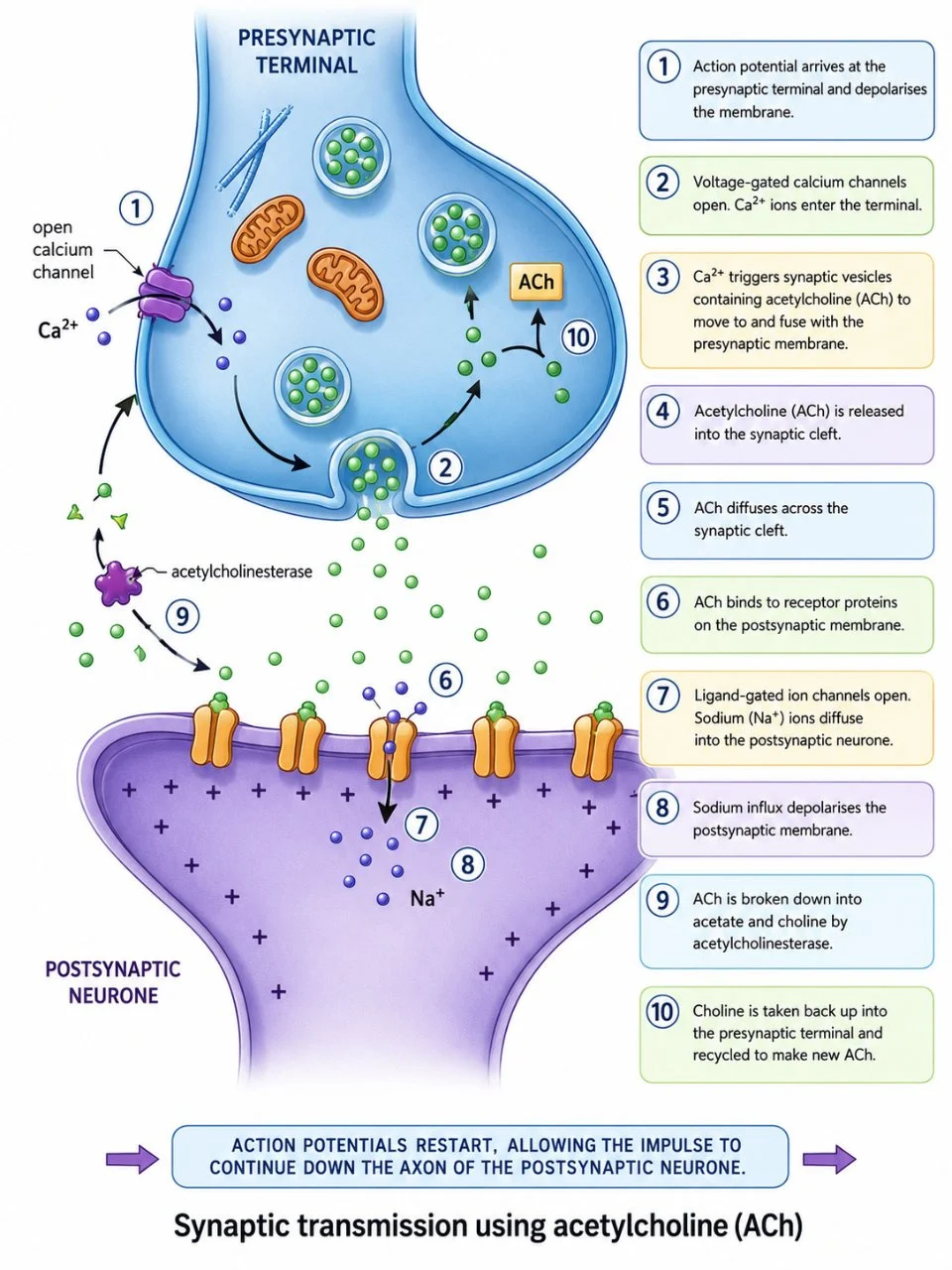
Detailed acetylcholine release, receptor binding and recycling at a cholinergic synapse" loading= - Dr Khaled Dabour Academy⤢ Enlarge
1

1
2

Students also receive subscores in addition to their (1–36) composite ACT score.
3

These indicators are designed to measure student performance and predict career readiness,

as well as competency in STEM and English language arts.(Science, Technology, Engineering, Mathematics)
4

ACT believes that these additional scores will give students better insight into their strengths and how those strengths can be harnessed for success in college and beyond.
5

2
6

In addition to the 1–36 score for each of the tests and their composite score, students now see score breakdowns in the following categories:
1 / 7Next ▶
Mechanisms, Detailed Processes & Governing Concepts
3
STEM score.
This score will show you how well you did on the Math and Science portions of the test.
Progress Toward Career Readiness indicator.
The ACT would have you believe this indicator measures how prepared you are for a career,

but really it just measures how prepared you are to take yet another test: the ACT National Career Readiness Certificate™.
4
◀ Previous2 / 7Next ▶
Mechanisms, Detailed Processes & Governing Concepts
1

English Language Arts score. If you take the Writing test, this score will give you a combined score for the English, Reading, and Writing tests.
2

5
3

Text Complexity Progress indicator.
4

This score will tell you how well you fared on those hard passages throughout the test.
5

There is also a section on the score report that breaks each section down into categories and tells you both how many questions there were in each category and how many of them you got correct.
6

Some of these categories can be useful in helping you know what you need to study: for example, if you missed a lot of questions in the ‘Geometry’ category, you should brush up your Geometry skills.
◀ Previous3 / 7Next ▶
Mechanisms, Detailed Processes & Governing Concepts
6
But if you did poorly in the ‘Integration of Knowledge and Ideas’ category, it’s not quite as obvious what you need to study. Don’t worry about these scores though—they’re there because they align with federal academic standards, and school districts that use the ACT for standardized testing for all juniors want those scores

but college don’t typically look at them for admissions purposes.
7
It’s All About the Composite: Whether you look at your score online or wait to get it in the mail, the biggest number on the page is always the composite. While admissions offices will certainly see the individual scores of all five tests (and their subscores), schools will use the composite to evaluate your application, and that’s why, in the end, it’s the only one that matters.
8
The composite is an average.
◀ Previous4 / 7Next ▶
Mechanisms, Detailed Processes & Governing Concepts
Let the full weight of that sink in.
Do you need to bring up all four scores equally to raise your composite?
Do you need to be a superstar in all four tests?
Should you focus more on your weaknesses than your strengths?
No, no, and absolutely not.
The best way to improve your composite is to shore up your weaknesses but exploit your strengths as much as possible.
◀ Previous5 / 7Next ▶
Mechanisms, Detailed Processes & Governing Concepts
1

9
2

To improve your ACT score, use your strengths to lift the composite score as high as possible.
3

You don’t need to be a rock star on all four tests.
4

Identify two, maybe three tests, and focus on raising those scores as much as you can to raise your composite.
5

Work on your weakest scores to keep them from pulling you down.
6

Think of it this way: if you had only one hour to devote to practice the week before the ACT, spend that hour on your best subjects.
◀ Previous6 / 7Next ▶
Mechanisms, Detailed Processes & Governing Concepts
1

10
2

Single-Section Tests and Superscoring: The people who write the ACT have announced their intention to allow students to take one, two, or three individual sections in a day, as opposed to needing to take the entire test. You will need to have taken the full ACT before using this option, and single-section tests will only be offered on the computer.
3

11
4

Unfortunately, plans to offer single-section retesting were delayed by the COVID-19 pandemic, and as of the publication of this book, a date for the rollout has not been announced. We encourage you to check the ACT website, www.act.org, for the most up-to-date information about the availability of single-section retesting when it is eventually offered.
◀ Previous7 / 7
1Key Experimental Procedures & Practical Investigations2Key Experimental Procedures & Practical Investigations3Key Experimental Procedures & Practical Investigations4Key Experimental Procedures & Practical Investigations5Key Experimental Procedures & Practical Investigations6Key Experimental Procedures & Practical Investigations
Key Experimental Procedures & Practical Investigations
1
One piece of good news is that ACT has begun Superscoring. If you take the ACT more than once, ACT will automatically take your highest English, Math, Reading, and Science scores and average them together to calculate a new ‘Superscore’ composite.
2
Sounds great, right? We think it is—this gives you the opportunity to show your best ACT score to schools. Now, colleges and universities still have the option as to whether to accept the Superscore

but for the schools that let you Superscore, this is all positive for you.
3
Science Scores: The Science test can be frustrating for science fans and non-science fans alike.
1 / 6Next ▶
Key Experimental Procedures & Practical Investigations
1

It’s not unusual for students that excel in science and math at school to find that Math is one of their highest scores and Science is one of their lowest scores.
2

There are good reasons for this.
3

The Math test, perhaps deceptively so, resembles school tests more than the other three.
4

Science feels the most different, and many students are intimidated by both the content and format.
5

4
6

Many students find improving scores on the Science test to be more difficult than the other sections. Unlike the Math or English test, there are no rules or content to master through rigorous practice. The Science test is designed to test your reasoning skills using passage-based information, not tap specific outside knowledge.
◀ Previous2 / 6Next ▶
Key Experimental Procedures & Practical Investigations
5
Who knows what specific topics will appear on the next ACT?
On the goods-news front, however, The Princeton Review can teach you a smart, effective approach designed to maximize your performance every time, regardless of content.
It can be tough to change your ways

but dedicated practice with a strategic method can prevent the Science score from pulling down that composite.
6
Time: How often do you take a final exam in school that gives you at most a minute per question?
◀ Previous3 / 6Next ▶
Key Experimental Procedures & Practical Investigations
Probably never.
The ACT isn’t a school test, and you can’t approach it as if it is.
While speed and accuracy depend on individual skills and grasp of content, almost all students struggle to finish the Science test on time.
The more you treat the test the same way you would a school final, the less likely you are to finish, much less finish with the greatest accuracy.
7
The Princeton Review’s strategies are all based on this time crunch. There’s a difference between knowing how to do a question under the best of circumstance and getting it right with a ticking clock and glowering proctor in the room.
◀ Previous4 / 6Next ▶
Key Experimental Procedures & Practical Investigations
1

8
2

STRATEGIES: You will raise your ACT score by working smarter, not harder, and a smart test-taker is a strategic test-taker. You will target specific content to review, you will apply an effective and efficient approach, and you will employ the common sense that frequently deserts many others when they pick up a number 2 pencil.
3

9
4

Each test on the ACT demands a different approach, and even the most universal strategies vary in their applications. In the chapters that follow, we’ll discuss these terms in greater detail customized to Science.
5

10
6

Personal Order of Difficulty (POOD): If time is going to run out, would you rather it run out on the most difficult questions or on the easiest questions?
◀ Previous5 / 6Next ▶
Key Experimental Procedures & Practical Investigations
1

Of course you want it to run out on the points you are less likely to get right.
2

The trick is to find all of the easiest questions and get them done first.
◀ Previous6 / 6
1Analytical Data, Comparative Structures & Scientific Framewo2Analytical Data, Comparative Structures & Scientific Framewo3Analytical Data, Comparative Structures & Scientific Framewo4Analytical Data, Comparative Structures & Scientific Framewo5Analytical Data, Comparative Structures & Scientific Framewo6Analytical Data, Comparative Structures & Scientific Framewo7Analytical Data, Comparative Structures & Scientific Framewo
Analytical Data, Comparative Structures & Scientific Frameworks
1
Now: Does a question look okay? Do you know how to do it? Do it Now. Later: Does a question make you go, ‘hmm’? If you can’t find a way to get your pencil moving right away, consider leaving it and coming back Later. Circle the question number for easy reference to return.
2
The Best Way to Bubble In: Work one page at a time, circling your answers right on the booklet.
Transfer a page’s worth of answers to the answer sheet.
It’s better to stay focused on working questions rather than disrupt your concentration to find where you left off on the answer sheet.
1 / 7Next ▶
Analytical Data, Comparative Structures & Scientific Frameworks
1

You’ll be more accurate at both tasks.
2

Do not wait to the end, however, to transfer all the answers of that test on your answer sheet.
3

Go one page at a time.
4

3
5

Never: Test-taker, know thyself. Know the topics that are most difficult for you, and learn the signs that flash danger. Don’t waste time on questions you should Never do. Instead, use more time to answer the Now and Later questions accurately.
6

4
◀ Previous2 / 7Next ▶
Analytical Data, Comparative Structures & Scientific Frameworks
Just because you don’t work a question doesn’t mean you don’t answer it.
There is no penalty for wrong answers on the ACT

so you should never leave any blanks on your answer sheet.
When you guess on Never questions, pick your favorite two-letter combo of answers and stick with it.
For example, always choose A/F or C/H.
If you’re consistent, you’re statistically more likely to pick up more points.
5
◀ Previous3 / 7Next ▶
Analytical Data, Comparative Structures & Scientific Frameworks
Note: if you are taking the ACT on a computer, all of the questions will have answer choices A, B, C, D (or A, B, C, D, E on the Math test). On the paper-and-pencil ACT, every other question will have answer choices F, G, H, J (or F, G, H, J, K on the Math test).
6
Process of Elimination (POE): In a perfect world, you’ll know how to work all of your Now and Later questions, quickly and accurately, circling the correct answer among the choices.
The ACT is not a perfect world.
But even with a ticking clock and a number 2 pencil in your sweaty hand, wrong answers can be obvious.
Sometimes POE is a great Plan B

but it is actually the best way to find the correct answer on many questions on the Science test.
◀ Previous4 / 7Next ▶
Analytical Data, Comparative Structures & Scientific Frameworks
1

7
2

And even when you can’t narrow the answers to only one, using POE to get rid of at least one or two wrong answers will substantially increase your odds of getting a question right.
3

8
4

Very often, the quickest way to the correct answer is to eliminate the wrong answer choices rather than focusing on finding the right one.
5

Pacing: The ACT may be designed for you to run out of time

but you can’t rush through it as quickly as possible.
6

All you’ll do is make careless errors on easy questions you should get right and spend way too much time on difficult ones you’re unlikely to get right.
◀ Previous5 / 7Next ▶
Analytical Data, Comparative Structures & Scientific Frameworks
1

9
2

To hit your target score, you have to know approximately how many raw points you need. Use the entire time allotted where it will do the most good. Go slowly enough to avoid careless errors on Now questions

but go quickly enough to get to as many Later questions as you need to hit your goal.
3

10
4

On each test of the ACT, the number of correct answers converts to a scaled score of 1–36.
5

ACT works hard to adjust the scale of each test at each administration as necessary to make all scaled scores comparable, smoothing out any differences in level of difficulty across test dates.
6

Thus, there is no truth to any one test date being ‘easier’ than the others,

but you can expect to see slight variations in the scale from test to test.
◀ Previous6 / 7Next ▶
Analytical Data, Comparative Structures & Scientific Frameworks
11
This is the scale from the 2021-2022 free test ACT makes available on its website, ACT.org. We’re going to use it to explain how to pick a target score and pace yourself.
◀ Previous7 / 7
1Comprehensive Problem Solving & Synoptic Evaluation2Comprehensive Problem Solving & Synoptic Evaluation3Comprehensive Problem Solving & Synoptic Evaluation4Comprehensive Problem Solving & Synoptic Evaluation5Comprehensive Problem Solving & Synoptic Evaluation6Comprehensive Problem Solving & Synoptic Evaluation7Comprehensive Problem Solving & Synoptic Evaluation8Comprehensive Problem Solving & Synoptic Evaluation9Comprehensive Problem Solving & Synoptic Evaluation10Comprehensive Problem Solving & Synoptic Evaluation
Comprehensive Problem Solving & Synoptic Evaluation
1

1
2

Science Pacing: Data Table Row(s):
3

Scale Score | Raw Score
4

36 | 38-40
5

35 | 37
6

34 | 36
1 / 10Next ▶
Comprehensive Problem Solving & Synoptic Evaluation
33 | 35
32 | 34
31 | —
30 | 33
29 | 32
28 | 31
◀ Previous2 / 10Next ▶
Comprehensive Problem Solving & Synoptic Evaluation
27 | —
26 | 30
25 | 28-29
24 | 26-27
23 | 25
22 | 23-24
◀ Previous3 / 10Next ▶
Comprehensive Problem Solving & Synoptic Evaluation
1

21 | 22
2

20 | 20-21
3

19 | 19
4

18 | 17-18
5

17 | 15-16
6

2
◀ Previous4 / 10Next ▶
Comprehensive Problem Solving & Synoptic Evaluation
1

Data Table Row(s): 16 | 13-14

15 | 12 14 | 11 13 | 10 12 | 9 11 | 8 10 | 7 9 | 6 8 | 5 7 | 4 6 | 3 5 | — 4 | 2 3 | 1 2 | — 1 | 0
2

3
3

The Science test has larger swings in difficulty levels between test administrations than the other subjects

so the scoring scale can vary significantly from one test to another. As a result, it’s hard to predict exactly how many questions you will need to get correct to reach your goal score.
4

4
5

Here’s one example scenario.
6

Let’s say your goal score on the Science is a 24.

Find 24 in the scaled score column and you’ll see that on the test that this scale is based on, you’d need 26–27 raw points.
◀ Previous5 / 10Next ▶
Comprehensive Problem Solving & Synoptic Evaluation
This could be done by devoting your time to the questions in 5 of the 6 passages and guessing LOTD on the remaining 6 or 7 questions.
Even allowing for 4 or 5 mistakes in the 5 passages you work, you could still hit your target score.
5
However, if the Science test you’re faced with is easier

then it could require 29 raw points to get a
24. On the other hand, if the test you’re faced with is harder

then might only require 26 raw points to get a scale score of 24.
The chart is useful to give you a general guideline of how many questions you need to answer correctly

but keep in mind that it varies.
◀ Previous6 / 10Next ▶
Comprehensive Problem Solving & Synoptic Evaluation
1

6
2

If you find yourself faced with a particularly difficult set of passages, you might be disheartened that you are unable to get through questions as quickly as you had hoped.
3

Don’t let that discourage you and distract you from the remaining questions!
4

The important thing to remember is that if the test is harder, the scoring curve will even out the difference.
5

Your job is to make sure that you are using your time wisely and picking the best passages and questions for Now.
6

We will focus on this strategy in the lesson that follows.
◀ Previous7 / 10Next ▶
Comprehensive Problem Solving & Synoptic Evaluation
7
Our advice is to be aggressive. Spend the time needed on the easiest passages first

but keep moving to get to your targeted raw score. Use the chart below to figure out approximately how many passages to work.
8
Data Table Row(s): Target Score | # of Passages to Attempt

27 | 6 passages
9
Be Ruthless: The worst mistake a test-taker can make is to throw good time after bad.
◀ Previous8 / 10Next ▶
Comprehensive Problem Solving & Synoptic Evaluation
You read a question and don’t understand it

so you read it again.
And again.
If you stare at it really hard, you know you’re going to just see it.
And you can’t move on

because really, after spending all that time, it would be a waste not to keep at it, right?
Actually, that way of thinking couldn’t be more wrong.
10
◀ Previous9 / 10Next ▶
Comprehensive Problem Solving & Synoptic Evaluation
1

You can’t let one tough question drag you down. Instead, the best way to improve your ACT score is to follow our advice. Use the techniques and strategies in the lessons to work efficiently and accurately through all your Now and Later questions.
2

11
3

Know your Never questions and use your LOTD. Know when to move on. Use POE and guess from what’s left. Now move on to the lessons and learn the best way to approach the content.
◀ Previous10 / 10
Accepted payment methods