Curriculum
Course: ACT SCIENCE
Login

Curriculum

ACT SCIENCE

Timed Practice

0/28 Dr Dabour Hub Science Diagram and Course Material
Text lesson

Princeton Review ACT Science Prep — Chapter 2: How to Approach the ACT Online Test

MasterStudy LMS Complete Reference — ACT Science Mastery: Princeton Review ACT Science Prep — Chapter 2: How to Approach the ACT Online Test.

1Theoretical Principles & Core Foundations2Theoretical Principles & Core Foundations3Theoretical Principles & Core Foundations4Theoretical Principles & Core Foundations5Theoretical Principles & Core Foundations6Theoretical Principles & Core Foundations7Theoretical Principles & Core Foundations8Theoretical Principles & Core Foundations9Theoretical Principles & Core Foundations
Theoretical Principles & Core Foundations
1
How to Approach the ACT Online Test: In this chapter, you’ll learn what to expect on the ACT Online Test, including how to apply its computer-based features and our strategies to the question types in each section—English, Math, Reading, Science, and Writing.
2
If your ACT will be pencil-and-paper, skip this chapter.
WHAT IS THE ACT ONLINE TEST?: The ACT Online Test is the ACT that you take on a computer, rather than with a pencil and paper.
Despite the name, you can’t take the ACT from the comfort of your own home

instead, you’ll have to go to a testing center (possibly your high school) and take the test on one of the center’s computers.
1 / 9Next ▶
Theoretical Principles & Core Foundations
1

3
2

ACT has indicated that eventually students in the United States will have the option of taking the ACT Online Test instead of the traditional pencil-and-paper version.
3

Students choosing this option will get their scores in about two to three business days (e.g., take the test on Saturday, have your score the next Wednesday).
4

However, at the time of this printing, no specific timeline was available.
5

4
6

At the time of this book’s printing, the option to take the ACT online at a testing center was postponed. ACT also plans to offer at-home online testing, although an exact rollout date has not yet been announced. For up-to-date news on both options, check the ACT website.
◀ Previous2 / 9Next ▶
Theoretical Principles & Core Foundations
5
WHO TAKES THE ACT ONLINE TEST?: ACT has been offering versions of the ACT on computer since about 2016. The first students to take the ACT on the computer were students taking the test at school. Schools and school districts decided whether to give the test on the computer.
6
As of September 2018, all students taking the ACT outside of the United States take the test on a computer (except for those students with accommodations requiring the use of a traditional pencil-and-paper test).
7
8
◀ Previous3 / 9Next ▶
Theoretical Principles & Core Foundations
Single-Section Retesting: If you are happy with the score you receive from a single test administration, you will still have the option to send just that score to colleges.
If your score in one section is not as high as you’d like, you will eventually have a chance to correct that.
Students who have already taken the full ACT may choose to take one, two, or three sections again using Single-Section Retesting.
9
ACT will then produce a ‘superscore’ consisting of your best results in all tests (English, Math, Reading, Science, and Writing (if you took it)). Note that not all colleges accept a superscored ACT

so do your research before taking advantage of this option.
10
◀ Previous4 / 9Next ▶
Theoretical Principles & Core Foundations
1

Single-Section Retesting is an incredible option for students. However, colleges still have the option to accept or not accept these new scores. Research your target schools early so you know your options!
2

11
3

ACT ONLINE TEST FEATURES: So, besides the obvious fact that it’s taken on a computer, what are the differences between taking the ACT on the computer and taking it on paper?
4

Let’s start with what you can’t do on the ACT Online Test.
5

You can’t ‘write’ on the screen in a freehand way.
6

You’re limited in how you’re able to mark the answer choices,

and each question appears on its own screen.(so you can’t see multiple questions at one glance)
◀ Previous5 / 9Next ▶
Theoretical Principles & Core Foundations
1

You will also be given a small ‘whiteboard’ and dry erase pen with which to make notes and do work.
2

12
3

So, what features does the ACT Online Test have? You can hide the timer by clicking on it. There is a 5-minute warning toward the end of each test. There is no audible signal at the 5-minute warning, only a small indicator in the upper-right corner of the screen.
4

13
5

You can use this tool to navigate directly to any question in the section. The Nav tool blocks the current question when opened. It also shows what questions you have flagged and/or left blank.
6

14
◀ Previous6 / 9Next ▶
Theoretical Principles & Core Foundations
You can flag questions in this menu. Question numbers at the bottom of the screen You can click on these numbers to navigate directly to any question in the section.
15
These numbers also indicate whether a question has been flagged and/or left blank. You can flag a question on the question screen itself or by using the Nav tool.
16
Flagging a question has no effect besides marking the question for your own purposes. Answer choices can be ‘crossed-off’ on-screen. An answer choice that’s been eliminated cannot be chosen and must be ‘un-crossed-off’ first by clicking the answer choice.
17
◀ Previous7 / 9Next ▶
Theoretical Principles & Core Foundations
1

You can use this to magnify specific parts of the screen. This tool covers part of the screen. There is an adjustable window you can use to limit what you can see.
2

18
3

This is an excellent tool if you need an aid to help you focus on specific parts of the text or figure. However, not everyone will find this tool useful

so do not feel obligated to use it!
4

19
5

Note that you cannot highlight the text in the window of the Line Mask. This tool hides the answer choices of a question. Answers can be revealed one at a time.
6

20
◀ Previous8 / 9Next ▶
Theoretical Principles & Core Foundations
This tool changes the zoom of the entire screen (as opposed to the magnifier

which magnifies only one part of the screen). Your screen zoom setting will remain the same from question to question.
◀ Previous9 / 9
1Mechanisms, Detailed Processes & Governing Concepts2Mechanisms, Detailed Processes & Governing Concepts3Mechanisms, Detailed Processes & Governing Concepts4Mechanisms, Detailed Processes & Governing Concepts5Mechanisms, Detailed Processes & Governing Concepts6Mechanisms, Detailed Processes & Governing Concepts7Mechanisms, Detailed Processes & Governing Concepts8Mechanisms, Detailed Processes & Governing Concepts9Mechanisms, Detailed Processes & Governing Concepts10Mechanisms, Detailed Processes & Governing Concepts
Detailed acetylcholine release, receptor binding and recycling at a cholinergic synapse
Mechanisms, Detailed Processes & Governing Concepts
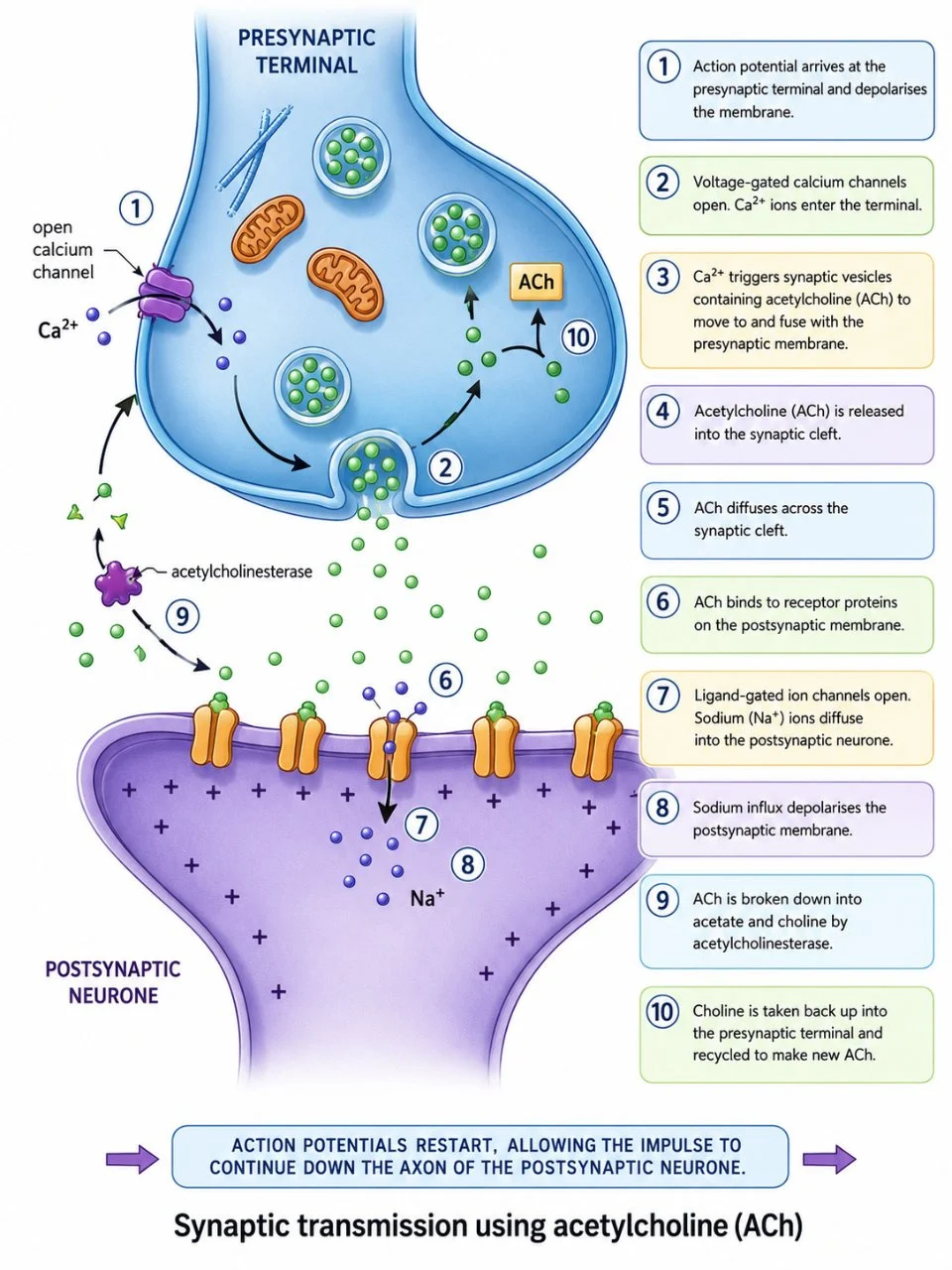
Detailed acetylcholine release, receptor binding and recycling at a cholinergic synapse" loading= - Dr Khaled Dabour Academy⤢ Enlarge
Mechanisms, Detailed Processes & Governing Concepts
1
You can use this tool to highlight parts of passage text, question text, or answer text.
You cannot highlight within figures.
If you highlight in a passage with multiple questions, your highlights will only show up on that question.
(In other words, if you highlight, for example, question 1 of a Reading passage, questions 2–10 of that same passage will not show those highlights.)
2
1 / 10Next ▶
Mechanisms, Detailed Processes & Governing Concepts
1

Turning off the highlighter tool removes your highlights. Data Table Row(s): Keybind | Function

Ctrl + H | Toggle HelpCtrl + F | Flag ItemCtrl + I | Item NavigationAlt + P | Previous QuestionAlt + N | Next QuestionA-E or 1-5 | Select AlternativeCtrl + Enter | Answer QuestionAlt + M | Toggle Magnifier
2

3
3

Data Table Row(s): Alt + H | Toggle Highlighter

Alt + E | Toggle Answer EliminatorAlt + A | Toggle Answer MaskingAlt + L | Toggle Line Masking
4

4
5

The Writing test is typed, rather than written by hand. You will also be given a small ‘whiteboard’ and dry erase pen with which to make notes and do work.
6

5
◀ Previous2 / 10Next ▶
Mechanisms, Detailed Processes & Governing Concepts
1

HOW TO APPROACH THE ACT ONLINE TEST: The strategies mentioned in this chapter are thoroughly discussed in our comprehensive guide, ACT Prep

so be sure to pick up a copy of that book if you have not already done so.
2

These approaches were created in reference to the pencil-and-paper format

but they still apply to the ACT Online Test with some adjustments.
3

This chapter assumes your familiarity with these strategies and will show you how to make the best use of them given the tools available in the computer-based format.
4

6
5

You will also want to incorporate some computer-based practice into your prep plan.
6

ACT’s website has practice sections for each of the four multiple-choice parts of the test and for the essay.
◀ Previous3 / 10Next ▶
Mechanisms, Detailed Processes & Governing Concepts
We recommend that you do those sections toward the end of your preparation (and close to your test date) to give yourself an opportunity to practice what you’ve learned on a platform similar to the one you’ll be using on the day of the test.
7
If you are planning to take the ACT online, you should practice as if you’re doing all your work on the computer, even when you’re working in a physical book.
Use a highlighter

but don’t use the highlighter on any figures (as the ACT Online Test won’t let you do so).
Use your pencil to eliminate answer choices and have a separate sheet of paper or a whiteboard to do any work you need to do, instead of writing on the problem itself.
8
◀ Previous4 / 10Next ▶
Mechanisms, Detailed Processes & Governing Concepts
1

Also, remember that our approaches work. Don’t get misled by ACT’s instructions on the day of the test—their way of approaching the test won’t give you the best results!
2

9
3

Your goal is to get the best possible score on the ACT. ACT’s goal is to assign a number to you that (supposedly) means something to colleges. Focus on your goal!
4

10
5

Overall: Your Personal Order of Difficulty (POOD) and Pacing goals will be the same on the ACT Online Test as on the pencil-and-paper version.
6

Because it is easy to change your answers, put in your Letter of the Day (LOTD) when skipping a Later or Never question.
◀ Previous5 / 10Next ▶
Mechanisms, Detailed Processes & Governing Concepts
Use the Flag tool on the Later questions so you can jump back easily (using either the navigation bar at the bottom of the screen or the Nav tool).
11
Process of Elimination (POE) is still a vital approach.
On both the paper-and-pencil ACT and the ACT Online test, there are more wrong answers than correct ones.
Eliminating one you know are wrong helps you to save time, avoid trap answers, and make a better guess if you have to.
On the ACT Online Test, you cannot write on the test

but you can use the Highlighter tool.
◀ Previous6 / 10Next ▶
Mechanisms, Detailed Processes & Governing Concepts
Turn on these tools (and the Line Mask, if desired) at the beginning of the English section and use them throughout.
12
ENGLISH: The Basic Approaches to both Proofreader and Editor questions are the same on the computerized and the paper versions of the ACT.
When you decide to skip a question to come back to it Later (for example, a question asking for the introduction to the topic of the passage before you’ve read any part of the passage), flag the question so you can easily jump back to it before moving on to the next passage.
13
When you have five minutes remaining, flag your current question and use the Nav tool to make sure you’ve put in your LOTD for any questions that you haven’t done

then return to your spot and work until time runs out.
◀ Previous7 / 10Next ▶
Mechanisms, Detailed Processes & Governing Concepts
1

14
2

For a comprehensive review of all sections of the ACT and the strategies mentioned throughout this chapter, check out our book, ACT Prep. When you work Proofreader questions, you can use the Highlighter tool to help you focus on the key parts of the text. Let’s see an example:
3

15
4

Sneaking down the corridor, the agent, taking care not to alert the guards, spotting the locked door. Use the tools available to help you focus on the key portions of the text. Practice with a highlighter when you’re working on paper (instead of underlining with your pencil).
5

16
6

Here’s How to Crack It Verbs are changing in the answer choices

so the question is testing subject/verb agreement. The verb must be consistent with the subject. The agent is the subjecthighlight it:
◀ Previous8 / 10Next ▶
Mechanisms, Detailed Processes & Governing Concepts
1

17
2

Sneaking down the corridor, the agent, taking care not to alert the guards, spotting the locked door. The agent is singular

so the verb must be singular. Eliminate (B) and (C), as both are plural. Spotting cannot be the main verb of a sentenceso eliminate (A). The correct answer is (D).
3

18
4

Similarly, the Highlighter tool is helpful on Editor questions. Use the tool on both the passage and the question to help you focus on the relevant parts of each.
5

19
6

As it’s name suggests, the Indian fantail is not native to North America.
◀ Previous9 / 10Next ▶
Mechanisms, Detailed Processes & Governing Concepts
In fact, its establishment here was quite accidental.
In 1926, the San Diego Zoo acquired four pythons from India for its reptile exhibit.
The long trip from India required, that, the pythons be provided with food for the journey,

and a group of unfortunate fantails was shipped for just that purpose.
Two lucky fantails survived, and their beautiful appearance caused the San Diego Zoo to keep and breed them for the public to see.
20
Eventually, some of the animals escaped captivity and developed populations in the wild, all thanks to those two birds!
◀ Previous10 / 10
1Key Experimental Procedures & Practical Investigations2Key Experimental Procedures & Practical Investigations3Key Experimental Procedures & Practical Investigations4Key Experimental Procedures & Practical Investigations5Key Experimental Procedures & Practical Investigations6Key Experimental Procedures & Practical Investigations7Key Experimental Procedures & Practical Investigations8Key Experimental Procedures & Practical Investigations9Key Experimental Procedures & Practical Investigations10Key Experimental Procedures & Practical Investigations
Key Experimental Procedures & Practical Investigations
1

1
2

Given that all the choices are true

which one provides the most relevant and specific information at this point in the essay? B. and they have quite an appetite.
3

2
4

C. because no one wanted them to starve.
5

D. and they are quite picky in what they’ll eat.
6

Here’s How to Crack It The question asks for the most relevant and specific information.
1 / 10Next ▶
Key Experimental Procedures & Practical Investigations
Highlight those words in the question.
The first sentence of the paragraph focuses on the Indian fantail, and the sentence after the underlined portion discusses (t)wo lucky fantails.
The final sentence discusses the animals that escaped.
Highlight these words in the paragraph.
3
Your screen should look like this: As it’s name suggests, the Indian fantail is not native to North America.
◀ Previous2 / 10Next ▶
Key Experimental Procedures & Practical Investigations
In fact, its establishment here was quite accidental.
In 1926, the San Diego Zoo acquired four pythons from India for its reptile exhibit.
The long trip from India required, that, the pythons be provided with food for the journey,

and a group of unfortunate fantails was shipped for just that purpose.
4
Two lucky fantails survived, and their beautiful appearance caused the San Diego Zoo to keep and breed them for the public to see. Eventually, some of the animals escaped captivity and developed populations in the wild, all thanks to those two birds!
5
◀ Previous3 / 10Next ▶
Key Experimental Procedures & Practical Investigations
1

6
2

Use POE, focusing on whether the choice is consistent with the highlights in the passage.
3

The sentence as written discusses a group of unfortunate fantails

keep (A).
4

Choices (B), (C), and (D) do not talk about the Indian fantail

instead, they focus on the pythons.
5

This is inconsistent with the goal of the sentence and the content of the paragraph

eliminate those answers.
6

The correct answer is (A).
◀ Previous4 / 10Next ▶
Key Experimental Procedures & Practical Investigations
1

7
2

Finally, you can’t write in the passage

so you’ll need to approach the Vertical Line Test slightly differently. On the paper-and-pencil ACT, you would use this strategy for questions about punctuation, drawing a vertical line where the punctuation breaks up the ideas in the text. On the computerized ACT, you should use the whiteboard to handle these questions.
3

8
4

I’m not searching for a ghost or yeti, my phantom is the Indian fantail. These beautiful creatures are members of the pigeon family

but you could not tell that by looking at them.
5

9
6

Here’s How to Crack It Punctuation is changing in the answer choices

so the question is testing STOP and GO punctuation. There is Half-Stop punctuation in (B)so use the Vertical Line Test. You cannot draw a line in the textso draw a ‘t’ on your whiteboard, with ‘yeti’ in the bottom-left and ‘my’ in the bottom-right:
◀ Previous5 / 10Next ▶
Key Experimental Procedures & Practical Investigations
10
Read each part of the sentence and determine whether it is complete or incomplete. I’m not searching for a ghost or yeti is a complete idea

write ‘C’ in the upper-left of the ‘t.’ My phantom is the Indian fantail is also a complete ideawrite ‘C’ (for ‘complete’) in the upper-right of the ‘t.’ Your board should look like this:
11
Eliminate any answer that cannot link two complete ideas.
Both (A) and (C) use GO punctuation

which cannot link complete ideaseliminate (A) and (C).
Choice (D) adds since

which makes the idea to the right of the line incomplete.
◀ Previous6 / 10Next ▶
Key Experimental Procedures & Practical Investigations
1

However, since is used to show time or causation

which does not work in the context of the sentence.
2

Eliminate (D).
3

The correct answer is (B).
4

12
5

MATH: First off, you’ll still need to bring your calculator to the ACT Online Test—which is a good thing! You’re already comfortable with your personal calculator

so there will be one less thing to worry about on the day of the test.
6

13
◀ Previous7 / 10Next ▶
Key Experimental Procedures & Practical Investigations
When choosing questions to do Later, flag the question so you can easily navigate back to it after doing your Now questions.
Do put in your LOTD when doing so

you don’t want to accidently leave a question blank!
When you get the five-minute warning, finish the question you’re working on, flag it (so you can find your spot easily),

then put in your LOTD for every unanswered question.
Then you can go back to working until time runs out.
14
Use the Highlighter tool to highlight what the question is actually asking, especially in Word Problems. Of course, you’ll want to use your whiteboard when working the steps of a math problem (don’t do the work in your head!).
◀ Previous8 / 10Next ▶
Key Experimental Procedures & Practical Investigations
15
It is tempting to do all your work in your head. Don’t fall into this trap! It’s easier to make mistakes when you’re not writing down your work, and you’ll often have to ‘go back’ if you don’t have something written down. Use your whiteboard!
16
ACT Online Geometry Basic Approach: Because you can’t write on the screen, the Basic Approach for Geometry questions needs a few slight tweaks:
17
Draw the figure on your whiteboard (copy if it’s provided

draw it yourself otherwise). If the figure would be better drawn differently from the way ACT has drawn it (for instance, a similar triangles question), redraw the figure in a way that will help you answer the question.
◀ Previous9 / 10Next ▶
Key Experimental Procedures & Practical Investigations
1

18
2

Label the figure you drew on your whiteboard with the information from both ACT’s figure and the question. Write down any formulas you need and fill in the information you know.
3

19
4

Let’s see how that works on a question. In the figure below, triangle ABC is similar to triangle DEF. What is the length of EF ? Here’s How to Crack It
5

20
6

The question asks for the length of EF

so highlight that in the question. Follow the Geometry Basic Approach. Start by drawing the figure on your whiteboard. Because the triangles are similar, redraw triangle DEF to be oriented the same way as ABC. Label your figure with the given information.
◀ Previous10 / 10
1Analytical Data, Comparative Structures & Scientific Framewo2Analytical Data, Comparative Structures & Scientific Framewo3Analytical Data, Comparative Structures & Scientific Framewo4Analytical Data, Comparative Structures & Scientific Framewo5Analytical Data, Comparative Structures & Scientific Framewo6Analytical Data, Comparative Structures & Scientific Framewo7Analytical Data, Comparative Structures & Scientific Framewo8Analytical Data, Comparative Structures & Scientific Framewo9Analytical Data, Comparative Structures & Scientific Framewo10Analytical Data, Comparative Structures & Scientific Framewo11Analytical Data, Comparative Structures & Scientific Framewo
Analytical Data, Comparative Structures & Scientific Frameworks
1

1
2

Write down the equation you need and fill in the necessary information.
3

AC corresponds to DF, and BC corresponds to EF.
4

Set up a proportion: .
5

Fill in the information from your figure:

where x is equal to EF.
6

Cross-multiply to get 6 x = 3(4.5), or 6 x = 13.5. Divide both sides by 6 to get x = 2.25. The correct answer is (B).
1 / 11Next ▶
Analytical Data, Comparative Structures & Scientific Frameworks
2
READING: First off, there are a few differences between the pencil-and-paper ACT and the ACT Online Test.
In the ACT Online Test, there are no line references

rather, the relevant part of the text is highlighted.
The passage will also ‘jump’ to the highlighted text if it’s off the screen when you go to that question.
This may disorient you at first: be prepared for this to happen.
3
◀ Previous2 / 11Next ▶
Analytical Data, Comparative Structures & Scientific Frameworks
1

Let’s see an example. …protested every step. We could still run, but, Hook worried, for how long? In a cross-country race, only a team’s top five runners score, and we weren’t those five. Our job was to finish ahead of as many of our rival teams’ top fives as we could.
2

4
3

Leah was a senior that year, my freshman year.
4

All season, she’d been counting down to this last race, praying her body wouldn’t say No.

She and I joked that we needed to go to the Knee Store and pick out new knees, ones that wouldn’t crack and pop and burn all the time.
5

It was hard to watch a teammate in that much pain,

but Leah was a trooper, never slacking from workouts, never stopping to walk, never losing sight of the next person in front of her to catch.
6

5
◀ Previous3 / 11Next ▶
Analytical Data, Comparative Structures & Scientific Frameworks
The crack of the starter’s pistol sent us surging out of that little crop of trees and onto the race course. I hollered, ‘See you at the Knee Store !’ Behind me, she laughed.
6
The pack stayed tight through the first quarter-mile, and I was surrounded by so many bodies I couldn’t think. I just ran, putting one foot in front of the other, trying not to fall. Trying to look beyond the jostling mass surrounding me, I could barely…
7
The narrator’s references to the Knee Store primarily serve to suggest that: A. Leah wishes to buy better knee supports. B. the narrator and Leah use humor to cope with their pain.
8
◀ Previous4 / 11Next ▶
Analytical Data, Comparative Structures & Scientific Frameworks
C. the narrator desires to learn more about her injury. D. Leah’s injuries, unlike the narrator’s, have become unbearable. Reading on a computer screen can be disorienting. Practice by reading articles or other passages on the computer when possible.
9
Here’s How to Crack It The question asks what the references to the Knee Store…suggest.
The references to the Knee Store are highlighted in the text.
Note that the text has shifted down to the highlighted portions.
The window indicates that Leah and the narrator joked that we needed to go to the Knee Store.
◀ Previous5 / 11Next ▶
Analytical Data, Comparative Structures & Scientific Frameworks
1

Leah laughed after the narrator referred to the Knee Store.
2

Therefore, the answer should be consistent with joking and laughing.
3

Choice (A) takes the reference too literally

eliminate (A).
4

10
5

‘Humor’ is consistent with the text’s references to joked and laughed

keep (B). There’s no indication of the narrator’s goal to learn more about her injury, nor does the text support the idea that Leah’s injuries have become unbearable, eliminate (C) and (D). The correct answer is (B).
6

11
◀ Previous6 / 11Next ▶
Analytical Data, Comparative Structures & Scientific Frameworks
1

When you have five minutes remaining, flag your current question and use the Nav tool to make sure you’ve put in your LOTD for any questions that you haven’t done.
2

Then return to your spot and work until time runs out.
3

If you’ve just started or finished a passage, click through the questions to look for Easy to Find questions in the remaining time,

and don’t forget to put in your LOTD for any question you don’t answer!
4

12
5

The biggest difference between the ACT Online Test and the paper-and-pencil ACT is that you can only see one question on the screen at a time.
6

Rather than looking over the questions at a glance, you must click from question to question.
◀ Previous7 / 11Next ▶
Analytical Data, Comparative Structures & Scientific Frameworks
This feature means that the Reading Basic Approach (covered below) needs to be modified in order to be as time efficient as possible.
13
ACT Online Reading Basic Approach: Preview Read only the blurb—do not go through and map the questions. Instead, write the question numbers on your whiteboard to prepare to Work the Passage.
14
This step is even more optional on the ACT Online Test than on the pencil-and-paper ACT.
You haven’t mapped the questions, and your highlights only show up on one question.
◀ Previous8 / 11Next ▶
Analytical Data, Comparative Structures & Scientific Frameworks
1

If you do decide to Work the Passage, ensure that you’re getting through the passage in 2–3 minutes.
2

More likely, you’ll find it best to just skip this step and move on to the questions after reading the blurb and setting up your whiteboard.
3

15
4

You don’t get points for reading—only for answering questions correctly. Determine whether Working the Passage helps you answer questions correctly and quickly.
5

16
6

Select and Understand a Question When Selecting a Question, if a question is Easy to Find (a portion of the text is highlighted or you Worked the Passage and know where in the passage the content you need is), do it Now.
◀ Previous9 / 11Next ▶
Analytical Data, Comparative Structures & Scientific Frameworks
Understand the question

then move on to Step 4.
If the question is not Easy to Find (in other words, you don’t immediately know where in the passage to go), write down the question’s lead words on your whiteboard next to the question number.
17
Include EXCEPT/LEAST/NOT if the question includes those words. If there are no lead words, flag the question.
18
After you do all the questions with highlights

then Work the Passage, scanning actively for your lead words. Once you find a lead word, do the corresponding question. After answering the questions with lead words, finish with the flagged questions.
◀ Previous10 / 11Next ▶
Analytical Data, Comparative Structures & Scientific Frameworks
19
Find the 5–10 lines you need to answer the question. Remember that only the quotation will be highlighted—the answer is not necessarily highlighted. You must read the lines before and after the highlighted portion to ensure that you find the correct answer to the question. If you find the Line Mask tool helpful, use it to frame your window.
20
Predict the Correct Answer As you read, look for evidence for the answer to the question in your window and highlight it using the highlighter tool. (You can highlight text that ACT has already highlighted—the color will change to ‘your’ highlighting color.) As always, base your prediction on the words in the passage as much as possible.
◀ Previous11 / 11
1Comprehensive Problem Solving & Synoptic Evaluation2Comprehensive Problem Solving & Synoptic Evaluation3Comprehensive Problem Solving & Synoptic Evaluation4Comprehensive Problem Solving & Synoptic Evaluation5Comprehensive Problem Solving & Synoptic Evaluation6Comprehensive Problem Solving & Synoptic Evaluation7Comprehensive Problem Solving & Synoptic Evaluation8Comprehensive Problem Solving & Synoptic Evaluation9Comprehensive Problem Solving & Synoptic Evaluation10Comprehensive Problem Solving & Synoptic Evaluation11Comprehensive Problem Solving & Synoptic Evaluation12Comprehensive Problem Solving & Synoptic Evaluation
Comprehensive Problem Solving & Synoptic Evaluation
1

1
2

Use the Answer Eliminator tool to narrow the answer choices down to one answer. If the question is an EXCEPT/LEAST/NOT question, instead write ABCD on your whiteboard and mark each answer T or F for True or False (or Y or N for Yes or No) and choose the odd one out.
3

2
4

Dual Reading Approach: The questions for Dual Reading passages are grouped with the questions about Passage A

then those about Passage Bthen those about both passages.
5

Each question should be labeled with an indicator for the passage the question refers to.
6

Work each passage separately, answering all the Passage A questions you plan to answer before moving onto the Passage B questions.
1 / 12Next ▶
Comprehensive Problem Solving & Synoptic Evaluation
1

3
2

You should also write down the Golden Thread of each passage on your whiteboard—either after Working the Passage or after finishing the questions on that passage. That will aid you in answering the questions about both passages.
3

4
4

SCIENCE: The overall approach to the Science test is the same on the ACT Online Test as it is on the traditional pencil-and-paper version. There are a few small adjustments to make

but the overall strategy remains the same.
5

5
6

The Flag tool is very important when identifying Later passages and questions. On a Later passage, flag the first question

then put your LOTD for every question on the passage. Make a note on your whiteboard of the first question in the passage so you can easily jump back to the passage.
◀ Previous2 / 12Next ▶
Comprehensive Problem Solving & Synoptic Evaluation
6
When working a Now passage, you may still encounter a Later question. For these stand-alone Later questions, flag the question but don’t put in your LOTD. When you get to the end of a passage, check the bar at the bottom of the screen to make sure you have answered every question up to that point.
7
Science Basic Approach: There are a few small changes to the Science approach when taking the ACT Online Test. You can’t highlight the figures. Experiment with taking quick notes about the variables, units, and trends on your whiteboard and determine whether it helps you find the needed information quickly.
8
Highlight the words and phrases from the figures in the question to help guide you to the relevant information. Use the Answer Eliminator tool to work POE on answer choices with multiple parts.
◀ Previous3 / 12Next ▶
Comprehensive Problem Solving & Synoptic Evaluation
1

9
2

Let’s look at an example.
3

A block is placed on a frictionless horizontal surface at point Q.
4

The block is pushed with a plunger and given initial velocity v along the horizontal surface.
5

At point R, the block slides up a ramp with coefficient of friction f to a maximum distance L along the ramp.
6

The distance between points Q and R is 1.0 m.
◀ Previous4 / 12Next ▶
Comprehensive Problem Solving & Synoptic Evaluation
10
Most passages in Science will require scrolling down to see all the figures.
Look for a scroll bar for every passage!
Figure 2, below, shows how L varies with v for different f on a ramp with θ = 20°.
Figure 3 (on the following page) shows how L varies with v for different θ on a ramp with f = 0.1.
11
◀ Previous5 / 12Next ▶
Comprehensive Problem Solving & Synoptic Evaluation
If f = 0.90 for the sliding block and v = 5.5 m/s, L will most likely be closest to which of the following?
Here’s How to Crack It Start by Working the Figures.
Figure 1 shows the points Q and R and variables L and θ

but there are no numbers or trends.
Figure 2 shows a direct relationship between L (m) and v (m/s)

mark this on your whiteboard.
Furthermore, the legend gives values of f

as f increases, L decreases.
Mark these relationships on your whiteboard.
◀ Previous6 / 12Next ▶
Comprehensive Problem Solving & Synoptic Evaluation
1

12
2

Figure 3 also shows a direct relationship between L (m) and v (m/s)

the legend, however, gives θ (°). As θ increases, L decreases. Put these on your whiteboard as well. Note that Figures 2 and 3 show both L and vFigure 2 has f, whereas Figure 3 has θ.
3

13
4

Your whiteboard should look like the following: Figure 2: L (m) ↑ v (m/s) ↑ and f ↑ L ↓ Figure 3: L (m) ↑ v (m/s) ↑ and θ ↑ L ↓ The question refers to the variables f, v, and L

highlight those variables.
5

Figure 2 has all three variables.
6

The highest value of v given in the figure is 4.5

so start there and use the trend to make a prediction about a v of 5.5.At v = 4.5 and f = 0.90, L is approximately 0.9.The trend is increasing, so a v of 5.5 must result in an L value of greater than 0.9; eliminate (A) and (B).
◀ Previous7 / 12Next ▶
Comprehensive Problem Solving & Synoptic Evaluation
1

14
2

An L value of 3.0 would be higher than any value already in Figure 2, and extending the trend for the line created by the f = 0.90 marks would not result in L increasing to 3.0 by the time v reaches 5.5

eliminate (D).
3

Although you can’t physically extend the line because it’s on a computer screen, it may be a good idea to use your finger to trace where you would draw on the screen.
4

The correct answer is (C).
5

15
6

You’ll still approach the passage that’s all or mostly text as if it is a Reading passage.
◀ Previous8 / 12Next ▶
Comprehensive Problem Solving & Synoptic Evaluation
Unlike in Reading, you will want to Map the Questions during the Preview step,

as there will not be a group of questions about each passage like there is in the Dual Reading passage.
Instead, the questions will not be asked in any particular order,

so use your whiteboard to map out which scientist(s) or experiment(s) each question refers to.
16
As with the other sections, at the five-minute warning, flag your question, put in your LOTD on any unanswered question

then keep working until time runs out.
17
WRITING: As you have probably guessed, you’ll be typing the Writing test on the ACT Online Test. But before we get to writing the essay, there are a few minor points to note about the format of this test on the computer.
◀ Previous9 / 12Next ▶
Comprehensive Problem Solving & Synoptic Evaluation
1

18
2

First, you won’t be able to highlight when Working the Prompt or Perspectives

so be sure to write notes on your whiteboard.
3

Second, ACT has given the prompt and perspectives on one screen

then repeated them on the screen that contains a text box.
4

Feel free to do your work on the screen within the text box.
5

If you’re used to making your essay outlines on a computer, you can use the text box to do so here,

as long as you remember to delete any notes before the section comes to an end.
6

19
◀ Previous10 / 12Next ▶
Comprehensive Problem Solving & Synoptic Evaluation
When writing the essay, all the same points apply to both the pencil-and-paper and online tests (have a clear thesis, make and organize your arguments in a way that is easy to follow, etc.).
When you have 5 minutes left, quickly type up a conclusion paragraph (if you haven’t already)

then go back and finish up your body paragraph ideas.
It’s more important to have a conclusion than it is to have perfect body paragraphs.
Finally, spend a minute or two at the end to quickly fix any obvious typos or grammatical issues.
20
When you practice the Writing test at home, type your essay in a word processing program instead of writing it by hand. Be sure to turn off spell check, as the ACT does not provide it

so you don’t want to rely on it.
◀ Previous11 / 12Next ▶
Comprehensive Problem Solving & Synoptic Evaluation
21
That’s it! Everything you’ve learned for the pencil-and-paper ACT can be applied to the ACT Online Test with a few small tweaks. You’ve got this!
◀ Previous12 / 12
Accepted payment methods