Curriculum
Course: ACT SCIENCE
Login

Curriculum

ACT SCIENCE

Timed Practice

0/28 Dr Dabour Hub Science Diagram and Course Material
Text lesson

Princeton Review ACT Science Prep — Chapter 7: Science Reading Passages

MasterStudy LMS Complete Reference — ACT Science Mastery: Princeton Review ACT Science Prep — Chapter 7: Science Reading Passages.

1Theoretical Principles & Core Foundations2Theoretical Principles & Core Foundations3Theoretical Principles & Core Foundations4Theoretical Principles & Core Foundations5Theoretical Principles & Core Foundations6Theoretical Principles & Core Foundations7Theoretical Principles & Core Foundations8Theoretical Principles & Core Foundations
Theoretical Principles & Core Foundations
1
Science Reading Passages: Passage I Scarlet larkspur, a type of wildflower found in the western United States, usually blooms in early summer.
The number of flower blooms varies from year to year due to several factors,

including precipitation and the presence of certain smoke-derived organic compounds.(such as butenolides)
Before conducting a study, four scientists discuss their theories about how precipitation and forest fires affect the prevalence of scarlet larkspur.
2
Scarlet larkspur grows best in habitats where forest fires are common.
1 / 8Next ▶
Theoretical Principles & Core Foundations
1

The compounds in the smoke of a forest fire spur germination of scarlet larkspur seeds.
2

As a result, the number of scarlet larkspur blooms will be greater on hillsides that experienced a fire in the previous summer than on hillsides that did not.
3

Precipitation does not affect the growth of scarlet larkspur.
4

3
5

Scarlet larkspur grows best in habitats with dry soil. Drought conditions prevent competition by inhibiting the germination of seeds from competing wildflower species. As a result of decreased competition, scarlet larkspur will produce more blooms on hillsides that have experienced below average rainfall during the spring. Forest fires do not affect the growth of scarlet larkspur.
6

4
◀ Previous2 / 8Next ▶
Theoretical Principles & Core Foundations
Scarlet larkspur is a versatile plant capable of flourishing under a variety of conditions. The level of competition faced by scarlet larkspur is similar at all precipitation levels, and the smoke from forest fires does not affect seed germination rates. Therefore, neither precipitation nor recent forest fires will affect the number of scarlet larkspur blooms found on a hillside.
5
Scarlet larkspur grows well in habitats with dry soil, and it also grows well in habitats that have experienced a recent forest fire.
Dry soil limits competition from other wildflower species, and compounds in smoke spur the germination of scarlet larkspur seeds.
The greatest number of scarlet larkspur blooms will be found on hillsides that have experienced below average spring rainfall and a forest fire in the previous summer.
6
◀ Previous3 / 8Next ▶
Theoretical Principles & Core Foundations
The scientists selected a variety of hillsides throughout the western United States and categorized them into four groups based on their spring precipitation totals and the presence or absence of a forest fire the previous summer.
None of the locations experienced forest fires in the fall, winter, or spring.
The scientists calculated the average number of scarlet larkspur blooms per 100 m 2 at the beginning of the summer under each set of conditions.
The results are shown in Table 1.
7
Data Table Row(s): Table 1

Below average rainfall? | Blooms without forest fire | Blooms with forest fireYes | 593 | 984 No | 456 | 768
◀ Previous4 / 8Next ▶
Theoretical Principles & Core Foundations
1

8
2

1. A researcher found that releasing a synthetic butenolide aerosol into a nursery increased the number of scarlet larkspur seeds that germinated. This finding is consistent with the theories of which of the scientists?
3

9
4

B. Scientists 1 and 4 only D. Scientists 3 and 4 only 2. Based on Scientist 4’s hypothesis, a scarlet larkspur seed would be least likely to bloom into a scarlet larkspur flower on a hillside with:
5

10
6

F. a recent forest fire and plentiful spring rain. G. a recent forest fire and minimal spring rain. H. no recent fires and plentiful spring rain.
◀ Previous5 / 8Next ▶
Theoretical Principles & Core Foundations
1

11
2

J. no recent fires and minimal spring rain. 3. Compare the average number of scarlet larkspur blooms for the hillsides without a recent forest fire and below average rainfall to the average number of blooms on the hillsides without a recent forest fire and average or above average rainfall. Are the results of the study consistent with the theory of Scientist 2 ?
3

12
4

A. Yes

there were more scarlet larkspur blooms on the hillsides that experienced below average rainfall. B. Yesthere were fewer scarlet larkspur blooms on the hillsides that experienced below average rainfall.
5

13
6

C. No

there were more scarlet larkspur blooms on the hillsides that experienced below average rainfall. D. Nothere were fewer scarlet larkspur blooms on the hillsides that experienced below average rainfall.
◀ Previous6 / 8Next ▶
Theoretical Principles & Core Foundations
1

14
2

4. Prior to conducting the study

which scientist would most likely have predicted that the average number of scarlet larkspur blooms per 100 m 2 would be approximately the same for all of the hillsides studied?
3

15
4

5. In another study, a researcher selected 10 hillsides that were exposed to forest fire smoke over the course of a year.
5

The researcher then recorded the total number of days that each hillside was exposed to smoke and estimated the percentage of the hillside that was covered in scarlet larkspur blooms the following summer.
6

The results compare the number of days of smoke exposure with the percentage of the hillside covered in blooms.
◀ Previous7 / 8Next ▶
Theoretical Principles & Core Foundations
1

16
2

The results of this study are consistent with the theory or theories of which of the scientists? C. Scientists 1 and 4 only D. Scientists 2 and 4 only
3

17
4

6. The results of the study shown in Table 1 are most consistent with the theory of which scientist? 7. All of the following questions can be directly answered by the results of the study shown in Table 1 EXCEPT:
5

18
6

A. Can scarlet larkspur seeds germinate without the presence a forest fire within the past 12 months? B. Does a decrease in precipitation decrease the competition that the scarlet larkspur faces from other flowering species?
◀ Previous8 / 8
1Mechanisms, Detailed Processes & Governing Concepts2Mechanisms, Detailed Processes & Governing Concepts3Mechanisms, Detailed Processes & Governing Concepts4Mechanisms, Detailed Processes & Governing Concepts5Mechanisms, Detailed Processes & Governing Concepts6Mechanisms, Detailed Processes & Governing Concepts7Mechanisms, Detailed Processes & Governing Concepts8Mechanisms, Detailed Processes & Governing Concepts9Mechanisms, Detailed Processes & Governing Concepts
Detailed acetylcholine release, receptor binding and recycling at a cholinergic synapse
Mechanisms, Detailed Processes & Governing Concepts
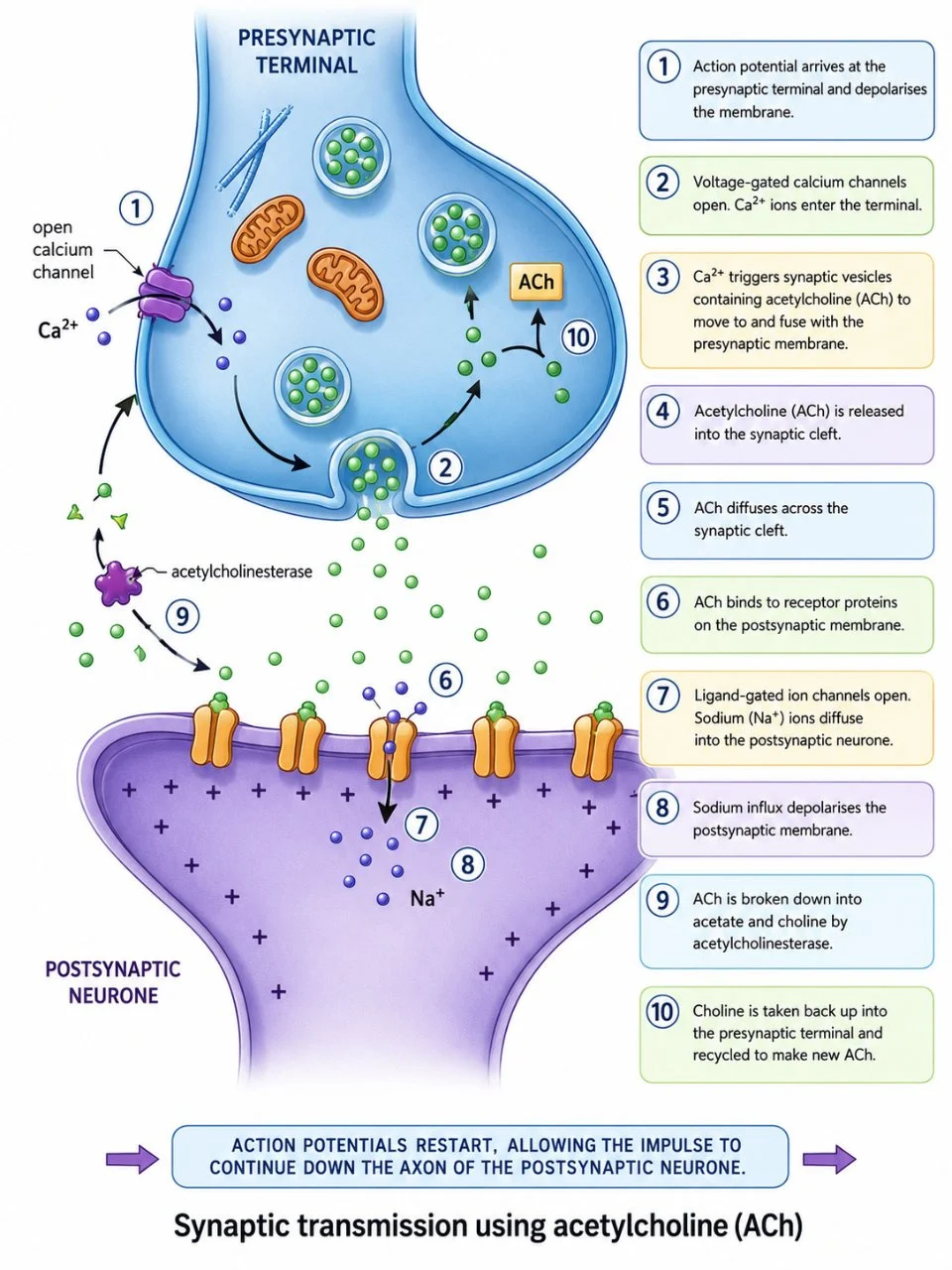
Detailed acetylcholine release, receptor binding and recycling at a cholinergic synapse" loading= - Dr Khaled Dabour Academy⤢ Enlarge
Mechanisms, Detailed Processes & Governing Concepts
1
C. Do summer forest fires coincide with an increase in the number of scarlet larkspur blooms the following summer? D. Does the average number of scarlet larkspur blooms per 100 m 2 differ between hillsides with below average spring rainfall and hillsides with average or above average spring rainfall?
2
Phytoplankton are a natural part of aquatic ecosystems

but a harmful algal bloom (HAB) occurs when a phytoplankton species grows out of control, endangering water quality, wildlife, and human health. Two graduate students present their theories about the development of HABs.
3
Heavy rains can lead to a significant increase in agricultural runoff, sending large amounts of nitrogen and phosphorous into a lake.
1 / 9Next ▶
Mechanisms, Detailed Processes & Governing Concepts
In a healthy lake, the majority of both of these nutrients are trapped in an unusable form in the sediment.
The growth of phytoplankton is curbed by the lack of available nitrogen.
However, a lake experiencing an HAB has approximately 90% of its nitrogen in useable form (70% from agricultural runoff and another 20% from microbial activity).
4
Due to the excess nitrogen, the algae grows until it overwhelms much of the other plant life.
While the runoff initially increases dissolved oxygen levels, the decomposition of these dead plants eventually leads to decreasing dissolved oxygen levels.
◀ Previous2 / 9Next ▶
Mechanisms, Detailed Processes & Governing Concepts
1

Once the oxygen drops below a critical threshold, dead zones will sometimes form that extend from the surface to depths of almost 30 m.
2

Algal blooms spread rapidly

but they also quickly consume the excess nitrogen.
3

5
4

After the nitrogen levels return to normal, the HAB will dissipate within a couple of weeks.
5

6
6

Nutrients such as nitrogen and phosphorous are concentrated in the sediment at the bottom of lakes.
◀ Previous3 / 9Next ▶
Mechanisms, Detailed Processes & Governing Concepts
1

When dissolved oxygen levels drop due to decreased water movement (such as during droughts or periods of decreased wind activity), a series of biochemical processes causes phosphorous to be released into the water.
2

During an HAB, up to 60% of the phosphorous in the lake is in readily available form in the water instead of in the sediment.
3

The prevalence of phosphorous fuels the growth of phytoplankton.
4

7
5

HABs form on or near the surface

but they release toxic gases that kill so much aquatic life that dead zones can extend up to 90 m below the surface.
6

The decomposing organic matter further decreases the oxygen levels, spurring the release of even more nutrients.
◀ Previous4 / 9Next ▶
Mechanisms, Detailed Processes & Governing Concepts
1

Once an HAB begins, it tends to worsen over time.
2

Without human intervention, an HAB is likely to spread until it consumes an entire lake.
3

8
4

1. Which of the following pie charts is most consistent with Student 1’s description of the distribution of nitrogen in a lake experiencing an HAB ?
5

9
6

2. Which of the students, if either, state(s) that decreasing dissolved oxygen levels leads to the release of nutrients from the sediments? F. Neither Student 1 nor Student 2
◀ Previous5 / 9Next ▶
Mechanisms, Detailed Processes & Governing Concepts
1

10
2

J. Both Student 1 and Student 2 3. Ephemeroptera (mayfly larvae) and Tubificidae (sludge worms) are indicator species used to identify changes in certain water quality characteristics. Ephemeroptera usually outnumber Tubificidae when dissolved oxygen levels are sufficient

but they cannot survive when oxygen levels drop below normal range. In contrast, Tubificidae flourish in low dissolved oxygen environments.
3

11
4

Based on the passage

which of the two indicator species would each student expect to be more prevalent in a lake at the start of an HAB ?
5

12
6

A. Student 1 : Ephemeroptera, Student 2 : Tubificidae B. Student 1 : Ephemeroptera, Student 2 : Ephemeroptera C. Student 1 : Tubificidae, Student 2 : Ephemeroptera
◀ Previous6 / 9Next ▶
Mechanisms, Detailed Processes & Governing Concepts
13
D. Student 1 : Tubificidae, Student 2 : Tubificidae 4. A study reveals that the majority of harmful algal blooms in a region occur annually in the beginning of summer and usually clear up by mid-fall without any intervention. The results of this study would better support the theory of which student?
14
F. Student 1

Student 1 claims that HABs clear up naturally after the bloom consumes the excess nitrogen. G. Student 1Student 1 claims that HABs usually require human intervention to dissipate.
15
H. Student 2

Student 2 claims that HABs clear up naturally after the bloom consumes the excess nitrogen. J. Student 2Student 2 claims that HABs usually require human intervention to dissipate.
◀ Previous7 / 9Next ▶
Mechanisms, Detailed Processes & Governing Concepts
16
5. The photic zone of a lake is the upper layer of water in which enough sunlight permeates to permit photosynthesis.
The photic zone of a particular lake extends from the surface to a depth of approximately 50 m.
Which of the students, if either, would most likely believe that the dead zone created by an HAB could extend below the photic zone of this lake?
17
A. Neither Student 1 nor Student 2 D. Both Student 1 and Student 2 6. A third student claims that lake sediment contains phosphorous in a form that is not readily available to aquatic life. Which of the students, if either, would likely agree with this claim?
◀ Previous8 / 9Next ▶
Mechanisms, Detailed Processes & Governing Concepts
1

18
2

F.
3

Neither Student 1 nor Student 2 J.
4

Both Student 1 and Student 2 7.

A limiting factor is a naturally occurring element, the relative scarcity of which limits the growth of certain plants or animals in an ecosystem.
5

Which of the following correctly pairs a student with the element that student most likely believes is the limiting factor with regard to phytoplankton growth?
◀ Previous9 / 9
1Key Experimental Procedures & Practical Investigations2Key Experimental Procedures & Practical Investigations3Key Experimental Procedures & Practical Investigations4Key Experimental Procedures & Practical Investigations5Key Experimental Procedures & Practical Investigations6Key Experimental Procedures & Practical Investigations7Key Experimental Procedures & Practical Investigations8Key Experimental Procedures & Practical Investigations9Key Experimental Procedures & Practical Investigations10Key Experimental Procedures & Practical Investigations
Key Experimental Procedures & Practical Investigations
1

1
2

A. Student 1: dissolved oxygen B. Student 1: nitrogen C. Student 2: dissolved oxygen D. Student 2: nitrogen Four scientists studied flamingos at three wetlands in Spain and observed some adults with dark pink coloring and some adults with light pink coloring. Each scientist proposed a theory for this observation.
3

2
4

All flamingos are born with gray feathers that are retained for 2–3 years.
5

Whether the flamingo will have dark pink or light pink coloring as an adult is determined by Gene P,

which has two alleles ( P and p ) and 3 possible genotypes.( PP, Pp, and pp )
6

A flamingo with the Gene P genotype pp produces light pink coloring in its feathers.
1 / 10Next ▶
Key Experimental Procedures & Practical Investigations
A flamingo with either the Gene P genotype PP or Pp produces dark pink coloring in its feathers.
The diet and the behavior of the flamingo has no effect on the development of pink coloring in its feathers.
3
A flamingo with either the Gene P genotype PP or Pp produces light pink coloring in its feathers.
A flamingo with the Gene P genotype pp produces dark pink coloring in its feathers.
4
◀ Previous2 / 10Next ▶
Key Experimental Procedures & Practical Investigations
1

If the flamingo has a steady diet high in carotenoids, it will have dark pink coloring as an adult.
2

Carotenoids, such as canthaxanthin, are photosynthetic compounds that dissolve in fats and are deposited in growing feathers

turning them dark pink.
3

A lack of carotenoids in a flamingo’s diet will result in new feather growth that is light pink, and the existing color will be lost through molting.
4

5
5

All flamingos studied are genetically the same

so genetics do not influence flamingo color.
6

6
◀ Previous3 / 10Next ▶
Key Experimental Procedures & Practical Investigations
Adult flamingos produce an oil high in carotenoids from a gland near their tails

which they dab onto their feathers with their beaks.
Flamingos that have reached breeding age (3-6 years old) and have not yet found a mate engage in this behavior more frequently during mating season,

causing their feathers to turn dark pink,whereas flamingos not searching for a mate engage in the behavior less frequently and have light pink feathers.
7
Once a dark pink flamingo has secured a mate or mating season ends, the flamingo will decrease the behavior and the feathers will return to a light pink color. All flamingos studied are genetically the same and eat the same diet

so neither genetics nor diet influence flamingo color.
8
1. Which scientist would be the most likely to agree that the availability of aquatic plants and algae in a habitat affects the color of the flamingos that live there?
◀ Previous4 / 10Next ▶
Key Experimental Procedures & Practical Investigations
9
2. Suppose it were discovered that flamingos with darker pink coloring are more attractive to potential mates. Would this discovery better support the theory of Scientist 3 or Scientist 4 ?
10
F. Scientist 3

because Scientist 3 indicated that flamingoes trying to attract a mate are dark pink. G. Scientist 3because Scientist 3 indicated that flamingoes trying to attract a mate are light pink.
11
H. Scientist 4

because Scientist 4 indicated that flamingoes trying to attract a mate are dark pink. J. Scientist 4because Scientist 4 indicated that flamingoes trying to attract a mate are light pink.
◀ Previous5 / 10Next ▶
Key Experimental Procedures & Practical Investigations
1

12
2

3. All 4 of the scientists’ theories are consistent with which of the following statements? A. Neither light pink nor dark pink flamingos have experienced a change in feather color over the course of their lifetimes.
3

13
4

B. Only light pink flamingos have experienced a change in feather color over the course of their lifetimes. C. Only dark pink flamingos have experienced a change in feather color over the course of their lifetimes.
5

14
6

D. Both light pink and dark pink flamingos have experienced a change in feather color over the course of their lifetimes. 4. Which of the scientists, if any, would be likely to agree that the conclusion of the mating season will cause a light pink flamingo to become dark pink?
◀ Previous6 / 10Next ▶
Key Experimental Procedures & Practical Investigations
1

15
2

F.
3

None of the scientists G.
4

Scientists 1 and 2 only H.
5

Scientists 1 and 3 only 5. Suppose 50 mated pairs of light pink flamingos in a population bred and hatched one egg per pair in a mating season.
6

The parent flamingos and their offspring lived under the same conditions at the wetland and engaged in the same behaviors.
◀ Previous7 / 10Next ▶
Key Experimental Procedures & Practical Investigations
Upon maturity, 39 of the offspring had light pink coloring and 11 had dark pink coloring.
These results best support the theory of which scientist?
16
6. Based on Scientist 1’s theory, if a light pink flamingo and a dark pink flamingo mated over several mating seasons and produced both light pink and dark pink offspring, the Gene P genotype of the parent with the:
17
F. light pink coloring must be Pp. G. light pink coloring must be PP. H. dark pink coloring must be Pp. J. dark pink coloring must be PP. 7. Which of the scientists would be likely to agree that flamingos given high doses of synthetic canthaxanthin could have either light pink or dark pink coloring?
◀ Previous8 / 10Next ▶
Key Experimental Procedures & Practical Investigations
1

18
2

A.
3

Scientists 1 and 2 only B.
4

Scientists 1, 2, and 4 only C.
5

Scientists 2, 3, and 4 only D.
6

Scientists 1, 2, 3,

and 4 The question asks which theories are consistent with the finding that synthetic butenolide increases the germination of scarlet larkspur seeds.
◀ Previous9 / 10Next ▶
Key Experimental Procedures & Practical Investigations
The introduction says that butenolides are smoke-derived compounds released during forest fires.
Both Scientist 1 and Scientist 4 state that compounds in smoke spur the germination of scarlet larkspur seeds.
◀ Previous10 / 10
1Analytical Data, Comparative Structures & Scientific Framewo2Analytical Data, Comparative Structures & Scientific Framewo3Analytical Data, Comparative Structures & Scientific Framewo4Analytical Data, Comparative Structures & Scientific Framewo5Analytical Data, Comparative Structures & Scientific Framewo6Analytical Data, Comparative Structures & Scientific Framewo7Analytical Data, Comparative Structures & Scientific Framewo8Analytical Data, Comparative Structures & Scientific Framewo9Analytical Data, Comparative Structures & Scientific Framewo10Analytical Data, Comparative Structures & Scientific Framewo11Analytical Data, Comparative Structures & Scientific Framewo12Analytical Data, Comparative Structures & Scientific Framewo
Analytical Data, Comparative Structures & Scientific Frameworks
1
Therefore, the finding that synthetic butenolide increases the germination of scarlet larkspur seeds is consistent with the theories of Scientists 1 and 4

which is (B).
2
The question asks, based on Scientist 4’s hypothesis, under which conditions a scarlet larkspur seed would be least likely to bloom.
Scientist 4 states that Scarlet larkspur grows well in habitats with dry soil,

and it also grows well in habitats that have experienced a recent forest fire.
Therefore, a seed would be least likely to bloom when the soil is moist and there has not been a recent forest fire.
1 / 12Next ▶
Analytical Data, Comparative Structures & Scientific Frameworks
1

The correct answer is (H).
2

3
3

The question asks if the results of the study are consistent with the theory of Scientist 2. Use POE.
4

Table 1 shows that, for hillsides without a recent forest fire, there were more blooms (593) on the hillsides with below average rainfall than on the hillsides with more rainfall (456).
5

Eliminate (B) and (D).
6

Scientist 2 states that Scarlet larkspur will produce more blooms on hillsides that have experienced below average rainfall during the spring.
◀ Previous2 / 12Next ▶
Analytical Data, Comparative Structures & Scientific Frameworks
1

This agrees with the finding.
2

The correct answer is (A).
3

4
4

The question asks, before the study was performed

which scientist would have been most likely to predict that all of the hillsides studied would have a similar number of scarlet larkspur blooms. The hillsides differ in rainfall and in the presence or absence of forest fires the previous summer.
5

5
6

The only scientist that will expect all the hillsides to have approximately the same number of scarlet larkspur blooms is the scientist who thinks that neither of these two factors affects the number of scarlet larkspur blooms. Scientist 3 does not think blooms are affected by precipitation or fires

so the answer is (H).
◀ Previous3 / 12Next ▶
Analytical Data, Comparative Structures & Scientific Frameworks
6
The question asks which scientists’ theories are consistent with the results of the figure.
The figure shows that exposure to forest fire smoke increases the percent of a hillside covered in scarlet larkspur blooms.
Both Scientist 1 and Scientist 4 believe that the compounds in smoke released by forest fires increase the germination of scarlet larkspur seeds.
The correct answer is (C).
7
◀ Previous4 / 12Next ▶
Analytical Data, Comparative Structures & Scientific Frameworks
1

The question asks which scientist’s theory is most consistent with the results of the study.
2

Table 1 shows that the most scarlet larkspur blooms occurred on the hillsides with a recent forest fire and below average precipitation.
3

This is consistent with Scientist 4’s statement that The greatest number of scarlet larkspur blooms will be found on hillsides that have experienced below average spring rainfall and a forest fire in the previous summer.
4

The correct answer is (J).
5

8
6

The question asks for the question that CANNOT be directly answered by the results of the study shown in Table 1. Use POE.
◀ Previous5 / 12Next ▶
Analytical Data, Comparative Structures & Scientific Frameworks
Table 1 shows that scarlet larkspur still bloomed even without the presence of a forest fire in the previous year,

so (A) can be answered using Table 1; eliminate (A).
The table shows that lower precipitation coincides with an increase in scarlet larkspur blooms,

but it does not provide any information about the level of competition.
9
Therefore, (B) cannot be directly answered by Table 1

keep (B). The hillsides with recent forest fires had more scarlet larkspur bloomsso eliminate (C). The hillsides with below average spring rainfall have more scarlet bloomsso eliminate (D). The correct answer is (B).
10
The question asks which pie chart is most consistent with Student 1’s description of the distribution of nitrogen in a lake experiencing an HAB.
◀ Previous6 / 12Next ▶
Analytical Data, Comparative Structures & Scientific Frameworks
Student 1 says that A lake experiencing an HAB has approximately 90% of its nitrogen in useable form (70% from agricultural runoff and another 20% from microbial activity).
Eliminate (A) and (C) because they do not show 70% nitrogen from runoff.
Eliminate (D) because it ignores the 10% of nitrogen that is trapped in the sediment in an unusable form.
The correct answer is (B).
11
The question asks which of the students, if either, states that decreasing oxygen levels leads to the release of nutrients from the sediment.
◀ Previous7 / 12Next ▶
Analytical Data, Comparative Structures & Scientific Frameworks
1

Student 2 says that When dissolved oxygen levels drop due to decreased water movement (such as during droughts or periods of decreased wind activity), a series of biochemical processes causes phosphorous to be released into the water.
2

Eliminate (F) and (G).
3

12
4

While Student 1 does discuss decreasing dissolved oxygen levels, there is no mention of the release of nutrients from the sediment. Eliminate (J), and choose (H).
5

13
6

The question asks which indicator species each student would expect to be more prevalent in a lake at the start of an HAB.
◀ Previous8 / 12Next ▶
Analytical Data, Comparative Structures & Scientific Frameworks
1

Consider one student at a time and use POE.
2

Student 1 says that HABs are started by excess nitrogen from runoff, and that the runoff initially increases dissolved oxygen levels.
3

The dissolved oxygen levels do not begin to drop until after the algae bloom has killed aquatic plant life.
4

14
5

Therefore, at the start of an HAB, the dissolved oxygen levels would be sufficient for Ephemeroptera to dominate.
6

Eliminate (C) and (D).
◀ Previous9 / 12Next ▶
Analytical Data, Comparative Structures & Scientific Frameworks
Student 2 says that HABs start after low dissolved oxygen levels trigger the release of phosphorous from the sediment.
Therefore, Student 2 would expect the dissolved oxygen levels to be low prior to the start of the HAB, meaning that Tubificidae would flourish.
Eliminate (B).
15
The question asks which student’s theory is better supported by a study that showed that the majority of harmful algal blooms in a region occur annually in the beginning of summer and clear up by mid-fall without any intervention.
Use POE.
◀ Previous10 / 12Next ▶
Analytical Data, Comparative Structures & Scientific Frameworks
1

The study reveals that the HABs do not require intervention.
2

Eliminate (G) and (J) because both say that HABs require human intervention.
3

Student 2 states that Without human intervention, an HAB is likely to spread until it consumes an entire lake.
4

16
5

This directly contradicts the idea that HABs clear up without intervention

so eliminate (H). The correct answer is (F).
6

17
◀ Previous11 / 12Next ▶
Analytical Data, Comparative Structures & Scientific Frameworks
The question asks which of the students, if either, would most likely believe that the dead zone created by an HAB could extend below the 50 m photic zone of a lake.
Student 1 says Once the oxygen drops below a critical threshold, dead zones will sometimes form that extend from the surface to depths of almost 30 m.
The question states that the photic zone extends 50 m deep

so Student 1 does not think the dead zone will extend below the photic zone.
18
Eliminate (B) and (D). Student 2 says that HABs form on or near the surface

but they release toxic gases that kill so much aquatic life that dead zones can extend up to 90 m below the surface. Therefore, Student 2 believes that the dead zone will extend below the 50 m deep photic zone. The correct answer is (C).
◀ Previous12 / 12
1Comprehensive Problem Solving & Synoptic Evaluation2Comprehensive Problem Solving & Synoptic Evaluation3Comprehensive Problem Solving & Synoptic Evaluation4Comprehensive Problem Solving & Synoptic Evaluation5Comprehensive Problem Solving & Synoptic Evaluation6Comprehensive Problem Solving & Synoptic Evaluation7Comprehensive Problem Solving & Synoptic Evaluation8Comprehensive Problem Solving & Synoptic Evaluation9Comprehensive Problem Solving & Synoptic Evaluation10Comprehensive Problem Solving & Synoptic Evaluation11Comprehensive Problem Solving & Synoptic Evaluation12Comprehensive Problem Solving & Synoptic Evaluation13Comprehensive Problem Solving & Synoptic Evaluation
Comprehensive Problem Solving & Synoptic Evaluation
1
The question asks which of the students, if either, would likely agree that lake sediment contains phosphorous in a form that is readily available to aquatic life.
Use POE.
Student 1 states that Heavy rains can lead to a significant increase in agricultural runoff, sending large amounts of nitrogen and phosphorous into a lake.
In a healthy lake, the majority of both of these nutrients are trapped in an unusable form in the sediment.
2
1 / 13Next ▶
Comprehensive Problem Solving & Synoptic Evaluation
1

Since Student 1 believes that phosphorous is in the sediment in an unusable form, eliminate (F) and (H). Student 2 says that Nutrients such as nitrogen and phosphorous are concentrated in the sediment at the bottom of lakes. Student 2’s theory is that HABs are triggered when low dissolved oxygen levels trigger the release of these nutrients into the water.
2

3
3

Therefore, it is reasonable to assume that under normal conditions they are not ‘readily available to aquatic life.’ Both students would agree with the third student’s claim. The correct answer is (J).
4

4
5

The question asks for the limiting factor with regards to phytoplankton growth. A limiting factor is a naturally occurring element whose scarcity limits the growth of certain plants or animals in an ecosystem. Student 1 states The growth of phytoplankton is curbed by the lack of available nitrogen. This matches (B).
6

5
◀ Previous2 / 13Next ▶
Comprehensive Problem Solving & Synoptic Evaluation
1

The question asks which scientist believes that the availability of aquatic plants and algae will affect the color of the local flamingos.
2

As the question asks about plantlife, look for references to diet.
3

Both Scientist 1 and Scientist 2 state that the diet and behavior of the flamingo has no effect on the development of pink coloring in its feathers.
4

Eliminate (A) and (B).
5

Scientist 3 states if the flamingo has a steady diet high in carotenoids, it will have dark pink coloring as an adult.
6

6
◀ Previous3 / 13Next ▶
Comprehensive Problem Solving & Synoptic Evaluation
As the diet of the flamingo is mentioned as a factor in flamingo coloring, keep (C). Scientist 4 states that all flamingos…eat the same diet

so neither genetics nor diet influence flamingo color. Eliminate (D). The correct answer is (C).
7
The question asks which scientist’s theory would be supported by the discovery that flamingos with darker pink coloring are more attractive to potential mates.
Look for references to mate or mating.
Scientist 3 never mentions mating

so this discovery cannot support Scientist 3’s theory.
Eliminate (F) and (G).
◀ Previous4 / 13Next ▶
Comprehensive Problem Solving & Synoptic Evaluation
1

Scientist 4 states that flamingos that…have not yet found a mate engage in this behavior more frequently during mating season,

causing their feathers to turn dark pink.
2

8
3

Eliminate (J), as it incorrectly identifies the color of the flamingos that are trying to attract a mate. The correct answer is (H).
4

9
5

The question asks which answer choice is consistent with all of the scientists’ theories.
6

Look at the answer choices.
◀ Previous5 / 13Next ▶
Comprehensive Problem Solving & Synoptic Evaluation
The answers revolve around the question of which flamingos experience a change in feather color over time.
The first sentence of each theory is all flamingos are born with gray feathers that are retained for 2–3 years.
Each scientist then goes on to talk about why some flamingos later become light pink

while others become dark pink.
10
All the scientists agree that flamingos start off gray and then become either light or dark pink. Eliminate (A), (B), and (C). The correct answer is (D).
11
◀ Previous6 / 13Next ▶
Comprehensive Problem Solving & Synoptic Evaluation
The question asks which scientists would agree that the conclusion of the mating season will cause a light pink flamingo to turn dark pink.
Look for references to mating season.
Only Scientist 4 mentions the mating season.
Scientist 4 states that o nce a dark pink flamingo has secured a mate or mating season ends, the flamingo will decrease the behavior and the feathers will return to a light pink color.
As this is the opposite of what the question states, eliminate (J).
12
◀ Previous7 / 13Next ▶
Comprehensive Problem Solving & Synoptic Evaluation
1

As Scientists 1–3 did not mention the mating season, eliminate (G) and (H). The correct answer is (F).
2

13
3

The question asks which scientist’s theory is best supported by the results of the study.
4

In this study, 50 mated pairs of flamingos living under similar conditions produced 39 light pink offspring and 11 dark pink offspring.
5

Look for information in each scientist’s theory about the effect of genetics on feather coloring.
6

Scientist 1 states that light pink flamingos only have the genotype pp.
◀ Previous8 / 13Next ▶
Comprehensive Problem Solving & Synoptic Evaluation
1

Two parents with only that genotype would have only light pink offspring.
2

Eliminate (A).
3

14
4

Scientist 2 states that light pink flamingos have genotypes of either PP or Pp.
5

Two light pink Pp flamingos could produce both light pink and dark pink offspring.
6

Keep (B).
◀ Previous9 / 13Next ▶
Comprehensive Problem Solving & Synoptic Evaluation
Scientist 3 says that feather color is determined by diet

so flamingos that lived under the same conditions should all be the same color.
Eliminate (C).
Scientist 4 believes dabbing behavior determines feather color,

so all flamingos that engaged in the same behaviors should be the same color; eliminate (D).
The correct answer is (B).
15
The question asks what the Gene P genotype of one of the parents must be if a light pink and a dark pink flamingo mated and had both light pink and dark pink offspring.
◀ Previous10 / 13Next ▶
Comprehensive Problem Solving & Synoptic Evaluation
1

This question refers to Scientist 1

so look to find what the genotypes are for both dark pink and light pink.
2

According to Scientist 1, light pink is pp and dark pink is either PP or Pp.
3

Eliminate (F) and (G), as flamingos with those genotypes would be dark pink, not light pink.
4

16
5

If the dark pink flamingo parent had the genotype PP, as in (J), all of the offspring would have the genotype Pp and dark pink coloring.
6

Since some offspring have light coloring, eliminate (J).
◀ Previous11 / 13Next ▶
Comprehensive Problem Solving & Synoptic Evaluation
If a dark pink flamingo with Pp,

as in (H), mated with a light pink flamingo with pp genotype, the offspring would be a mix of dark pink Pp and light pink pp flamingos.
The correct answer is (H).
17
The question asks which scientists would agree that flamingos given canthaxanthin could have either light pink or dark pink coloring.
Look for references to canthaxanthin.
Scientist 3 is the only scientist who mentions this.
◀ Previous12 / 13Next ▶
Comprehensive Problem Solving & Synoptic Evaluation
Scientist 3 states if the flamingo has a steady diet high in carotenoids, it will have dark pink coloring as an adult and then goes on to give canthaxanthin as an example of a carotenoid.
Scientist 3 would not agree that a flamingo given canthaxanthin might have light coloring.
18
Eliminate (C) and (D). The remaining 3 scientists do not believe that the amount of carotenoids a flamingo consumes affect flamingo color

so a flamingo given canthaxanthin could be either light pink or dark pink depending on their genes or mating status. The correct answer is (B).
◀ Previous13 / 13
Accepted payment methods