Curriculum
Course: ACT SCIENCE
Login

Curriculum

ACT SCIENCE

Timed Practice

0/28 Dr Dabour Hub Science Diagram and Course Material
Text lesson

2.3 Trends, Interpolation and Extrapolation

MasterStudy LMS Complete Reference — ACT Science Mastery: 2.3 Trends, Interpolation and Extrapolation.

1Theoretical Principles & Core Foundations2Theoretical Principles & Core Foundations3Theoretical Principles & Core Foundations4Theoretical Principles & Core Foundations
Theoretical Principles & Core Foundations
1
Trends, Interpolation and Extrapolation ACT Science notes: Identify trends.
2
In the pendulum table, quadrupling length doubles period: period ∝ √length.
3
Extrapolation is less reliable than interpolation.
1 / 4Next ▶
Theoretical Principles & Core Foundations
1

4
2

Outliers may result from measurement error.
3

5
4

Trends can reverse — check the whole range.
5

6
6

Ratios between successive values reveal multiplicative patterns.
◀ Previous2 / 4Next ▶
Theoretical Principles & Core Foundations
7
Estimate by interpolation and extrapolation.
8
Recognise mathematical relationships.
9
Evenly spaced x-values make estimation easier.
◀ Previous3 / 4Next ▶
Theoretical Principles & Core Foundations
10
Curved relationships need careful extrapolation.
◀ Previous4 / 4
1Mechanisms, Detailed Processes & Governing Concepts2Mechanisms, Detailed Processes & Governing Concepts3Mechanisms, Detailed Processes & Governing Concepts4Mechanisms, Detailed Processes & Governing Concepts5Mechanisms, Detailed Processes & Governing Concepts
Mechanisms, Detailed Processes & Governing Concepts
1

1
2

A constant difference between y-values means a linear relation.
3

2
4

A constant ratio means exponential change.
5

3
6

Choose answer ranges (‘between 3 and 4’) by bracketing values.
1 / 5Next ▶
Mechanisms, Detailed Processes & Governing Concepts
1

4
2

Describe the trend in words (increases, decreases, peaks).
3

5
4

For interpolation, find the two nearest measured points and estimate between them.
5

6
6

For extrapolation, extend the pattern at the same rate.
◀ Previous2 / 5Next ▶
Mechanisms, Detailed Processes & Governing Concepts
7
Test proportionality by checking what happens when x doubles.
8
State the answer with correct units.
9
Making a prediction — write these steps in this order

each step is a marking point.
◀ Previous3 / 5Next ▶
Mechanisms, Detailed Processes & Governing Concepts
1

10
2

Using the pendulum table, predict the period for a 9.00 m pendulum. Length is 9 × 1.00 m

so period is √9 × 2.0 = 6.0 s.
3

11
4

Length is 9 × 1.00 m

so period is √9 × 2.0 = 6.0 s.
◀ Previous4 / 5Next ▶
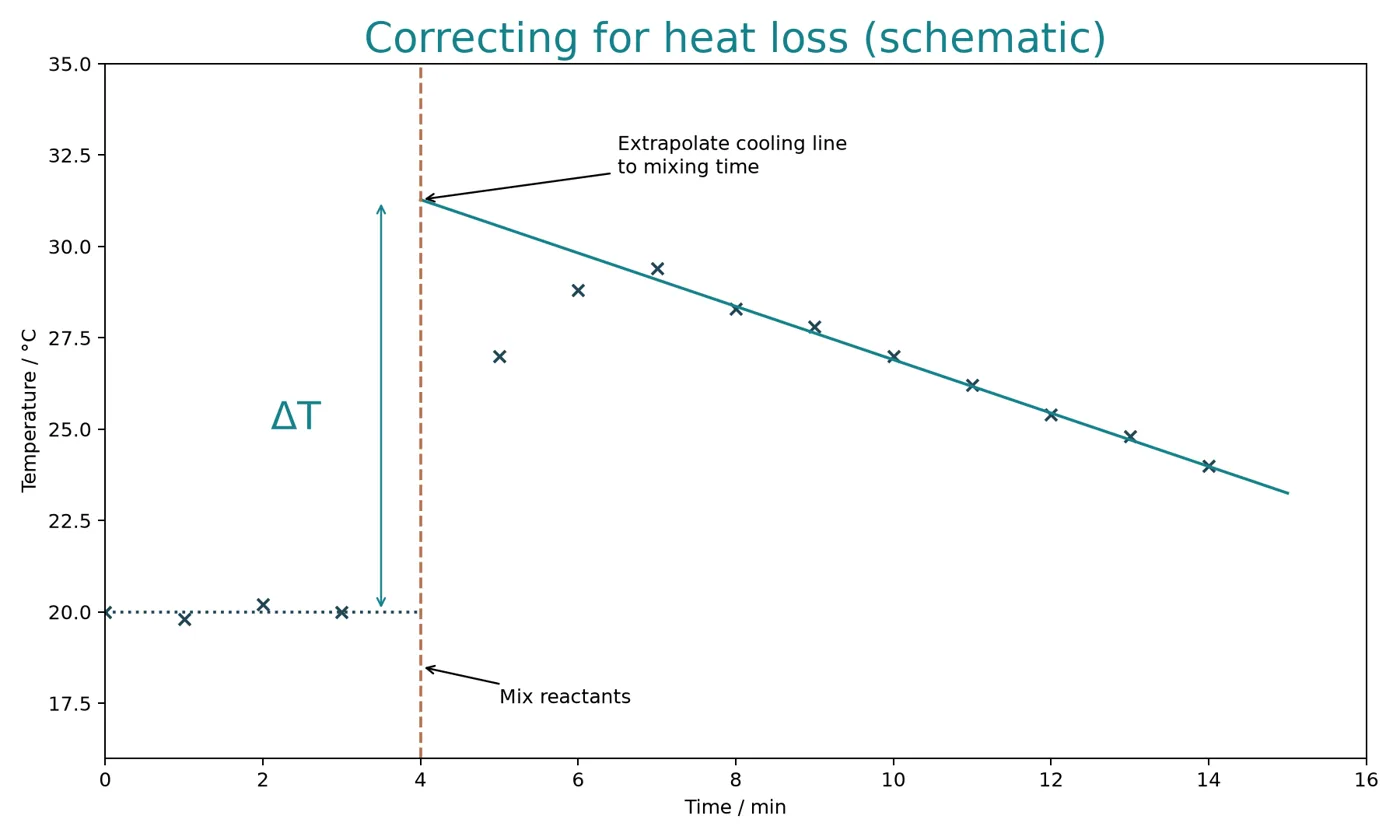
Calorimetry cooling curve extrapolation
Mechanisms, Detailed Processes & Governing Concepts
◀ Previous5 / 5
1Key Experimental Procedures & Practical Investigations2Key Experimental Procedures & Practical Investigations3Key Experimental Procedures & Practical Investigations4Key Experimental Procedures & Practical Investigations
Key Experimental Procedures & Practical Investigations
1
Estimate the period for 1.5 m. Between 2.0 and 3.0 s, about 2.4 s.
2
Between 2.0 and 3.0 s, about 2.4 s.
3
Interpolate inside, extrapolate outside the data.
1 / 4Next ▶
Key Experimental Procedures & Practical Investigations
1

4
2

Double x to test proportionality.
3

5
4

Q1. Estimating between measured points is
5

6
6

Q2. If x doubles and y halves, the relationship is
◀ Previous2 / 4Next ▶
Key Experimental Procedures & Practical Investigations
1

7
2

Q3. Using the pendulum data, period for 16 m
3

8
4

Q4. Extrapolation is risky because
5

9
6

B. the trend may not continue
◀ Previous3 / 4Next ▶
Key Experimental Procedures & Practical Investigations
10
These Trends, Interpolation and Extrapolation ACT Science notes covered the key ideas, worked examples and exam technique for this topic. Check your Trends, Interpolation and Extrapolation ACT Science understanding with the practice questions below

then reread any Trends, Interpolation and Extrapolation ACT Science point you were unsure about before moving on.
◀ Previous4 / 4
1Analytical Data, Comparative Structures & Scientific Framewo2Analytical Data, Comparative Structures & Scientific Framewo3Analytical Data, Comparative Structures & Scientific Framewo4Analytical Data, Comparative Structures & Scientific Framewo
Analytical Data, Comparative Structures & Scientific Frameworks
1

1
2

Practice: Trends, Interpolation and Extrapolation ACT Science practice questions
3

2
4

Previous lesson: 2.2 Reading Graphs
5

3
6

Next lesson: 3.1 Experimental Design and Variables
1 / 4Next ▶
Analytical Data, Comparative Structures & Scientific Frameworks
4
Course: ACT Science — all units
5
Official syllabus: ACT Science test description (act.org)
6
The general direction of change in data.
◀ Previous2 / 4Next ▶
Analytical Data, Comparative Structures & Scientific Frameworks
7
Estimating a value within the measured range.
8
Estimating a value beyond the measured range by extending the trend.
9
y = kx

doubling x doubles y.
◀ Previous3 / 4Next ▶
Analytical Data, Comparative Structures & Scientific Frameworks
1

10
2

y = k/x

doubling x halves y.
3

11
4

A data point that does not fit the pattern.
◀ Previous4 / 4
1Comprehensive Problem Solving & Synoptic Evaluation2Comprehensive Problem Solving & Synoptic Evaluation3Comprehensive Problem Solving & Synoptic Evaluation4Comprehensive Problem Solving & Synoptic Evaluation
Comprehensive Problem Solving & Synoptic Evaluation
1

1
2

Identify / Describe (FRQ) A short, specific statement

describing requires relevant characteristics, not a single word.
3

2
4

Explain / Justify (FRQ) Give the cause-and-effect reasoning or evidence

a restated fact does not score.
5

3
6

Calculate Show setup, substitution and the answer with units.
1 / 4Next ▶
Comprehensive Problem Solving & Synoptic Evaluation
4
Predict State the expected outcome

add a reason only if asked to justify.
5
MCQ technique Read every option

eliminate distractors that are true statements but do not answer the questionwatch for NOT/EXCEPT.
6
Trend · Interpolation · Extrapolation · Proportional · Inversely proportional · Outlier
◀ Previous2 / 4Next ▶
Comprehensive Problem Solving & Synoptic Evaluation
1

7
2

Learn each definition in the Key words tab exactly

a missing keyword in a definition usually loses the mark.
3

8
4

Answer exactly what is asked

extra correct material does not earn credit, and contradictory statements can cancel credit (AP FRQ).
5

9
6

Use precise vocabulary (e.g. ‘active site’, ‘concentration gradient’, ‘allele’), never ‘it/stuff/things’.
◀ Previous3 / 4Next ▶
Comprehensive Problem Solving & Synoptic Evaluation
10
Show units and working in calculations.
11
In MCQs, predict the answer before reading the options

then eliminate.
◀ Previous4 / 4
Accepted payment methods