Curriculum
Course: ACT SCIENCE
Login

Curriculum

ACT SCIENCE

Timed Practice

0/28 Dr Dabour Hub Science Diagram and Course Material
Text lesson

3.1 Experimental Design and Variables

MasterStudy LMS Complete Reference — ACT Science Mastery: 3.1 Experimental Design and Variables.

1Theoretical Principles & Core Foundations2Theoretical Principles & Core Foundations3Theoretical Principles & Core Foundations4Theoretical Principles & Core Foundations
Theoretical Principles & Core Foundations
1
Experimental Design and Variables ACT Science notes: Identify variables in experiments.
2
A fair test changes only one independent variable at a time.
3
Repeated trials reduce the effect of random error.
1 / 4Next ▶
Theoretical Principles & Core Foundations
1

4
2

The control group allows the effect of the treatment to be seen.
3

5
4

The question ‘Why did the researchers…?’ usually tests controlled variables.
5

6
6

Conclusions must be limited to conditions actually tested.
◀ Previous2 / 4Next ▶
Theoretical Principles & Core Foundations
7
Identify variables in experiments.
8
Recognise controls and constants.
9
Evaluate experimental design.
◀ Previous3 / 4Next ▶
Theoretical Principles & Core Foundations
10
Variables are often named in italics or in table headers.
◀ Previous4 / 4
1Mechanisms, Detailed Processes & Governing Concepts2Mechanisms, Detailed Processes & Governing Concepts3Mechanisms, Detailed Processes & Governing Concepts4Mechanisms, Detailed Processes & Governing Concepts
Mechanisms, Detailed Processes & Governing Concepts
1

1
2

Multiple experiments may test different independent variables.
3

2
4

A placebo is a control in medical studies.
5

3
6

Sample size increases confidence.
1 / 4Next ▶
Mechanisms, Detailed Processes & Governing Concepts
1

4
2

Precision is improved by better instruments.
3

5
4

Find what the experimenter changed between trials (independent).
5

6
6

Find what was recorded in the results (dependent).
◀ Previous2 / 4Next ▶
Mechanisms, Detailed Processes & Governing Concepts
7
List everything kept the same (controlled).
8
Identify the purpose of each experiment.
9
Check whether the design supports the conclusion.
◀ Previous3 / 4Next ▶
Mechanisms, Detailed Processes & Governing Concepts
1

10
2

Anatomy of an experiment — write these steps in this order

each step is a marking point.
◀ Previous4 / 4
1Key Experimental Procedures & Practical Investigations2Key Experimental Procedures & Practical Investigations3Key Experimental Procedures & Practical Investigations4Key Experimental Procedures & Practical Investigations
Key Experimental Procedures & Practical Investigations
1
Change one variable at a time.
2
Measure the dependent variable.
3
Keep controlled variables constant.
1 / 4Next ▶
Key Experimental Procedures & Practical Investigations
4
Q1. In the plant study, the dependent variable is
5
Q2. Why use the same soil for all plants?
6
Q3. An experiment changing both temperature and pH at once is flawed because
◀ Previous2 / 4Next ▶
Key Experimental Procedures & Practical Investigations
1

7
2

B. the cause of changes is unclear
3

8
4

Q4. Repeating trials mainly improves
5

9
6

C. the independent variable
◀ Previous3 / 4Next ▶
gas syringe reaction rate apparatus
Key Experimental Procedures & Practical Investigations
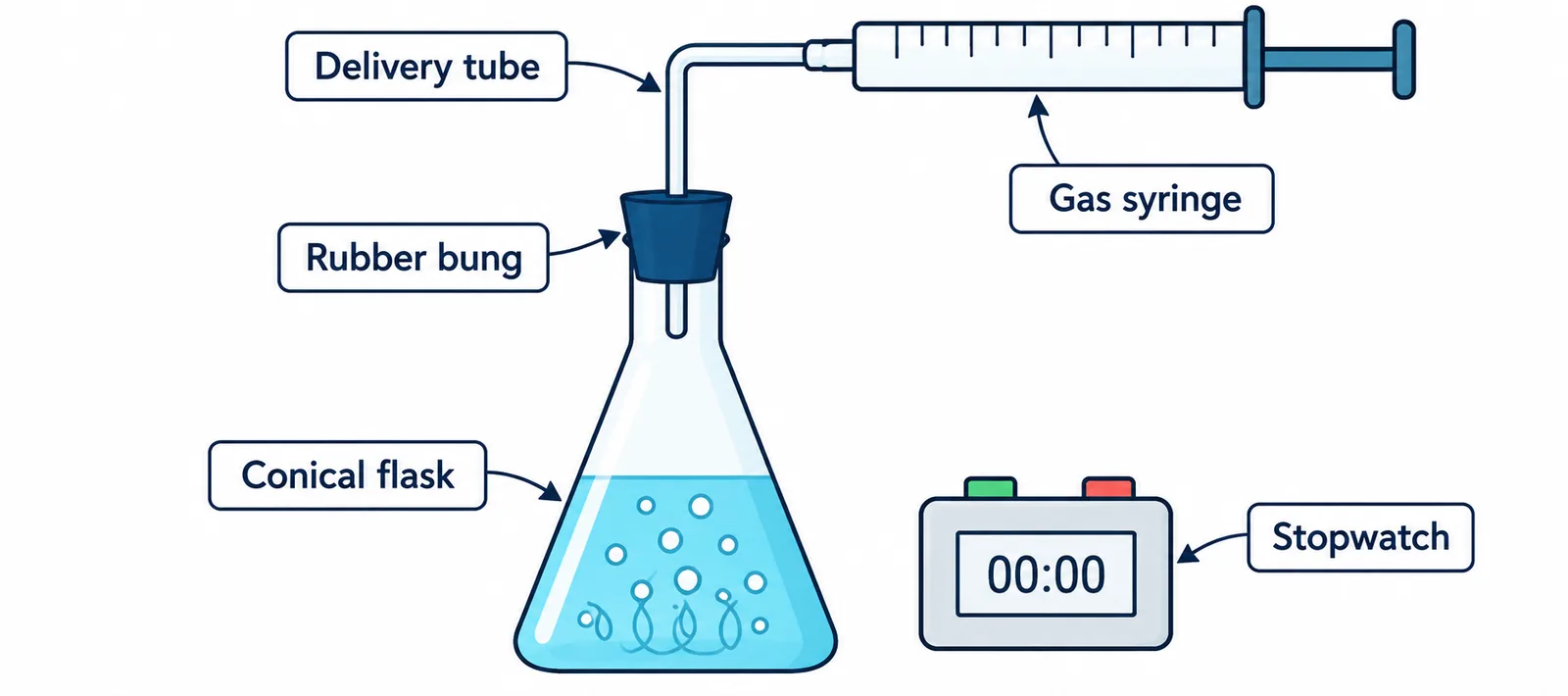
gas syringe reaction rate apparatus" loading= - Dr Khaled Dabour Academy⤢ Enlarge
1

10
2

These Experimental Design and Variables ACT Science notes covered the key ideas, worked examples and exam technique for this topic. Check your Experimental Design and Variables ACT Science understanding with the practice questions below

then reread any Experimental Design and Variables ACT Science point you were unsure about before moving on.
◀ Previous4 / 4
1Analytical Data, Comparative Structures & Scientific Framewo2Analytical Data, Comparative Structures & Scientific Framewo3Analytical Data, Comparative Structures & Scientific Framewo4Analytical Data, Comparative Structures & Scientific Framewo
Analytical Data, Comparative Structures & Scientific Frameworks
1
Practice: Experimental Design and Variables ACT Science practice questions
2
Previous lesson: 2.3 Trends, Interpolation and Extrapolation
3
Next lesson: 3.2 Comparing Experiments and Predicting Results
1 / 4Next ▶
Analytical Data, Comparative Structures & Scientific Frameworks
1

4
2

Course: ACT Science — all units
3

5
4

Official syllabus: ACT Science test description (act.org)
5

6
6

A testable prediction about the relationship between variables.
◀ Previous2 / 4Next ▶
Analytical Data, Comparative Structures & Scientific Frameworks
7
The factor the experimenter changes.
8
A factor kept constant so it does not affect results.
9
A group not given the experimental treatment, for comparison.
◀ Previous3 / 4Next ▶
Analytical Data, Comparative Structures & Scientific Frameworks
10
One run of an experiment

repeated trials improve reliability.
◀ Previous4 / 4
1Comprehensive Problem Solving & Synoptic Evaluation2Comprehensive Problem Solving & Synoptic Evaluation3Comprehensive Problem Solving & Synoptic Evaluation4Comprehensive Problem Solving & Synoptic Evaluation
Comprehensive Problem Solving & Synoptic Evaluation
1

1
2

Identify / Describe (FRQ) A short, specific statement

describing requires relevant characteristics, not a single word.
3

2
4

Explain / Justify (FRQ) Give the cause-and-effect reasoning or evidence

a restated fact does not score.
5

3
6

Calculate Show setup, substitution and the answer with units.
1 / 4Next ▶
Comprehensive Problem Solving & Synoptic Evaluation
1

4
2

Predict State the expected outcome

add a reason only if asked to justify.
3

5
4

MCQ technique Read every option

eliminate distractors that are true statements but do not answer the questionwatch for NOT/EXCEPT.
5

6
6

Hypothesis · Independent variable · Dependent variable · Controlled variable · Control group · Trial
◀ Previous2 / 4Next ▶
Comprehensive Problem Solving & Synoptic Evaluation
7
Learn each definition in the Key words tab exactly

a missing keyword in a definition usually loses the mark.
8
Answer exactly what is asked

extra correct material does not earn credit, and contradictory statements can cancel credit (AP FRQ).
9
Use precise vocabulary (e.g. ‘active site’, ‘concentration gradient’, ‘allele’), never ‘it/stuff/things’.
◀ Previous3 / 4Next ▶
Comprehensive Problem Solving & Synoptic Evaluation
1

10
2

Show units and working in calculations.
3

11
4

In MCQs, predict the answer before reading the options

then eliminate.
◀ Previous4 / 4
Accepted payment methods