Curriculum
Course: ACT SCIENCE
Login

Curriculum

ACT SCIENCE

Timed Practice

0/28 Dr Dabour Hub Science Diagram and Course Material
Text lesson

Princeton Review ACT Science Prep — Chapter 4: Science Reading Strategy

MasterStudy LMS Complete Reference — ACT Science Mastery: Princeton Review ACT Science Prep — Chapter 4: Science Reading Strategy.

1Theoretical Principles & Core Foundations2Theoretical Principles & Core Foundations3Theoretical Principles & Core Foundations4Theoretical Principles & Core Foundations5Theoretical Principles & Core Foundations
Theoretical Principles & Core Foundations
1
SCIENCE READING: The Science Reading passage contains questions about two or more viewpoints, theories, or hypotheses regarding the same scientific topic.
The ACT calls them ‘Conflicting Viewpoints,’ but we call them Science Reading because while they sometimes have figures, the majority of the information necessary to answer the questions comes from the passage text.
There is no way around reading on the Science Reading passage!
2
Now or Later?: These passages may be Now, Later, or Never passages for you, depending on your POOD. If you’re a strong reader or there are some particularly tricky Later passages in the test, you might do the Science Reading passage between the Now passages and the Later passages. Otherwise, do it Later or Never.
1 / 5Next ▶
Theoretical Principles & Core Foundations
1

3
2

Recognizing the Science Reading Passage: Since this passage requires a different approach, it’s important that you know how to recognize it. Here are the key things that all Science Reading passages have in common:
3

4
4

A lot of text: approximately half of the Science Reading passages will have some type of figure

but ALL will have a significant amount of text.
5

5
6

2–4 different viewpoints: the viewpoints (sometimes called theories or hypotheses) are usually presented as Students 1–4 or Scientists 1–4, and each viewpoint is separated under its own italicized heading.
◀ Previous2 / 5Next ▶
Theoretical Principles & Core Foundations
6
7 questions: these questions will be a mix of viewpoint specific questions and comparing viewpoints questions. Science Reading Basic Approach: Apply our 4-step Science Reading Basic Approach to earn as many points as you can. Let’s work through it with a sample Science Reading passage.
7
Step 1: Preview: First, read the introduction to see what scientific topic the viewpoints are addressing. Unlike many of the other Science passages, you cannot skip the introduction! Generally, the longer the introduction is, the more important it is.
8
A group of students added 100 mg of Salt A to an Erlenmeyer flask containing 100 mL of water at 20°C. The mixture was heated over a Bunsen burner, and a thermometer was placed in the flask to acquire temperature readings (Figure 1).
◀ Previous3 / 5Next ▶
Theoretical Principles & Core Foundations
9
The mixture was heated, and temperature readings were acquired every 30 sec until the solution reached a full boil and the solid had completely dissolved. The boiling temperature for the solution was measured to be 104°C. The procedure was repeated with Salt B

which resulted in a boiling temperature of 110°C.
10
The teacher asked 3 of the students in the group to explain why the solutions had different boiling temperatures. The number of ions produced, molar mass, and enthalpy change dissolution (D H ° diss ) of some common salts are shown in Table 1.
11
Table 1
Salt Ions produced Molar mass (g/mol) ∆H°diss (kJ/mol)
Sodium chloride 2 58.4 +3.9
Calcium chloride 3 111.0 -81.2
Ammonium nitrate 2 80.1 +25.7
Potassium hydroxide 2 56.11 -57.6
Magnesium sulfate 2 120.38 -91.0
◀ Previous4 / 5Next ▶
Theoretical Principles & Core Foundations
1

12
2

Table 1 shows some properties of some common salts. There aren’t any obvious trends to note in Table 1

so don’t spend too much time trying to make sense of it yet. Before you move on though, determine what topic the students are discussing. The students are discussing different explanations for why the solutions had different boiling points.
◀ Previous5 / 5
1Mechanisms, Detailed Processes & Governing Concepts2Mechanisms, Detailed Processes & Governing Concepts3Mechanisms, Detailed Processes & Governing Concepts4Mechanisms, Detailed Processes & Governing Concepts
Detailed acetylcholine release, receptor binding and recycling at a cholinergic synapse
Mechanisms, Detailed Processes & Governing Concepts
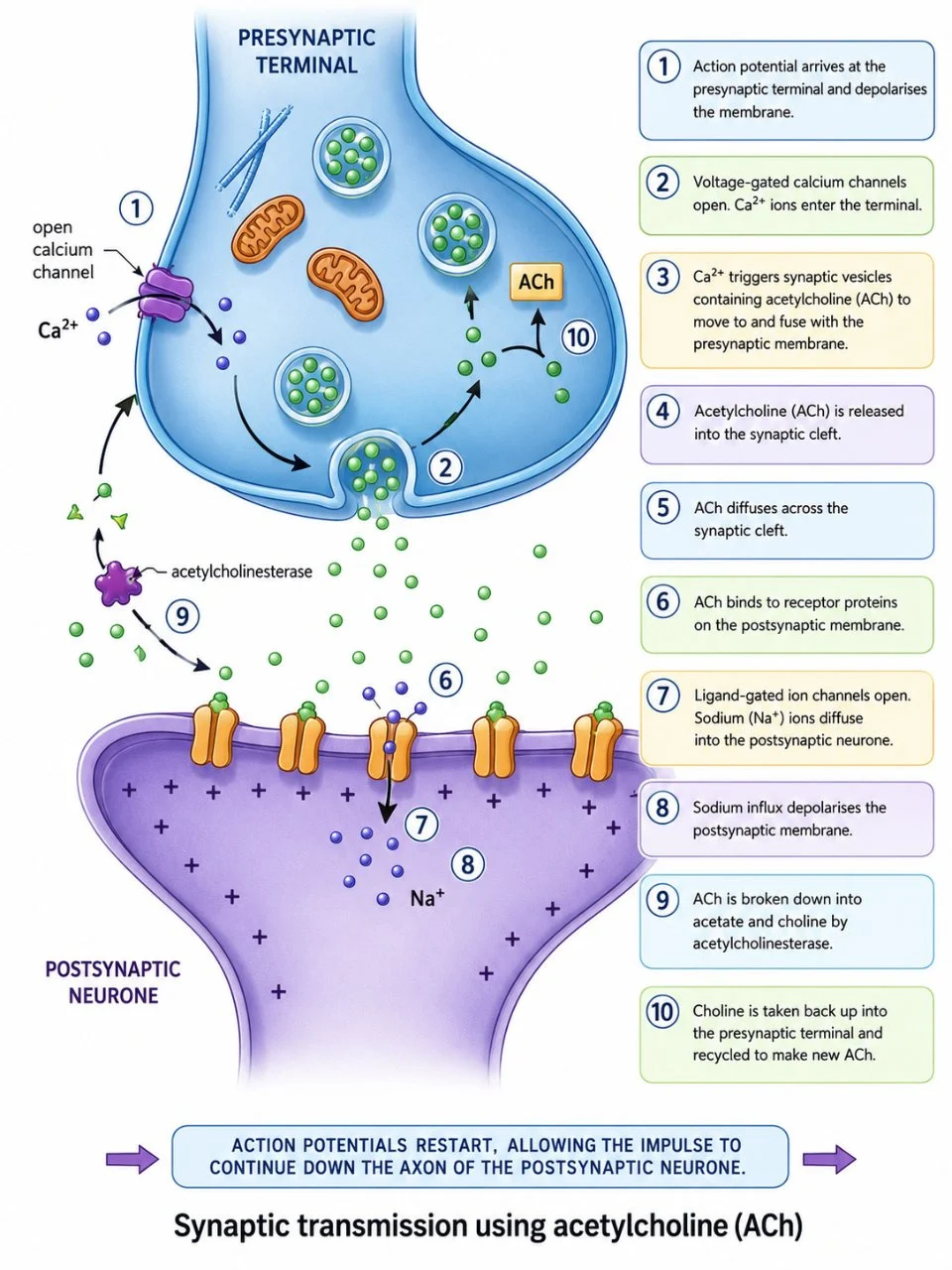
Detailed acetylcholine release, receptor binding and recycling at a cholinergic synapse" loading= - Dr Khaled Dabour Academy⤢ Enlarge
1

1
2

Next, go straight to the questions and identify which viewpoint you’ll need to read in order to answer the question. Any question that just covers Student 1, should be labeled ‘1,’ any passage that just covers Student 2 should be labeled ‘2,’ and any question that just covers Student 3 should be labeled ‘3.’ For questions that cover all 3, write ‘all.’
3

2
4

all 1. Suppose that Salt A had been potassium hydroxide and Salt B had been magnesium sulfate. The results of the experiment would have supported the explanation(s) provided by which student(s)?
5

3
6

C. Students 1 and 3 only D. Students 2 and 3 only 2 2. Suppose that the students also tested ammonium nitrate in the experiment and found it to have resulted in a boiling temperature in solution of 107°C. Student 2 would claim that ammonium nitrate:
1 / 4Next ▶
Mechanisms, Detailed Processes & Governing Concepts
4
F. has a greater molar mass than Salt A

but a smaller molar mass than Salt B. G. has a greater molar mass than Salt Bbut a smaller molar mass than Salt A.
5
H. has a greater enthalpy change of dissolution than Salt A

but a smaller enthalpy change of dissolution than Salt B. J. has a greater enthalpy change of dissolution than Salt Bbut a smaller enthalpy change of dissolution than Salt A.
6
2 3. Which of the following graphs of the relative number of particles produced is most consistent with Student 2’s explanation? all 4. Over the course of the experiment, the readings on the thermometer:
◀ Previous2 / 4Next ▶
Mechanisms, Detailed Processes & Governing Concepts
1

7
2

H. increased

then decreased. J. decreasedthen increased. 3 5. Based on Student 3’s explanationwhich of the salts in Table 1 would result in the greatest solution boiling temperature?
3

8
4

C. Potassium hydroxide D. Magnesium sulfate all 6. Consider the data for cesium hydroxide shown in the table below:
5

9
6

Which student(s), if any, would predict that cesium hydroxide would produce a solution with a lower boiling temperature than calcium chloride?
Ions produced Molar mass (g/mol) ΔH°diss (kJ/mol)
2 149.91 –71.6
◀ Previous3 / 4Next ▶
Mechanisms, Detailed Processes & Governing Concepts
10
G. Students 2 and 3 only H. Students 1, 2, and 3 J. None of the students 2 7. Is the claim ‘If equal amounts of salt are dissolved, sodium chloride will result in a greater boiling point than ammonium nitrate’ consistent with Student 2’s explanation?
11
A. No

because sodium chloride has a smaller molar mass than ammonium nitrate. B. Nobecause sodium chloride has a more negative enthalpy change of dissolution.
12
C. Yes

because sodium chloride has a smaller molar mass than ammonium nitrate. D. Yesbecause sodium chloride has a more negative enthalpy change of dissolution.
◀ Previous4 / 4
1Key Experimental Procedures & Practical Investigations2Key Experimental Procedures & Practical Investigations3Key Experimental Procedures & Practical Investigations4Key Experimental Procedures & Practical Investigations5Key Experimental Procedures & Practical Investigations6Key Experimental Procedures & Practical Investigations7Key Experimental Procedures & Practical Investigations
Key Experimental Procedures & Practical Investigations
1
Step 2: One Side at a Time: Read one viewpoint and answer all questions on that viewpoint only.
Sometimes there are not many stand-alone viewpoint specific questions

while sometimes over half of the questions are viewpoint specific.
Usually you will start with Viewpoint 1

but in this case, 3 of the 7 questions refer to Student 2 onlywhile none of them refer to Student 1 only.
In situations in which one viewpoint is relevant to more questions than the others, it’s good to start there.
2
1 / 7Next ▶
Key Experimental Procedures & Practical Investigations
1

The solution containing Salt B had a higher boiling point because it had a lower molar mass (the mass of 6.02 × 10²³ particles).
2

Consider equal amounts of two salts with different molar masses.
3

The salt with the greater molar mass will require more mass to result in the same number of particles.
4

Since more heat energy is required to boil water with more interactions, the solution with more salt particles will boil at a higher temperature.
5

3
6

Thus, if equal amounts of two salts with different molar masses are added, the salt with the lower molar mass will result in more particles and a greater solution boiling point than a salt with a greater molar mass.
◀ Previous2 / 7Next ▶
Key Experimental Procedures & Practical Investigations
1

4
2

Recall that the topic is why the solutions boiled at different temperatures. Student 2’s response can be summarized as the following: a smaller molar mass leads to a higher boiling point. Try Question 2:
3

5
4

2. Suppose that the students also tested ammonium nitrate in the experiment and found it to have resulted in a boiling temperature in solution of 107°C. Student 2 would claim that ammonium nitrate:
5

6
6

F. has a greater molar mass than Salt A

but a smaller molar mass than Salt B. G. has a greater molar mass than Salt Bbut a smaller molar mass than Salt A.
◀ Previous3 / 7Next ▶
Key Experimental Procedures & Practical Investigations
7
H. has a greater enthalpy change of dissolution than Salt A

but a smaller enthalpy change of dissolution than Salt B. J. has a greater enthalpy change of dissolution than Salt Bbut a smaller enthalpy change of dissolution than Salt A.
8
Use POE. Eliminate (H) and (J) because Student 2 never mentions enthalpy change of dissolution. Choice (F) means that Salt B has the greatest molar mass of the three solutions

but Student 2 states specifically that Salt B had a smaller molar mass than Salt Aso eliminate (F).
9
Since the boiling point for ammonium nitrate is in between the boiling points mentioned in the introduction for Salt A and Salt B, Student 2 would claim the molar mass of ammonium nitrate was greater than that of Salt B

but less than that of Salt A. The correct answer is (G).
◀ Previous4 / 7Next ▶
Key Experimental Procedures & Practical Investigations
1

10
2

3. Which of the following graphs of the relative number of particles produced is most consistent with Student 2’s explanation?
3

Refer back to Student 2’s discussion and look for the term particles.
4

Student 2 says if equal amounts of two salts with different molar masses are added, the salt with the smaller molar mass will result in more particles.
5

Student 2 does not mention any of the 3 salts

but Table 1 does.
6

Look to Table 1 to compare the molar masses of the three salts.
◀ Previous5 / 7Next ▶
Key Experimental Procedures & Practical Investigations
11
Potassium hydroxide has the smallest molar mass, at 56.11 g/mol

so Student 2 would expect potassium hydroxide to have the most particles produced.
Eliminate (B) and (C) because they show magnesium sulfate with the highest number of particles.
Eliminate (D) because potassium hydroxide and magnesium sulfate should not be equal since they do not have the same molar mass.
Only (A) is consistent with Student 2’s discussion.
12
◀ Previous6 / 7Next ▶
Key Experimental Procedures & Practical Investigations
7. Is the claim ‘If equal amounts of salt are dissolved, sodium chloride will result in a greater boiling point than ammonium nitrate’ consistent with Student 2’s explanation?
13
A. No

because sodium chloride has a smaller molar mass than ammonium nitrate. B. Nobecause sodium chloride has a more negative enthalpy change of dissolution.
◀ Previous7 / 7
1Analytical Data, Comparative Structures & Scientific Framewo2Analytical Data, Comparative Structures & Scientific Framewo3Analytical Data, Comparative Structures & Scientific Framewo4Analytical Data, Comparative Structures & Scientific Framewo5Analytical Data, Comparative Structures & Scientific Framewo6Analytical Data, Comparative Structures & Scientific Framewo7Analytical Data, Comparative Structures & Scientific Framewo
Analytical Data, Comparative Structures & Scientific Frameworks
1

1
2

C. Yes

because sodium chloride has a smaller molar mass than ammonium nitrate. D. Yesbecause sodium chloride has a more negative enthalpy change of dissolution.
3

2
4

Rather than tackling the Yes or No first, focus on the reasons and use POE.
5

Since Student 2 did not discuss enthalpy change of dissolution, eliminate (B) and (D).
6

Recall that you’ve already established that Student 2 believes that a smaller molar mass leads to a higher boiling point.
1 / 7Next ▶
Analytical Data, Comparative Structures & Scientific Frameworks
1

Both (A) and (C) state that sodium chloride has a smaller molar mass,

so Student 2 would believe that sodium chloride will have a higher boiling point.
2

This is consistent with the claim

so eliminate (A) and choose (C).
3

3
4

Now that you’ve finished all of the Student 2 specific questions, it’s time to move on to Step 3. Step 3: The Other Side(s): Read the next viewpoint and do all the questions that pertain to that viewpoint only.
5

On passages with more than two viewpoints, you will have to repeat this step.
6

Regardless of how many viewpoints there are, read one viewpoint at a time and work any stand-alone questions that pertain to it before moving on to the next viewpoint.
◀ Previous2 / 7Next ▶
Analytical Data, Comparative Structures & Scientific Frameworks
4
Since Student 3 has a stand-alone question, let’s do Student 3 next.
The solution containing Salt B had a higher boiling point because Salt B releases more heat upon dissolving than Salt A.
The enthalpy change of dissolution (D H ° diss ) is a measure of the net amount of heat energy absorbed in the process of dissolving a salt.
Salts that absorb more energy to dissolve will have more positive D H ° diss values and will make the solution cooler.
5
◀ Previous3 / 7Next ▶
Analytical Data, Comparative Structures & Scientific Frameworks
1

Salts that absorb less energy than they release will have more negative D H ° diss values and will make the solution warmer. If equal amounts of two salts with different D H ° diss values are dissolved in solution, the solution containing the salt with the more negative D H ° diss value will release more heat and thus result in a greater boiling point.
2

6
3

Student 3’s viewpoint on why the boiling points differed can be summarized as the following: solutions with a more negative enthalpy change of dissolution (∆ H ° diss ) will release more heat and thus result in a greater boiling point. Try Question 5:
4

7
5

5. Based on Student 3’s explanation

which of the salts in Table 1 would result in the greatest solution boiling temperature? C. Potassium hydroxide
6

8
◀ Previous4 / 7Next ▶
Analytical Data, Comparative Structures & Scientific Frameworks
D.
Magnesium sulfate Since Student 3 says that the solutions with more negative ∆ H ° diss values have greater boiling points, refer to Table 1 to find the solution with the most negative ∆ H ° diss value.
In Table 1, magnesium sulfate has the most negative ∆ H ° diss value at −91 kJ/mol,

so Student 3 would expect magnesium sulfate to have the greatest boiling point temperature.
The correct answer is (D).
9
Next, repeat Step 3 with the final viewpoint: Student 1. The solution containing Salt B had a higher boiling point because Salt B produces more ions in solution than Salt A.
◀ Previous5 / 7Next ▶
Analytical Data, Comparative Structures & Scientific Frameworks
As the solid dissolves, the salt ionizes and interacts with water molecules.
This causes more interactions between the ions and water, thus requiring more energy for water molecules to break these interactions and become a gas (boiling).
10
Since salts become ions in solution, salts that produce more ions will have more interactions with water than salts producing fewer ions. Thus, if two salts of equal amounts are added to water, the solution containing the salt that produces more ions will boil at the higher temperature.
11
There are no stand-alone questions about Student 1

but it’s still good to take note of Student 1’s position before you move on to Step 4. Student 1’s viewpoint can be summarized as the following: solutions with more ions will boil at higher temperatures.
◀ Previous6 / 7Next ▶
Analytical Data, Comparative Structures & Scientific Frameworks
1

12
2

Now that you have a good idea of what the students believe and how they differ, it’s time to move on to Step 4. Step 4: Compare and Contrast: Always save all of the compare and contrast questions for last.
3

You’ll have a much easier time keeping track of who said what, how they agree, and how they disagree at this point.
4

Use POE as much as possible.
◀ Previous7 / 7
1Comprehensive Problem Solving & Synoptic Evaluation2Comprehensive Problem Solving & Synoptic Evaluation3Comprehensive Problem Solving & Synoptic Evaluation4Comprehensive Problem Solving & Synoptic Evaluation5Comprehensive Problem Solving & Synoptic Evaluation6Comprehensive Problem Solving & Synoptic Evaluation7Comprehensive Problem Solving & Synoptic Evaluation8Comprehensive Problem Solving & Synoptic Evaluation9Comprehensive Problem Solving & Synoptic Evaluation
Comprehensive Problem Solving & Synoptic Evaluation
1

1
2

Try Question 4 first because it is short and has short answers: 4. Over the course of the experiment, the readings on the thermometer: H. increased

then decreased.
3

2
4

J. decreased

then increased.
5

None of the students discussed a thermometer

so refer back to the introduction.
6

Figure 1 shows a thermometer,

and the description below it states that the mixture was heated,and temperature readings were acquired every 30 sec until the solution reached a full boil and the solid had completely dissolved.
1 / 9Next ▶
Comprehensive Problem Solving & Synoptic Evaluation
Since the mixture is only heated, it can be inferred that its temperature increased only.
3
There’s no indication that the substance is ever cooled

so (F) is the only answer supported by information from the passage.
4
Next, try Question 1: 1. Suppose that Salt A had been potassium hydroxide and Salt B had been magnesium sulfate. The results of the experiment would have supported the explanation(s) provided by which student(s)?
5
◀ Previous2 / 9Next ▶
Comprehensive Problem Solving & Synoptic Evaluation
1

C.
2

Students 1 and 3 only D.
3

Students 2 and 3 only According to the introduction, Salt A had a boiling point of 104°C and Salt B had a boiling point of 110°C.
4

If Salt A is potassium hydroxide and Salt B is magnesium sulfate, you need to determine which student(s)’ explanations would predict that magnesium sulfate would have a higher boiling point than potassium hydroxide.
5

Use POE.
6

Since Student 3 is in most of the answers, start with Student 3.
◀ Previous3 / 9Next ▶
Comprehensive Problem Solving & Synoptic Evaluation
6
You already determined in Question 5 that Student 3 would expect magnesium sulfate to have the highest boiling point due to the fact that it has the most negative ∆ H ° diss value.
Therefore, Student 3’s theory is supported by the results of the experiment.
Eliminate (A).
Student 2 believes a smaller molar mass leads to a higher boiling point,

so look at Table 1 to compare the molar masses of magnesium sulfate and potassium hydroxide.
7
◀ Previous4 / 9Next ▶
Comprehensive Problem Solving & Synoptic Evaluation
According to Table 1, the molar mass of magnesium sulfate (120.38 g/mol) is greater than that of potassium hydroxide (56.11 g/mol)

so Student 2 would expect potassium hydroxide to have a higher boiling point.
This does not agree with the results of the experiment

so eliminate (D).
Finally, Student 1 believes that solutions with more ions boil at higher temperatures.
According to Table 1, both solutions produce 2 ions

so Student 1 would expect them to boil at the same temperature.
8
Eliminate (C) as this does not match the results of the experiment. Only Student 3’s explanation matches the results of the experiment

so the answer is (B).
◀ Previous5 / 9Next ▶
Comprehensive Problem Solving & Synoptic Evaluation
1

9
2

Finally, finish with Question 6: 6. Consider the data for cesium hydroxide shown in the table below:
3

10
4

Which student(s), if any, would predict that cesium hydroxide would produce a solution with a lower boiling temperature than calcium chloride?
5

11
6

G.
Ions produced Molar mass (g/mol) ΔH°diss (kJ/mol)
2 149.91 –71.6
◀ Previous6 / 9Next ▶
Comprehensive Problem Solving & Synoptic Evaluation
1

Students 2 and 3 only H.
2

Students 1, 2, and 3 J.
3

None of the students Compare the new values given in the question to those for calcium chloride given in Table 1 and use POE.
4

Cesium hydroxide produces 2 ions

while calcium chloride produces 3.Since Student 1 believes that solutions with more ions have higher boiling points, Student 1 would agree with the prediction that cesium hydroxide, with fewer ions, would have a lower boiling point than calcium chloride.
5

Eliminate (G) and (J).
6

12
◀ Previous7 / 9Next ▶
Comprehensive Problem Solving & Synoptic Evaluation
Cesium hydroxide has a molar mass 149.91 g/mol

while calcium chloride has a molar mass of 111.0 g/mol.
Student 2 believes that solutions with smaller molar masses have higher boiling points.
Therefore, Student 2 would agree with the prediction that cesium hydroxide, with a greater molar mass, would have a lower boiling temperature.
Eliminate (F).
The only option left is (H).
13
◀ Previous8 / 9Next ▶
Comprehensive Problem Solving & Synoptic Evaluation
1

PRACTICE: You can apply this same basic approach to the Science Reading passage regardless of whether there are 2, 3, or 4 different viewpoints.
2

Try it yourself with the practice passages in Chapter 7

then try the complete tests in Part III.
3

Make sure to go through your answers and consider how you can improve after each practice test before attempting the next!
◀ Previous9 / 9
Accepted payment methods