15.4Chapter 15: The Earth in Space (Universe and Stars)
The life cycle of stars — Alhussan Physics - Stage 9 Revision Notes & Topical Questions
5 min read 8 parts Lesson 4 of 6 2 quizzes
Lesson summary
Physics 15.4 The life cycle of stars — Nebulae, Main Sequence, Red Giants, White Dwarfs and Supernovae — Alhussan International Academy — Physics (Stages 7–9) notes: Describe what a nebula is and how stars form and die.Light travel time — Light from some objects has taken million…
- Different ages
- Stellar nursery
- Contraction
- Nuclear fusion
- Conditions
- Stable stage
Section 1 of 8Looking back in time
Light travel time
- Light from some objects has taken millions or billions of years to reach us.
Different ages
- Some stars we see are very young and others are near the end of their life cycle.
Section 2 of 8Nebulae and star formation
Nebula
Nebula a cloud of dust and gas.
Stellar nursery
- A nebula in which gravity pulls the gas together to make a star.
Contraction
- As the ball of gas contracts it heats up until its centre is hot enough for fusion to begin and a star is born.
Example
- The Eagle Nebula is a stellar nursery and the Orion Nebula can be seen with the naked eye.
Section 3 of 8The main sequence
1Nuclear fusion
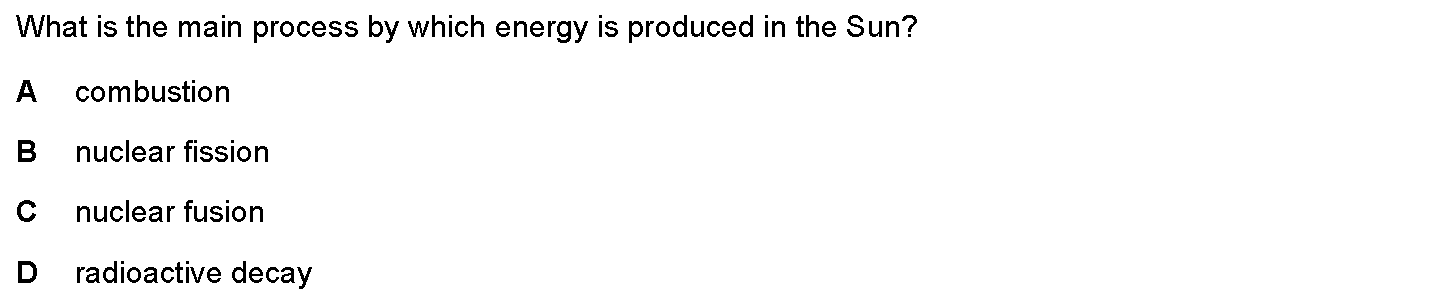
- In the centre of stars hydrogen atoms fuse to make helium and energy is released, which makes the star shine.
2Conditions
- The temperatures and pressures needed for fusion are found in the centre of stars.
3Elements
- Helium then fuses to make other elements, and elements up to iron are made in stars like the Sun.
4Stable stage
- A star spends most of its life, billions of years, on the main sequence, with the inward pull of gravity balanced by outward pressure.
5The Sun
- It is a main-sequence star with enough fuel to shine for about another 5 billion years.
Section 4 of 8Life cycle of a Sun-like star
1
A nebula of gas and dust is pulled together by gravity.
2
The star becomes a main-sequence star.
3
When the hydrogen is used up, it grows into a red giant, which may swallow Mercury, Venus and possibly Earth.
4
The outer layers are thrown into space as a planetary nebula, which has nothing to do with planets.
5
The centre shrinks to a hot white dwarf.
6
The white dwarf cools to an invisible black dwarf.
Section 5 of 8Life cycle of a massive star
1
A nebula forms a main-sequence star much bigger than the Sun.
2
The star swells into a red supergiant.
3
It explodes as a supernova, one of the most energetic explosions in the Universe.
4
The remains form a neutron star or a black hole.
1Heavy elements
- Elements heavier than iron are made only in supernova explosions.
2Recycling
- The remnants flung into space form nebulae that can make new stars and planets, so we are made of stardust.
Section 6 of 8Comparing the two life cycles
| Stage | Sun-like star | Massive star |
|---|---|---|
| Birth | Nebula | Nebula |
| Long stable stage | Main sequence | Main sequence |
| Expanding | Red giant | Red supergiant |
| End | Planetary nebula and white dwarf, then black dwarf | Supernova, then neutron star or black hole |
- Both
- Both types of star produce nebulae that can go on to form new stars.
Section 7 of 8Key terms
| Term | Meaning |
|---|---|
| Nebula | A cloud of dust and gas in space. |
| Nuclear fusion | The joining of light nuclei, such as hydrogen into helium, releasing energy. |
| Main sequence | The long stable stage of a star's life. |
| Red giant | A large cool star formed when a Sun-like star runs out of hydrogen. |
| Supernova | The explosion of a massive star. |
| White dwarf | A small hot dense remnant of a Sun-like star. |
Section 8 of 8Exam technique
1
Thinking a planetary nebula involves planets — it only looks like a planet.
2
Thinking the Sun will become a black hole — it will become a white dwarf.
3
Thinking all elements are made in the Sun — heavy elements form in supernovae.
4
Thinking stars burn fuel like fire — their energy comes from nuclear fusion.
Marked practiceQuizzes for this lesson
?What do you want to solve now?
✓Checkpoint Quiz
2 multiple-choice questions from real exam papers on this lesson.

Last updated: