Skip to content
Dabour HubLEARN · PRACTICE · EXPLORESign inStudent

7.1Gravitation

Planetary Motion and Gravitation — American System Physics Revision Notes & Topical Questions

10 min read 7 parts Lesson 3 of 5 1 quiz

🩺
100% Curriculum Specification Match Lesson Doctor Verified
The only platform with 100% curriculum specification match and verified interactive question banks.
0%read
Lesson summary

State and apply Newton's law of universal gravitation, including the inverse-square dependence.Gravitational force = G × mass 1 × mass 2 ÷ (distance between centres)2: F = Gm1m2/r2 (F in N, m in kg, r in m).What the symbols mean: F = gravitational force (N) · G = 6.67 × 10⁻¹¹ N m…

  • Newton's third law
  • Kepler's third law
  • From Newton's law for a circular orbit
  • Second law
  • Cavendish used a torsion balance
  • Universal gravitational constant (G)

Section 1 of 7Planetary Motion and Gravitation
1
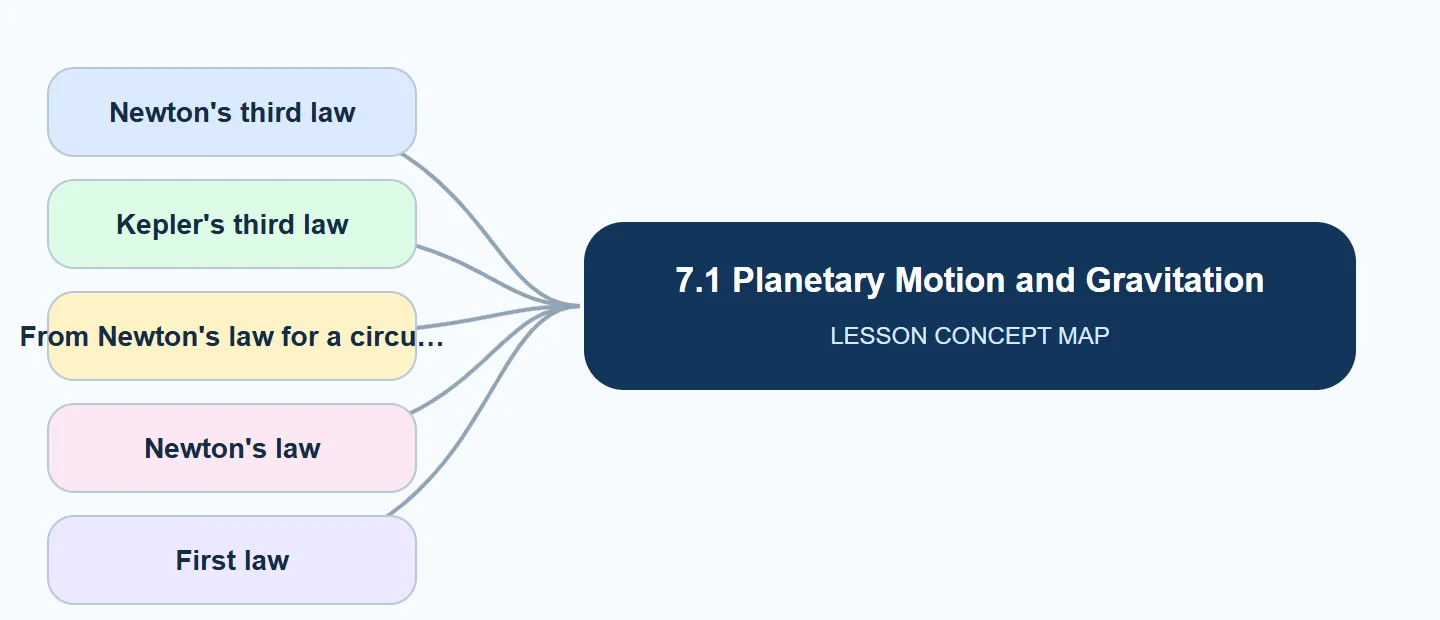
7.1 Planetary Motion and Gravitation concept map: Newton's third law, Kepler's third law, From Newton's law for a circu, Newton's law, First law
Visual guide to the key ideas explained in this lesson.
2
Gravity is a non-contact force that acts between all objects with mass. It is always attractive – there is no 'negative mass' that repels.
3
Newton's law
F = Gm1m2/r2. The force is directly proportional to each mass and inversely proportional to the square of the centre-to-centre distance.
4
The pair of forces between two objects are equal and opposite (Newton's third law pair), even if one object is huge (Earth) and the other tiny (an apple). The apple accelerates noticeably because its mass is small; Earth's acceleration is negligible.
5
G is very small (6.67 × 10⁻¹¹ N·m2/kg2), so the attraction between two people is far too tiny to notice; it only becomes large when a planet or star is involved.
6
Kepler analysed Tycho Brahe's naked-eye data and found three empirical laws. They describe planetary motion but do not explain its cause; Newton's gravitation explained them.
7
First law
First law orbits are ellipses with the Sun at one focus. Most planetary orbits are nearly circular, so at this level we often treat them as circles.
8
Second law
Second law the Sun–planet line sweeps equal areas in equal times. Near the Sun (perihelion) the line is short, so the planet must move faster to sweep the same area; far away (aphelion) it moves slower.
9
Third law
T2 ∝ r3 for objects orbiting the same body. It applies to the planets around the Sun, or to all moons/satellites around Earth – but you cannot compare a moon of Jupiter with a planet around the Sun using the same constant.
10
Combining F = Gm1m2/r2 with the centripetal force for a circular orbit gives T2 = (4π2/Gmcentral) r3, which is Kepler's third law with the constant explained. The orbiting object's own mass cancels.
11
Cavendish used a torsion balance
Cavendish used a torsion balance small lead spheres on a rod hung from a thin fibre were attracted by large lead spheres; the tiny twist of the fibre gave the force, and hence G. Knowing G and g let him calculate Earth's mass ('weighing the Earth').
12
Newton realised that the same force that pulls an apple down also keeps the Moon in orbit – the Moon is continually 'falling' towards Earth while moving sideways fast enough never to hit it.

Section 2 of 7Process & sequence

1
Write down Newton's law: F = Gm1m2/r2.
2
Convert all masses to kilograms and all distances to metres.
3
Make sure r is measured centre-to-centre (add the planet's radius to any altitude above the surface).
4
Square r before dividing; multiply the two masses and G.
5
Give the answer in newtons to 2–3 significant figures and state that the force is attractive and acts along the line of centres.
6
Check using ratios: e.g. if r doubles the answer must fall to one quarter.

Using Kepler's third lawwrite these steps in this order; each step is a marking point.

1
Check both objects orbit the SAME central body.
2
Write (TA/TB)2 = (rA/rB)3.
3
Put in the known ratio (units cancel if they match).
4
Cube or square the known ratio, then take the square or cube root.
5
Multiply by the known period or radius to get the answer.

Section 3 of 7Compare

Kepler's three laws at a glance
LawStatement (short)What it tells you
FirstOrbits are ellipses, Sun at one focusShape of an orbit
SecondEqual areas in equal timesPlanet speeds up near the Sun, slows far away
ThirdT2 ∝ r3 for the same central bodyFarther planets have much longer years

Kepler found the laws from Tycho Brahe's observations; Newton later explained them with gravitation.

Effect of changing mass and distance on gravitational force
ChangeNew force
Double one mass2F
Double both masses4F
Double the distanceF/4
Triple the distanceF/9
Halve the distance4F

Section 4 of 7Worked examples

1
Find the gravitational force between Earth (5.97 × 1024 kg) and the Moon (7.35 × 10²² kg) whose centres are 3.84 × 10⁸ m apart.
  • F = Gm1m2/r2 = (6.67 × 10⁻¹¹)(5.97 × 1024)(7.35 × 10²²) / (3.84 × 10⁸)2
    Numerator = 2.927 × 1037;
    • denominator = 1.475 × 10¹⁷
      F = 1.98 × 10²⁰ N (attractive, along the Earth–Moon line).
2
8.0 N
Two objects attract with 36 N. The distance between them is tripled and one mass is doubled. What is the new force?
  • F ∝ m1m2/r2. New F = 36 × 2 / 32 = 36 × 2/9 = 8.0 N.
3
1.87 Earth years
Mars is on average 1.52 times as far from the Sun as Earth. Find the length of a Martian year in Earth years.
  • Kepler's third law(TM/TE)2 = (rM/rE)3 = 1.523 = 3.512
    TM/TE = √3.512 = 1.87
    TM = 1.87 × 1 year = 1.87 Earth years.

Section 5 of 7Key terms

Section 6 of 7Command terms

Command terms
Identify / Describe (FRQ)
A short, specific statement; describing requires relevant characteristics, not a single word.
Explain / Justify (FRQ)
Give the cause-and-effect reasoning or evidence; a restated fact does not score.
Calculate
Show setup, substitution and the answer with units.
Predict
State the expected outcome; add a reason only if asked to justify.
MCQ technique
Read every option; eliminate distractors that are true statements but do not answer the question; watch for NOT/EXCEPT.

Section 7 of 7Exam technique

Keywords the mark scheme looks for in this lesson

Keywords the mark scheme looks for in this lesson
Gravitational force · Newton's law of universal gravitation · Universal gravitational constant (G) · Inverse-square law · Kepler's first law · Kepler's second law · Kepler's third law · Ellipse · Orbital period (T) · Orbital radius (r) · Solar system · Cavendish experiment
Learn each definition in the Key words tab exactly; a missing keyword in a definition usually loses the mark.

How to get full marks (examiner guidance)

1
Answer exactly what is asked; extra correct material does not earn credit, and contradictory statements can cancel credit (AP FRQ).
2
Use precise vocabulary, never “it/stuff/things”.
3
Show units and working in calculations.
4
In MCQs, predict the answer before reading the options, then eliminate.

Words to avoid

1
gravity depends on distancegravitational force is inversely proportional to the square of the distance between centres
2
r is the height above the groundr is the distance between the centres of the two masses
3
the Earth pulls the apple harder than the apple pulls the Earththe forces are equal in size and opposite in direction (Newton's third law pair)
4
planets move at constant speed in their orbitsa planet moves faster when nearer the Sun (equal areas in equal times)
5
T is proportional to rT2 is proportional to r3

Last updated: