11.1Thermal Energy
Temperature, Internal Energy and Thermal Expansion — American System Physics Revision Notes & Topical Questions
10 min read 7 parts Lesson 3 of 5 1 quiz
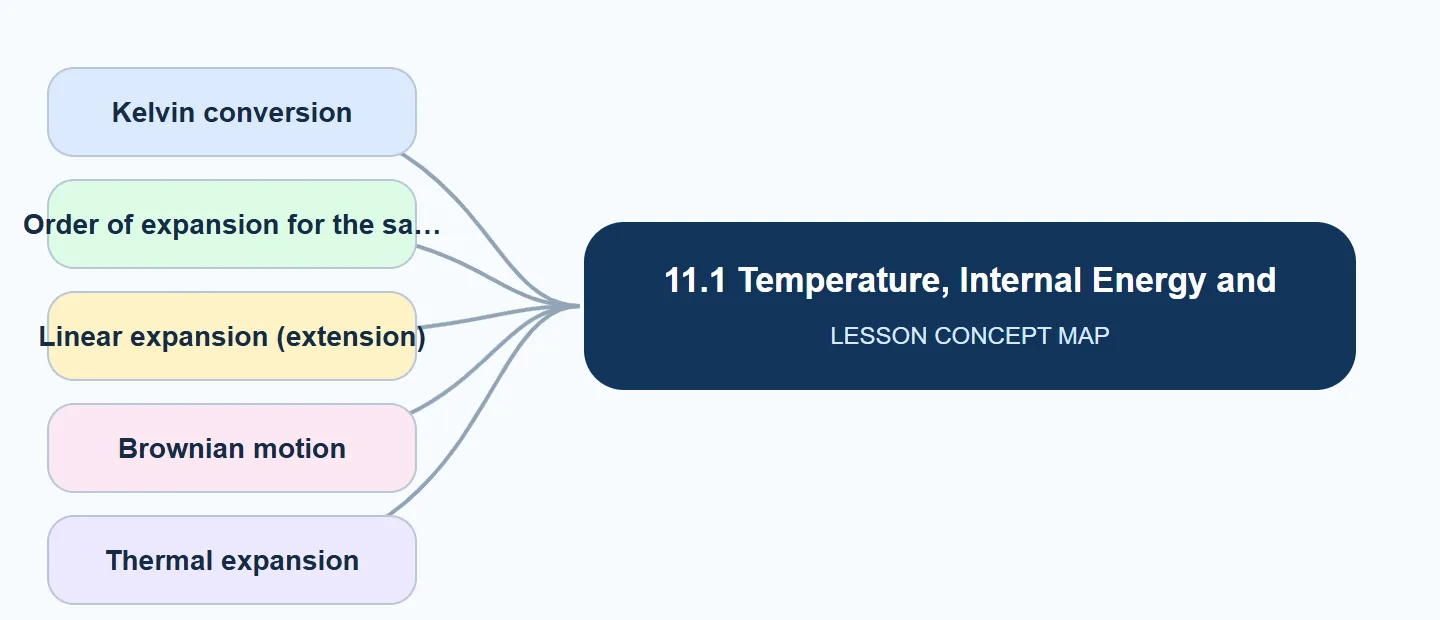
Distinguish between temperature and internal energy.Kelvin conversionT (K) = θ (°C) + 273; e.g.
- Order of expansion for the same temperature rise
- Linear expansion (extension)
- Brownian motion
- Thermal expansion
- Consequences and uses of expansion
- Water is unusual
Part 1 of 7Key ideas
Part 2 of 7Learning objectives
Part 3 of 7Essential knowledge
Part 4 of 7Process & sequence
How a thermostat bimetallic strip workswrite these steps in this order; each step is a marking point.
Part 5 of 7Worked examples
- (a) T = 37 + 273 = 310 K. (b) T = −196 + 273 = 77 K.
- ΔL = αL0Δθ = 1.2 × 10−5 × 25 m × 30 = 9.0 × 10⁻³ m = 9.0 mm. So gaps of about 1 cm are needed between rails.
Part 6 of 7Summary
Part 7 of 7Compare: Compare
| Feature | Temperature | Internal energy |
|---|---|---|
| What it measures | Average kinetic energy per particle | Total kinetic + potential energy of all particles |
| Depends on amount of substance? | No | Yes (more mass → more internal energy) |
| Unit | °C or K | J |
| Example | A cup and a bath of water can both be 40 °C | The bath at 40 °C has far more internal energy |
| State | Expansion on heating | Reason |
|---|---|---|
| Solid | Smallest | Strong forces hold particles in fixed positions; they only vibrate more |
| Liquid | Medium | Weaker forces; particles move further apart |
| Gas | Largest | Almost no forces; particles move freely and fast |
Key terms
Command terms
Exam technique
Keywords the mark scheme looks for in this lesson
How to get full marks (examiner guidance)
Words to avoid
Instant feedbackCheck yourself
Q1. What does temperature measure?
Show answer
B. Temperature is related to the average kinetic energy per particle.
Q2. 25 °C in kelvin is:
- A. −248 K
- B. 25 K
- C. 298 K
- D. 273 K
Show answer
C. 25 + 273 = 298 K.
Q3. Gaps are left between sections of railway track so that:
Show answer
B. Steel expands when heated; gaps allow for expansion.
Q4. Brownian motion of smoke particles is caused by:
- A. convection currents
- B. the smoke particles' own energy
- C. collisions with fast-moving air molecules
- D. gravity
Show answer
C. Uneven bombardment by air molecules pushes smoke particles randomly.
Q5. Which expands most for a given temperature rise?
- A. gas
- B. copper
- C. water
- D. glass
Show answer
A. Gases expand most because intermolecular forces are negligible.
Q6. A bath and a cup of water are both at 50 °C. Which statement is correct?
Show answer
C. Same average KE per particle, but the bath has far more particles.
Marked practiceQuizzes for this lesson
Last updated: